
BuddhistCatholicContemplativeEvangelicalGeneral ChristianHinduJewishLatter-day SaintMuslimNew VisionsProgressive Christian
Beliefs
- Buddhist
- Catholic
- Contemplative
- Evangelical
- General Christian
- Hindu
- Jewish
- Latter-day Saint
- More Voices
- Muslim
- New Visions
- Pagan
- Progressive Christian
Topics
- Religion News
- Food and Religion
- Sports and Religion
- Religious Art
- Religious Music and Entertainment
- Religious Events
- History and Religion
- Style and Religion
- Politics and Religion
- Women in Religion
- Recreation Outdoors and Religion
- Business Finance and Religion
- Careers Workplace and Religion
- Education and Religion
- Family Parenting and Religion
- Health Fitness and Religion
- Home and Religion
- Relationships and Religion
- Technology and Religion
- Travel and Religion
Columnists
- Buddhist Columnists
- Business Finance and Religion Columnists
- Careers Workplace and Religion Columnists
- Catholic Columnists
- Contemplative Columnists
- Education and Religion Columnists
- Evangelists Columnists
- Family Parenting and Religion Columnists
- General Christian Columnists
- Health Fitness and Religion Columnists
- Hindu Columnists
- History and Religion Columnists
- Home and Religion Columnists
- Jewish Columnists
- More Voices Columnists
- Latter Day Columnists
- Muslim Columnists
- New Visions Columnists
- Nonreligious Columnists
- Pagan Columnists
- Politics and Religion Columnists
- Progressive Columnists
- Recreation Outdoors and Religion Columnists
- Relationships and Religion Columnists
- Religion News Columnists
- Religious Art Columnists
- Religious Events Columnists
- Religious Music and Entertainment Columnists
- Sports and Religion Columnists
- Style and Religion Columnists
- Technology and Religion Columnists
- Travel and Religion Columnists
- Women in Religion Columnists
Resource Library
- 2026 Calendar
- Library of World Religions
- The 100 Most Holy Places on Earth
- Patheos Answers
- Podcasts
- Videos
- Faith Leaders Database
- Anglican Episcopalian
- Bahai
- Baptist
- Buddhism
- Christianity
- Confucianism
- Eastern Orthodoxy
- Hinduism
- Holiness and Pentecostal
- ISKCON
- Islam
- Judaism
- Lutheran
- Methodist
- The Church of Jesus Christ of Latter-day Saints
- New Age
- Paganism
- Presbytarian and Reformed
- Protestantism
- Religion Behind the Scenes
- Roman Catholic
- Scientology
- Shia Islam
- Sikhism
- Sufism
- Sunni Islam
- Taoism
- Zen
- See all religions
Research Tools
 Ad-Free & Subscriber Log-In Subscription Support
Ad-Free & Subscriber Log-In Subscription Support
Follow Patheos 

- Trending:
- Forgiveness
- |
- Marriage
- |
- Consciousness
- |
- Death Penalty
- |
- Election
- |
- Halloween

- Home
- Progressive Christian
- History and Religion
- Sin 8: How can Satan Cast Out Satan?
Sin 8: How can Satan Cast Out Satan?
Last updated on: August 20, 2023 at 1:23 pm by Ted Peters
Sin 8: How can Satan Cast Out Satan? 2023-08-20T13:23:59-07:00 Ted Peters
Patheos Explore the world's faith through different perspectives on religion and spirituality! Patheos has the views of the prevalent religions and spiritualities of the world.
 How can Satan cast out Satan?
ST 2158. Sin 8. How can Satan cast out Satan?
How can Satan cast out Satan? What is Satanic is the casting out. Did I get this right?
In a previous column post — “Sin 7: The True Story of Satanic Panic” — we reminded ourselves of just what happened in the 1980s. This led to some worrisome questions. Might this happen again in the 2020s? If we undergo another Satanic Panic, will it repeat what happened previously? Will Satan himself participate? Or, can we reduce the new Satanic Panic to the irresponsibility of evangelicals and Republicans? No to these queries. Let’s turn ninety degrees toward public systematic theology.
Here in this post, I would like to dig a bit deeper into the way Satan manifests himself in the social domain. This extends a discussion begun in previous posts on sin as self-justification, on the visible scapegoat, the invisible scapegoat, and the dialectic of sin ‘n’ grace.
If you want to find Satan, don’t bother going to the public Satanic Temple or attend secret sacrificial ceremonies. Just go to the workplace. Join a club. Play violent video games. Watch politicians debate each other on the television. You won’t see Satan as a person. But you’ll follow Satan’s droppings like flies follow a horse trail.
From Accusation to Scapegoat to Social Order
On the one hand, God’s grace at work in Jesus Christ casts out sin, death, and the Devil. On the other hand, God’s grace does not cast out anything. Rather, grace forgives sin and reconciles God with all things.
Did I get this right? Well, almost. Might there be more to this picture? Yes.
 The serpent in Genesis 2-3 is the subtle one. Is Satan subtle? Might we look Satan in the eye and not recognize him? Not if our ears are open, listening for accusations.
Satan, at least in the book of Job, is the accuser. In the Law-Gospel dialectic, Lutherans like to ascribe accusation to the 2nd use of God’s law, to the left hand of God. The divine law in the form of the Ten Commandments accuses us of sin. When we realize that we are sinful, then we kneel before Christ, confess, and plead for forgiveness. God then extends the right hand of grace and we receive forgiveness and reconciliation. God’s left hand is the law. God’s right hand is the gospel. Two divine hands. Two divine actions. You and I get tossed from one hand to the other like a bowling pin in the hands of a juggler.
Here’s a puzzle. Are Satan and God’s left hand the same thing? Not quite. It might feel that way. Here’s the difference. With God, there is reconciliation. With Satan, there is no reconciliation. Accusation is followed by accusation which in turn is followed by still more accusing ad infinitum.
Initially, the cacophony of accusations in a social group produces chaos. After the group grows weary of the chaos, the accusations become focused on a single scapegoat. The scapegoat may be an individual or an enemy or a group within the larger group. Once selected, the scapegoat is then marginalized, tortured, and eliminated. In the coffee klatch, the scapegoat is asked not to come any more. In the corporation, the scapegoat is fired. In the mob, the scapegoat is hung. In international affairs, the scapegoat is bombed. This is the method by which accusatory chaos leads through social disorder to social order. This social order makes God sad but makes Satan giddily happy.
This stable social order founded on a scapegoat is only temporary. As quickly as we can read the texts on our cell phone, the accusatory mayhem begins anew. And the cycle repeats itself. So is das Leben. C’est la vie. ਇਹ ਜਿੰਦਗੀ ਹੈ. такова жизнь. That’s life as we know it.
That’s life under the Prince of this World. Jesus comments on judgment: “the prince of this world now stands condemned” (John 16:11). The left hand of God condemns the work of Satan.
James F. McGrath asks: How can Satan cast out Satan?
As Plato pointed out, all evil is irrational. Actually, evil is based in ignorance, making evil incapable of rational justification. The presence of evil is a surd. So, don’t ask Satan for a rational answer to all of our questions. Evil is a puzzling s it is terrifying.
Patheos columnist James McGrath asks one such puzzling question: what does it mean for Satan to cast out Satan? Here is the biblical passage that leads to this question.
James McGrath, “Satan against Satan”
Jesus asks, “How can Satan cast out Satan? If a kingdom is divided against itself, that kingdom cannot stand. If a house is divided against itself, that house cannot stand. And if Satan opposes himself and is divided, he cannot stand; his end has come.” (Mark 3:23-26).
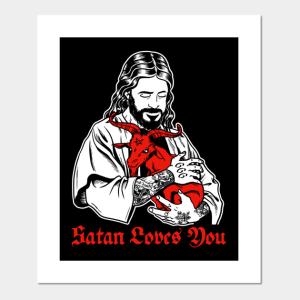 McGrath asks us: can you see what is puzzling? McGrath’s impression previously been that Jesus thought that Satan’s kingdom would not stand at the arrival of the messiah. Jesus, allegedly, believed that he himself was overseeing evil’s downfall. Might there be more to this picture?
McGrath speculates further.
“In that case, the puzzle used to stump his hearers is that the kingdom of Satan is doomed to fall. But it hasn’t collapsed yet, and so it isn’t internally divided. And the solution to the puzzle is that there is another way for a kingdom to be brought down: a stronger power conquering it. I’m not sure that this resolves the issue in this text satisfactorily – what do others think?”
Well, Doctor McGrath, let me explore with you what I think.
Let’s set aside for a moment the notion that Christ the Victor (Christus Victor) overpowers the forces of evil. Yes, that warrior symbolism is alive and well, especially in the book of Revelation. But, if we momentarily bracket out the conquering power metaphor and look directly at the cross, what do we see? Enter, René Girard.
René Girard asks: How can Satan cast out Satan?
On the face of it, Mark 3:23-26 seems to be saying this: Satan’s kingdom is unified, not divided. So, if Satan’s kingdom falls, it would be due to an outside force. That force is the Prince of Peace. That force is St. Michael and All Angels (Revelation 12:7). That force is not found in the Christus Victor theory of Atonement. Would this interpretation suffice? Maybe not.

French Writer Rene Girard (Photo by Sophie Bassouls/Sygma/Sygma via Getty Images)
So, suppose we take seriously the assumption that Satan casts out Satan. Jesus seems to presuppose that this is the case. Then we ask: how does Satan get away with it? Why does Satan’s kingdom still stand? Or, perhaps a bit more precisely, why is Satan’s kingdom perpetually falling?
René Girard assigns a paradox to Satan. “He is a principle of order as much as disorder” (Girard 2001, 34).
Let’s start with Satan as the accuser. You and I can observe daily how individuals and groups persistently accuse others of bad judgment, malicious intent, and outright evil. By accusing the other, the accuser places himself or herself on the good side of every line. In short, every voice lifted in accusation is Satan’s voice sewing disorder into the social fabric.
When the level of disorder becomes intolerable, then the scapegoat mechanism clicks in. Those who previously accused each other shift their acrimony from one another to the scapegoat. The scapegoat is viewed as evil, so by casting out the evil one a sacred order becomes established. And Satan laughs all the way to the bank. By casting out Satan, Satan has reestablished himself as the Prince of this World. [Cross by Salvador Dali]
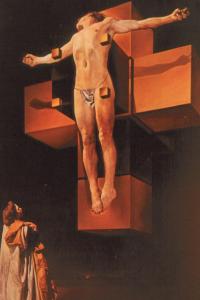 “If he were purely a destroyer, Satan would have lost his domain long ago. To understand why he is the master of all the kingdoms of this world, we must take Jesus at his word: disorder expels disorder, or in other words Satan really expels Satan. By executing this extraordinary feat, he has been able to make himself indispensable, and so his power remains great….He is the accuser of the hero in the book of Job, before God and even more so before the people. In transforming a community of people with distinct identities and roles into a hysterical mass, Satan produces myths and is the principle of systematic accusation…” (Girard 2001, 35).
How do we know this? How do we know that we participate in Satan’s casting out of Satan? We learn it from revelation. We learn it from the cross. “The Cross and the mechanism of Satan are one and the same thing” (Girard 2001, 36). When we look at the cross, we look into our own souls in a revelatory way.
Satan sought to cast out Satan by scapegoating Jesus, but it turns out Jesus was not Satan. Satan overreached, so to speak. Perhaps this overreach became the downfall Jesus hinted at.
You’ll know Satan is present when…
Here is the first and most important thing you need to know when taking up this subject matter: Satan is present when you hear the call to shed innocent blood (Peters, Sin: Radical Evil in Soul and Society 1993, 257). As we saw in the discussion above, the call to shed innocent blood occurs during an accusation. We accuse others of being ugly, weak, wrong, or evil. If we accuse someone else of being evil, then we look good in comparison. My term for this is self-justification with scapegoating. If such accusing becomes hot enough, it risks inciting a mob that would dishonor, ostracize, or even lynch the person accused. You’ll know Satan is present when you hear the call to shed innocent blood, figuratively or literally.
Conclusion: Logs in our eyes
Why is Jesus not Satanic? Why does Jesus avoid accusing? Well, usually. Jesus had his judgmental moments too. Still we ask: just what does God’s grace look like in Satan’s kingdom? Here is a clue. We find it in the Sermon on the Mount.
 Do not judge, so that you may not be judged. For with the judgement you make you will be judged, and the measure you give will be the measure you get. Why do you see the speck in your neighbour’s eye, but do not notice the log in your own eye? Or how can you say to your neighbour, “Let me take the speck out of your eye”, while the log is in your own eye? You hypocrite. (Matthew 7:1-5)
Might it be possible to live daily and avoid accusing others? Definitely not in my progressive context. We get our moral juices up when denouncing our neighbors as bigots, racists, gay bashers, Islamophobes, science-deniers, warmongers. The list goes on. We congratulate ourselves for being prophetic, not Satanic.
Parallels happen in evangelical Christian communities, atheist gatherings, and virtually every group striving for a we-versus-they identity.
Public systematic theologians have a term for this: sin.
▓
 Ted Peters is a Lutheran pastor and emeritus seminary professor. His one volume systematic theology is now in its 3rd edition, God—The World’s Future (Fortress 2015). He has undertaken a thorough examination of the sin-and-grace dialectic in two works, Sin: Radical Evil in Soul and Society (Eerdmans 1994) and Sin Boldly! (Fortress 2015). Watch for his forthcoming, The Voice of Public Christian Theology (ATF 2022). See his website: TedsTimelyTake.com.
▓
References
Girard, René. 2001. I See Satan Fall Like Lightening. Maryknoll NY: Orbis.
Peters, Ted. 2015. Sin Boldly! Minneapolis MN: Fortress Press.
Peters, Ted. 2000. “Sin, Scapegoating, and Justifying Faith.” In God, Evil, and Suffering: Essays in Honor of Paul Sponheim, by eds Terrence Fretheim and Curtis Thompson, 62-74. St. Paul MN: Luther Seminary.
—. 1993. Sin: Radical Evil in Soul and Society. Grand Rapids MI: Wm B Eerdmans.
Peters, Ted. 2006. “Six Ways of Salvation: How Does Jesus Save?” Dialog 45:3 223-235.
History and Religion

About Ted Peters
Ted Peters is a Lutheran pastor and emeritus seminary professor. His one volume systematic theology is now in its 3rd edition, God—The World’s Future (Fortress 2015). He has undertaken a thorough examination of the sin-and-grace dialectic in two works, Sin: Radical Evil in Soul and Society (Eerdmans 1994) and Sin Boldly! (Fortress 2015). Watch for his forthcoming, The Voice of Public Christian Theology (ATF 2022). See his website: TedsTimelyTake.com. You can read more about the author here.
Previous Post

February 8, 2022
Are we going to war with Russia now?
Next Post
February 15, 2022 The Public Theology of Valerie Miles-Tribble
Browse Our Archives
Select a Category Afterlife America in Crisis Ancient Alien Apocalypse Art Artificial Intelligence Astrobiology Astrotheology Atheism Big History Buddhist Catholic Christian Nationalism Christmas Comparative Theology Death Ecology Ethics ETI Evangelical Evolution Existential Questions Free Will General Christian Hermeneutics Hindu https://www.patheos.com/blogs/allsetfree/2020/12/sins-we-need-to-talk-about/?utm_source=Newsletter&utm_medium=email&utm_campaign=Christians+For+a+Better+Christianity&utm_content=43&lct Interreligious Islam Jewish Justice Latter-Day Saints Literature Literature and Theology Lutheran Methodism Mormonism Nonreligious ontology Orthodox Pagam Prayer progressive Christian PT 6 Dignity Public Theology Race racial justice Religious Liberty Romance Satan Scapegoat Science & Religion Science and Religion social justice Spirituality SR 8 Transhumanism Systematic Theology Taoism Ted Peters UAP UFO Uncategorized War
Select a Month September 2026 August 2026 July 2026 June 2026 May 2026 April 2026 March 2026 February 2026 December 2025 November 2025 October 2025 September 2025 August 2025 July 2025 June 2025 May 2025 April 2025 March 2025 February 2025 January 2025 December 2024 November 2024 October 2024 September 2024 August 2024 July 2024 June 2024 May 2024 April 2024 March 2024 February 2024 January 2024 December 2023 November 2023 October 2023 September 2023 August 2023 July 2023 June 2023 May 2023 April 2023 March 2023 February 2023 January 2023 December 2022 November 2022 October 2022 September 2022 August 2022 July 2022 June 2022 May 2022 April 2022 March 2022 February 2022 January 2022 December 2021 November 2021 October 2021 September 2021
Follow Us!
TAKE THE
Religious Wisdom Quiz
What does the name "Elijah" mean?
Select your answer to see how you score.
The Lord is my God God Saves God Provides The Chosen One
Related posts from Public Theology

Why Public Theology Needs a Theology of Nature

Do You Believe in UFOs? A Theologian's Answer.

Free Will and Christian Freedom TWO

Quantum Consciousness Theology: Response to Keith Giles
TRENDING AT PATHEOS Progressive Christian

What Being a Modern-Day Apostle Means to Me
In my last column, I discussed the ins and outs of modern-day...

Did Ancient China Once Worship the God of...
Across human history, a common thread weaves through the origins of the...

Love Your Neighbor – Including Earth-Kin: Lev. 19,...
God’s command to love your neighbor means acting in an ethical and...

Lead a Church Study of “Jesus and Lao...
Guest writer Jack Thomas (The Irreverent Reverend) reflects on leading his church...

Pastoral Wisdom for Responding to Sermon Pushback
Getting sermon pushback on your social justice sermon? Learn practical, Proverbs-based strategies...

Principles for Understanding the Apostolic Ministry Today
Whenever people discover that my formal ministry title is "apostle," as in...
view all Progressive Christian blogs
Ad-Free & Subscriber Log-In Subscription Support
- About Us
- 2026 Calendar
- Videos
- Podcasts
- Library of World Religions
- Faith In Media Tracker
- Advertise With Us
- Write for Us
- Privacy Policy
- Terms of Service
- Do Not Sell My Data
- Contact Us
- Radiant Digital
- Manage Newsletter Subscriptions
- Unsubscribe From Notifications
- Sitemap
Copyright 2008-2026, Patheos. All rights reserved.
Subscription Support Ad-Free & Subscriber Log-In
Follow Patheos