
BuddhistCatholicContemplativeEvangelicalGeneral ChristianHinduJewishLatter-day SaintMuslimNew VisionsProgressive Christian
Beliefs
- Buddhist
- Catholic
- Contemplative
- Evangelical
- General Christian
- Hindu
- Jewish
- Latter-day Saint
- More Voices
- Muslim
- New Visions
- Pagan
- Progressive Christian
Topics
- Religion News
- Food and Religion
- Sports and Religion
- Religious Art
- Religious Music and Entertainment
- Religious Events
- History and Religion
- Style and Religion
- Politics and Religion
- Women in Religion
- Recreation Outdoors and Religion
- Business Finance and Religion
- Careers Workplace and Religion
- Education and Religion
- Family Parenting and Religion
- Health Fitness and Religion
- Home and Religion
- Relationships and Religion
- Technology and Religion
- Travel and Religion
Columnists
- Buddhist Columnists
- Business Finance and Religion Columnists
- Careers Workplace and Religion Columnists
- Catholic Columnists
- Contemplative Columnists
- Education and Religion Columnists
- Evangelists Columnists
- Family Parenting and Religion Columnists
- General Christian Columnists
- Health Fitness and Religion Columnists
- Hindu Columnists
- History and Religion Columnists
- Home and Religion Columnists
- Jewish Columnists
- More Voices Columnists
- Latter Day Columnists
- Muslim Columnists
- New Visions Columnists
- Nonreligious Columnists
- Pagan Columnists
- Politics and Religion Columnists
- Progressive Columnists
- Recreation Outdoors and Religion Columnists
- Relationships and Religion Columnists
- Religion News Columnists
- Religious Art Columnists
- Religious Events Columnists
- Religious Music and Entertainment Columnists
- Sports and Religion Columnists
- Style and Religion Columnists
- Technology and Religion Columnists
- Travel and Religion Columnists
- Women in Religion Columnists
Resource Library
- 2026 Calendar
- Library of World Religions
- The 100 Most Holy Places on Earth
- Patheos Answers
- Podcasts
- Videos
- Faith Leaders Database
- Anglican Episcopalian
- Bahai
- Baptist
- Buddhism
- Christianity
- Confucianism
- Eastern Orthodoxy
- Hinduism
- Holiness and Pentecostal
- ISKCON
- Islam
- Judaism
- Lutheran
- Methodist
- The Church of Jesus Christ of Latter-day Saints
- New Age
- Paganism
- Presbytarian and Reformed
- Protestantism
- Religion Behind the Scenes
- Roman Catholic
- Scientology
- Shia Islam
- Sikhism
- Sufism
- Sunni Islam
- Taoism
- Zen
- See all religions
Research Tools
 Ad-Free & Subscriber Log-In Subscription Support
Ad-Free & Subscriber Log-In Subscription Support
Follow Patheos 

- Trending:
- Forgiveness
- |
- Marriage
- |
- Consciousness
- |
- Death Penalty
- |
- Election
- |
- Halloween

- Home
- Progressive Christian
- Short Prayers 34: Sin Boldly!
Short Prayers 34: Sin Boldly!
Last updated on: February 28, 2022 at 6:02 pm by Ted Peters
Short Prayers 34: Sin Boldly! 2022-02-28T18:02:24-08:00 Ted Peters
Patheos Explore the world's faith through different perspectives on religion and spirituality! Patheos has the views of the prevalent religions and spiritualities of the world.
For freedom Christ has set us free. Stand firm, therefore, and do not submit again to a yoke of slavery. (Galatians 5:1) [Artist: Anna Rybat)]
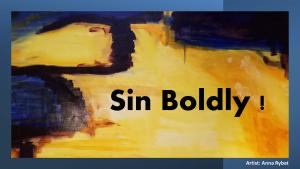 Just what does Christian freedom mean? When Christ has been placed in your heart by the Holy Spirit so that you love your neighbor as God does, you become liberated from your own selfish impediments to authentic loving. Freedom from the self becomes freedom to love others. Now, that’s awesome.
There’s another quirk at work here. It sounds counter-intuitive, but it’s quite important. Once liberated from the self by Christian freedom, you do not need to strive to always be good. You no longer need virtue or perfection or even a good reputation to establish a relationship with God. You’re free of all that.
Now, here’s the quirky implication: you may sin boldly! Did you get that? Sin boldly!
Sin Boldly!
Sin boldly! Really? Yes. To sin boldly means two things. First, relish and enjoy the freedom given you by God’s grace. Second, make moral decisions based on your best judgment. Then, proceed to act. None of your moral judgments will be pure and undefiled. So, proceed to sin boldly!
Grace is the key. If we are justified by God’s grace in our faith, then we do not need to justify ourselves. We do not need to purify ourselves by scapegoating others. We do not need to claim innocence on the grounds that we did nothing rather than risk making a mistake. Why? Because God has already rightwised us–justified us–by grace. Peter Marty’s Reformation sermon on 10.31.2021 helps us grasp this.
Where does “Sin Boldly!” come from?
Where do we get the maxim to sin boldly! It comes from a letter written by Martin Luther (1483-1546) to his younger colleague at Wittenberg University, Philip Melanchthon (1497-1560).
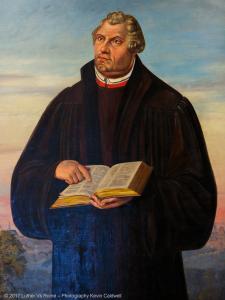 “If you are a preacher of grace, then preach a true and not a fictitious grace; if grace is true, you must bear a true and not a fictitious sin. God does not save people who are only fictitious sinners. Be a sinner and sin boldly, but believe and rejoice in Christ even more boldly, for he is victorious over sin, death, and the world. As long as we are here [in this world] we have to sin. This life is not the dwelling place of righteousness, but, as [Saint] Peter says, we look for new heavens and a new earth in which righteousness dwells. It is enough that by the riches of God’s glory we have come to know the Lamb that takes away the sin of the world. No sin will separate us from the Lamb, even though we commit fornication and murder a thousand times a day. Do you think that the purchase price that was paid for the redemption of our sins by so great a Lamb is too small? Pray boldly—you too are a mighty sinner.” (Luther 1961-1986, 48: 281-282)
Only sinners in this life make moral decisions and take compassionate actions. That describes you and me. That describes every conscientious Christian who is simul justus et peccator, at once both saint and sinner.
Here is my ethical advice. If sinful action is unavoidable, be honest and follow the best path your judgment can set out. Make moral decisions carefully but courageously!
Bondage to the Self
In a Patheos post, “We Are What We Do,” Henry Karlson in the tradition of Maximus the Confessor describes the self that is bound to the self.
The more we establish ourselves in virtue, the more we will experience the world in a way void of the egotistical self, while the more we establish ourselves in and through the enactment of selfish desires, inordinate passions, the more we will create a hermeneutic which interprets the world as good or bad in relation to the way things affirm or hinder our selfish desires. Selfishness, and the pursuit of all the desires we might have through the creation of a selfish, prideful self, leads to delusion and ignorance of the world as it is; this is why such a self must die.
To be liberated from bondage to the self, says Karlson, the self must die.
Daily, say the Protestant Reformers, we should die to our sin and rise with Christ into the life of love.
Freedom in Christ
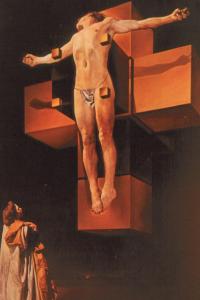 The Holy Spirit empowers the self to transcend the self in order to love God for Godself and to love the neighbor for the sake of the neighbor’s self. This is one way that God’s grace manifests itself within our daily life. We experience it as freedom. [Crucifixion by Dali]
“For freedom Christ has set us free. Stand firm, therefore, and do not submit again to a yoke of slavery.” (Galatians 5:1) From what yoke of slavery have we been freed? From enslavement to that little voice whispering, ‘you must be perfect!’ ‘If you sin you will spend eternity in hell’. ‘You must purify yourself by scapegoating others’. ‘If you can’t do it right, then don’t do it at all’. This is freedom from our conscience within our conscience.
Is it time to throw off all moral constraints and live a life of debauchery? No, antinomianism is not what is at stake here. Neither St. Paul nor Martin Luther are removing all restraints on pride or narcissism or concupiscence. Luther has something quite different in mind.
Luther the Reformer recognizes that we find ourselves frequently in moral dilemmas. If we are conscientious and want to pursue the right path, we may find that the right path leads to collateral damage. In some situations of conflict, even no action may yield moral damage. Damned if you do. Damned if you don’t. In such a dilemma, Luther reminds us that grace covers us. Make a decision. Take some action. We will not have to justify ourselves, because we have already been justified by God. Therefore, sin boldly.
PRAYER
Holy Spirit, place the living Christ in our heart; free us from bondage to the self; and inspire us to love our neighbor even if it requires that we sin boldly. Amen.
▓
 Ted Peters is a Lutheran pastor and emeritus seminary professor. He is author of Short Prayers and The Cosmic Self. His one volume systematic theology is now in its 3rd edition, God—The World’s Future (Fortress 2015). He has undertaken a thorough examination of the sin-and-grace dialectic in two works, Sin: Radical Evil in Soul and Society (Eerdmans 1994) and Sin Boldly! (Fortress 2015). Watch for his forthcoming, The Voice of Public Christian Theology (ATF 2022). See his website: TedsTimelyTake.com.
▓
For more on this topic than you may wish to read, click on our series on sin: (1) Sin? Really? (2) Sin as Self-justification; (3) Sin and the Visible Scapegoat; (4) Sin and the Invisible Scapegoat; plus (5) Sin Boldly!

About Ted Peters
Ted Peters is a Lutheran pastor and emeritus seminary professor. He is author of Short Prayers and The Cosmic Self. His one volume systematic theology is now in its 3rd edition, God—The World’s Future (Fortress 2015). He has undertaken a thorough examination of the sin-and-grace dialectic in two works, Sin: Radical Evil in Soul and Society (Eerdmans 1994) and Sin Boldly! (Fortress 2015). Watch for his forthcoming, The Voice of Public Christian Theology (ATF 2022). See his website: TedsTimelyTake.com. You can read more about the author here.
Previous Post

February 28, 2022
Short Prayers 32: Sin
Next Post
March 2, 2022 The Art of War in Ukraine
Browse Our Archives
Select a Category Afterlife America in Crisis Ancient Alien Apocalypse Art Artificial Intelligence Astrobiology Astrotheology Atheism Big History Buddhist Catholic Christian Nationalism Christmas Comparative Theology Death Ecology Ethics ETI Evangelical Evolution Existential Questions Free Will General Christian Hermeneutics Hindu https://www.patheos.com/blogs/allsetfree/2020/12/sins-we-need-to-talk-about/?utm_source=Newsletter&utm_medium=email&utm_campaign=Christians+For+a+Better+Christianity&utm_content=43&lct Interreligious Islam Jewish Justice Latter-Day Saints Literature Literature and Theology Lutheran Methodism Mormonism Nonreligious ontology Orthodox Pagam Prayer progressive Christian PT 6 Dignity Public Theology Race racial justice Religious Liberty Romance Satan Scapegoat Science & Religion Science and Religion social justice Spirituality SR 8 Transhumanism Systematic Theology Taoism Ted Peters UAP UFO Uncategorized War
Select a Month September 2026 August 2026 July 2026 June 2026 May 2026 April 2026 March 2026 February 2026 December 2025 November 2025 October 2025 September 2025 August 2025 July 2025 June 2025 May 2025 April 2025 March 2025 February 2025 January 2025 December 2024 November 2024 October 2024 September 2024 August 2024 July 2024 June 2024 May 2024 April 2024 March 2024 February 2024 January 2024 December 2023 November 2023 October 2023 September 2023 August 2023 July 2023 June 2023 May 2023 April 2023 March 2023 February 2023 January 2023 December 2022 November 2022 October 2022 September 2022 August 2022 July 2022 June 2022 May 2022 April 2022 March 2022 February 2022 January 2022 December 2021 November 2021 October 2021 September 2021
Follow Us!
TAKE THE
Religious Wisdom Quiz
Who was stoned to death, becoming the first Christian martyr?
Select your answer to see how you score.
Stephen Paul Peter James
Related posts from Public Theology

Why Public Theology Needs a Theology of Nature

America's 250th Birthday Gift: Civic Renewal

Do You Believe in UFOs? A Theologian's Answer.

Free Will and Christian Freedom TWO
TRENDING AT PATHEOS Progressive Christian

What Being a Modern-Day Apostle Means to Me
In my last column, I discussed the ins and outs of modern-day...

Did Ancient China Once Worship the God of...
Across human history, a common thread weaves through the origins of the...

Love Your Neighbor – Including Earth-Kin: Lev. 19,...
God’s command to love your neighbor means acting in an ethical and...

Lead a Church Study of “Jesus and Lao...
Guest writer Jack Thomas (The Irreverent Reverend) reflects on leading his church...

Pastoral Wisdom for Responding to Sermon Pushback
Getting sermon pushback on your social justice sermon? Learn practical, Proverbs-based strategies...

Principles for Understanding the Apostolic Ministry Today
Whenever people discover that my formal ministry title is "apostle," as in...
view all Progressive Christian blogs
Ad-Free & Subscriber Log-In Subscription Support
- About Us
- 2026 Calendar
- Videos
- Podcasts
- Library of World Religions
- Faith In Media Tracker
- Advertise With Us
- Write for Us
- Privacy Policy
- Terms of Service
- Do Not Sell My Data
- Contact Us
- Radiant Digital
- Manage Newsletter Subscriptions
- Unsubscribe From Notifications
- Sitemap
Copyright 2008-2026, Patheos. All rights reserved.
Subscription Support Ad-Free & Subscriber Log-In
Follow Patheos