
BuddhistCatholicContemplativeEvangelicalGeneral ChristianHinduJewishLatter-day SaintMuslimNew VisionsProgressive Christian
Beliefs
- Buddhist
- Catholic
- Contemplative
- Evangelical
- General Christian
- Hindu
- Jewish
- Latter-day Saint
- More Voices
- Muslim
- New Visions
- Pagan
- Progressive Christian
Topics
- Religion News
- Food and Religion
- Sports and Religion
- Religious Art
- Religious Music and Entertainment
- Religious Events
- History and Religion
- Style and Religion
- Politics and Religion
- Women in Religion
- Recreation Outdoors and Religion
- Business Finance and Religion
- Careers Workplace and Religion
- Education and Religion
- Family Parenting and Religion
- Health Fitness and Religion
- Home and Religion
- Relationships and Religion
- Technology and Religion
- Travel and Religion
Columnists
- Buddhist Columnists
- Business Finance and Religion Columnists
- Careers Workplace and Religion Columnists
- Catholic Columnists
- Contemplative Columnists
- Education and Religion Columnists
- Evangelists Columnists
- Family Parenting and Religion Columnists
- General Christian Columnists
- Health Fitness and Religion Columnists
- Hindu Columnists
- History and Religion Columnists
- Home and Religion Columnists
- Jewish Columnists
- More Voices Columnists
- Latter Day Columnists
- Muslim Columnists
- New Visions Columnists
- Nonreligious Columnists
- Pagan Columnists
- Politics and Religion Columnists
- Progressive Columnists
- Recreation Outdoors and Religion Columnists
- Relationships and Religion Columnists
- Religion News Columnists
- Religious Art Columnists
- Religious Events Columnists
- Religious Music and Entertainment Columnists
- Sports and Religion Columnists
- Style and Religion Columnists
- Technology and Religion Columnists
- Travel and Religion Columnists
- Women in Religion Columnists
Resource Library
- 2026 Calendar
- Library of World Religions
- The 100 Most Holy Places on Earth
- Patheos Answers
- Podcasts
- Videos
- Faith Leaders Database
- Anglican Episcopalian
- Bahai
- Baptist
- Buddhism
- Christianity
- Confucianism
- Eastern Orthodoxy
- Hinduism
- Holiness and Pentecostal
- ISKCON
- Islam
- Judaism
- Lutheran
- Methodist
- The Church of Jesus Christ of Latter-day Saints
- New Age
- Paganism
- Presbytarian and Reformed
- Protestantism
- Religion Behind the Scenes
- Roman Catholic
- Scientology
- Shia Islam
- Sikhism
- Sufism
- Sunni Islam
- Taoism
- Zen
- See all religions
Research Tools
 Ad-Free & Subscriber Log-In Subscription Support
Ad-Free & Subscriber Log-In Subscription Support
Follow Patheos 

- Trending:
- Forgiveness
- |
- Marriage
- |
- Consciousness
- |
- Death Penalty
- |
- Election
- |
- Halloween

- Home
- Progressive Christian
- Education and Religion
- Short Prayers 32: Sin
Short Prayers 32: Sin
Last updated on: October 12, 2022 at 7:11 am by Ted Peters
Short Prayers 32: Sin 2022-10-12T07:11:55-07:00 Ted Peters
Patheos Explore the world's faith through different perspectives on religion and spirituality! Patheos has the views of the prevalent religions and spiritualities of the world.
The man said, ‘The woman whom you gave to be with me, she gave me fruit from the tree, and I ate.’ Then the Lord God said to the woman, ‘What is this that you have done?’ The woman said, ‘The serpent tricked me, and I ate.’ (Genesis 3:12-13) [Painting of Adam, Eve, and the Serpent by Franz van Stuck]
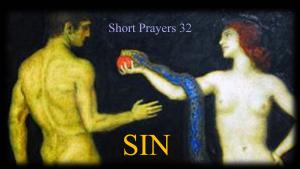
Adam, Eve, and Self-Justification in the Garden
Do you recall what happened in the second and third chapters of Genesis? Let me repeat our telling of this story found in Sin 2: Self-Justification. The story of Adam and Eve is our story, whether we like it or not.
Eve, recall, is looking at the tree bearing the forbidden fruit. She likes what she sees. It appears “good” to eat. At that moment a serpent engages her in conversation. The serpent–the “subtle” or “crafty” serpent–tells her not to hesitate eating the forbidden fruit, because something good will happen. “You will not die,” says the serpent in Genesis 3:4-5: “for God knows that when you eat of it your eyes will be opened, and you will be like God, knowing good and evil.” To have one’s eyes opened, to gain enlightenment, to gain knowledge: now, that sounds attractive! It sounds like the goal of a spiritual quest. (Painting by Hugo van der Goes)
To be like God! Awesome! Deification through apple eating. Awesome!
Being Godly is Tricky
Being godly is a good thing, right? How could one turn down such an opportunity? Genesis 3:6-7: “So when the woman saw that the tree was good for food, and that it was a delight to the eyes, and that the tree was to be desired to make one wise, she took of its fruit and ate; and she also gave some to her husband, who was with her, and he ate.” Eating the forbidden fruit was a good thing to do. At least, it appeared to be a good thing to Eve.
There is gain here for both the man and the woman: the knowledge of good and evil. Their eyes were opened. But, this gain included some collateral damage. Suddenly, they realized something they had not noticed prior, namely, they were not wearing any clothes. The biblical text continues. Genesis 3: 7-13: “Then the eyes of both were opened, and they knew that they were naked; and they sewed fig leaves together and made loincloths for themselves.
Adam and Eve then heard the sound of the LORD God walking in the garden at the time of the evening breeze, and the man and his wife hid themselves from the presence of the LORD God among the trees of the garden. But the LORD God called to the man, and said to him, ‘Where are you?’ He said, ‘I heard the sound of you in the garden, and I was afraid, because I was naked; and I hid myself.’ He said, ‘Who told you that you were naked? Have you eaten from the tree of which I commanded you not to eat?’ The man said, ‘The woman whom you gave to be with me, she gave me fruit from the tree, and I ate.’ Then the LORD God said to the woman, ‘What is this that you have done?’ The woman said, ‘The serpent tricked me, and I ate’.”
Here is what you and I do almost every day in our imagination. In our private mind or in our political rhetoric, we draw a line between good and evil. Then, we place ourselves on the good side of the line. Once we find ourselves on the good side of the line, we breathe easily.
What’s wrong with that? This demonstrates that the human being is basically good, right? Because I am good, other people should like me. Right?
Yes, we humans are born with a thirst for what is good. Thank God. But, it’s more complicated. Sometimes we put somebody else on the evil side of that imaginary line. This in turn justifies you and me in behaving badly toward the person on the evil side of the line. We think we have gained the right to punish. We think it is our task to rid the world of the scourge of evil on the other side of our line. No matter how cruel or violently we behave, whatever evil we perpetrate is justified in our own mind. We feel innocent, powerful, victorious.
We perpetrate evil only in the name of the good. What is Good? The right way to do things? God’s will? The security of our nation? Those things are good. Right?
Sin and Self-Justification
 To reiterate: here is what we do routinely: we draw the line and place ourselves on the good side. On the evil side we place sinners, threatening people, evil-doers, and sometimes even the devil and all his minions. Those on the evil side become our scapegoats. Whom do we scapegoat? Usually our boss. But others in authority also make good scapegoats such as the president, our parents, rich people, big corporations, and such. We also love to draw a line between our in-group and other races or other political parties or just any ol’ other. Religious people frequently draw a line and put atheists on the other side. Atheists draw a line and put religious people on the other side. The evil ones are a moving target.
The problem, of course, is that this is a lie we tell ourselves. It matters zilch whether our accusations against those on the evil side of the line are objectively true or not. The lie is that somehow we ourselves become good by accusing others of being evil.
It is the lie of self-justification. The victim of our self-justification is called the “scapegoat.” We even scapegoat God. That’s right. The sinner scapegoat’s God.
Don’t Blame Me! Blame…
Note the chain of self-justification at work here in Genesis. Adam says the equivalent of “it’s not my fault. Blame the woman you gave me.” Eve follows, “it’s not my fault. Blame the serpent who beguiled me. And, God, while we’re at it, who made the serpent?” Well, God, of course. God is guilty for creating a serpent who talks and lives in the Garden of Eden. It’s God’s fault for denying the man and woman the awareness of good and evil, therefore, God is really the guilty party. Adam and Eve have drawn a line between good and evil, and they’ve put each other, the serpent, and even God on the evil side. We sheepish sinners are desperate to think of ourselves as good.
“Adam wanted to appear innocent, he passed on his guilt from himself to God, who had given him his wife. Eve also tries to excuse herself and accuses the serpent, which was also a creature of God,” comments Martin Luther. “Here Adam is presented as a typical instance of all sinners and of such despair because of their sin. They cannot do otherwise than accuse God and excuse themselves” (Luther, 1955-1986, pp. 1: 178-179). Adam and Eve drew a line between good and evil; and they placed God on the evil side of that line. In order to justify themselves, they scapegoated God.
Much to the surprise and chagrin of the human race, God voluntarily accepts being placed on the evil side of our line. When you and I self-justify by placing ourselves on the good side of the line, we have separated ourselves from God. But, when we join God on the evil side, then as forgiven sinners we sin boldly! (Peters, Sin Boldly!, 2015) “For our sake he made him to be sin who knew no sin, so that in him we might become the righteousness of God” (2 Corinthians 5:21). But, alas, that’s another story.
Back to our story. Without being daily aware of it, you and I work with the assumption that goodness is eternal. We are so desperate to identify ourselves with what is good that we will vilify our boss, immigrants, Republicans, Democrats, neighbors, and even God if necessary. When we scapegoat God, we in effect judge God by a criterion that transcends God.
Now, on the surface this seems like nonsense. Yet, our intuitions sometimes invest us in nonsense or, more precisely, the lie. It is a lie to declare ourselves good and everyone else, God included, as evil.
Now, that’s a bummer, you might say. Well, Lent is full of bummers.
PRAYER
Holy Spirit, inspire us to draw that line between good and evil and place ourselves on the evil side, where you are. Amen
▓
Ted Peters is a Lutheran pastor and emeritus seminary professor. He is author of Short Prayers and The Cosmic Self. His one volume systematic theology is now in its 3rd edition, God—The World’s Future (Fortress 2015). He has undertaken a thorough examination of the sin-and-grace dialectic in two works, Sin: Radical Evil in Soul and Society (Eerdmans 1994) and Sin Boldly! (Fortress 2015). Watch for his forthcoming, The Voice of Public Christian Theology (ATF 2022). See his website: TedsTimelyTake.com.
▓
References
Luther, Martin. 1955-1986. Luther’s Works, American Edition, 55 Volumes. St. Louis and Minneapolis: Concordia and Fortress.
Peters, Ted. 2015. Sin Boldly! Minneapolis MN: Fortress Press.
Education and Religion

About Ted Peters
Ted Peters is a Lutheran pastor and emeritus seminary professor. He is author of Short Prayers and The Cosmic Self. His one volume systematic theology is now in its 3rd edition, God—The World’s Future (Fortress 2015). He has undertaken a thorough examination of the sin-and-grace dialectic in two works, Sin: Radical Evil in Soul and Society (Eerdmans 1994) and Sin Boldly! (Fortress 2015). Watch for his forthcoming, The Voice of Public Christian Theology (ATF 2022). See his website: TedsTimelyTake.com. You can read more about the author here.
Previous Post

February 28, 2022
Short Prayers 33: Redemptive Violence
Next Post
February 28, 2022 Short Prayers 34: Sin Boldly!
Browse Our Archives
Select a Category Afterlife America in Crisis Ancient Alien Apocalypse Art Artificial Intelligence Astrobiology Astrotheology Atheism Big History Buddhist Catholic Christian Nationalism Christmas Comparative Theology Death Ecology Ethics ETI Evangelical Evolution Existential Questions Free Will General Christian Hermeneutics Hindu https://www.patheos.com/blogs/allsetfree/2020/12/sins-we-need-to-talk-about/?utm_source=Newsletter&utm_medium=email&utm_campaign=Christians+For+a+Better+Christianity&utm_content=43&lct Interreligious Islam Jewish Justice Latter-Day Saints Literature Literature and Theology Lutheran Methodism Mormonism Nonreligious ontology Orthodox Pagam Prayer progressive Christian PT 6 Dignity Public Theology Race racial justice Religious Liberty Romance Satan Scapegoat Science & Religion Science and Religion social justice Spirituality SR 8 Transhumanism Systematic Theology Taoism Ted Peters UAP UFO Uncategorized War
Select a Month September 2026 August 2026 July 2026 June 2026 May 2026 April 2026 March 2026 February 2026 December 2025 November 2025 October 2025 September 2025 August 2025 July 2025 June 2025 May 2025 April 2025 March 2025 February 2025 January 2025 December 2024 November 2024 October 2024 September 2024 August 2024 July 2024 June 2024 May 2024 April 2024 March 2024 February 2024 January 2024 December 2023 November 2023 October 2023 September 2023 August 2023 July 2023 June 2023 May 2023 April 2023 March 2023 February 2023 January 2023 December 2022 November 2022 October 2022 September 2022 August 2022 July 2022 June 2022 May 2022 April 2022 March 2022 February 2022 January 2022 December 2021 November 2021 October 2021 September 2021
Follow Us!
TAKE THE
Religious Wisdom Quiz
What was the primary legal document?
Select your answer to see how you score.
Contract Scroll Deed Tablet
Related posts from Public Theology

Why Public Theology Needs a Theology of Nature

America's 250th Birthday Gift: Civic Renewal

Do You Believe in UFOs? A Theologian's Answer.

Free Will and Christian Freedom TWO
TRENDING AT PATHEOS Progressive Christian

What Being a Modern-Day Apostle Means to Me
In my last column, I discussed the ins and outs of modern-day...

Did Ancient China Once Worship the God of...
Across human history, a common thread weaves through the origins of the...

Love Your Neighbor – Including Earth-Kin: Lev. 19,...
God’s command to love your neighbor means acting in an ethical and...

Lead a Church Study of “Jesus and Lao...
Guest writer Jack Thomas (The Irreverent Reverend) reflects on leading his church...

Pastoral Wisdom for Responding to Sermon Pushback
Getting sermon pushback on your social justice sermon? Learn practical, Proverbs-based strategies...

Principles for Understanding the Apostolic Ministry Today
Whenever people discover that my formal ministry title is "apostle," as in...
view all Progressive Christian blogs
Ad-Free & Subscriber Log-In Subscription Support
- About Us
- 2026 Calendar
- Videos
- Podcasts
- Library of World Religions
- Faith In Media Tracker
- Advertise With Us
- Write for Us
- Privacy Policy
- Terms of Service
- Do Not Sell My Data
- Contact Us
- Radiant Digital
- Manage Newsletter Subscriptions
- Unsubscribe From Notifications
- Sitemap
Copyright 2008-2026, Patheos. All rights reserved.
Subscription Support Ad-Free & Subscriber Log-In
Follow Patheos