
BuddhistCatholicContemplativeEvangelicalGeneral ChristianHinduJewishLatter-day SaintMuslimNew VisionsProgressive Christian
Beliefs
- Buddhist
- Catholic
- Contemplative
- Evangelical
- General Christian
- Hindu
- Jewish
- Latter-day Saint
- More Voices
- Muslim
- New Visions
- Pagan
- Progressive Christian
Topics
- Religion News
- Food and Religion
- Sports and Religion
- Religious Art
- Religious Music and Entertainment
- Religious Events
- History and Religion
- Style and Religion
- Politics and Religion
- Women in Religion
- Recreation Outdoors and Religion
- Business Finance and Religion
- Careers Workplace and Religion
- Education and Religion
- Family Parenting and Religion
- Health Fitness and Religion
- Home and Religion
- Relationships and Religion
- Technology and Religion
- Travel and Religion
Columnists
- Buddhist Columnists
- Business Finance and Religion Columnists
- Careers Workplace and Religion Columnists
- Catholic Columnists
- Contemplative Columnists
- Education and Religion Columnists
- Evangelists Columnists
- Family Parenting and Religion Columnists
- General Christian Columnists
- Health Fitness and Religion Columnists
- Hindu Columnists
- History and Religion Columnists
- Home and Religion Columnists
- Jewish Columnists
- More Voices Columnists
- Latter Day Columnists
- Muslim Columnists
- New Visions Columnists
- Nonreligious Columnists
- Pagan Columnists
- Politics and Religion Columnists
- Progressive Columnists
- Recreation Outdoors and Religion Columnists
- Relationships and Religion Columnists
- Religion News Columnists
- Religious Art Columnists
- Religious Events Columnists
- Religious Music and Entertainment Columnists
- Sports and Religion Columnists
- Style and Religion Columnists
- Technology and Religion Columnists
- Travel and Religion Columnists
- Women in Religion Columnists
Resource Library
- 2026 Calendar
- Library of World Religions
- The 100 Most Holy Places on Earth
- Patheos Answers
- Podcasts
- Videos
- Faith Leaders Database
- Anglican Episcopalian
- Bahai
- Baptist
- Buddhism
- Christianity
- Confucianism
- Eastern Orthodoxy
- Hinduism
- Holiness and Pentecostal
- ISKCON
- Islam
- Judaism
- Lutheran
- Methodist
- The Church of Jesus Christ of Latter-day Saints
- New Age
- Paganism
- Presbytarian and Reformed
- Protestantism
- Religion Behind the Scenes
- Roman Catholic
- Scientology
- Shia Islam
- Sikhism
- Sufism
- Sunni Islam
- Taoism
- Zen
- See all religions
Research Tools
 Ad-Free & Subscriber Log-In Subscription Support
Ad-Free & Subscriber Log-In Subscription Support
Follow Patheos 

- Trending:
- Forgiveness
- |
- Marriage
- |
- Consciousness
- |
- Death Penalty
- |
- Election
- |
- Halloween

- Home
- Progressive Christian
- Why is Traditional Religion Dwindling in America? A Response to Roger Olson
Why is Traditional Religion Dwindling in America? A Response to Roger Olson
Last updated on: January 27, 2022 at 3:03 pm by Ted Peters
Why is Traditional Religion Dwindling in America? A Response to Roger Olson 2022-01-27T15:03:25-08:00 Ted Peters
Patheos Explore the world's faith through different perspectives on religion and spirituality! Patheos has the views of the prevalent religions and spiritualities of the world.
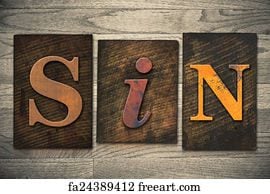 Why is traditional religion dwindling in America? Why do we face a church crisis? Has the Holy Spirit temporarily abandoned us Christians? Should we blame God? Blame ourselves? Does it help to blame anybody?
Some say the church crisis is due to the over-emphasis on sin in our evangelical churches. Others say the church crisis is the result of politics.
Could it be Politics?
“Politics explains part of the decline,” is the diagnosis of Ronald Inglehart. “Since the 1990s, the Republican Party has sought to win support by adopting conservative Christian positions on same sex marriage, abortion, and other cultural issues. But this appeal to religious voters has had the corollary effect of pushing other voters, especially young liberal ones, away from religion. The uncritical embrace of President Donald Trump by conservative evangelical leaders has accelerated this trend. ” In short, those who do not like Trump vacate our pews.
Is this the correct diagnosis? Or, might sin be a more accurate diagnosis?
Can We Blame the Evangelicals for the Church Crisis?
Frankly, I’ve been flabbergasted at the hurricane of anti-evangelical Patheos posts analyzing the church crisis. Like flinging feathered missiles at a dart target, critics throw at evangelical churches mud, invective, and vitriol. Matthew Distanfano, Brian Mclaren, Scott McKinght, Jack Lee, Morgan Guyton, Vance Morgan, Suzanne Tikameyer, and Captain Cassidy, provide examples.
Why is traditional religion dwindling in America? The simple answer: sin. Really?
“What is it with Evangelicalism’s obsession with sin?” cries out progressive Matthew Distafano. “So, what the hell gives? Why is sin so featured in their theology?”
Evangelicals, it is claimed by critics both within and without evangelicalism, deserve this crisis because of the nefarious habit of preaching about sin. Stop it!
One theme seems salient in our Patheos discourse: no longer do people want to be called sinners. No longer do people want to feel like worms, to feel dirty, to feel devalued. The solution to the crisis seems equally obvious: stop preaching sin.
Now, I ask you, Dear Reader, is this an appropriate solution to the church crisis?
Roger Olson’s Answer to: why is traditional religion dwindling in America?
Into this fray comes Roger Olson. Dr. Olson is an erudite, well published, and widely respected systematic theologian. Yes, he says, sin lies at the center of the church crisis. But, his take is slightly different from the critics cited above. Here is how he speaks to the church crisis.
 Some time ago, I can’t say exactly when, most Americans simply lost any sense of being sinful, of needing forgiveness. Most don’t think they are bad. Of course, they will admit to having faults, but basically they think they are “good people” and so are most others. They don’t respond to talk of their “need of a savior.” They don’t even know what that means and, if it is explained to them, they shake their heads in disagreement.
To the question–why is traditional religion dwindling in America?–Roger Olson answers: because we don’t feel sinful and in need of forgiveness. The problem does not originate within the evangelical churches. Rather, the problem originates in American society. That’s a good answer. Olson suggests that evangelicals should keep preaching sin. Really? Yes, really. But, I think more needs to be said about sin.
Sin-Awareness as Blaming Others
 There is no dearth of sin-awareness in our wider society. It is my observation that in America there is widespread even obnoxious awareness of sin. Somebody else’s sin.
Morgan Guyton cries out in pain, “Sin is not a zero sum game!” Or, to say it another way, we don’t have to utterly demolish others who sin while hiding our own sin.
…arguments get reduced to categorical invalidation of the other side rather than critical thinking and growth. Everything is swept into a monolithic pile of evidence that the other side is completely illegitimate, untrustworthy, overly sensitive, spoiled rotten, stupid, etc. At least that’s what seems to happen on the macro-narrative level. Look at those racists; all conservative Christians are racists; look at those knee-jerk libtards calling kids racist before they know all the facts.
What else is political rhetoric if not an incessant, relentless, and vitriolic blame game? We have even come to accept the demand for condemnations by public figures against what we don’t like. It seems that winning popularity contests requires superior skill in blaming others. Sin-awareness comes shrink-wrapped in my-own-sin-denial.
To my reading, America’s evangelical Christians are unique in that they are willing to blame themselves for the church crisis. Perhaps evangelicals are in the habit of confessing. Perhaps this self-blame is just one more example of confession of sin. This could be healthy, actually. Not neurotic. Hooray for the evangelicals! Perhaps the capacity to see oneself as a sinner is just what the world around needs at this dramatic moment in history.
Why might this be healthy? Because the conventional norm is that others blame others. Liberals and progressives blame the evangelicals for supporting America’s social inequalities. Mainline Muslims blame terrorist Muslims for violence. Atheists blame all religion for promoting anti-scientific ignorance, racist bigotry, denial of LGBTQ+, rights, sexual abuse, and for supporting America First politics. There’s lots of sin to go around. But, it’s routinely somebody else’s sin. Not mine.
I would like to blame the church crisis on the six hours per day each teenager spends on the cell phone. I would like to blame Covid 19. I would like to blame the aggressive atheists for blaming the churches. I would like to blame…Mmmm? Who’s next on the list? Me? Well, maybe I’ll get around to that later.
The Sin ‘n’ Grace Dialectic
What is needed for our analysis of the church crisis is a more subtle understanding of sin and of the sin ‘n’ grace dialectic. My contribution to the current Patheos dialogue has been a series of posts on sin. One point I emphasize frequently is this: sin already includes in its definition the blaming of others. At the root of blaming others is self-justification and scapegoating. The gospel of grace announces that God forgives us, that we are justified by grace and not by our own self. So, we don’t have to blame others. We can sin boldly.
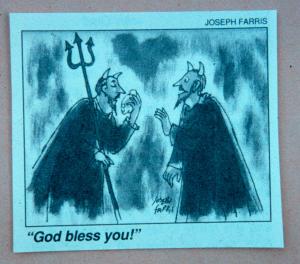 It is important to preach sin. Why? Because we sinners lie to ourselves. We lie by saying, “I’m OK. Somebody else is responsible for evil.” What’s happening in our current church crisis is that a large portion of the society claims that religion is responsible for all our evils. What the Christian preacher offers is discourse clarification–that is, the preacher points out the lie. This is what the Bible ineluctably calls ‘judgment’.
Without applying judgment to ourselves, God’s forgiving grace makes no sense. What confounds us is that the self-justificatory lie is like tank armor. It’s difficult to penetrate. It takes a powerful sermon like a howitzer to penetrate the lie.
I contend that the preacher who penetrates the lie and exposes our sin is earning an honest living. It would be a mistake to eliminate the word, sin, from the pulpit or the microphone.
American evangelicals for two and a half centuries have preached substitutionary atonement along with the dialectic of sin ‘n’ grace. Lutherans call it the dialectic of Law and Gospel. For Karl Barth and many contemporary Calvinists it is the gospel of forgiveness, not the divine law, that first reveals to us that we are sinners in need of grace. What all of these share in common, to be sure, is the gospel message that our God is a gracious and forgiving God.
Conclusion
Why is traditional religion dwindling in America? I am as distressed over the church crisis as is Roger Olson and the many other evangelical and progressive columnists at Patheos. But, alas, I do not have a diagnosis let alone a cure. Whether our churches swing in the wind with Donald Trump’s flag, I simply cannot judge. Yet, the matter of sin is well worth our attention.
Regardless of the church crisis, today’s preacher can offer something unwelcome to the larger society. The preacher can offer discourse clarification. That is, the preacher can point out the lies, the lies that blame others and only heap sin upon sin.
The mechanism of self-justification accompanied by scapegoating does not apply solely to people sitting in a church pew. It belongs to the entire human race. The dialectic of judgment and forgiveness is God’s gift to the entire human race.
So, what about developing a public theology addressed to the entire human race? Roger Olson asks: is there such a thing as public theology? Yes. And there could even be a distinctively evangelical public theology. “Public theology…is biblical and theological and then extended into the public sector through political means,” says Sojourners magazine.
If the pews are empty, perhaps the preacher can turn to the wider public for an audience. The preacher of sin ‘n’ grace can become a public theologian. The wider public still needs to hear the divine law that judges sin and the divine gospel that forgives, redeems, and renews..
▓
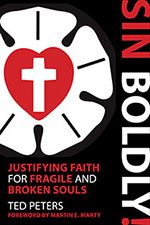 Ted Peters is a Lutheran pastor and emeritus seminary professor. His one volume systematic theology is now in its 3rd edition, God—The World’s Future (Fortress 2015). He has undertaken a thorough examination of the sin-and-grace dialectic in two works, Sin: Radical Evil in Soul and Society (Eerdmans 1994) and Sin Boldly! (Fortress 2015). Watch for his forthcoming, The Voice of Public Christian Theology (ATF 2022). See his website: TedsTimelyTake.com.
▓

About Ted Peters
▓ Ted Peters is a Lutheran pastor and emeritus seminary professor. His one volume systematic theology is now in its 3rd edition, God—The World’s Future (Fortress 2015). He has undertaken a thorough examination of the sin-and-grace dialectic in two works, Sin: Radical Evil in Soul and Society (Eerdmans 1994) and Sin Boldly! (Fortress 2015). Watch for his forthcoming, The Voice of Public Christian Theology (ATF 2022). See his website: TedsTimelyTake.com. ▓ You can read more about the author here.
Previous Post

January 16, 2022
The Public Theology of Rudolf von Sinner
Next Post
January 22, 2022 H+ 2: The Transhuman, the Posthuman, & the Truly Human
Browse Our Archives
Select a Category Afterlife America in Crisis Ancient Alien Apocalypse Art Artificial Intelligence Astrobiology Astrotheology Atheism Big History Buddhist Catholic Christian Nationalism Christmas Comparative Theology Death Ecology Ethics ETI Evangelical Evolution Existential Questions Free Will General Christian Hermeneutics Hindu https://www.patheos.com/blogs/allsetfree/2020/12/sins-we-need-to-talk-about/?utm_source=Newsletter&utm_medium=email&utm_campaign=Christians+For+a+Better+Christianity&utm_content=43&lct Interreligious Islam Jewish Justice Latter-Day Saints Literature Literature and Theology Lutheran Methodism Mormonism Nonreligious ontology Orthodox Pagam Prayer progressive Christian PT 6 Dignity Public Theology Race racial justice Religious Liberty Romance Satan Scapegoat Science & Religion Science and Religion social justice Spirituality SR 8 Transhumanism Systematic Theology Taoism Ted Peters UAP UFO Uncategorized War
Select a Month September 2026 August 2026 July 2026 June 2026 May 2026 April 2026 March 2026 February 2026 December 2025 November 2025 October 2025 September 2025 August 2025 July 2025 June 2025 May 2025 April 2025 March 2025 February 2025 January 2025 December 2024 November 2024 October 2024 September 2024 August 2024 July 2024 June 2024 May 2024 April 2024 March 2024 February 2024 January 2024 December 2023 November 2023 October 2023 September 2023 August 2023 July 2023 June 2023 May 2023 April 2023 March 2023 February 2023 January 2023 December 2022 November 2022 October 2022 September 2022 August 2022 July 2022 June 2022 May 2022 April 2022 March 2022 February 2022 January 2022 December 2021 November 2021 October 2021 September 2021
Follow Us!
TAKE THE
Religious Wisdom Quiz
Who did God call as a boy in the Tabernacle, saying his name three times?
Select your answer to see how you score.
David Samuel Eli Saul
Related posts from Public Theology

Why Public Theology Needs a Theology of Nature

America's 250th Birthday Gift: Civic Renewal

Do You Believe in UFOs? A Theologian's Answer.

Free Will and Christian Freedom TWO
TRENDING AT PATHEOS Progressive Christian

What Being a Modern-Day Apostle Means to Me
In my last column, I discussed the ins and outs of modern-day...

Did Ancient China Once Worship the God of...
Across human history, a common thread weaves through the origins of the...

Love Your Neighbor – Including Earth-Kin: Lev. 19,...
God’s command to love your neighbor means acting in an ethical and...

Lead a Church Study of “Jesus and Lao...
Guest writer Jack Thomas (The Irreverent Reverend) reflects on leading his church...

Pastoral Wisdom for Responding to Sermon Pushback
Getting sermon pushback on your social justice sermon? Learn practical, Proverbs-based strategies...

Principles for Understanding the Apostolic Ministry Today
Whenever people discover that my formal ministry title is "apostle," as in...
view all Progressive Christian blogs
Ad-Free & Subscriber Log-In Subscription Support
- About Us
- 2026 Calendar
- Videos
- Podcasts
- Library of World Religions
- Faith In Media Tracker
- Advertise With Us
- Write for Us
- Privacy Policy
- Terms of Service
- Do Not Sell My Data
- Contact Us
- Radiant Digital
- Manage Newsletter Subscriptions
- Unsubscribe From Notifications
- Sitemap
Copyright 2008-2026, Patheos. All rights reserved.
Subscription Support Ad-Free & Subscriber Log-In
Follow Patheos