
BuddhistCatholicContemplativeEvangelicalGeneral ChristianHinduJewishLatter-day SaintMuslimNew VisionsProgressive Christian
Beliefs
- Buddhist
- Catholic
- Contemplative
- Evangelical
- General Christian
- Hindu
- Jewish
- Latter-day Saint
- More Voices
- Muslim
- New Visions
- Pagan
- Progressive Christian
Topics
- Religion News
- Food and Religion
- Sports and Religion
- Religious Art
- Religious Music and Entertainment
- Religious Events
- History and Religion
- Style and Religion
- Politics and Religion
- Women in Religion
- Recreation Outdoors and Religion
- Business Finance and Religion
- Careers Workplace and Religion
- Education and Religion
- Family Parenting and Religion
- Health Fitness and Religion
- Home and Religion
- Relationships and Religion
- Technology and Religion
- Travel and Religion
Columnists
- Buddhist Columnists
- Business Finance and Religion Columnists
- Careers Workplace and Religion Columnists
- Catholic Columnists
- Contemplative Columnists
- Education and Religion Columnists
- Evangelists Columnists
- Family Parenting and Religion Columnists
- General Christian Columnists
- Health Fitness and Religion Columnists
- Hindu Columnists
- History and Religion Columnists
- Home and Religion Columnists
- Jewish Columnists
- More Voices Columnists
- Latter Day Columnists
- Muslim Columnists
- New Visions Columnists
- Nonreligious Columnists
- Pagan Columnists
- Politics and Religion Columnists
- Progressive Columnists
- Recreation Outdoors and Religion Columnists
- Relationships and Religion Columnists
- Religion News Columnists
- Religious Art Columnists
- Religious Events Columnists
- Religious Music and Entertainment Columnists
- Sports and Religion Columnists
- Style and Religion Columnists
- Technology and Religion Columnists
- Travel and Religion Columnists
- Women in Religion Columnists
Resource Library
- 2026 Calendar
- Library of World Religions
- The 100 Most Holy Places on Earth
- Patheos Answers
- Podcasts
- Videos
- Faith Leaders Database
- Anglican Episcopalian
- Bahai
- Baptist
- Buddhism
- Christianity
- Confucianism
- Eastern Orthodoxy
- Hinduism
- Holiness and Pentecostal
- ISKCON
- Islam
- Judaism
- Lutheran
- Methodist
- The Church of Jesus Christ of Latter-day Saints
- New Age
- Paganism
- Presbytarian and Reformed
- Protestantism
- Religion Behind the Scenes
- Roman Catholic
- Scientology
- Shia Islam
- Sikhism
- Sufism
- Sunni Islam
- Taoism
- Zen
- See all religions
Research Tools
 Ad-Free & Subscriber Log-In Subscription Support
Ad-Free & Subscriber Log-In Subscription Support
Follow Patheos 

- Trending:
- Forgiveness
- |
- Marriage
- |
- Consciousness
- |
- Death Penalty
- |
- Election
- |
- Halloween

- Home
- Progressive Christian
- Are Jesus-Substitutes Blasphemy?
Are Jesus-Substitutes Blasphemy?
Last updated on: November 30, 2021 at 8:59 pm by Ted Peters
Are Jesus-Substitutes Blasphemy? 2021-11-30T20:59:56-08:00 Ted Peters
Patheos Explore the world's faith through different perspectives on religion and spirituality! Patheos has the views of the prevalent religions and spiritualities of the world.
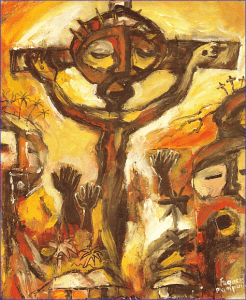 Who belongs in the manger? Who belongs on the cross? Jesus? Or, a Jesus-substitute? Does a Jesus-Substitute commit blasphemy?
Christian iconography and art collapses the historical Jesus into the artist’s context. Hermeneutically, this is the principle of application or applicatio. The saving work of Jesus Christ is pro me, for me, Martin Luther emphasized (Stjerna). Because nobody took a video or photograph of the historical Jesus, every artistic depiction includes a constructive interpretation by the artist. The critical postmodern interpreter of such art might ask: “Mmmmm? Whose power interests are being served here?” (Crucifixion by Francis Mampuya Kito, Congo, 1997). When can we discern blasphemy?
Oh Mama! George Floyd as Jesus sparks fury at Catholic University
In a Patheos post, Berry Duke reports on a controversy at the Catholic University of America. Like hand grenades, two paintings have exploded into spiritual chaos. A chapter of the Young Americans for Freedom has judged these paintings to be “blasphemous.” One student complains, “it’s just another symptom of the liberalization and secularization of our campus.”
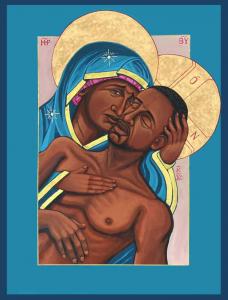
The two identical paintings by Kelly Latimore take the form of an icon. Whose head is resting in the arms of the Holy Virgin mother? Not Jesus. No, it’s George Floyd. Floyd, you may recall, was a black man murdered by a white Minneapolis police officer on May 25, 2020. Reaction by Black Lives Matter prompted a worldwide outcry against racial injustice. (Icon by Kelly Latimore). Here is how CUA’s president John Garvey interprets the icon.
The icon “Mama” is a pieta depicting Mary and her Son, Jesus Christ. The letters in the halo are Ὁ ὬΝ, which is shorthand in Greek for “I Am.” The letters are used in icons only in connection with Jesus Christ, the Son of God.
There are those who would like to see George Floyd as the male figure in the icon. That is not how we read it. The image represents to our community a good-faith attempt to include religious imagery on campus that reflects the universality of the Catholic Church.
Blasphemy? Symbol Stealing? Critical Deconstruction?
Now, let’s look at this issue from the point of view of the systematic theologian. The core question comes in two forms. First, which baby belongs in the manger or in Mary’s arms? Jesus, or somebody else? Second, who should be nailed to the cross? Jesus, or somebody else? When is a Jesus-Substitute blasphemy or not?
It seems to me that three coherent answers obtain: (1) blasphemy outrage; (2) symbol theft; or (3) critical postmodern analysis. Symbol theft may be an actual theft in order to steal sacred power on behalf of an ideology. Yet, at a very subtle level, it might instead illustrate the Theology of the Cross. It might make applicatio (application) of the saving power of the cross to a specific context.
Theology of the Cross
In Martin Luther’s Theology of the Cross, the saving power of God is revealed under the despair and abandonment of the cross. God is revealed under what is apparently not God. (Stjerna) Here’s Lutheran theologian Mark Mattes.
God reveals himself, but only paradoxically as revealed in the cross: God’s wisdom is granted to foolishness, his power in weakness, his glory in lowliness, and his life in the death of his Son. (Mattes, 2017, p.735)
In Jurgen Moltmann’s augmentation of the Theology of the Cross, Jesus Christ is present with those of us who suffer by suffering with us.
…the Son suffers and dies on the cross. The Father suffers with him, but not in the same way. There is a trinitarian solution to the paradox that God is dead on the cross and yet is not dead, once one abandons the simple concept of God [on behalf of a trinitarian] concept of God. (Moltmann, 1974, p.205)
According to the Theology of the Cross, your and my suffering are shared by God. One might expect a creative artist to attempt to show how your and my suffering are absorbed into the divine life through Jesus.
This means that we the interpreters must exert some effort to distinguish outright symbol stealing from authentic applicatio.
Let me elaborate while commenting on another example.
Christa Crucifix
In 1984 Edwina Sandys’ Christa Crucifix was placed in St. John the Divine Cathedral in New York City. As you can see, instead of Jesus on the cross we see a nude nameless woman.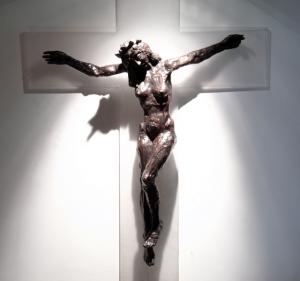
How should we interpret this?
First, blaephemous outrage. One who responds with outrage over blasphemy, would expect Jesus and not a Jesus substitute on the cross. Suffragan Bishop of New York Walter Dennis criticized the sculpture. It is “theologically and historically indefensible,” he said. The good bishop assumes that Jesus and only Jesus should be pictured in such an icon or artistic rendering. Christa was quickly removed but then returned in 2016.
Second, Symbol Theft. Is artist Edwina Sandys making application of the saving work of Jesus Christ for women in her context? Or, is she stealing symbolic power in order to empower a feminist ideology?
The cross of Jesus Christ possesses and exudes sacred power that others might covet. Sandys wanted a transfer of this power. “I wanted to portray the sufferings of women,” said Edwina Sandys. By stealing the symbol of the divine from the Christian tradition, Sandys could muster that power on behalf of her particular cause.
“Most women of my generation have been stamped with the idea of Man’s superiority over Woman, which is hard to throw off without seeming aggressive. I hope that ‘Christa’ continues to reveal the journey of suffering that we all have in common.”
Third, Critical or Postmodern Deconstruction. The critical postmodernist would immediately observe that classical icons or traditional art depicting the historical Jesus are already overlaid with ideology. An unconscious ideology, to be sure; but ideology all the same. The simple fact that we inherit a tradition in which the Child of God is male testifies to the cultural assumption that the male gender is closer to God than other genders. The only difference in the case of Christa is the conscious or deliberate reference to the plight of women who suffer. By shocking our traditional sensibilities, artist Sandys is waking us up to past injustice. We get woke. By stealing the power of the Christian symbol Sandys is empowering women.
Sallman’s Bearded Lady?
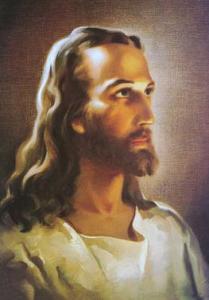
Here is Jesus Christ in devotional art painted by Warner Sallman in 1940. My all male seminary classmates in the 1960s referred to this painting as the “bearded lady.” Unkind. What was behind their unkikndness?
A critical postmodernist would aver that no artist today has access to what the historical Jesus looked like. This means that every artistic rendering is a construction. In this case, Jesus looks like the All-American boy with a beard. Actually, Jesus looks Anglo-Saxon, the dominant racial and ethnic segment of a pluralistic American society. Without acknowledging it, Sallman’s rendering offers divine blessing to Teutonic genes.
Sri Lanka’s Pro Me
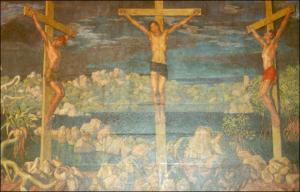
Let’s go to Kandy, Sri Lanka. Here is the reredos mosaic behind the altar of a church I visited. I took this photo at night in this outdoor worship area. Unfortunately, my flash obscures some details.
Note how Jesus and the two thieves look like ethnic Sinhala people. The rocks and terrain are typical of this region of Sri Lanka. Symbol theft? Or, the principle of applicatio? Jesus died for me? for my people? for Sri Lanka? for the entire creation? I would rather dub it applicatio, depicting Jesus Christ as pro me, pro the people of Sri Lanka.
As you can see, the line between symbol stealing and applicatio is not a sharp one. Who draws the line: the artist or the viewer?
A Symbol Theft by the NRA?
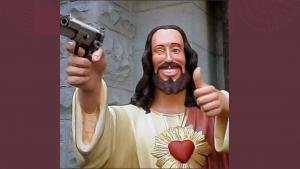
Symbol Theft by Black Lives Matter?
Even though this painting, “Christ as Poor, Black, Death Row Inmate” by Marylyn Felon, predates today’s Black Lives Matter movement, it shares the spirit. This rendering of the condemned Jesus illustrates applicatio. The Theology of the Cross posits that God experiences on the cross of Christ what you and I experience when marginalized, wrongly accused, abused, and forgotten. 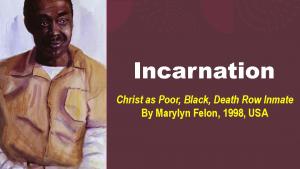
Conclusion
My task here is not to resolve the controversy at the Catholic University of America. Rather, my task is to point out the subtleties and ambiguities of interpreting iconography and art. When a Jesus-substitute steals the sacred power of the Christian symbol and employs it for an ideology, the pious devotee has a right to shake a fist and holler, “Blasphemy!”
Yet, this side of blasphemy, we fully expect the Theology of the Cross to express God’s identification with each of us in our historical contexts because the gospel message is addressed to us. If the gospel is pro me, then we could expect our iconography and art to be pro me.
▓

Ted Peters is a Lutheran pastor and emeritus seminary professor. His one volume systematic theology is now in its 3rd edition, God—The World’s Future (Fortress 2015). He has undertaken a thorough examination of the sin-and-grace dialectic in two works, Sin: Radical Evil in Soul and Society (Eerdmans 1994) and Sin Boldly! (Fortress 2015). Watch for his forthcoming, The Voice of Public Christian Theology (ATF 2022). See his website: TedsTimelyTake.com.
▓
References
Mattes, M. (2017). Theology of the Cross. In T. Wengert, Dictionary of Luther and the Lutheran Tradition (pp. 734-737). Grand Rapids MI: Baker Academic.
Moltmann, J. (1974). The Crucified God. New York: Harper.
Stjerna, K. (2021). Lutheran Theology: A Grammar of Faith. Edeinburgh: T & T Clark.

About Ted Peters
Ted Peters is a Lutheran pastor and seminary professor. His fields of teaching and writing include public systematic theology as well as the dialogue between faith and science. You can read more about the author here.
Previous Post
November 28, 2021
Sin 5: Sin Boldly!
Next Post

November 30, 2021 Christmas: the Great Human Dignity Conferral
Browse Our Archives
Select a Category Afterlife America in Crisis Ancient Alien Apocalypse Art Artificial Intelligence Astrobiology Astrotheology Atheism Big History Buddhist Catholic Christian Nationalism Christmas Comparative Theology Death Ecology Ethics ETI Evangelical Evolution Existential Questions Free Will General Christian Hermeneutics Hindu https://www.patheos.com/blogs/allsetfree/2020/12/sins-we-need-to-talk-about/?utm_source=Newsletter&utm_medium=email&utm_campaign=Christians+For+a+Better+Christianity&utm_content=43&lct Interreligious Islam Jewish Justice Latter-Day Saints Literature Literature and Theology Lutheran Methodism Mormonism Nonreligious ontology Orthodox Pagam Prayer progressive Christian PT 6 Dignity Public Theology Race racial justice Religious Liberty Romance Satan Scapegoat Science & Religion Science and Religion social justice Spirituality SR 8 Transhumanism Systematic Theology Taoism Ted Peters UAP UFO Uncategorized War
Select a Month September 2026 August 2026 July 2026 June 2026 May 2026 April 2026 March 2026 February 2026 December 2025 November 2025 October 2025 September 2025 August 2025 July 2025 June 2025 May 2025 April 2025 March 2025 February 2025 January 2025 December 2024 November 2024 October 2024 September 2024 August 2024 July 2024 June 2024 May 2024 April 2024 March 2024 February 2024 January 2024 December 2023 November 2023 October 2023 September 2023 August 2023 July 2023 June 2023 May 2023 April 2023 March 2023 February 2023 January 2023 December 2022 November 2022 October 2022 September 2022 August 2022 July 2022 June 2022 May 2022 April 2022 March 2022 February 2022 January 2022 December 2021 November 2021 October 2021 September 2021
Follow Us!
TAKE THE
Religious Wisdom Quiz
How many books are in the New Testament?
Select your answer to see how you score.
27 21 39 24
Related posts from Public Theology

Why Public Theology Needs a Theology of Nature

America's 250th Birthday Gift: Civic Renewal

Do You Believe in UFOs? A Theologian's Answer.

Free Will and Christian Freedom TWO
TRENDING AT PATHEOS Progressive Christian

What Being a Modern-Day Apostle Means to Me
In my last column, I discussed the ins and outs of modern-day...

Did Ancient China Once Worship the God of...
Across human history, a common thread weaves through the origins of the...

Love Your Neighbor – Including Earth-Kin: Lev. 19,...
God’s command to love your neighbor means acting in an ethical and...

Lead a Church Study of “Jesus and Lao...
Guest writer Jack Thomas (The Irreverent Reverend) reflects on leading his church...

Pastoral Wisdom for Responding to Sermon Pushback
Getting sermon pushback on your social justice sermon? Learn practical, Proverbs-based strategies...

Principles for Understanding the Apostolic Ministry Today
Whenever people discover that my formal ministry title is "apostle," as in...
view all Progressive Christian blogs
Ad-Free & Subscriber Log-In Subscription Support
- About Us
- 2026 Calendar
- Videos
- Podcasts
- Library of World Religions
- Faith In Media Tracker
- Advertise With Us
- Write for Us
- Privacy Policy
- Terms of Service
- Do Not Sell My Data
- Contact Us
- Radiant Digital
- Manage Newsletter Subscriptions
- Unsubscribe From Notifications
- Sitemap
Copyright 2008-2026, Patheos. All rights reserved.
Subscription Support Ad-Free & Subscriber Log-In
Follow Patheos