
BuddhistCatholicContemplativeEvangelicalGeneral ChristianHinduJewishLatter-day SaintMuslimNew VisionsProgressive Christian
Beliefs
- Buddhist
- Catholic
- Contemplative
- Evangelical
- General Christian
- Hindu
- Jewish
- Latter-day Saint
- More Voices
- Muslim
- New Visions
- Pagan
- Progressive Christian
Topics
- Religion News
- Food and Religion
- Sports and Religion
- Religious Art
- Religious Music and Entertainment
- Religious Events
- History and Religion
- Style and Religion
- Politics and Religion
- Women in Religion
- Recreation Outdoors and Religion
- Business Finance and Religion
- Careers Workplace and Religion
- Education and Religion
- Family Parenting and Religion
- Health Fitness and Religion
- Home and Religion
- Relationships and Religion
- Technology and Religion
- Travel and Religion
Columnists
- Buddhist Columnists
- Business Finance and Religion Columnists
- Careers Workplace and Religion Columnists
- Catholic Columnists
- Contemplative Columnists
- Education and Religion Columnists
- Evangelists Columnists
- Family Parenting and Religion Columnists
- General Christian Columnists
- Health Fitness and Religion Columnists
- Hindu Columnists
- History and Religion Columnists
- Home and Religion Columnists
- Jewish Columnists
- More Voices Columnists
- Latter Day Columnists
- Muslim Columnists
- New Visions Columnists
- Nonreligious Columnists
- Pagan Columnists
- Politics and Religion Columnists
- Progressive Columnists
- Recreation Outdoors and Religion Columnists
- Relationships and Religion Columnists
- Religion News Columnists
- Religious Art Columnists
- Religious Events Columnists
- Religious Music and Entertainment Columnists
- Sports and Religion Columnists
- Style and Religion Columnists
- Technology and Religion Columnists
- Travel and Religion Columnists
- Women in Religion Columnists
Resource Library
- 2026 Calendar
- Library of World Religions
- The 100 Most Holy Places on Earth
- Patheos Answers
- Podcasts
- Videos
- Faith Leaders Database
- Anglican Episcopalian
- Bahai
- Baptist
- Buddhism
- Christianity
- Confucianism
- Eastern Orthodoxy
- Hinduism
- Holiness and Pentecostal
- ISKCON
- Islam
- Judaism
- Lutheran
- Methodist
- The Church of Jesus Christ of Latter-day Saints
- New Age
- Paganism
- Presbytarian and Reformed
- Protestantism
- Religion Behind the Scenes
- Roman Catholic
- Scientology
- Shia Islam
- Sikhism
- Sufism
- Sunni Islam
- Taoism
- Zen
- See all religions
Research Tools
 Ad-Free & Subscriber Log-In Subscription Support
Ad-Free & Subscriber Log-In Subscription Support
Follow Patheos 

- Trending:
- Forgiveness
- |
- Marriage
- |
- Consciousness
- |
- Death Penalty
- |
- Election
- |
- Halloween

- Home
- Progressive Christian
- History and Religion
- Sin 1: Sin? Really?
Sin 1: Sin? Really?
Last updated on: December 15, 2022 at 11:14 am by Ted Peters
Sin 1: Sin? Really? 2022-12-15T11:14:46-08:00 Ted Peters
Patheos Explore the world's faith through different perspectives on religion and spirituality! Patheos has the views of the prevalent religions and spiritualities of the world.
 Sin blinds us to sin. Sin itself makes us think that there is no sin. Sin turns off the lights, so to speak, so that the truth about ourselves becomes invisible. What accompanies sin is secrecy, fog, darkness.
How does the dark darken? Sin, say critics of religion, is an idea invented by nefarious clergy to keep the hoi poloi under control. Sin is an idea that frightens little children. By making us feel guilt-ridden and requiring us to bow and scrape before the priest in the confessional, this fake doctrine fills us with fear. When we otherwise good people are harangued in church with sin talk, we become self-effacing, self-deprecating, and self-destroying. All this is true. Right?
Atheists are not the only ones to bark complaints. Christians complain too. One Patheos columnist, Mathew Destefano, just can’t stand all this sin-talk. “Evangelicals focus so heavily on sin that they are living in fear. Their universe is one that would strike fear in the heart of anyone who affirms it. Perpetual hell. Eternal damnation. Everlasting torment. FEAR. FEAR. FEAR.” So, it’s time to simply jettison the idea of sin. Right?
Not quite. The Christian doctrine of sin reveals the secrets of our human condition like an x-ray camera reveals what’s under our skin. As an exercise in public theology, let’s x-ray the dark shadows of daily human life. Let’s get real about our human predicament. Let’s try on for size four different views of sin, testing them to see which are more realistic than the others.
1. SIN DOES NOT EXIST
“Sin Does Not Exist: And Believing That It Does Is Ruining Us,” writes podcaster Richard Bellrock (Bellrock April 18 2019). Really? Quite the contrary, I contend. But, it’s complicated.
We’ve all heard of the 7 Deadly Sins. The Vatican recently added an 8th: littering. We love to trivialize sins so that, like a pesky mosquito, a quick slap will make their sting go away. After all, the National Catholic Reporter observes: “Interestingly, pride, greed, lust, anger, gluttony, envy and sloth probably comprise the majority of motives found on television and in movies, and account for the background attitudes in nearly all of our advertising.”
But here, let’s get serious. Sin leads to evil, and evil leads to the destruction of what is. Got that straight? (Peters 1993)
Now, I would agree that evil does not exist. To exist means to stand out [exist = ek stasis] of non-being. To exist is to be something. To exist is to be this and not that.
But—and here’s the point–sin leads to evil, and evil is the aggressive power of nonbeing. Evil destroys what is. Sin leads to death, finally. Evil aggressively turns what is into what is no longer. To be realistic we must see sin as a force that destroys both the sinner and everything else.
In short, Christian public theology illuminates the universal human condition so that we can be realistic about ourselves. Confessing our sins testifies to the truth about who we are.
2. SIN IS IGNORANCE
Skeptic Paul Kurtz contends that the actual sin we should fear is ignorance combined with gullibility. Christians are so gullible they believe this nonsense about sin. “Gullibility and ignorance are the source of much nonsense in religion, ideology, morality, and politics” (Kurtz 1986, 62). Because religious people lack the power of reason, they are gullible to misleading rhetoric about sin. Really? No, of course not.
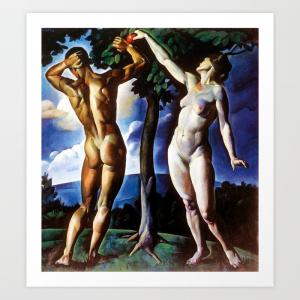 This reminds me of Socrates, who diagnosed the fundamental human disease: we are ignorant of the good. Once we find the true good through the power of reason, we will do the good, said Socrates. Therefore, the path to social salvation leads through education toward increased knowledge, wisdom, and virtue. In short, the human race could reason its way out of violence and destruction. (Adam and Eve painting by Karoly Patco)
One of the phenomena that neither Socrates nor Kurtz could account for is this: some of the smartest and most educated people in our society are the most selfish, narcissistic, and dangerous. They lead us into war; and people die. Increased knowledge leads to increased capacity to do evil. Reason and knowledge will not overcome evil.
3. SIN PRODUCES EVIL BY THE WILL
This debate over sin as ignorance led Saint Augustine to diagnose the fundamental human disease in terms of the will rather than the mind. If you or I are malevolent, then our malevolent will darkens our perception so that we are no longer able to see the light of truth or goodness. Sin blinds us to sin. Following Augustine, Ian Barbour observes, “”Sin is…a defect of the will, not of reason” (Barbour 2006, 364).
Under ordinary circumstances, our will is bound to serve the interests of the self. When the Holy Spirit empowers us by grace, we become liberated from the interests of the self and become capable of loving our neighbor for the sake of our neighbor. The simplest child among us who has not yet graduated from the school of higher reason can become quite capable of loving selflessly.

Feminists worry that this emphasis on selfless love risks impeding healthy self-development in young people, especially girls. It risks suppressing self-actualization (Plaskow 1975, 238). This is a healthy caution, I think. Even so, it may help theologically to recognize that the empowerment of the Holy Spirit strengthens and emboldens our self. When we shed pride or hubris, we do not deny the existence of the self. We self-actualize and self-define as a self who loves the neighbor.
4. SIN IS ALIENATION FROM GOD
“Sin as rebellion against creation necessarily entails sin against God,” declares process theologian Marjorie Suchocki (Suchocki 1994, 248). Because all of physical and spiritual reality is connected, any sin anywhere at any time has a destructive impact on the whole of God’s creation and, of course, on God as well.
We human beings—and the entire creation for that matter—are estranged from our Creator God. We are alienated from God largely because we do not trust God in faith. When sin is described by the theologian as pride or hubris, this suggests that we tacitly elevate our own self into the sphere of the divine. We treat our self as a god, at least indirectly. We sinners are the ones responsible for alienating ourselves from God. God is not responsible for this alienation.
Baylor’s Paul Sands tries to clarify some nuances between self-esteem and self-apotheosis. “Proper self-esteem is a barometer that rises and falls with the quality of one’s life. Good people should feel good about themselves; bad people should not.” Proper self-esteem is to be esteemed. What is to be feared is a self-apotheosis: a monstrous pride that reorganizes every nearby sycophant’s life so that we all feed the wannabe god’s narcissistic and insatiable appetite for fawning, scraping, compliments, and devotion. While the false god evacuates us of our own integrity, the wannabe god himself or herself commands a fiefdom through megalomania, intolerance, and abuse. The self-declared human gods in our life confuse our loyalties and distort our charity.
Martin Luther distinguishes between belief in oneself as an idol and belief the true God. The prideful self who refuses to treat God as God becomes a danger. “The root and source of sin is unbelief and turning away from God, just as, on the other hand, the source and root of righteousness is faith” (Luther 1955-1986, 1:162). Really? Yes, really. “The essence of sin is disbelief, the state of estrangement from God,” adds Paul Tillich (Tillich 1955, 55). The true God gives us life through faith. The false gods–our proud friends–suck the life right out of us and swallow it for their own sakes.
“Like lost phones bereft of chargers and batteries,” observes Kaitlyn Dudley Curtin, “human persons cannot even recognize their desperation, much less take steps toward a remedy” (Curtin September 14 2021). Might a public theologian engaged in discourse clarification on the topic of sin shine enough light for us to find ourselves in a dark room?
Now, if our malevolent will distorts our reason so that we remain blind to how our pride alienates us from God, is our situation hopeless? No. Because God’s incarnation in Christ shines a carbon arc lamp into the world of darkness. According to Karl Barth, “Only when we know Jesus Christ do we really know that man is the man of sin, and what sin is, and what it means for man” (Barth 1936-1962, IV/i, 389).
Conclusion
It is actual sin—not the concept of sin—that distorts our vision. We human beings largely choose darkness over the bright light of truth. “The people living in darkness have seen a great light; on those living in the land of the shadow of death a light has dawned” (Matthew 4:16). Any revelation of God is simultaneously a revelation of who we are.
I’ve been recommending that the public theologian use the doctrine of sin like a flashlight to illuminate the human situation. Is there such as thing as public theology? asks Roger Olson? Yes, indeed. And today’s public theologian can help us by illuminating everyday life with the rechargeable Maglite of the story of Jesus. The story of Jesus is like a brightly lit mirror. It tells us who we are.
The story of Jesus, in addition. announces grace for sinners. Grace “is not merely for the forgiveness of sin,” announces Patheos columnist Duncan Edward Pile, but also for “transformation and freedom.” The dialectic of sin ‘n’ grace is what gives faithful living its excitement.

————–
Ted Peters is a pastor, professor, and author of both fiction and nonfiction. Visit: TedsTimelyTake.com.
Ted is emeritus professor of systematic theology and ethics at Pacific Lutheran Theological Seminary and the Graduate Theological Union in Berkeley, California. He co-edits the journal, Theology and Science at the Center for Theology and the Natural Sciences. His fictional thrillers feature an inner-city pastor, Leona Foxx, who courageously challenges the structures of political domination buttressed by the latest in science and technology.
—————–
Works Cited
Barbour, Ian G. 2006. “Indeterminacy, Holism, and God’s Action.” In God’s Action in Nature’s World: Essays in Honor of Robert John Russell, 113-128. Aldershot UK: Ashgate.
Barth, Karl. 1936-1962. Church Dogmatics, 4 Volumes. Edinburgh: T&T Clark.
Bellrock, S Rkichard. April 18 2019. Sin Does Not Exist: And Believing That It Does Is Ruining Us. Podcast, https://sunstone.org/sin-does-not-exist/: Sunstone.
Curtin, Kaitlyn Dudley. September 14 2021. Patron Saint of Operator Error: Augustine of Hippo. Podcast, https://www.patheos.com/articles/patron-saint-of-operator-error-augustine-of-hippo: Patheos.
Kurtz, Paul. 1986. Transcendental Temptation: A Critique of Religion and the Paranormal. Buffalo: Prometheus Books.
Luther, Martin. 1955-1986. Luther’s Works, American Edition, 55 Volumes. St. Louis and Minneapolis: Concordia and Fortress.
Peters, Ted. 1993. Sin: Radical Evil in Soul and Society. Grand Rapids MI: Wm B Eerdmans.
Plaskow, Judith Ellen. 1975. Sex, Sin, and Grace: Women’s Experience and the Theologies of Reinhold Niebuhr and Paul Tillich. Lanham MD: University Press of America.
Suchocki, Marjorie. 1994. The Fall to Violence: Original Sin and Relational Theology. New York: Continuum.
Tillich, Paul. 1955. Biblical Religion and the Search for Ultimate Reality. Chicago: University of Chicago Press.
History and Religion

About Ted Peters
Ted Peters is a pastor, professor, and author of both fiction and nonfiction. Visit: TedsTimelyTake.com. You can read more about the author here.
Previous Post

October 10, 2021
Evolution and Religion: Should Christians Dump Darwin?
Next Post
October 16, 2021 Should Religion Go Extinct with the Dinosaurs?
Browse Our Archives
Select a Category Afterlife America in Crisis Ancient Alien Apocalypse Art Artificial Intelligence Astrobiology Astrotheology Atheism Big History Buddhist Catholic Christian Nationalism Christmas Comparative Theology Death Ecology Ethics ETI Evangelical Evolution Existential Questions Free Will General Christian Hermeneutics Hindu https://www.patheos.com/blogs/allsetfree/2020/12/sins-we-need-to-talk-about/?utm_source=Newsletter&utm_medium=email&utm_campaign=Christians+For+a+Better+Christianity&utm_content=43&lct Interreligious Islam Jewish Justice Latter-Day Saints Literature Literature and Theology Lutheran Methodism Mormonism Nonreligious ontology Orthodox Pagam Prayer progressive Christian PT 6 Dignity Public Theology Race racial justice Religious Liberty Romance Satan Scapegoat Science & Religion Science and Religion social justice Spirituality SR 8 Transhumanism Systematic Theology Taoism Ted Peters UAP UFO Uncategorized War
Select a Month September 2026 August 2026 July 2026 June 2026 May 2026 April 2026 March 2026 February 2026 December 2025 November 2025 October 2025 September 2025 August 2025 July 2025 June 2025 May 2025 April 2025 March 2025 February 2025 January 2025 December 2024 November 2024 October 2024 September 2024 August 2024 July 2024 June 2024 May 2024 April 2024 March 2024 February 2024 January 2024 December 2023 November 2023 October 2023 September 2023 August 2023 July 2023 June 2023 May 2023 April 2023 March 2023 February 2023 January 2023 December 2022 November 2022 October 2022 September 2022 August 2022 July 2022 June 2022 May 2022 April 2022 March 2022 February 2022 January 2022 December 2021 November 2021 October 2021 September 2021
Follow Us!
TAKE THE
Religious Wisdom Quiz
What question did Jesus ask Saul on the road to Damascus?
Select your answer to see how you score.
Why do you persecute my followers? Why do you hate me? Do you not know who I am? Saul, Saul, why do you persecute me?
Related posts from Public Theology

Why Public Theology Needs a Theology of Nature

America's 250th Birthday Gift: Civic Renewal

Do You Believe in UFOs? A Theologian's Answer.

Free Will and Christian Freedom TWO
TRENDING AT PATHEOS Progressive Christian

What Being a Modern-Day Apostle Means to Me
In my last column, I discussed the ins and outs of modern-day...

Did Ancient China Once Worship the God of...
Across human history, a common thread weaves through the origins of the...

Love Your Neighbor – Including Earth-Kin: Lev. 19,...
God’s command to love your neighbor means acting in an ethical and...

Lead a Church Study of “Jesus and Lao...
Guest writer Jack Thomas (The Irreverent Reverend) reflects on leading his church...

Pastoral Wisdom for Responding to Sermon Pushback
Getting sermon pushback on your social justice sermon? Learn practical, Proverbs-based strategies...

Principles for Understanding the Apostolic Ministry Today
Whenever people discover that my formal ministry title is "apostle," as in...
view all Progressive Christian blogs
Ad-Free & Subscriber Log-In Subscription Support
- About Us
- 2026 Calendar
- Videos
- Podcasts
- Library of World Religions
- Faith In Media Tracker
- Advertise With Us
- Write for Us
- Privacy Policy
- Terms of Service
- Do Not Sell My Data
- Contact Us
- Radiant Digital
- Manage Newsletter Subscriptions
- Unsubscribe From Notifications
- Sitemap
Copyright 2008-2026, Patheos. All rights reserved.
Subscription Support Ad-Free & Subscriber Log-In
Follow Patheos