
BuddhistCatholicContemplativeEvangelicalGeneral ChristianHinduJewishLatter-day SaintMuslimNew VisionsProgressive Christian
Beliefs
- Buddhist
- Catholic
- Contemplative
- Evangelical
- General Christian
- Hindu
- Jewish
- Latter-day Saint
- More Voices
- Muslim
- New Visions
- Pagan
- Progressive Christian
Topics
- Religion News
- Food and Religion
- Sports and Religion
- Religious Art
- Religious Music and Entertainment
- Religious Events
- History and Religion
- Style and Religion
- Politics and Religion
- Women in Religion
- Recreation Outdoors and Religion
- Business Finance and Religion
- Careers Workplace and Religion
- Education and Religion
- Family Parenting and Religion
- Health Fitness and Religion
- Home and Religion
- Relationships and Religion
- Technology and Religion
- Travel and Religion
Columnists
- Buddhist Columnists
- Business Finance and Religion Columnists
- Careers Workplace and Religion Columnists
- Catholic Columnists
- Contemplative Columnists
- Education and Religion Columnists
- Evangelists Columnists
- Family Parenting and Religion Columnists
- General Christian Columnists
- Health Fitness and Religion Columnists
- Hindu Columnists
- History and Religion Columnists
- Home and Religion Columnists
- Jewish Columnists
- More Voices Columnists
- Latter Day Columnists
- Muslim Columnists
- New Visions Columnists
- Nonreligious Columnists
- Pagan Columnists
- Politics and Religion Columnists
- Progressive Columnists
- Recreation Outdoors and Religion Columnists
- Relationships and Religion Columnists
- Religion News Columnists
- Religious Art Columnists
- Religious Events Columnists
- Religious Music and Entertainment Columnists
- Sports and Religion Columnists
- Style and Religion Columnists
- Technology and Religion Columnists
- Travel and Religion Columnists
- Women in Religion Columnists
Resource Library
- 2026 Calendar
- Library of World Religions
- The 100 Most Holy Places on Earth
- Patheos Answers
- Podcasts
- Videos
- Faith Leaders Database
- Anglican Episcopalian
- Bahai
- Baptist
- Buddhism
- Christianity
- Confucianism
- Eastern Orthodoxy
- Hinduism
- Holiness and Pentecostal
- ISKCON
- Islam
- Judaism
- Lutheran
- Methodist
- The Church of Jesus Christ of Latter-day Saints
- New Age
- Paganism
- Presbytarian and Reformed
- Protestantism
- Religion Behind the Scenes
- Roman Catholic
- Scientology
- Shia Islam
- Sikhism
- Sufism
- Sunni Islam
- Taoism
- Zen
- See all religions
Research Tools
 Ad-Free & Subscriber Log-In Subscription Support
Ad-Free & Subscriber Log-In Subscription Support
Follow Patheos 

- Trending:
- Forgiveness
- |
- Marriage
- |
- Consciousness
- |
- Death Penalty
- |
- Election
- |
- Halloween
 Proper Nomenclature
- Home
- Catholic
- When Marx cited Luther to Slam Capitalism – but Catholics did it First
When Marx cited Luther to Slam Capitalism – but Catholics did it First
Last updated on: September 6, 2016 at 3:49 pm by Keith Michael Estrada
When Marx cited Luther to Slam Capitalism – but Catholics did it First 2016-09-06T15:49:54-07:00 Keith Michael Estrada
Patheos Explore the world's faith through different perspectives on religion and spirituality! Patheos has the views of the prevalent religions and spiritualities of the world.
Join Keith Michael Estrada on Facebook …
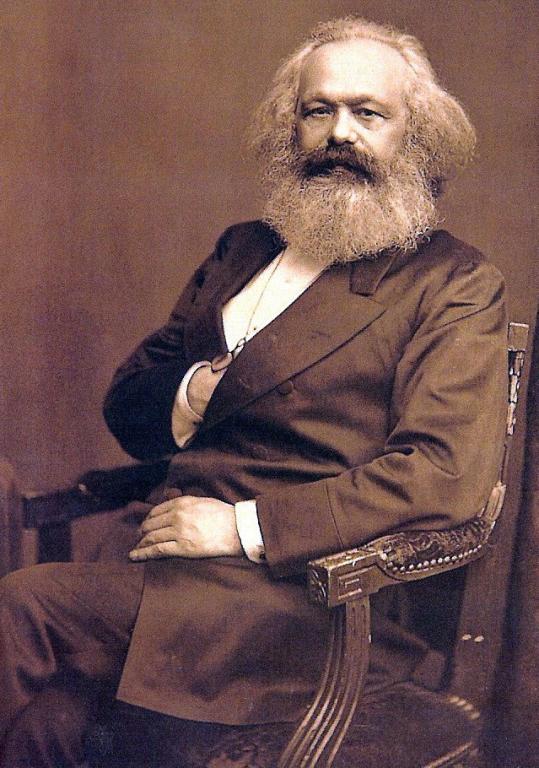
Photo credit: IISH via wikipedia.org / (Public Domain)
In the third volume of Capital, put together and published by Engels in 1894, we find Marx citing M. Luther.
We find the Marx’s lengthy Luther quote in part IV, ch. 20. Reading Marx, I cannot help but think of Proudhon’s “La propriété, c’est le vol!” Luther is cited in the middle of the following sentence:
“Commercial capital, when it holds a dominant position, is thus in all cases a system of plunder, just as its development in the trading peoples of both ancient and modern times is directly bound up with violent plunder, piracy, the taking of slaves and subjugation of colonies….”
This system of plunder, rebuked by Proudhon, Marx, and Christian thinkers throughout the ages, nonetheless finds itself crystalized in “the American way” – both throughout the continent via the expansion of Christendom beginning with C. Columbus and via the United States of America, the Empire of the West.
Here’s what Marx quotes from Luther as he rips capitalism:
“Now there is among merchants much complaint about the nobles, or robbers, because they must trade under great danger and run the risk of being kidnapped, beaten, blackmailed, and robbed. If they would suffer these things for the sake of justice, the merchants would be saintly people…. But since such great wrong and unchristian thievery and robbery are committed all over the world by merchants, and even among themselves, is it any wonder that God should procure that such great wealth, gained by wrong, should again be lost or stolen, and they themselves be hit over the head or made prisoner? … And the princes should punish such unjust bargains with due rigour and take care that their subjects shall not be so outrageously abused by merchants. Because they fail to do so, God employs knights and robbers, and punishes the merchants through them for the wrongs they committed, and uses them as his devils, just as he plagues Egypt and all the world with devils, or destroys through enemies. He thus pits one against the other, without thereby insinuating that knights are any the less robbers than merchants, although the merchants daily rob the whole world, while a knight may rob one or two once or twice a year.” “Go by the word of Isaiah: Thy princes have become the companions of robbers. For they hang the thieves, who have stolen a gulden or a half gulden, but they associate with those, who rob all the world and steal with greater assurance than all others, so that the proverb remains true: Big thieves hang little thieves; and as the Roman senator Cato said: Mean thieves lie in prisons and stocks, but public thieves are clothed in gold and silks. But what will God say finally? He will do as he said to Ezekiel; he will amalgamate princes and merchants, one thief with another, like lead and iron, as when a city burns down, leaving neither princes nor merchants.” (Martin Luther, Von Kaufshandlung und Wucher, 1524, S. 296-97.)
Join Keith Michael Estrada on Facebook …
Of course, St. John Chrysostom – with Ambrose, Basil, etc. – was on top of this over a thousand years prior to Luther. From his Homily XXXVIII on Matt XI, we read:
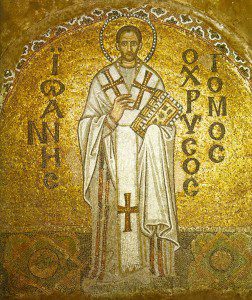
A Byzantine mosaic of John Chrysostom
from the Hagia Sophia. / Public Domain
But that virtue’s yoke is sweet and light, is manifest many other ways also; but to conclude, if you please, let us look also at the burdens of sin. Let us then bring forward the covetous, the retailers and second-hand dealers in shameless bargains. What now could be a heavier burden than such transactions? how many sorrows, how many anxieties, how many disappointments, how many dangers, how many plots and wars, daily spring up from these gains? how many troubles and disturbances? For as one can never see the sea without waves, so neither such a soul without anxiety, and despondency, and fear, and disturbance; yea, the second overtakes the first, and again others come up, and when these are not yet ceased, others come to a head.
Capitalism, as we have said, is not compatible with a way of living that respects the dignity of persons – the Catholic tradition has maintained this for quite a while, and non-Catholics can see this, too.
Many see Francis (the Bishop of Rome and, as a result, Pope) as some radical. This is true in a way people who consider him being a radical wouldn’t understand. What I mean is this: Francis is a radical Catholic insofar as we consider radical to signify (radix) going back to the origin, the essential, the roots of Catholicism, where we find the many great Saints who embodied ortho-praxis, the way of love.
Until next time,
Previous Post

August 1, 2016
Did Francis Blame the West and Capitalism for Terrorism and Violence?



Browse Our Archives
Select a Category Benedict XVI Canada Capital Punishment Capitalism Care for Creation Catholic Committee of Appalachia Catholic News Catholic Social Teaching Catholic Tradition - Art Catholic Worker Catholic Worker Inspirations CST in 140 Characters or Less Diocese of San Diego Faithful Citizenship Father Frank Pavone Chronicles Fathers, Mothers, Saints, and Doctors Francis Guest Posts Gun Violence Humor, Parody, and/or Satire Interfaith Dialogue John Eudes John Paul II Marriage and Family Migration New Evangelization News Not a formal post. Our Lady of Guadalupe Paul VI Popes Pro-Life Racial Justice Releases Religious Freedom Repeat/Repost Saints Socialism Thomas Aquinas Uncategorized
Select a Month March 2020 July 2019 June 2018 May 2018 March 2018 December 2017 October 2017 September 2017 July 2017 June 2017 May 2017 April 2017 March 2017 December 2016 November 2016 October 2016 September 2016 August 2016 July 2016 April 2016 February 2016 January 2016 December 2015
Follow Us!
TAKE THE
Religious Wisdom Quiz
Who did Paul call "my true child in the faith"?
Select your answer to see how you score.
Barnabas Silas James Timothy
Related posts from Proper Nomenclature
Bishop of San Jose: Do not deny sacraments,...
Pope: Death penalty is inadmissible

Pope Francis gave a Laudato si' Ted Talk...
San Diego's New Bishop: Pope appoints Pastor of...
TRENDING AT PATHEOS Catholic

Rejecting Doom: Christian Hope And Human Action
Christianity is a religion of hope. We are to have hope and...

It’s What Comes From Within Which Matters
One of the most difficult things for us to understand is why...

Why I Choose the Eucharist Over the Sermon
Choose the Eucharist, Not the Sermon What are we supposed to get...

5 Design Elements Found in Spiritually Rooted Homes
Putting Spirituality Into Home Decor Our homes are more than our living...

Credo: A Story of God Told with the...
About 10 years ago, I began to imagine a personal "Credo" that...

The Anatomy of Divine Revelation in Catholic Thought
The claim that God has made Himself known to human beings is...
view all Catholic blogs
Ad-Free & Subscriber Log-In Subscription Support
- About Us
- 2026 Calendar
- Videos
- Podcasts
- Library of World Religions
- Faith In Media Tracker
- Advertise With Us
- Write for Us
- Privacy Policy
- Terms of Service
- Do Not Sell My Data
- Contact Us
- Radiant Digital
- Manage Newsletter Subscriptions
- Unsubscribe From Notifications
- Sitemap
Copyright 2008-2026, Patheos. All rights reserved.
Subscription Support Ad-Free & Subscriber Log-In
Follow Patheos