
BuddhistCatholicContemplativeEvangelicalGeneral ChristianHinduJewishLatter-day SaintMuslimNew VisionsProgressive Christian
Beliefs
- Buddhist
- Catholic
- Contemplative
- Evangelical
- General Christian
- Hindu
- Jewish
- Latter-day Saint
- More Voices
- Muslim
- New Visions
- Pagan
- Progressive Christian
Topics
- Religion News
- Food and Religion
- Sports and Religion
- Religious Art
- Religious Music and Entertainment
- Religious Events
- History and Religion
- Style and Religion
- Politics and Religion
- Women in Religion
- Recreation Outdoors and Religion
- Business Finance and Religion
- Careers Workplace and Religion
- Education and Religion
- Family Parenting and Religion
- Health Fitness and Religion
- Home and Religion
- Relationships and Religion
- Technology and Religion
- Travel and Religion
Columnists
- Buddhist Columnists
- Business Finance and Religion Columnists
- Careers Workplace and Religion Columnists
- Catholic Columnists
- Contemplative Columnists
- Education and Religion Columnists
- Evangelists Columnists
- Family Parenting and Religion Columnists
- General Christian Columnists
- Health Fitness and Religion Columnists
- Hindu Columnists
- History and Religion Columnists
- Home and Religion Columnists
- Jewish Columnists
- More Voices Columnists
- Latter Day Columnists
- Muslim Columnists
- New Visions Columnists
- Nonreligious Columnists
- Pagan Columnists
- Politics and Religion Columnists
- Progressive Columnists
- Recreation Outdoors and Religion Columnists
- Relationships and Religion Columnists
- Religion News Columnists
- Religious Art Columnists
- Religious Events Columnists
- Religious Music and Entertainment Columnists
- Sports and Religion Columnists
- Style and Religion Columnists
- Technology and Religion Columnists
- Travel and Religion Columnists
- Women in Religion Columnists
Resource Library
- 2026 Calendar
- Library of World Religions
- The 100 Most Holy Places on Earth
- Patheos Answers
- Podcasts
- Videos
- Faith Leaders Database
- Anglican Episcopalian
- Bahai
- Baptist
- Buddhism
- Christianity
- Confucianism
- Eastern Orthodoxy
- Hinduism
- Holiness and Pentecostal
- ISKCON
- Islam
- Judaism
- Lutheran
- Methodist
- The Church of Jesus Christ of Latter-day Saints
- New Age
- Paganism
- Presbytarian and Reformed
- Protestantism
- Religion Behind the Scenes
- Roman Catholic
- Scientology
- Shia Islam
- Sikhism
- Sufism
- Sunni Islam
- Taoism
- Zen
- See all religions
Research Tools
 Ad-Free & Subscriber Log-In Subscription Support
Ad-Free & Subscriber Log-In Subscription Support
Follow Patheos 

- Trending:
- Forgiveness
- |
- Marriage
- |
- Consciousness
- |
- Death Penalty
- |
- Election
- |
- Halloween
 Proper Nomenclature
- Home
- Catholic
- Subversive Love: Our Lady of Guadalupe
Subversive Love: Our Lady of Guadalupe
Last updated on: December 11, 2017 at 6:38 pm by Keith Michael Estrada
Subversive Love: Our Lady of Guadalupe 2017-12-11T18:38:08-07:00 Keith Michael Estrada
Patheos Explore the world's faith through different perspectives on religion and spirituality! Patheos has the views of the prevalent religions and spiritualities of the world.
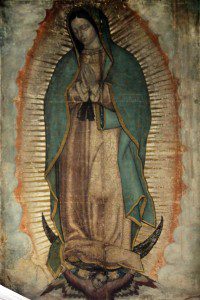
Picture of Our Lady of Guadalupe (also known as the Virgin of Guadalupe) shown in the Basilica of Our Lady of Guadalupe in México City. This image was originally posted to Wikipedia. It is in the public domain.

December 12th marks the anniversary of Maria of Guadalupe’s image miraculously appearing on the tilma of the indian Juan Diego in the year 1531. Her image has remained on Juan Diego’s tilma ever since.
A decade earlier, Hernan Cortes and his conquistadores – along with their disease – would bring about the fall of the Aztec Empire in 1521 – paving the way for continued conquest and domination throughout the region.
The “I-Conquer” of Columbus in 1492, where we can also place the birth of both capitalism as a system and modernity, would eventually be followed by Descartes’ “I-Think”, consistently presenting the bourgeois identity of the european mind, filled with desires for wealth and power and kept busy by concerns for ideas and metaphysics. ¹
By 1521, the encomienda system was already being practiced – as a reward for service to the crown, the system would grant conquistadors the right to demand labor and tribute from the conquered indigenous. Moreover, the conquered people were now the subject of Spanish corporeal and spiritual “care” through this system. This, of course, was a heavily abused system, completely devastating the indigenous way of life – beyond bringing an end to the system of human sacrifice (to some degree) – and fortifying the expansion of Latin Christendom.²
Thus, when the dark Virgin – or, morenita – entered the scene, “America” had seen the blood of many indigenous spilled, sacrificed to new, imposed gods of greed and conquest. Culture, instead of being received with openness and respect, was being destroyed. A distinct Spanish Christendom, not necessarily Christianity, was forced onto various societies. These societies were broken up and again sacrificed to further lusts for wealth and power through the encomienda. The strength of the empire’s weapons and their inability to respect life and the sacred gave birth to the mestizo – the mixed race born of rape, the Spanish and indigenous.
Again, the culture of a civilization destroyed ‘for the sake’ of the Gospel, a people enslaved (or killed) for Spanish consumption, and women – violated, used as mere objects of pleasure – now giving birth to a new race, one that would continue to live in oppression: this is the scene in which the dark Virgin appeared.
Guadalupe – perhaps coming from *Coātlaxopeuh, “*the one who crushes the serpent” – would call out to Juan Diego in an area of Tepeyac where the temple of Tonāntzin – the god known as mother, or mother earth – had recently been destroyed.
Of course, when Guadalupe would call Juan Diego her son, and identify herself as his mother, Tonāntzin came to mind. Of all the places Our Lady could have appeared, she chose a place belonging to the mother of her people, and rightly took her place as mother. Miriam enculturates, and her image on the tilma of Juan Diego allows for enculturation to be preserved, no matter how much strength is exerted to destroy the culture of a people.
The people knew Guadalupe belonged to them. She chose them. She had/has a preferential love for them – the poor, the oppressed, the enslaved, the alienated. She came to Latin-Hispanic Christendom as one of them, as a mestiza – not a Spaniard – decorated with numerous symbols belonging to her conquered children.
With her dark face, she affirmed the dignity and worth of the Indian – over and against the abuses of the europeans. She shared their flesh, elevating them and embracing them.
A woman, a virgin – with child -, and a mestiza: she is the one who would come before europeans and indigenous, identifying herself as empress, as divinized, but also pointing to her Son – the true source of life.
The words of Maria would help the Spaniards realize who she was – but the images on her cloak and dress, as well as her posture, would help the indigenous realize who she was. She was from the home of the gods, but greater than all those to whom sacrifices were offered. She was a virgin – her hair – but with child – the flower and ribbon. Clearly, she was royal – the color of her cloak – yet, she was not the greatest. With her face not facing you directly – as only gods would do so – and her posture demonstrating that her feet were placed in a movement of dance – the way of prayer for the indigenous -, she communicated that there was one above her. Guadalupe – Maria – offered herself to the people in the symbols of the people, preserving them for almost half a millennium.³
She expresses her motherhood to Juan Diego: “I will hear their weeping, their complaints and heal all their sorrows, hardships and sufferings.”
She affirms her power and authority: “Am I not here, I, who am your Mother? Are you not under my shadow and protection? Am I not the source of your joy? Are you not in the hollow of my mantle, in the crossing of my arms? Do you need anything more? Let nothing else worry you, disturb you.”
It is not difficult to imagine why the greatest evangelist was able to bring about the greatest conversion in history, leading to nine million baptisms in seven years.
Truly, this woman embodied the subversion of her Son.
Previous Post

December 2, 2017
Pope Francis on the Trickle Down Fetishes in the GOP Tax Plans
Next Post

March 22, 2018 "Summer in the Forest": L'Arche Demands Love in Every Encounter
Browse Our Archives
Select a Category Benedict XVI Canada Capital Punishment Capitalism Care for Creation Catholic Committee of Appalachia Catholic News Catholic Social Teaching Catholic Tradition - Art Catholic Worker Catholic Worker Inspirations CST in 140 Characters or Less Diocese of San Diego Faithful Citizenship Father Frank Pavone Chronicles Fathers, Mothers, Saints, and Doctors Francis Guest Posts Gun Violence Humor, Parody, and/or Satire Interfaith Dialogue John Eudes John Paul II Marriage and Family Migration New Evangelization News Not a formal post. Our Lady of Guadalupe Paul VI Popes Pro-Life Racial Justice Releases Religious Freedom Repeat/Repost Saints Socialism Thomas Aquinas Uncategorized
Select a Month March 2020 July 2019 June 2018 May 2018 March 2018 December 2017 October 2017 September 2017 July 2017 June 2017 May 2017 April 2017 March 2017 December 2016 November 2016 October 2016 September 2016 August 2016 July 2016 April 2016 February 2016 January 2016 December 2015
Follow Us!
TAKE THE
Religious Wisdom Quiz
What nation took Israel into captivity in 722 BC?
Select your answer to see how you score.
Persia Assyria Babylon Egypt
Related posts from Proper Nomenclature
Pope: Death penalty is inadmissible
A Catholic's Crippling Grief: This Latina's powerful Word...
BREAKING: Diocese of Amarillo Slams Father Frank Pavone...

Breaking: Fr. Frank Pavone defends sacrilege: "The issue...
TRENDING AT PATHEOS Catholic

Rejecting Doom: Christian Hope And Human Action
Christianity is a religion of hope. We are to have hope and...

It’s What Comes From Within Which Matters
One of the most difficult things for us to understand is why...

Why I Choose the Eucharist Over the Sermon
Choose the Eucharist, Not the Sermon What are we supposed to get...

5 Design Elements Found in Spiritually Rooted Homes
Putting Spirituality Into Home Decor Our homes are more than our living...

Credo: A Story of God Told with the...
About 10 years ago, I began to imagine a personal "Credo" that...

The Anatomy of Divine Revelation in Catholic Thought
The claim that God has made Himself known to human beings is...
view all Catholic blogs
Ad-Free & Subscriber Log-In Subscription Support
- About Us
- 2026 Calendar
- Videos
- Podcasts
- Library of World Religions
- Faith In Media Tracker
- Advertise With Us
- Write for Us
- Privacy Policy
- Terms of Service
- Do Not Sell My Data
- Contact Us
- Radiant Digital
- Manage Newsletter Subscriptions
- Unsubscribe From Notifications
- Sitemap
Copyright 2008-2026, Patheos. All rights reserved.
Subscription Support Ad-Free & Subscriber Log-In
Follow Patheos