
BuddhistCatholicContemplativeEvangelicalGeneral ChristianHinduJewishLatter-day SaintMuslimNew VisionsProgressive Christian
Beliefs
- Buddhist
- Catholic
- Contemplative
- Evangelical
- General Christian
- Hindu
- Jewish
- Latter-day Saint
- More Voices
- Muslim
- New Visions
- Pagan
- Progressive Christian
Topics
- Religion News
- Food and Religion
- Sports and Religion
- Religious Art
- Religious Music and Entertainment
- Religious Events
- History and Religion
- Style and Religion
- Politics and Religion
- Women in Religion
- Recreation Outdoors and Religion
- Business Finance and Religion
- Careers Workplace and Religion
- Education and Religion
- Family Parenting and Religion
- Health Fitness and Religion
- Home and Religion
- Relationships and Religion
- Technology and Religion
- Travel and Religion
Columnists
- Buddhist Columnists
- Business Finance and Religion Columnists
- Careers Workplace and Religion Columnists
- Catholic Columnists
- Contemplative Columnists
- Education and Religion Columnists
- Evangelists Columnists
- Family Parenting and Religion Columnists
- General Christian Columnists
- Health Fitness and Religion Columnists
- Hindu Columnists
- History and Religion Columnists
- Home and Religion Columnists
- Jewish Columnists
- More Voices Columnists
- Latter Day Columnists
- Muslim Columnists
- New Visions Columnists
- Nonreligious Columnists
- Pagan Columnists
- Politics and Religion Columnists
- Progressive Columnists
- Recreation Outdoors and Religion Columnists
- Relationships and Religion Columnists
- Religion News Columnists
- Religious Art Columnists
- Religious Events Columnists
- Religious Music and Entertainment Columnists
- Sports and Religion Columnists
- Style and Religion Columnists
- Technology and Religion Columnists
- Travel and Religion Columnists
- Women in Religion Columnists
Resource Library
- 2026 Calendar
- Library of World Religions
- The 100 Most Holy Places on Earth
- Patheos Answers
- Podcasts
- Videos
- Faith Leaders Database
- Anglican Episcopalian
- Bahai
- Baptist
- Buddhism
- Christianity
- Confucianism
- Eastern Orthodoxy
- Hinduism
- Holiness and Pentecostal
- ISKCON
- Islam
- Judaism
- Lutheran
- Methodist
- The Church of Jesus Christ of Latter-day Saints
- New Age
- Paganism
- Presbytarian and Reformed
- Protestantism
- Religion Behind the Scenes
- Roman Catholic
- Scientology
- Shia Islam
- Sikhism
- Sufism
- Sunni Islam
- Taoism
- Zen
- See all religions
Research Tools
 Ad-Free & Subscriber Log-In Subscription Support
Ad-Free & Subscriber Log-In Subscription Support
Follow Patheos 

- Trending:
- Forgiveness
- |
- Marriage
- |
- Consciousness
- |
- Death Penalty
- |
- Election
- |
- Halloween
 Proper Nomenclature
- Home
- Catholic
- Remembering Chaput: Welfare and Taxes are “Prudential Judgments”
Remembering Chaput: Welfare and Taxes are “Prudential Judgments”
Last updated on: January 5, 2016 at 8:53 pm by Keith Michael Estrada
Remembering Chaput: Welfare and Taxes are “Prudential Judgments” 2016-01-05T20:53:39-07:00 Keith Michael Estrada
Patheos Explore the world's faith through different perspectives on religion and spirituality! Patheos has the views of the prevalent religions and spiritualities of the world.
In a 2012 interview for the National Catholic Reporter, John L. Allen, Jr., asked Archbishop Chaput:
We’re speaking on the night Barack Obama is delivering his acceptance speech at the Democratic National Convention. Let me ask flat-out: Do you believe a Catholic in good faith can vote for Obama?
The Archbishop responded:
I can only speak in terms of my own personal views. I certainly can’t vote for somebody who’s either pro-choice or pro-abortion.
I’m not a Republican and I’m not a Democrat. I’m registered as an independent, because I don’t think the church should be identified with one party or another. As an individual and voter I have deep personal concerns about any party that supports changing the definition of marriage, supports abortion in all circumstances, wants to restrict the traditional understanding of religious freedom. Those kinds of issues cause me a great deal of uneasiness.
Allen went further:
What about the wing of the church that says a party that supports the Ryan budget also ought to cause concern?
The Archbishop famously replied:
Jesus tells us very clearly that if we don’t help the poor, we’re going to go to hell. Period. There’s just no doubt about it. That has to be a foundational concern of Catholics and of all Christians. But Jesus didn’t say the government has to take care of them, or that we have to pay taxes to take care of them. Those are prudential judgments. Anybody who would condemn someone because of their position on taxes is making a leap that I can’t make as a Catholic. … You can’t say that somebody’s not Christian because they want to limit taxation. Again, I’m speaking only for myself, but I think that’s a legitimate position. It may not be the correct one, but it’s certainly a legitimate Catholic position; and to say that it’s somehow intrinsically evil like abortion doesn’t make any sense at all.
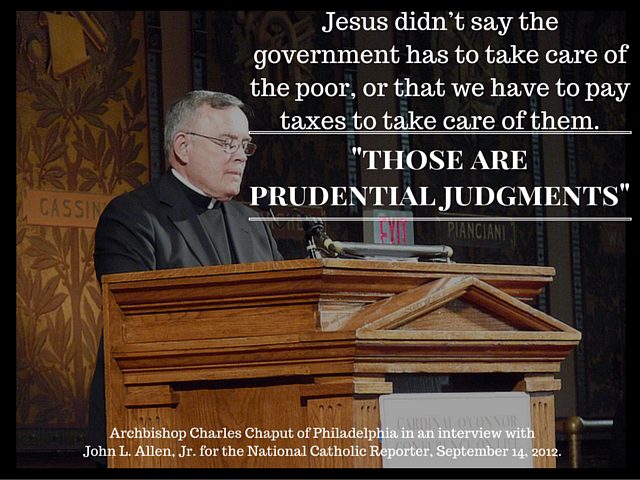
Photo credit: HazteOir.org via Foter.com / CC BY-SA
What does this mean for us, today?
As we enter the primaries for the hunger for power games (presidential election) of 2016, many of our friends on the religious right will be forced to wrestle with our duty to care for the poor as individuals and through our political activity.
I am not sure if what Allen reported was all Chaput said or edited, though it is difficult to extract from his statement something that would seem consistent with what the US Bishops, as a whole, would put forward in their guide, “Forming Consciences for Faithful Citizenship“, recently re-released in updated form last month.
Our difficulty with Chaput’s opinion – or at least as it was expressed – also has to do with its lack of detail and nuance, as well as its ability to distract us from the importance of poverty and other evils by presenting the matter in a way similar to voting guides using select “non-negotiables” for their framework.
Prudential judgment is often misunderstood by Catholics. Sometimes it is taken to mean, do whatever you want about this or that problem. Sometimes it is taken to mean, it’s up to you to determine if it matters or not. Sometimes it is taken to mean, let’s work on that later, it’s less important. None of these are correct understandings of prudential judgment.
Can the state, through taxation, force you to fund programs for the needy? If so, do you have to agree with their doing so?
As the election approaches, we’ll go over these and other questions on “faithful citizenship” and political activity.
Let me know what you’re interested in talking about.
Until next time,
If you have found the content on Keith Michael Estrada’s “Proper Nomenclature” to be useful, kindly consider supporting the cause with a donation.
Use the button below to donate through PayPal:
Thank you!
Previous Post
December 16, 2015
Planned Parenthood Shooter Shouldn't Get Death Penalty
Next Post
December 18, 2015 Trudeau: You Know the Church Apologized, Right?
Browse Our Archives
Select a Category Benedict XVI Canada Capital Punishment Capitalism Care for Creation Catholic Committee of Appalachia Catholic News Catholic Social Teaching Catholic Tradition - Art Catholic Worker Catholic Worker Inspirations CST in 140 Characters or Less Diocese of San Diego Faithful Citizenship Father Frank Pavone Chronicles Fathers, Mothers, Saints, and Doctors Francis Guest Posts Gun Violence Humor, Parody, and/or Satire Interfaith Dialogue John Eudes John Paul II Marriage and Family Migration New Evangelization News Not a formal post. Our Lady of Guadalupe Paul VI Popes Pro-Life Racial Justice Releases Religious Freedom Repeat/Repost Saints Socialism Thomas Aquinas Uncategorized
Select a Month March 2020 July 2019 June 2018 May 2018 March 2018 December 2017 October 2017 September 2017 July 2017 June 2017 May 2017 April 2017 March 2017 December 2016 November 2016 October 2016 September 2016 August 2016 July 2016 April 2016 February 2016 January 2016 December 2015
Follow Us!
TAKE THE
Religious Wisdom Quiz
What does Hebrews say Jesus learned through what he suffered?
Select your answer to see how you score.
Humility Mercy Compassion Obedience
Related posts from Proper Nomenclature

Watch the trauma that comes from family separations...

Franciscan University of Steubenville not recommend; alumni aren't...
Bishop of San Jose: Do not deny sacraments,...
Pope: Death penalty is inadmissible
TRENDING AT PATHEOS Catholic

Rejecting Doom: Christian Hope And Human Action
Christianity is a religion of hope. We are to have hope and...

It’s What Comes From Within Which Matters
One of the most difficult things for us to understand is why...

Why I Choose the Eucharist Over the Sermon
Choose the Eucharist, Not the Sermon What are we supposed to get...

5 Design Elements Found in Spiritually Rooted Homes
Putting Spirituality Into Home Decor Our homes are more than our living...

Credo: A Story of God Told with the...
About 10 years ago, I began to imagine a personal "Credo" that...

The Anatomy of Divine Revelation in Catholic Thought
The claim that God has made Himself known to human beings is...
view all Catholic blogs
Ad-Free & Subscriber Log-In Subscription Support
- About Us
- 2026 Calendar
- Videos
- Podcasts
- Library of World Religions
- Faith In Media Tracker
- Advertise With Us
- Write for Us
- Privacy Policy
- Terms of Service
- Do Not Sell My Data
- Contact Us
- Radiant Digital
- Manage Newsletter Subscriptions
- Unsubscribe From Notifications
- Sitemap
Copyright 2008-2026, Patheos. All rights reserved.
Subscription Support Ad-Free & Subscriber Log-In
Follow Patheos