
BuddhistCatholicContemplativeEvangelicalGeneral ChristianHinduJewishLatter-day SaintMuslimNew VisionsProgressive Christian
Beliefs
- Buddhist
- Catholic
- Contemplative
- Evangelical
- General Christian
- Hindu
- Jewish
- Latter-day Saint
- More Voices
- Muslim
- New Visions
- Pagan
- Progressive Christian
Topics
- Religion News
- Food and Religion
- Sports and Religion
- Religious Art
- Religious Music and Entertainment
- Religious Events
- History and Religion
- Style and Religion
- Politics and Religion
- Women in Religion
- Recreation Outdoors and Religion
- Business Finance and Religion
- Careers Workplace and Religion
- Education and Religion
- Family Parenting and Religion
- Health Fitness and Religion
- Home and Religion
- Relationships and Religion
- Technology and Religion
- Travel and Religion
Columnists
- Buddhist Columnists
- Business Finance and Religion Columnists
- Careers Workplace and Religion Columnists
- Catholic Columnists
- Contemplative Columnists
- Education and Religion Columnists
- Evangelists Columnists
- Family Parenting and Religion Columnists
- General Christian Columnists
- Health Fitness and Religion Columnists
- Hindu Columnists
- History and Religion Columnists
- Home and Religion Columnists
- Jewish Columnists
- More Voices Columnists
- Latter Day Columnists
- Muslim Columnists
- New Visions Columnists
- Nonreligious Columnists
- Pagan Columnists
- Politics and Religion Columnists
- Progressive Columnists
- Recreation Outdoors and Religion Columnists
- Relationships and Religion Columnists
- Religion News Columnists
- Religious Art Columnists
- Religious Events Columnists
- Religious Music and Entertainment Columnists
- Sports and Religion Columnists
- Style and Religion Columnists
- Technology and Religion Columnists
- Travel and Religion Columnists
- Women in Religion Columnists
Resource Library
- 2026 Calendar
- Library of World Religions
- The 100 Most Holy Places on Earth
- Patheos Answers
- Podcasts
- Videos
- Faith Leaders Database
- Anglican Episcopalian
- Bahai
- Baptist
- Buddhism
- Christianity
- Confucianism
- Eastern Orthodoxy
- Hinduism
- Holiness and Pentecostal
- ISKCON
- Islam
- Judaism
- Lutheran
- Methodist
- The Church of Jesus Christ of Latter-day Saints
- New Age
- Paganism
- Presbytarian and Reformed
- Protestantism
- Religion Behind the Scenes
- Roman Catholic
- Scientology
- Shia Islam
- Sikhism
- Sufism
- Sunni Islam
- Taoism
- Zen
- See all religions
Research Tools
 Ad-Free & Subscriber Log-In Subscription Support
Ad-Free & Subscriber Log-In Subscription Support
Follow Patheos 

- Trending:
- Forgiveness
- |
- Marriage
- |
- Consciousness
- |
- Death Penalty
- |
- Election
- |
- Halloween
 Proper Nomenclature
- Home
- Catholic
- Popes Agree: Capitalist Sin Destroys Relationships
Popes Agree: Capitalist Sin Destroys Relationships
Last updated on: July 9, 2017 at 7:10 am by Keith Michael Estrada
Popes Agree: Capitalist Sin Destroys Relationships 2017-07-08T15:49:19-07:00 Keith Michael Estrada
Patheos Explore the world's faith through different perspectives on religion and spirituality! Patheos has the views of the prevalent religions and spiritualities of the world.
This isn’t anything new in Catholic thought. It shouldn’t be a surprise to hear Archbishop Wenski say this for at least three reasons, which are all connected.
1) Archbishop Wenski was discussing Laudato si’, which, consistent with Francis’s teaching since taking on the Petrine ministry (especially as we find in Evangelii Gaudium), leaves no room for any embrace of the “prevailing economic system” (see Evangelii Gaudium, 54) – that is, capitalism. This reading is also consistent as we begin to discuss here.
2) Archbishop Wenski is cool with Pope Benedict XVI and was appointed to Miami by BXVI. The Archbishop wasn’t saying anything that BXVI hadn’t already said, albeit BXVI used less direct terms. For example, in Caritas in Veritate, BXVI placed the economy, the present day economy (2009), within the context of sin and the destruction of relationships, our need for God and one another, etc. (See paragraph 34, quoted in its entirety below.)¹
3) Archbishop Wenski is Catholic. The Catholic tradition makes these connections. An example of how capitalism destroys the family, a very basic and vital relationship, can be found from our former post here. The Archbishop is simply being consistent, not a cafeteria, Catholic.
My dearest friends, Capitalism destroys relationships. This is not to say capitalism is original sin, only that capitalism is one form of sin. This is why we’ve written, in agreement with Cardinal R. Marx, that we should move beyond capitalism. Though, with Cardinal R. Marx, we’re not on shaky territory or uncharted waters; we’re simply identifying with a consistent approach to capitalism.
You’ll remember Francis, Benedict XVI, John Paul II, Paul VI, John XXII, Pius XII², and Pius XI, etc., offered us teachings that would (if embraced) keep capitalism from functioning.
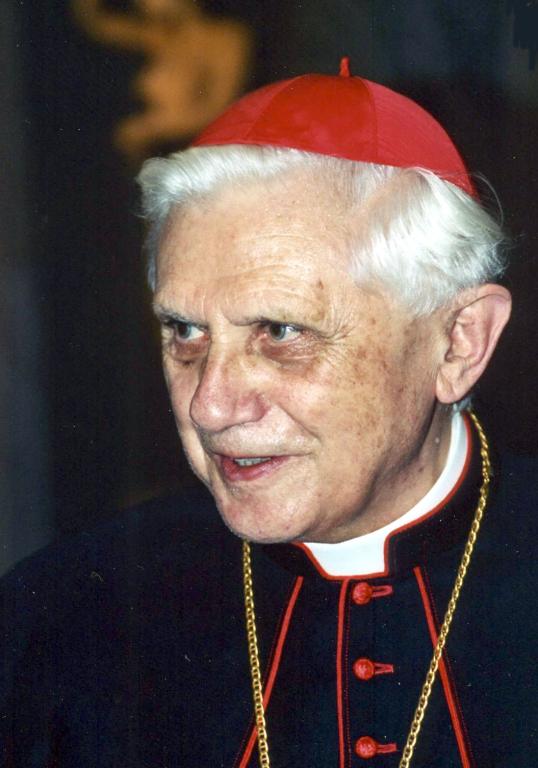
Kardinal Joseph Ratzinger. This image was originally posted to Wikimedia Commons by Manfredo Ferrari at https://en.wikipedia.org/wiki/Theology_of_Pope_Benedict_XVI#/media/File:Joseph_Ratzinger.jpg. It used under the terms of the cc-by-sa-4.0.

To better understand capitalism and the destruction of relationships, we turn to Joseph Ratzinger’s ‘In the Beginning…’: A Catholic Understanding of the Story of Creation and the Fall, translated into English and published in 1990. Ratzinger writes,
Finding an answer to this requires nothing less than trying to understand the human person better. It must once again be stressed that no human being is closed in upon himself or herself and that no one can live of or for himself or herself alone. We receive our life not only at the moment of birth but every day from without — from others who are not ourselves but who nonetheless somehow pertain to us. Human beings have their selves not only in themselves but also outside of themselves: they live in those whom they love and in those who love them and to whom they are “present.” Human beings are relational, and they possess their lives — themselves — only by way of relationship. I alone am not myself, but only in and with you am I myself. To be truly a human being means to be related in love, to be of and for. But [capitalism] means the damaging or the destruction of relationality. [Capitalism] is a rejection of relationality because it wants to make the human being a god. [Capitalism] is loss of relationship, disturbance of relationship, and therefore it is not restricted to the individual. When I destroy a relation- ship, then this event — [capitalism] — touches the other person involved in the relationship. Consequently [capitalism] is always an offense that touches others, that alters the world and damages it. To the extent that this is true, when the network of human relationships is damaged from the very beginning, then every human being enters into a world that is marked by relational damage. At the very moment that a person begins human existence, which is a good, he or she is confronted by a [capitalism]-damaged world. Each of us enters into a situation in which relationality has been hurt. Consequently each person is, from the very start, damaged in relationships and does not engage in them as he or she ought. [Capitalism] pursues the human being, and he or she capitulates to it.
But from this it is also clear that human beings alone cannot save themselves. Their innate error is precisely that they want to do this by themselves. We can only be saved — that is, be free and true — when we stop wanting to be God and when we renounce the madness of autonomy and self-sufficiency. We can only be saved — that is, become ourselves — when we engage in the proper relationship. But our interpersonal relationships occur in the context of our utter creatureliness, and it is there that the damage lies. Since the relationship with creation has been damaged, only the Creator himself can be our savior. We can be saved only when he from whom we have cut ourselves off takes the initiative with us and stretches out his hand to us. Only being loved is being saved, and only God’s love can purify damaged human love and radically reestablish the network of relationships that have suffered from alienation.
Isn’t it interesting, that this sounds very much like Caritas in Veritate and Laudato si’? Of course, I switched out the word “sin” for “capitalism” in the above quote to demonstrate how the entire discussion of capitalism as destructive of relationships is more easily seen when we look at it for what it really is, one manifestation of sin.
(Alienation is in the original text and it carries a very unique weight in this conversation. Consider alienation as it is here, and how Marx would use it in his work – that’s Karl Marx, not Cardinal Marx. Wojtyla/JPII would use it in a similar way.)
If you’re offended by this, see BXVI and Francis, Oscar Romero³, Chesterton, or Dorothy Day, or Romano Guardini⁴ or any other gift (many listed here) to the heritage we call the Catholic social imagination.
¹Paragraph 34 of Caritas in Veritate, by Pope Benedict XVI (2009):
- Charity in truth places man before the astonishing experience of gift. Gratuitousness is present in our lives in many different forms, which often go unrecognized because of a purely consumerist and utilitarian view of life. The human being is made for gift, which expresses and makes present his transcendent dimension. Sometimes modern man is wrongly convinced that he is the sole author of himself, his life and society. This is a presumption that follows from being selfishly closed in upon himself, and it is a consequence — to express it in faith terms — of original sin. The Church’s wisdom has always pointed to the presence of original sin in social conditions and in the structure of society: “Ignorance of the fact that man has a wounded nature inclined to evil gives rise to serious errors in the areas of education, politics, social action and morals”. In the list of areas where the pernicious effects of sin are evident, the economy has been included for some time now. We have a clear proof of this at the present time. The conviction that man is self-sufficient and can successfully eliminate the evil present in history by his own action alone has led him to confuse happiness and salvation with immanent forms of material prosperity and social action. Then, the conviction that the economy must be autonomous, that it must be shielded from “influences” of a moral character, has led man to abuse the economic process in a thoroughly destructive way. In the long term, these convictions have led to economic, social and political systems that trample upon personal and social freedom, and are therefore unable to deliver the justice that they promise. As I said in my Encyclical Letter Spe Salvi, history is thereby deprived of Christian hope, deprived of a powerful social resource at the service of integral human development, sought in freedom and in justice. Hope encourages reason and gives it the strength to direct the will. It is already present in faith, indeed it is called forth by faith. Charity in truth feeds on hope and, at the same time, manifests it. As the absolutely gratuitous gift of God, hope bursts into our lives as something not due to us, something that transcends every law of justice. Gift by its nature goes beyond merit, its rule is that of superabundance. It takes first place in our souls as a sign of God’s presence in us, a sign of what he expects from us. Truth — which is itself gift, in the same way as charity — is greater than we are, as Saint Augustine teaches. Likewise the truth of ourselves, of our personal conscience, is first of all given to us. In every cognitive process, truth is not something that we produce, it is always found, or better, received. Truth, like love, “is neither planned nor willed, but somehow imposes itself upon human beings”.
Because it is a gift received by everyone, charity in truth is a force that builds community, it brings all people together without imposing barriers or limits. The human community that we build by ourselves can never, purely by its own strength, be a fully fraternal community, nor can it overcome every division and become a truly universal community. The unity of the human race, a fraternal communion transcending every barrier, is called into being by the word of God-who-is-Love. In addressing this key question, we must make it clear, on the one hand, that the logic of gift does not exclude justice, nor does it merely sit alongside it as a second element added from without; on the other hand, economic, social and political development, if it is to be authentically human, needs to make room for the principle of gratuitousness as an expression of fraternity.
² Consider these words of Pius XII:
Pero otros se muestran no menos temerosos e inciertos ante aquel sistema económico que se llama capitalismo; cuyas graves consecuencias la Iglesia repetidas veces ha denunciado claramente. La Iglesia, en efecto, ha indicado no sólo los abusos del capital y del exagerado derecho de propiedad que semejante sistema promueve y defiende, sino que ha enseñado también que el capital y la propiedad han de ser instrumentos adecuados de la producción en beneficio así de toda la sociedad como del sostenimiento y defensa de la libertad y dignidad humanas. – Pius XII, 1950.
Poichè questi erronei principi sono all’opera! — Quante volte Noi abbiamo affermato e spiegato l’amore della Chiesa verso gli operai! Eppure si propaga largamente l’atroce calunnia che « la Chiesa è alleata del capitalismo contro i lavoratori »! – Pius XII, 1955.
³ Oscar Romero was no friend of capitalism. He wrote, “There is an “atheism” that is closer at hand and more dangerous to our church. It is the atheism of capitalism, in which material possessions are set up as idols and take God’s place.”
⁴ I would consider starting your Guardini investigations with Letters from Lake Como: Explorations in Technology and the Human Race.
*This post was originally published on December 8, 2015*
Previous Post
June 30, 2017
Bishop of San Jose: Do not deny sacraments, burial sought in good faith
Next Post

July 12, 2017 Graphic video of San Diego Police K9 bite is concerning.
Browse Our Archives
Select a Category Benedict XVI Canada Capital Punishment Capitalism Care for Creation Catholic Committee of Appalachia Catholic News Catholic Social Teaching Catholic Tradition - Art Catholic Worker Catholic Worker Inspirations CST in 140 Characters or Less Diocese of San Diego Faithful Citizenship Father Frank Pavone Chronicles Fathers, Mothers, Saints, and Doctors Francis Guest Posts Gun Violence Humor, Parody, and/or Satire Interfaith Dialogue John Eudes John Paul II Marriage and Family Migration New Evangelization News Not a formal post. Our Lady of Guadalupe Paul VI Popes Pro-Life Racial Justice Releases Religious Freedom Repeat/Repost Saints Socialism Thomas Aquinas Uncategorized
Select a Month March 2020 July 2019 June 2018 May 2018 March 2018 December 2017 October 2017 September 2017 July 2017 June 2017 May 2017 April 2017 March 2017 December 2016 November 2016 October 2016 September 2016 August 2016 July 2016 April 2016 February 2016 January 2016 December 2015
Follow Us!
TAKE THE
Religious Wisdom Quiz
What does Paul tell Timothy to fan into flame?
Select your answer to see how you score.
The gift of God The Holy Spirit His faith His zeal
Related posts from Proper Nomenclature

Franciscan University of Steubenville not recommend; alumni aren't...
Bishop of San Jose: Do not deny sacraments,...
Pope: Death penalty is inadmissible
Pope Francis gave a Laudato si' Ted Talk...
TRENDING AT PATHEOS Catholic

Rejecting Doom: Christian Hope And Human Action
Christianity is a religion of hope. We are to have hope and...

It’s What Comes From Within Which Matters
One of the most difficult things for us to understand is why...

Why I Choose the Eucharist Over the Sermon
Choose the Eucharist, Not the Sermon What are we supposed to get...

5 Design Elements Found in Spiritually Rooted Homes
Putting Spirituality Into Home Decor Our homes are more than our living...

Credo: A Story of God Told with the...
About 10 years ago, I began to imagine a personal "Credo" that...

The Anatomy of Divine Revelation in Catholic Thought
The claim that God has made Himself known to human beings is...
view all Catholic blogs
Ad-Free & Subscriber Log-In Subscription Support
- About Us
- 2026 Calendar
- Videos
- Podcasts
- Library of World Religions
- Faith In Media Tracker
- Advertise With Us
- Write for Us
- Privacy Policy
- Terms of Service
- Do Not Sell My Data
- Contact Us
- Radiant Digital
- Manage Newsletter Subscriptions
- Unsubscribe From Notifications
- Sitemap
Copyright 2008-2026, Patheos. All rights reserved.
Subscription Support Ad-Free & Subscriber Log-In
Follow Patheos