
BuddhistCatholicContemplativeEvangelicalGeneral ChristianHinduJewishLatter-day SaintMuslimNew VisionsProgressive Christian
Beliefs
- Buddhist
- Catholic
- Contemplative
- Evangelical
- General Christian
- Hindu
- Jewish
- Latter-day Saint
- More Voices
- Muslim
- New Visions
- Pagan
- Progressive Christian
Topics
- Religion News
- Food and Religion
- Sports and Religion
- Religious Art
- Religious Music and Entertainment
- Religious Events
- History and Religion
- Style and Religion
- Politics and Religion
- Women in Religion
- Recreation Outdoors and Religion
- Business Finance and Religion
- Careers Workplace and Religion
- Education and Religion
- Family Parenting and Religion
- Health Fitness and Religion
- Home and Religion
- Relationships and Religion
- Technology and Religion
- Travel and Religion
Columnists
- Buddhist Columnists
- Business Finance and Religion Columnists
- Careers Workplace and Religion Columnists
- Catholic Columnists
- Contemplative Columnists
- Education and Religion Columnists
- Evangelists Columnists
- Family Parenting and Religion Columnists
- General Christian Columnists
- Health Fitness and Religion Columnists
- Hindu Columnists
- History and Religion Columnists
- Home and Religion Columnists
- Jewish Columnists
- More Voices Columnists
- Latter Day Columnists
- Muslim Columnists
- New Visions Columnists
- Nonreligious Columnists
- Pagan Columnists
- Politics and Religion Columnists
- Progressive Columnists
- Recreation Outdoors and Religion Columnists
- Relationships and Religion Columnists
- Religion News Columnists
- Religious Art Columnists
- Religious Events Columnists
- Religious Music and Entertainment Columnists
- Sports and Religion Columnists
- Style and Religion Columnists
- Technology and Religion Columnists
- Travel and Religion Columnists
- Women in Religion Columnists
Resource Library
- 2026 Calendar
- Library of World Religions
- The 100 Most Holy Places on Earth
- Patheos Answers
- Podcasts
- Videos
- Faith Leaders Database
- Anglican Episcopalian
- Bahai
- Baptist
- Buddhism
- Christianity
- Confucianism
- Eastern Orthodoxy
- Hinduism
- Holiness and Pentecostal
- ISKCON
- Islam
- Judaism
- Lutheran
- Methodist
- The Church of Jesus Christ of Latter-day Saints
- New Age
- Paganism
- Presbytarian and Reformed
- Protestantism
- Religion Behind the Scenes
- Roman Catholic
- Scientology
- Shia Islam
- Sikhism
- Sufism
- Sunni Islam
- Taoism
- Zen
- See all religions
Research Tools
 Ad-Free & Subscriber Log-In Subscription Support
Ad-Free & Subscriber Log-In Subscription Support
Follow Patheos 

- Trending:
- Forgiveness
- |
- Marriage
- |
- Consciousness
- |
- Death Penalty
- |
- Election
- |
- Halloween
 Proper Nomenclature
- Home
- Catholic
- Laudato si’ Invites You: An Economy Beyond Capitalism
Laudato si’ Invites You: An Economy Beyond Capitalism
Last updated on: January 5, 2016 at 8:39 pm by Keith Michael Estrada
Laudato si’ Invites You: An Economy Beyond Capitalism 2016-01-05T20:39:06-07:00 Keith Michael Estrada
Patheos Explore the world's faith through different perspectives on religion and spirituality! Patheos has the views of the prevalent religions and spiritualities of the world.
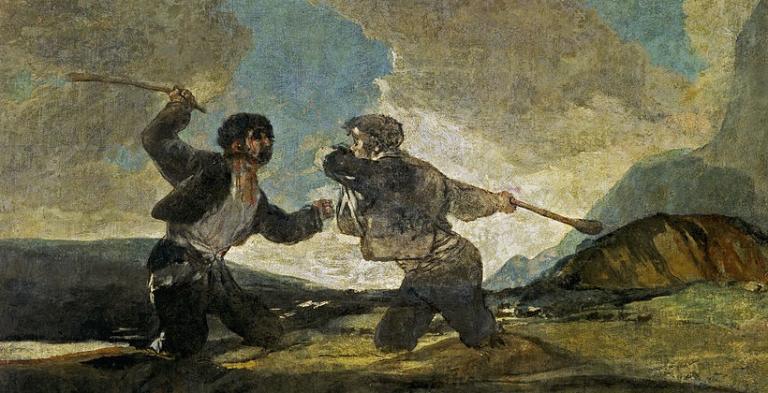
Dying in a global economy: Competitors sinking in quicksand as a volcano is about to go off (Francisco Goya, Fight with Cudgels, 1823; Source: Wikimedia Commons, PD-Old-100).
A group within a people has no claim to being favored in the distribution of goods and honors because it produces a large quantity of useful consumer goods.
– Max Scheler, Ressentiment
The world received Laudato si’ this year and, as a result, has a lot to consider. The 190-pages of Francis’ second encyclical demands a universal examination of conscience and begs a critical re-thinking of our ways of living and the social structures we have in place.
Reading the encyclical is, I think, a necessary venture for those who can access it and have the time. By “have the time” I mean to reference the many men and women, Catholics and non-Catholics alike, who really do not seem to have the time. Overworked, underpaid, undernourished, on the cusp of total exclusion from society, these people must receive the good news of the encyclical by the positive change that comes from those of us who read it.
It is crucial to understand the encyclical as it is written. Reading commentaries or quick news bits that include a few quotes and mesh it together either with an ideological attack or an ideological defense, whether left or right, typically seems to reinforce and rationalize a comfortable embrace of various brands of cafeteria Catholicism, for some, and à la carte reasoning, for others. In other words, Laudato points out and rebukes various brands of the same relativism in today’s society.
Here are some of the themes we can rationally extract from Laudato: a consistent ethic of life; an urgent transition to renewable energy; cooperation and dialogue; property, the means of production, and (an appropriate understanding of) subsidiarity; technology, power, and consumerism; the continuity of Laudato within the papal magisterium, the magisterium in general, the lives of the saints, the scriptures, and natural law; changes in lifestyle; the relationship between politics and the economy; the social and ecological problem as indistinguishable; inconsistencies found in leftist and rightist ideology; the ecological problem, in general; the intrinsic value of all creation; needs of the poor and the planet; the universal super-religious call to action; the value of religion; the new evangelization; and the prevailing economic order.
The encyclical also contains an underlying message that challenges us socially, politically, culturally, and economically: everything is connected. I mentioned that themes above were extracted only rationally to provide some distinction; but the distinction is not as real as some would believe. Everything is connected. This is difficult to grasp for many in Europe and North America. Our desire to compartmentalize and hyper-specialize areas of life has been an obstacle to true progress. However, in order to present Laudato in a way that expresses its message and, at the same time, enters into conversation with it, I would like to present the encyclical in relation one of themes mentioned above. This is a lengthy task. It is also a complicated task as this will require plenty of overlap, lest we fail to connect the dots and show how everything is connected. Therefore I will go over some of what Francis has to say on the prevailing economic order and consider the realistic possibility that the Holy Father has laid out an argument in favor of moving beyond capitalism.

Browse Our Archives
Select a Category Benedict XVI Canada Capital Punishment Capitalism Care for Creation Catholic Committee of Appalachia Catholic News Catholic Social Teaching Catholic Tradition - Art Catholic Worker Catholic Worker Inspirations CST in 140 Characters or Less Diocese of San Diego Faithful Citizenship Father Frank Pavone Chronicles Fathers, Mothers, Saints, and Doctors Francis Guest Posts Gun Violence Humor, Parody, and/or Satire Interfaith Dialogue John Eudes John Paul II Marriage and Family Migration New Evangelization News Not a formal post. Our Lady of Guadalupe Paul VI Popes Pro-Life Racial Justice Releases Religious Freedom Repeat/Repost Saints Socialism Thomas Aquinas Uncategorized
Select a Month March 2020 July 2019 June 2018 May 2018 March 2018 December 2017 October 2017 September 2017 July 2017 June 2017 May 2017 April 2017 March 2017 December 2016 November 2016 October 2016 September 2016 August 2016 July 2016 April 2016 February 2016 January 2016 December 2015
Follow Us!
TAKE THE
Religious Wisdom Quiz
Why was it scandalous for the woman to anoint Jesus' feet with tears?
Select your answer to see how you score.
She was foreign She was a child She was a known sinner She was wealthy
Related posts from Proper Nomenclature
Franciscan University of Steubenville not recommend; alumni aren't...
Bishop of San Jose: Do not deny sacraments,...
Pope: Death penalty is inadmissible
Pope Francis gave a Laudato si' Ted Talk...
TRENDING AT PATHEOS Catholic

Rejecting Doom: Christian Hope And Human Action
Christianity is a religion of hope. We are to have hope and...

It’s What Comes From Within Which Matters
One of the most difficult things for us to understand is why...

Why I Choose the Eucharist Over the Sermon
Choose the Eucharist, Not the Sermon What are we supposed to get...

5 Design Elements Found in Spiritually Rooted Homes
Putting Spirituality Into Home Decor Our homes are more than our living...

Credo: A Story of God Told with the...
About 10 years ago, I began to imagine a personal "Credo" that...

The Anatomy of Divine Revelation in Catholic Thought
The claim that God has made Himself known to human beings is...
view all Catholic blogs
Ad-Free & Subscriber Log-In Subscription Support
- About Us
- 2026 Calendar
- Videos
- Podcasts
- Library of World Religions
- Faith In Media Tracker
- Advertise With Us
- Write for Us
- Privacy Policy
- Terms of Service
- Do Not Sell My Data
- Contact Us
- Radiant Digital
- Manage Newsletter Subscriptions
- Unsubscribe From Notifications
- Sitemap
Copyright 2008-2026, Patheos. All rights reserved.
Subscription Support Ad-Free & Subscriber Log-In
Follow Patheos