
BuddhistCatholicContemplativeEvangelicalGeneral ChristianHinduJewishLatter-day SaintMuslimNew VisionsProgressive Christian
Beliefs
- Buddhist
- Catholic
- Contemplative
- Evangelical
- General Christian
- Hindu
- Jewish
- Latter-day Saint
- More Voices
- Muslim
- New Visions
- Pagan
- Progressive Christian
Topics
- Religion News
- Food and Religion
- Sports and Religion
- Religious Art
- Religious Music and Entertainment
- Religious Events
- History and Religion
- Style and Religion
- Politics and Religion
- Women in Religion
- Recreation Outdoors and Religion
- Business Finance and Religion
- Careers Workplace and Religion
- Education and Religion
- Family Parenting and Religion
- Health Fitness and Religion
- Home and Religion
- Relationships and Religion
- Technology and Religion
- Travel and Religion
Columnists
- Buddhist Columnists
- Business Finance and Religion Columnists
- Careers Workplace and Religion Columnists
- Catholic Columnists
- Contemplative Columnists
- Education and Religion Columnists
- Evangelists Columnists
- Family Parenting and Religion Columnists
- General Christian Columnists
- Health Fitness and Religion Columnists
- Hindu Columnists
- History and Religion Columnists
- Home and Religion Columnists
- Jewish Columnists
- More Voices Columnists
- Latter Day Columnists
- Muslim Columnists
- New Visions Columnists
- Nonreligious Columnists
- Pagan Columnists
- Politics and Religion Columnists
- Progressive Columnists
- Recreation Outdoors and Religion Columnists
- Relationships and Religion Columnists
- Religion News Columnists
- Religious Art Columnists
- Religious Events Columnists
- Religious Music and Entertainment Columnists
- Sports and Religion Columnists
- Style and Religion Columnists
- Technology and Religion Columnists
- Travel and Religion Columnists
- Women in Religion Columnists
Resource Library
- 2026 Calendar
- Library of World Religions
- The 100 Most Holy Places on Earth
- Patheos Answers
- Podcasts
- Videos
- Faith Leaders Database
- Anglican Episcopalian
- Bahai
- Baptist
- Buddhism
- Christianity
- Confucianism
- Eastern Orthodoxy
- Hinduism
- Holiness and Pentecostal
- ISKCON
- Islam
- Judaism
- Lutheran
- Methodist
- The Church of Jesus Christ of Latter-day Saints
- New Age
- Paganism
- Presbytarian and Reformed
- Protestantism
- Religion Behind the Scenes
- Roman Catholic
- Scientology
- Shia Islam
- Sikhism
- Sufism
- Sunni Islam
- Taoism
- Zen
- See all religions
Research Tools
 Ad-Free & Subscriber Log-In Subscription Support
Ad-Free & Subscriber Log-In Subscription Support
Follow Patheos 

- Trending:
- Forgiveness
- |
- Marriage
- |
- Consciousness
- |
- Death Penalty
- |
- Election
- |
- Halloween
 Proper Nomenclature
- Home
- Catholic
- CST in 140 Characters or Less: Heinrich Pesch on Capitalism
CST in 140 Characters or Less: Heinrich Pesch on Capitalism
Last updated on: January 11, 2016 at 7:30 am by Keith Michael Estrada
CST in 140 Characters or Less: Heinrich Pesch on Capitalism 2016-01-10T20:44:57-07:00 Keith Michael Estrada
Patheos Explore the world's faith through different perspectives on religion and spirituality! Patheos has the views of the prevalent religions and spiritualities of the world.
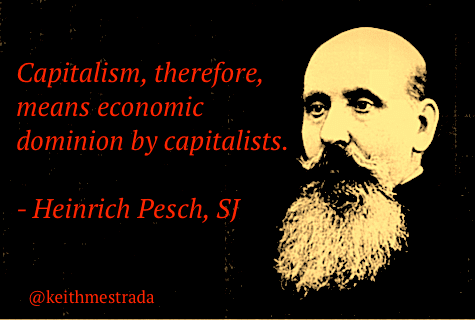
“Capitalists are usurers in the broadest sense of the word.”*
Heinrich Pesch, SJ (1854-1926)
58 characters [Tweet this]

A German Jesuit Priest who was influenced by Leo XIII’s Rerum Novarum, Heinrich Pesch, SJ, would become a towering figure in Catholic economic thought with his work on Solidarism – an alternative to the individualism (capitalism) and collectivism of his time. Although Pesch would reject the particular socialism of his day – much like Leo XIII – he managed to make a list of persons advocating various pseudo-socialisms in Ludwig von Mises‘ Socialism (first published in 1922). Along with being championed and cited by some Distributists to this day, Pesch is thought to have profoundly influenced Pius XI’s encyclical Quadragesimo anon.
Pesch’s quotes above come from his Ethics and the National Economy, written towards the end of World War I. The introduction to the text is in itself worth reading. One of my favorite lines in the IHS Press directors’ forward, drawing from the spirit of Pesch, reads “There can be no doubt that the ancient and venerable Mass built western civilization; there is no less doubt that Capitalism, along with Modernism, is destroying it.” [Tweet this]
Here are several, powerful excerpts from his book that I’ll leave you with; we’re providing quite a bit as it all very well summarizes capitalism as a structure of relations with value/vice preferences and its hostility to Christian ethics.
If Christianity condemns the injustices and lack of charity found in the conduct of business so harshly, along with the inordinate grasping for property and possessions which completely loses sight of our eternal destiny, and the greed and restless and unscrupulous craving to accumulate money, and also the capitalistic spirit of Mammon, the desire for pleasure, the callousness in administering and using earthly possessions; and if, on the other hand, it looks with praise on certain individuals who assume actual voluntary poverty because they have a special calling from God to religious life, all of this does not mean that Christian morality stands in the way of a moderate and well-ordered striving to increase one’s wealth so long as there is due regard for Christian conduct in conformity with justice and charity.
Therefore a person who operates his business in total disregard for the dictates of morality and the general welfare, who no longer listens to the voice of his conscience, and who endangers his immortal soul for the sake of business profits deserves to be punished. In other words, what I have previously referred to as the reckless and unrestricted pursuit of gain has always been condemned by all Catholic moral teachers. These have given expression to the idea which prevailed until the beginnings of the capitalist era and which, incidentally, did not rule out any and all kinds of windfall profit. What the Church’s moral teaching sought to prevent and what it actually helped to prevent was the kind of inversion of all human values which did in fact occur only in our times. So much for Sombart. In his view, the “early capitalistic era” had not yet divorced itself completely from the influence of Christian ethics. That is, however, definitely the case in what we now refer to as “capitalism” and the “capitalistic spirit.” Thus, we have to reject any notion that Christian moral teaching actually fostered “capitalism” when that is understood as embodying the “capitalistic spirit”; and in terms of the “inversion of all human values” which has occurred in our time, we may regard it as totally false.
The capitalistic entrepreneur opposes any restraints and limitations on his activities. When he calls for economic freedom for all, he does so only because otherwise he cannot expect economic freedom for himself. He feels that he is strong enough to do battle with his rivals in the market place, and for those who are definitely weaker than he, he proposes free competition. [Tweet this]
Capital is either a small or a large quantity of goods which serves the purpose of accumulating profit. Capitalists are usurers in the broadest sense of the word. We understand usury in the same sense as Franz Schaub does, as any contractual expropriation of what is clearly surplus value. So, in our time, we use the word capitalism to mean a social system where usury operates with more or less complete freedom. The concept, capitalism, signifies a quest for gain that is totally uninhibited. Capitalism, therefore, means economic dominion by capitalists and it must be understood as a historic category.
By contrast, in the older Christian view of things, personal labor was the principal means of earning income, whereas in the capitalist era it is the ownership of material wealth or of money; in other words, capital. For that reason, the bitter antagonism between the “capitalist” and the worker is also “an essentially capitalistic phenomenon.”
Now we find, even in the capitalistic era, outstanding and thoroughly fair-minded entrepreneurs who strive to go ahead solely on the basis of their efficiency and the value of their services. However, what predominates is the chrematistic, materialistic preoccupation of the profit-seeking businessman. That, by and large, is the normal state of affairs in capitalistic economic life. National economic concerns take a back seat to private economic considerations.
Until next time,
If you have found the content on Keith Michael Estrada’s “Proper Nomenclature” to be useful, kindly consider supporting the cause with a donation.
Use the button below to donate through PayPal:

Thank you!
Catholic Social Teaching (CST) in 140 Characters or Less is an attempt to provide short bits from within our Catholic moral and social tradition to an audience subject to the tendencies of consumerism and immediate gratification. When possible, and please remind me if I forget, I will include a fuller portion of the quote provided for additional context, and may add a line or two of comment.
Certainly, we can learn much from short statements, but we must see things from within the whole of our faith tradition. This reminds me of what Henri de Lubac wrote in The Discovery of God, concerning Saint Augustine’s dilige et quod vis fac, that this exhortation is proper and may be embraced without error “if you love enough to act, in every circumstance, according to the dictates of love.” De Lubac continues, “One might also say ‘love and believe what you will’ – if you know how to extract all the light from love, whose source is not in you.” Therefore, start with and share small pieces if you prefer, but orient yourself towards learning the whole.
Read what different teachers of the faith have had to say on the Gospel’s demand for justice. See what/who inspired the Catholic Worker Movement, read the Compendium of the Social Doctrine of the Church, read whole documents and the many writers who contributed to this treasure.
For every CST in 140 Characters or Less post, I’ll have a Tweet button available for you to click if you want to share a Tweetable version of the post’s quote. Give it a try!

Next Post
January 14, 2016 John Paul II: If You Want Priestly Vocations, Reject Capitalism
Browse Our Archives
Select a Category Benedict XVI Canada Capital Punishment Capitalism Care for Creation Catholic Committee of Appalachia Catholic News Catholic Social Teaching Catholic Tradition - Art Catholic Worker Catholic Worker Inspirations CST in 140 Characters or Less Diocese of San Diego Faithful Citizenship Father Frank Pavone Chronicles Fathers, Mothers, Saints, and Doctors Francis Guest Posts Gun Violence Humor, Parody, and/or Satire Interfaith Dialogue John Eudes John Paul II Marriage and Family Migration New Evangelization News Not a formal post. Our Lady of Guadalupe Paul VI Popes Pro-Life Racial Justice Releases Religious Freedom Repeat/Repost Saints Socialism Thomas Aquinas Uncategorized
Select a Month March 2020 July 2019 June 2018 May 2018 March 2018 December 2017 October 2017 September 2017 July 2017 June 2017 May 2017 April 2017 March 2017 December 2016 November 2016 October 2016 September 2016 August 2016 July 2016 April 2016 February 2016 January 2016 December 2015
Follow Us!
TAKE THE
Religious Wisdom Quiz
How many Beatitudes are in the Sermon on the Mount?
Select your answer to see how you score.
7 8 12 10
Related posts from Proper Nomenclature

Franciscan University of Steubenville not recommend; alumni aren't...

Bishop of San Jose: Do not deny sacraments,...

Pope: Death penalty is inadmissible

Pope Francis gave a Laudato si' Ted Talk...
TRENDING AT PATHEOS Catholic

The Parable Of The Sower And The Word...
One of Christ’s most famous parables is that of the sower who...

Rejecting Doom: Christian Hope And Human Action
Christianity is a religion of hope. We are to have hope and...

Why I Choose the Eucharist Over the Sermon
Choose the Eucharist, Not the Sermon What are we supposed to get...

5 Design Elements Found in Spiritually Rooted Homes
Putting Spirituality Into Home Decor Our homes are more than our living...

Credo: A Story of God Told with the...
About 10 years ago, I began to imagine a personal "Credo" that...

The Anatomy of Divine Revelation in Catholic Thought
The claim that God has made Himself known to human beings is...
view all Catholic blogs
Ad-Free & Subscriber Log-In Subscription Support
- About Us
- 2026 Calendar
- Videos
- Podcasts
- Library of World Religions
- Faith In Media Tracker
- Advertise With Us
- Write for Us
- Privacy Policy
- Terms of Service
- Do Not Sell My Data
- Contact Us
- Radiant Digital
- Manage Newsletter Subscriptions
- Unsubscribe From Notifications
- Sitemap
Copyright 2008-2026, Patheos. All rights reserved.
Subscription Support Ad-Free & Subscriber Log-In
Follow Patheos