
BuddhistCatholicContemplativeEvangelicalGeneral ChristianHinduJewishLatter-day SaintMuslimNew VisionsProgressive Christian
Beliefs
- Buddhist
- Catholic
- Contemplative
- Evangelical
- General Christian
- Hindu
- Jewish
- Latter-day Saint
- More Voices
- Muslim
- New Visions
- Pagan
- Progressive Christian
Topics
- Religion News
- Food and Religion
- Sports and Religion
- Religious Art
- Religious Music and Entertainment
- Religious Events
- History and Religion
- Style and Religion
- Politics and Religion
- Women in Religion
- Recreation Outdoors and Religion
- Business Finance and Religion
- Careers Workplace and Religion
- Education and Religion
- Family Parenting and Religion
- Health Fitness and Religion
- Home and Religion
- Relationships and Religion
- Technology and Religion
- Travel and Religion
Columnists
- Buddhist Columnists
- Business Finance and Religion Columnists
- Careers Workplace and Religion Columnists
- Catholic Columnists
- Contemplative Columnists
- Education and Religion Columnists
- Evangelists Columnists
- Family Parenting and Religion Columnists
- General Christian Columnists
- Health Fitness and Religion Columnists
- Hindu Columnists
- History and Religion Columnists
- Home and Religion Columnists
- Jewish Columnists
- More Voices Columnists
- Latter Day Columnists
- Muslim Columnists
- New Visions Columnists
- Nonreligious Columnists
- Pagan Columnists
- Politics and Religion Columnists
- Progressive Columnists
- Recreation Outdoors and Religion Columnists
- Relationships and Religion Columnists
- Religion News Columnists
- Religious Art Columnists
- Religious Events Columnists
- Religious Music and Entertainment Columnists
- Sports and Religion Columnists
- Style and Religion Columnists
- Technology and Religion Columnists
- Travel and Religion Columnists
- Women in Religion Columnists
Resource Library
- 2026 Calendar
- Library of World Religions
- The 100 Most Holy Places on Earth
- Patheos Answers
- Podcasts
- Videos
- Faith Leaders Database
- Anglican Episcopalian
- Bahai
- Baptist
- Buddhism
- Christianity
- Confucianism
- Eastern Orthodoxy
- Hinduism
- Holiness and Pentecostal
- ISKCON
- Islam
- Judaism
- Lutheran
- Methodist
- The Church of Jesus Christ of Latter-day Saints
- New Age
- Paganism
- Presbytarian and Reformed
- Protestantism
- Religion Behind the Scenes
- Roman Catholic
- Scientology
- Shia Islam
- Sikhism
- Sufism
- Sunni Islam
- Taoism
- Zen
- See all religions
Research Tools
 Ad-Free & Subscriber Log-In Subscription Support
Ad-Free & Subscriber Log-In Subscription Support
Follow Patheos 

- Trending:
- Forgiveness
- |
- Marriage
- |
- Consciousness
- |
- Death Penalty
- |
- Election
- |
- Halloween
 Proper Nomenclature
- Home
- Catholic
- Catholic Worker Inspirations: Jean Vanier (Part 1 – with a video)
Catholic Worker Inspirations: Jean Vanier (Part 1 – with a video)
Last updated on: January 5, 2016 at 8:32 pm by Keith Michael Estrada
Catholic Worker Inspirations: Jean Vanier (Part 1 – with a video) 2016-01-05T20:32:33-07:00 Keith Michael Estrada
Patheos Explore the world's faith through different perspectives on religion and spirituality! Patheos has the views of the prevalent religions and spiritualities of the world.
Jean Vanier (1928-) is the founder of L’Arche, an”International Federation dedicated to the creation and growth of homes, programs, and support networks with people who have intellectual disabilities.”
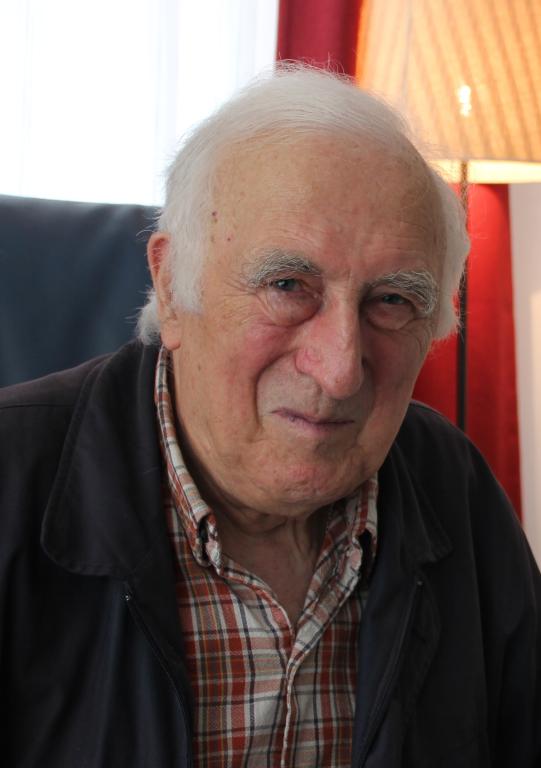
Photo credit: Kotukaran via CC BY-SA 3.0
Vanier is the author of numerous texts and a magnificent servant of the Gospel.
In 1964, Vanier invited two men with intellectual disabilities to live with him in community after he witnessed the disgraceful manner in which they lived by being institutionalized in Paris, France. He’s a Canadian and a philosopher, and was invited by Pope Saint John Paul II to participate in the Synod on the Laity of 1987 in Rome.
Within five years of starting L’Arche, Dorothy Day took notice of Vanier. In a December 1969 issue of The Catholic Worker, Day mentions then quotes Vanier:
So many of the little ones are left to die in mental hospitals, the only other place where they can be put. As Jean Vanier, son of the former Governor General of Canada wrote in the Jesus Caritas Bulletin, “These little ones are good for two things, they can be loved, and they can love. These innocents! Sinless and suffering, a mystery, not ‘vegetables’ but little human beings, capable of loving, and evoking love!”
Similarly, in a February 1972 issue she wrote:
I went through that hospital and thanked God that here the crippled and retarded, hydrocephalic and idiot had the kindness of the c.o.’s and the gentleness which reflected their respect for life.
Jean Vanier, son of a former governor general of Canada, has started several “villages” for the retarded, and he wrote once that there were two great contributions which these most unfortunate of “little ones” could make – that was, to love and to be loved, and so increase the sum total of love in the world.
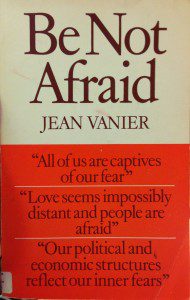
Be Not Afraid (1975) by Jean Vanier.
Many of our troubles have to do with the fact that, instead of loving the other, we’re afraid of the other. We build walls that prevent us from being vulnerable, from being human, from loving.
In his 1975 text, Be Not Afraid, Jean Vanier wrote powerfully of our need to recognize the beauty of the other and to bring down the walls of the ego.
Competition and greed would have us see others as enemies, threats.
We would build up walls with possessions to shut out the other, in order to make sure we would not have to acknowledge their dignity – we would embrace false symbols of “status” and “power” to degrade the poor and the weak. Doing so, however, prevents us from loving and serving according to the demands of not just our faith, but of our humanity. This is why, instead of loving the other, we exclude or discard them. The other becomes our enemy when we see their face, because we are challenged to put their good above our comfort.
This is why if we respond to the other – embrace them, love them, cherish their dignity – we’re forced to change.
He writes,
The poor man – the weak man, the man who cries because he is in need – is a danger to the rich man, the man who is self-satisfied and shut up in his liberty and his pride. If the rich man starts to approach the poor man, he cannot remain rich. He has to change. He has to open himself and he has to share.
The poor man is a danger to the rich man. The black man is a danger to the white man enfolded in his pride and sense of superiority. The handicapped and the weak are a danger to the able-bodied. The person in need is a danger to the one who has the goods of this world.
When we see another in need; if we truly see them for who they are, in their worth, their dignity; we’d respond accordingly. With so many in need, the man who responded out of love would share – and thus there would be no rich man who knew how to love his neighbor:
The rich man is rich precisely because he does not know how to give, because he does not know how to share. If he had known how to share he wouldn’t be rich any longer.
Vanier recently won the Templeton prize for his work in the world. Where others see burdens, defects, and disposables, Vanier sees beauty, dignity, and humanity.
It’s unfortunate, Vanier remarks, that our current culture is one of success and desire for power and wealth. Those who cannot produce results, who cannot attain status in our society, are deemed without worth.
Indeed, with the individualism, utilitarianism, relativism, materialism, and consumerism of capitalism, Vanier is right to consider ours a society that does not value the fellow person as person. I’d like to look into the work of Vanier a bit more, but for now we’ll end with an interview he gave after receiving the Templeton prize, shared below. Consider the remarkable contrast between a utilitarian, capitalist way of life, where people are treated as means to the end of material prosperity or are seen as a burden or threat – spouses, children, parents, the poor, the sick, the disabled – versus the mentality of love, beauty, and dignity evident in Vanier’s interview below:
Until next time,
If you have found the content on Keith Michael Estrada’s “Proper Nomenclature” to be useful, kindly consider supporting the cause with a donation.
Use the button below to donate through PayPal:
Thank you!
-See More at our Catholic Worker Inspirations Index-


Next Post

December 31, 2015 Wanted: Campaign Staff for Campaign that has No Chance
Browse Our Archives
Select a Category Benedict XVI Canada Capital Punishment Capitalism Care for Creation Catholic Committee of Appalachia Catholic News Catholic Social Teaching Catholic Tradition - Art Catholic Worker Catholic Worker Inspirations CST in 140 Characters or Less Diocese of San Diego Faithful Citizenship Father Frank Pavone Chronicles Fathers, Mothers, Saints, and Doctors Francis Guest Posts Gun Violence Humor, Parody, and/or Satire Interfaith Dialogue John Eudes John Paul II Marriage and Family Migration New Evangelization News Not a formal post. Our Lady of Guadalupe Paul VI Popes Pro-Life Racial Justice Releases Religious Freedom Repeat/Repost Saints Socialism Thomas Aquinas Uncategorized
Select a Month March 2020 July 2019 June 2018 May 2018 March 2018 December 2017 October 2017 September 2017 July 2017 June 2017 May 2017 April 2017 March 2017 December 2016 November 2016 October 2016 September 2016 August 2016 July 2016 April 2016 February 2016 January 2016 December 2015
Follow Us!
TAKE THE
Religious Wisdom Quiz
What does Siloam mean?
Select your answer to see how you score.
Gift Received Sent Love
Related posts from Proper Nomenclature

Franciscan University of Steubenville not recommend; alumni aren't...
Bishop of San Jose: Do not deny sacraments,...

Pope: Death penalty is inadmissible

Pope Francis gave a Laudato si' Ted Talk...
TRENDING AT PATHEOS Catholic

Rejecting Doom: Christian Hope And Human Action
Christianity is a religion of hope. We are to have hope and...

It’s What Comes From Within Which Matters
One of the most difficult things for us to understand is why...

Why I Choose the Eucharist Over the Sermon
Choose the Eucharist, Not the Sermon What are we supposed to get...

5 Design Elements Found in Spiritually Rooted Homes
Putting Spirituality Into Home Decor Our homes are more than our living...

Credo: A Story of God Told with the...
About 10 years ago, I began to imagine a personal "Credo" that...

The Anatomy of Divine Revelation in Catholic Thought
The claim that God has made Himself known to human beings is...
view all Catholic blogs
Ad-Free & Subscriber Log-In Subscription Support
- About Us
- 2026 Calendar
- Videos
- Podcasts
- Library of World Religions
- Faith In Media Tracker
- Advertise With Us
- Write for Us
- Privacy Policy
- Terms of Service
- Do Not Sell My Data
- Contact Us
- Radiant Digital
- Manage Newsletter Subscriptions
- Unsubscribe From Notifications
- Sitemap
Copyright 2008-2026, Patheos. All rights reserved.
Subscription Support Ad-Free & Subscriber Log-In
Follow Patheos