
BuddhistCatholicContemplativeEvangelicalGeneral ChristianHinduJewishLatter-day SaintMuslimNew VisionsProgressive Christian
Beliefs
- Buddhist
- Catholic
- Contemplative
- Evangelical
- General Christian
- Hindu
- Jewish
- Latter-day Saint
- More Voices
- Muslim
- New Visions
- Pagan
- Progressive Christian
Topics
- Religion News
- Food and Religion
- Sports and Religion
- Religious Art
- Religious Music and Entertainment
- Religious Events
- History and Religion
- Style and Religion
- Politics and Religion
- Women in Religion
- Recreation Outdoors and Religion
- Business Finance and Religion
- Careers Workplace and Religion
- Education and Religion
- Family Parenting and Religion
- Health Fitness and Religion
- Home and Religion
- Relationships and Religion
- Technology and Religion
- Travel and Religion
Columnists
- Buddhist Columnists
- Business Finance and Religion Columnists
- Careers Workplace and Religion Columnists
- Catholic Columnists
- Contemplative Columnists
- Education and Religion Columnists
- Evangelists Columnists
- Family Parenting and Religion Columnists
- General Christian Columnists
- Health Fitness and Religion Columnists
- Hindu Columnists
- History and Religion Columnists
- Home and Religion Columnists
- Jewish Columnists
- More Voices Columnists
- Latter Day Columnists
- Muslim Columnists
- New Visions Columnists
- Nonreligious Columnists
- Pagan Columnists
- Politics and Religion Columnists
- Progressive Columnists
- Recreation Outdoors and Religion Columnists
- Relationships and Religion Columnists
- Religion News Columnists
- Religious Art Columnists
- Religious Events Columnists
- Religious Music and Entertainment Columnists
- Sports and Religion Columnists
- Style and Religion Columnists
- Technology and Religion Columnists
- Travel and Religion Columnists
- Women in Religion Columnists
Resource Library
- 2026 Calendar
- Library of World Religions
- The 100 Most Holy Places on Earth
- Patheos Answers
- Podcasts
- Videos
- Faith Leaders Database
- Anglican Episcopalian
- Bahai
- Baptist
- Buddhism
- Christianity
- Confucianism
- Eastern Orthodoxy
- Hinduism
- Holiness and Pentecostal
- ISKCON
- Islam
- Judaism
- Lutheran
- Methodist
- The Church of Jesus Christ of Latter-day Saints
- New Age
- Paganism
- Presbytarian and Reformed
- Protestantism
- Religion Behind the Scenes
- Roman Catholic
- Scientology
- Shia Islam
- Sikhism
- Sufism
- Sunni Islam
- Taoism
- Zen
- See all religions
Research Tools
 Ad-Free & Subscriber Log-In Subscription Support
Ad-Free & Subscriber Log-In Subscription Support
Follow Patheos 

- Trending:
- Forgiveness
- |
- Marriage
- |
- Consciousness
- |
- Death Penalty
- |
- Election
- |
- Halloween
 Proper Nomenclature
- Home
- Catholic
- 11 Pope Francis Quotes on Ecology that Part from Saint John Paul II’s Teaching
11 Pope Francis Quotes on Ecology that Part from Saint John Paul II’s Teaching
Last updated on: January 5, 2016 at 8:42 pm by Keith Michael Estrada
11 Pope Francis Quotes on Ecology that Part from Saint John Paul II’s Teaching 2016-01-05T20:42:05-07:00 Keith Michael Estrada
Patheos Explore the world's faith through different perspectives on religion and spirituality! Patheos has the views of the prevalent religions and spiritualities of the world.
Friends,
You saw (here) that Francis allowed St. Peter’s to be used to raise awareness of our contribution to the destruction of the planet and the threat to all life, human and organic. Clearly, the words of Pope Francis are scary, political, ideological, inconsistent with the prudence of his predecessors, especially John Paul II (who embraced the GOP with his words).
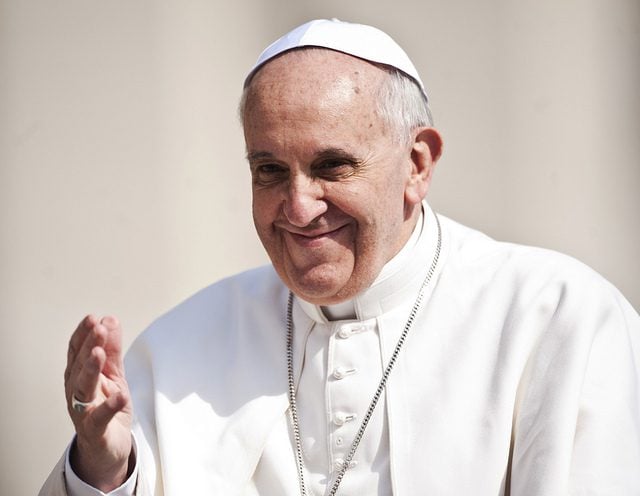
Francis cares. General Audience with Pope Francis. This image was originally posted to Flickr by catholicism (Catholic Church England and Wales) at https://www.flickr.com/photos/catholicism/8657304105/. It used under the terms of the cc-by-sa-2.0.
Tell me John Paul II wouldn’t be upset to find these words written by Pope Francis:
1. He begins with this ridiculous embrace of bad science for the sake of prudence:
The gradual depletion of the ozone layer and the related “greenhouse effect”has now reached crisis proportions as a consequence of industrial growth, massive urban concentrations and vastly increased energy needs. Industrial waste, the burning of fossil fuels, unrestricted deforestation, the use of certain types of herbicides, coolants and propellants: all of these are known to harm the atmosphere and environment. The resulting meteorological and atmospheric changes range from damage to health to the possible future submersion of low-lying lands.
2. Then Francis goes on to embrace, not just individual action, but action on the part of States and international bodies! What is this? Where is subsidiarity?!
While in some cases the damage already done may well be irreversible, in many other cases it can still be halted. It is necessary, however, that the entire human community – individuals, States and international bodies – take seriously the responsibility that is theirs.
3. There he goes, reciting the same old Laudato si’ rhetoric on the moral character of the ecological crisis.
Certain elements of today’s ecological crisis reveal its moral character. First among these is the indiscriminate application of advances in science and technology. Many recent discoveries have brought undeniable benefits to humanity. Indeed, they demonstrate the nobility of the human vocation to participate responsibly in God’s creative action in the world. Unfortunately, it is now clear that the application of these discoveries in the fields of industry and agriculture have produced harmful long-term effects. This has led to the painful realization that we cannot interfere in one area of the ecosystem without paying due attention both to the consequences of such interference in other areas and to the well-being of future generations.
4. Oh, my, goodness. Watch this guy basically form this all as a “pro-life” issue.
The most profound and serious indication of the moral implications underlying the ecological problem is the lack of respect for life evident in many of the patterns of environmental pollution. Often, the interests of production prevail over concern for the dignity of workers, while economic interests take priority over the good of individuals and even entire peoples. In these cases, pollution or environmental destruction is the result of an unnatural and reductionist vision which at times leads to a genuine contempt for man.
5. Then he thinks that God can’t fix everything, that it’s our fault, and that technological progress can hurt us all. What a lefty anti-capitalist Marxist:
On another level, delicate ecological balances are upset by the uncontrolled destruction of animal and plant life or by a reckless exploitation of natural resources. It should be pointed out that all of this, even if carried out in the name of progress and well-being, is ultimately to mankind’s disadvantage.
6. Again, Francis bothers us with his connection of life, not just human life, but all life, to the economy, industry, and science:
Respect for life, and above all for the dignity of the human person, is the ultimate guiding norm for any sound economic, industrial or scientific progress.
7. Francis pretends that these principles have been around for some time – like how long, Francis? I bet John Paul II wouldn’t have said this a quarter of a century ago:
The complexity of the ecological question is evident to all. There are, however, certain underlying principles, which, while respecting the legitimate autonomy and the specific competence of those involved, can direct research towards adequate and lasting solutions. These principles are essential to the building of a peaceful society; no peaceful society can afford to neglect either respect for life or the fact that there is an integrity to creation.
8. Again, what is this guy talking about? International action, State action, international standards, changing the “American” life-style?
The need for joint action on the international level does not lessen the responsibility of each individual State. Not only should each State join with others in implementing internationally accepted standards, but it should also make or facilitate necessary socio-economic adjustments within its own borders, giving special attention to the most vulnerable sectors of society.
9. Who does this guy think he is, St. Bonaventure? St. Bonaventure’s Journey of the Mind to God is super compatible with this stuff, but JP II wouldn’t say:
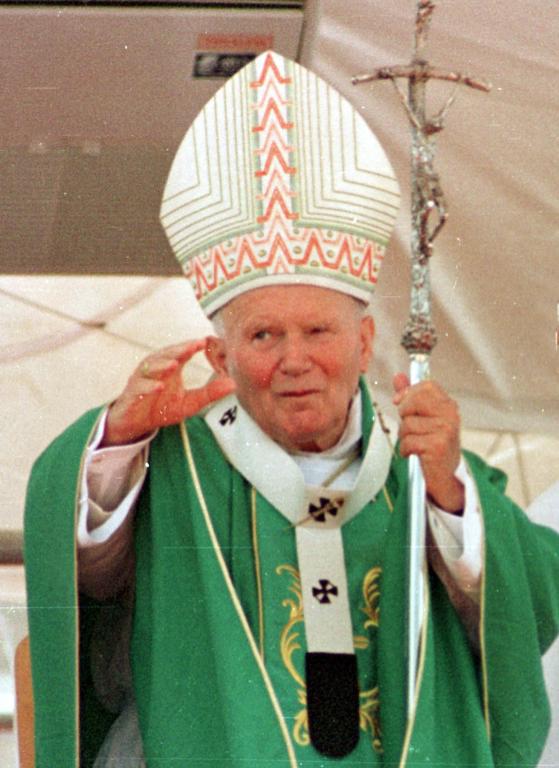
Pope John Paul II in Brazil in 1997. This image was originally posted to Wikimedia Commons https://upload.wikimedia.org/wikipedia/commons/1/18/John_Paul_II_Brazil_1997_3.jpg. It is used under the creative commons agreement CC BY 3.0 BR.
Finally, the aesthetic value of creation cannot be overlooked. Our very contact with nature has a deep restorative power; contemplation of its magnificence imparts peace and serenity.
10. Caring for creation, duty towards nature – essential part of my faith? John Paul II would have a fit!
Christians, in particular, realize that their responsibility within creation and their duty towards nature and the Creator are an essential part of their faith.
11. Again, brings up his namesake, Francis (Saint Francis of Assisi). John Paul II wouldn’t have this, using Saint Francis for some environmentalist bologna:
He offers Christians an example of genuine and deep respect for the integrity of creation. As a friend of the poor who was loved by God’s creatures, Saint Francis invited all of creation – animals, plants, natural forces, even Brother Sun and Sister Moon – to give honour and praise to the Lord. The poor man of Assisi gives us striking witness that when we are at peace with God we are better able to devote ourselves to building up that peace with all creation which is inseparable from peace among all peoples.
The nerve!
To think that the beginning of this document calls us to be at “peace with all of creation”, and that we lack “due respect for nature“.
What would John Paul the Great say?
He would say the exact same thing.
Literally. Word for word.
Well, really, the thing is … every quote from above is from John Paul II.
The document can be found here.
I guess Francis was following John Paul II’s lead all along – so should we.
Until next time,
If you have found the content on Keith Michael Estrada’s “Proper Nomenclature” to be useful, kindly consider supporting the cause with a donation.
Use the button below to donate through PayPal:
Thank you!
Previous Post
December 9, 2015
Catholic Worker Inspirations: Dorothy Day on Capitalism (Part 1)

Browse Our Archives
Select a Category Benedict XVI Canada Capital Punishment Capitalism Care for Creation Catholic Committee of Appalachia Catholic News Catholic Social Teaching Catholic Tradition - Art Catholic Worker Catholic Worker Inspirations CST in 140 Characters or Less Diocese of San Diego Faithful Citizenship Father Frank Pavone Chronicles Fathers, Mothers, Saints, and Doctors Francis Guest Posts Gun Violence Humor, Parody, and/or Satire Interfaith Dialogue John Eudes John Paul II Marriage and Family Migration New Evangelization News Not a formal post. Our Lady of Guadalupe Paul VI Popes Pro-Life Racial Justice Releases Religious Freedom Repeat/Repost Saints Socialism Thomas Aquinas Uncategorized
Select a Month March 2020 July 2019 June 2018 May 2018 March 2018 December 2017 October 2017 September 2017 July 2017 June 2017 May 2017 April 2017 March 2017 December 2016 November 2016 October 2016 September 2016 August 2016 July 2016 April 2016 February 2016 January 2016 December 2015
Follow Us!
TAKE THE
Religious Wisdom Quiz
What sea did Jesus walk on?
Select your answer to see how you score.
Sea of Galilee Red Sea Dead Sea Mediterranean Sea
Related posts from Proper Nomenclature

Franciscan University of Steubenville not recommend; alumni aren't...
Bishop of San Jose: Do not deny sacraments,...
Pope: Death penalty is inadmissible
Pope Francis gave a Laudato si' Ted Talk...
TRENDING AT PATHEOS Catholic

Creation, Preservation, and Teleology in Catholic Theology
As I write this, it is very early Monday morning. Like millions...

The Parable Of The Sower And The Word...
One of Christ’s most famous parables is that of the sower who...

Rejecting Doom: Christian Hope And Human Action
Christianity is a religion of hope. We are to have hope and...

Why I Choose the Eucharist Over the Sermon
Choose the Eucharist, Not the Sermon What are we supposed to get...

5 Design Elements Found in Spiritually Rooted Homes
Putting Spirituality Into Home Decor Our homes are more than our living...

Credo: A Story of God Told with the...
About 10 years ago, I began to imagine a personal "Credo" that...
view all Catholic blogs
Ad-Free & Subscriber Log-In Subscription Support
- About Us
- 2026 Calendar
- Videos
- Podcasts
- Library of World Religions
- Faith In Media Tracker
- Advertise With Us
- Write for Us
- Privacy Policy
- Terms of Service
- Do Not Sell My Data
- Contact Us
- Radiant Digital
- Manage Newsletter Subscriptions
- Unsubscribe From Notifications
- Sitemap
Copyright 2008-2026, Patheos. All rights reserved.
Subscription Support Ad-Free & Subscriber Log-In
Follow Patheos