
BuddhistCatholicContemplativeEvangelicalGeneral ChristianHinduJewishLatter-day SaintMuslimNew VisionsProgressive Christian
Beliefs
- Buddhist
- Catholic
- Contemplative
- Evangelical
- General Christian
- Hindu
- Jewish
- Latter-day Saint
- More Voices
- Muslim
- New Visions
- Pagan
- Progressive Christian
Topics
- Religion News
- Food and Religion
- Sports and Religion
- Religious Art
- Religious Music and Entertainment
- Religious Events
- History and Religion
- Style and Religion
- Politics and Religion
- Women in Religion
- Recreation Outdoors and Religion
- Business Finance and Religion
- Careers Workplace and Religion
- Education and Religion
- Family Parenting and Religion
- Health Fitness and Religion
- Home and Religion
- Relationships and Religion
- Technology and Religion
- Travel and Religion
Columnists
- Buddhist Columnists
- Business Finance and Religion Columnists
- Careers Workplace and Religion Columnists
- Catholic Columnists
- Contemplative Columnists
- Education and Religion Columnists
- Evangelists Columnists
- Family Parenting and Religion Columnists
- General Christian Columnists
- Health Fitness and Religion Columnists
- Hindu Columnists
- History and Religion Columnists
- Home and Religion Columnists
- Jewish Columnists
- More Voices Columnists
- Latter Day Columnists
- Muslim Columnists
- New Visions Columnists
- Nonreligious Columnists
- Pagan Columnists
- Politics and Religion Columnists
- Progressive Columnists
- Recreation Outdoors and Religion Columnists
- Relationships and Religion Columnists
- Religion News Columnists
- Religious Art Columnists
- Religious Events Columnists
- Religious Music and Entertainment Columnists
- Sports and Religion Columnists
- Style and Religion Columnists
- Technology and Religion Columnists
- Travel and Religion Columnists
- Women in Religion Columnists
Resource Library
- 2026 Calendar
- Library of World Religions
- The 100 Most Holy Places on Earth
- Patheos Answers
- Podcasts
- Videos
- Faith Leaders Database
- Anglican Episcopalian
- Bahai
- Baptist
- Buddhism
- Christianity
- Confucianism
- Eastern Orthodoxy
- Hinduism
- Holiness and Pentecostal
- ISKCON
- Islam
- Judaism
- Lutheran
- Methodist
- The Church of Jesus Christ of Latter-day Saints
- New Age
- Paganism
- Presbytarian and Reformed
- Protestantism
- Religion Behind the Scenes
- Roman Catholic
- Scientology
- Shia Islam
- Sikhism
- Sufism
- Sunni Islam
- Taoism
- Zen
- See all religions
Research Tools
 Ad-Free & Subscriber Log-In Subscription Support
Ad-Free & Subscriber Log-In Subscription Support
Follow Patheos 

- Trending:
- Forgiveness
- |
- Marriage
- |
- Consciousness
- |
- Death Penalty
- |
- Election
- |
- Halloween
 Profession of Faith
- Home
- Careers, Workplace and Religion
- How Much Openness Can We Afford?
How Much Openness Can We Afford?
Last updated on: May 29, 2015 at 6:09 am by Sarah Conrad Sours
How Much Openness Can We Afford? 2015-05-26T14:53:23-06:00 Sarah Conrad Sours
Patheos Explore the world's faith through different perspectives on religion and spirituality! Patheos has the views of the prevalent religions and spiritualities of the world.
One of the things I am constantly thinking over, during the summer when I actually have time to think, is the tension between openness and control that constantly tugs at my course planning.
Do I make policies, procedures, assignments, and evaluations with an eye toward those students who will make the most of their opportunities to learn? Or do I focus on requirements and regulations–curtailing cheaters, prodding the lazy, forcing the unwilling, and nagging the distracted?
This is not a dilemma that exists only for educators. Most organizations and businesses, especially those that operate beyond the local level, must operate with the assumption that people will screw up. They must account for laziness, incompetence, apathy, mischievousness, greed, and criminality.
I’m always pulled toward more open pedagogies: elective assignments, “flipped” classrooms, optional readings, self-directed learning. But whenever I think of how to implement them, I imagine how the screw-ups will screw it up.
So my syllabus gets longer every year, mostly to cover negative situations that happened in previous years. Someone does something stupid (sometimes, I’m the someone), and I write a new paragraph of warning, a new policy, a re-clarified policy, another half-sentence description, an explanatory chart.
Similarly, businesses and organizations that begin their operations with openness and generosity often find themselves having to write restrictive or preventative policies, after an experience of malicious advantage-taking, vandalism, or theft.
So, after Google allowed crowd-sourced edits to its mapping website, they quickly discovered that someone had taken advantage of their openness by dropping a pin with a racist vulgarity at the White House’s coordinates. (This is why we can’t have nice things.)
Wikipedia has made several changes to its editorial structures, sometimes to account for its exploding popularity, but sometimes in response to malicious, self-serving, and profiteering actions.
Online enterprises aren’t the only ones troubled by the phenomenon: many of my fellow faculty members have had the experience of leaving free books out for students to take, only to discover that a single student takes all the books and sells them on Amazon Marketplace.
Similarly, a Goodwill store near where I used to live discontinued a discount that no doubt helped many people, after a few were using it to make money. They used to have Wedding Dress Wednesdays, where donated wedding dresses were on deep discount (most were under $10). They discovered that a few local homemakers were buying the most promising dresses, cleaning and mending them, and selling them for a substantial profit on eBay and Craigslist.
The Goodwill case was especially interesting. Personally, I appreciated the industry and enterprise of the homemakers, but I also understood why the store managers were distressed. The women were buying dresses for $5 that someone else might honestly need, and need at exactly $5; they were also sourcing their materials through donations that were not intended to subsidize their business. On the other hand, the women believed they were taking dresses that could not be used as is and making them beautiful (or at least usable).
When the discount was suspended, though, I think everyone lost. Now, instead of picked-over wedding dresses at $5, there are no wedding dresses at $5. Perhaps an honest conversation with the budding businesswomen might have resulted in a happy compromise–all wedding dresses going unsold for three months could have been sold to them at the discounted price?
In any case, it’s not that the more restrictive policies are wrong, but they do tend to have the effect of emphasizing and even advertising the pettiest aspects of humanity.
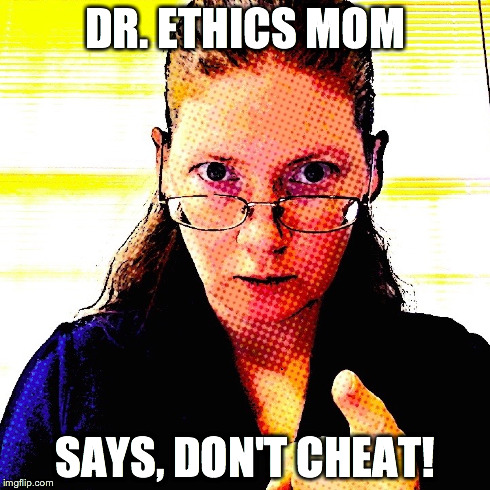
Image copyright Dr. Ethics Mom. No stealing, or she’ll glare at you, too.
I hate writing the academic integrity paragraph on my syllabus. I have to name all the ways a student can cheat, because someone has done it in the past, and I have to make sure that whoever does it in the future can legitimately be held responsible for his misdeeds.
I’ve done my best to rewrite it to emphasize what ought to be done, rather than what ought not to be done, but I can’t do away with the finger-wagging part entirely.
And that seems a shame.
On the other hand, pretending that there is no such thing as the human tendency to sin and selfishness is no less a shame.
Previous Post

May 26, 2015
Costly Competence?
Next Post

June 9, 2015 Malestrom: Why Egalitarian-Minded Evangelicals Don't Have to Chuck the Bible
Browse Our Archives
Select a Category Uncategorized
Select a Month July 2017 February 2017 October 2016 August 2016 June 2016 April 2016 March 2016 January 2016 December 2015 November 2015 October 2015 September 2015 August 2015 July 2015 June 2015 May 2015 April 2015 March 2015
Follow Us!
TAKE THE
Religious Wisdom Quiz
I became queen through a beauty contest, hiding my Jewish identity at my cousin's advice. Who am I?
Select your answer to see how you score.
Vashti Esther Sarah Ruth
Related posts from Profession of Faith

Professional Integrity in Uncertain Times, Part II

Professional Integrity in Uncertain Times

Conscientiousness Matters: He Who is Faithful in a...

Locker Room Talk at the Workplace
TRENDING AT PATHEOS Careers, Workplace and Religion

St. Francis by Bill Droel Pope Leo XIV declares 2026 as “Year...

Catholics are schooled in the faith by memorizing dogmatic points and lots...

The Good News of Our Human Limitations -...
After another day of trying to meet deadlines and working on projects,...

Quiet Holy Attentiveness (podcast) with Sarah Clarkson
We know that quiet is an essential aspect of the spiritual life,...

Every Vocation Everywhere All At Once
What is a vocation? How does it endure through the years? Can...

I promise this is not going to become a Taylor Swift Studies...
view all Careers, Workplace and Religion blogs
Ad-Free & Subscriber Log-In Subscription Support
- About Us
- 2026 Calendar
- Videos
- Podcasts
- Library of World Religions
- Faith In Media Tracker
- Advertise With Us
- Write for Us
- Privacy Policy
- Terms of Service
- Do Not Sell My Data
- Contact Us
- Radiant Digital
- Manage Newsletter Subscriptions
- Unsubscribe From Notifications
- Sitemap
Copyright 2008-2026, Patheos. All rights reserved.
Subscription Support Ad-Free & Subscriber Log-In
Follow Patheos