
BuddhistCatholicContemplativeEvangelicalGeneral ChristianHinduJewishLatter-day SaintMuslimNew VisionsProgressive Christian
Beliefs
- Buddhist
- Catholic
- Contemplative
- Evangelical
- General Christian
- Hindu
- Jewish
- Latter-day Saint
- More Voices
- Muslim
- New Visions
- Pagan
- Progressive Christian
Topics
- Religion News
- Food and Religion
- Sports and Religion
- Religious Art
- Religious Music and Entertainment
- Religious Events
- History and Religion
- Style and Religion
- Politics and Religion
- Women in Religion
- Recreation Outdoors and Religion
- Business Finance and Religion
- Careers Workplace and Religion
- Education and Religion
- Family Parenting and Religion
- Health Fitness and Religion
- Home and Religion
- Relationships and Religion
- Technology and Religion
- Travel and Religion
Columnists
- Buddhist Columnists
- Business Finance and Religion Columnists
- Careers Workplace and Religion Columnists
- Catholic Columnists
- Contemplative Columnists
- Education and Religion Columnists
- Evangelists Columnists
- Family Parenting and Religion Columnists
- General Christian Columnists
- Health Fitness and Religion Columnists
- Hindu Columnists
- History and Religion Columnists
- Home and Religion Columnists
- Jewish Columnists
- More Voices Columnists
- Latter Day Columnists
- Muslim Columnists
- New Visions Columnists
- Nonreligious Columnists
- Pagan Columnists
- Politics and Religion Columnists
- Progressive Columnists
- Recreation Outdoors and Religion Columnists
- Relationships and Religion Columnists
- Religion News Columnists
- Religious Art Columnists
- Religious Events Columnists
- Religious Music and Entertainment Columnists
- Sports and Religion Columnists
- Style and Religion Columnists
- Technology and Religion Columnists
- Travel and Religion Columnists
- Women in Religion Columnists
Resource Library
- 2026 Calendar
- Library of World Religions
- The 100 Most Holy Places on Earth
- Patheos Answers
- Podcasts
- Videos
- Faith Leaders Database
- Anglican Episcopalian
- Bahai
- Baptist
- Buddhism
- Christianity
- Confucianism
- Eastern Orthodoxy
- Hinduism
- Holiness and Pentecostal
- ISKCON
- Islam
- Judaism
- Lutheran
- Methodist
- The Church of Jesus Christ of Latter-day Saints
- New Age
- Paganism
- Presbytarian and Reformed
- Protestantism
- Religion Behind the Scenes
- Roman Catholic
- Scientology
- Shia Islam
- Sikhism
- Sufism
- Sunni Islam
- Taoism
- Zen
- See all religions
Research Tools
 Ad-Free & Subscriber Log-In Subscription Support
Ad-Free & Subscriber Log-In Subscription Support
Follow Patheos 

- Trending:
- Forgiveness
- |
- Marriage
- |
- Consciousness
- |
- Death Penalty
- |
- Election
- |
- Halloween
 Preventing Grace
- Home
- Evangelical
- Every Lady Her Own Book Reviewer
Every Lady Her Own Book Reviewer
Last updated on: August 26, 2021 at 7:37 am by Anne Kennedy
Every Lady Her Own Book Reviewer 2021-08-26T07:37:44-04:00 Anne Kennedy
Patheos Explore the world's faith through different perspectives on religion and spirituality! Patheos has the views of the prevalent religions and spiritualities of the world.
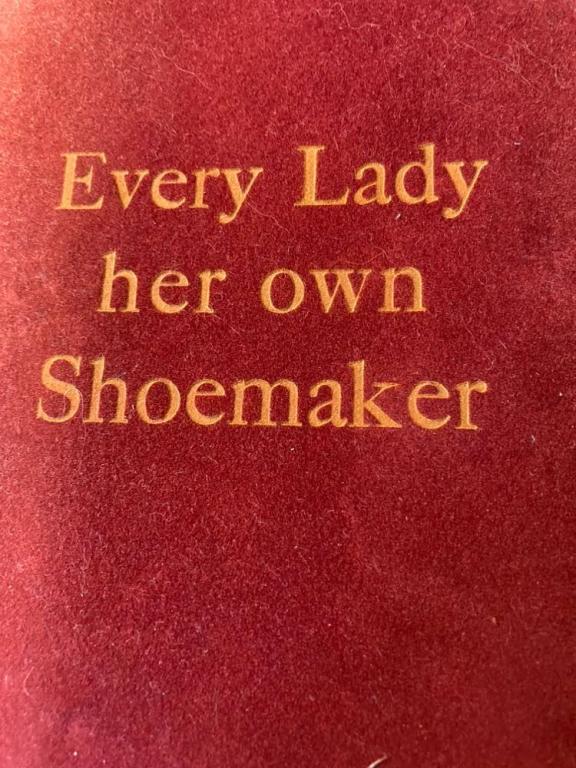
Don’t worry, I’m not going to go on blathering about The Lord of the Rings and The Great Mortality. I have three other important books for you today.
The First Book
In the height of covid, I managed to acquire a clever little book called Every Lady her own Shoemaker or A Complete Self-Instructor in The Art of Making Gaiters and Shoes by A Lady. It’s all about how to make a nice pair of shoes. All you need is Patent last, Instep block, Tin sole pattern, One awl, Two Saddler’s needles, One ball of shoe thread, Shoemaker’s wax, and a Shoe-knife. All of which you should be able to get for about 80 cents, so says the author in the year of our Lord 1856. There is also this extremely prescient point made right away before all the instructions begin:
One advantage in making shoes is, that the fashions do not change. A last, if once purchased, will answer a lifetime. The same last may fit several in the same family; or if each family does not wish to buy one separately, they may joing their neighbors and have one in common: still we prefer to have one of our own.
Do we indeed? I guess, amongst all my other troubles, I should go and look up what a “last” is. While I’m doing that, you might meditate on this astonishing revelation:
It takes but a short time to make a pair, and as every lady can work equally as nice as any shoemaker, and also as the number is very small who are not obliged to practice economy and retrenchment in their expenditures, we though maky might like to learn how to make their own shoes, if the knowledge was only brought within their reach–hence the following pages.
This must be unequivable, for, as we all know, if we all know better, we will all do better. So anyway, on to more pressing matters. Those two book reviews I wrote this summer are out from behind their respective paywalls, and as I am extremely busy with not only pondering the cunnundrum of whether or not I should begin at once to make a pair of shoes, but also writing a pile of other articles, teaching a teenage boy how to actually do laundry, and petting the cat, I will link them here for your own edification and amusement.
The Second Book
The first is about The Book of Longings. Here’s how it begins:
**Editor’s Note: This article contains spoilers for The Book of Longings: A Novel****
“He reached out his hand, a laborer’s hand. Thick knuckles, calluses, his palm a terrain of hardships.”1 This is the moment Jesus enters the narrative of Sue Monk Kidd’s best-selling novel, The Book of Longings. Ana, who (spoiler alert) becomes his wife after suitable trials and tribulations, has tumbled to the ground in a near faint in the marketplace of Sepphoris where she has just been affianced by her father to an elderly, repulsive scoundrel. It is the first century and Ana is the daughter of the chief scribe of Herod Antipas. She is fourteen years old, literate, precocious, full to the brim of longing to know and accept herself. As such, she is the ideal heroine for such a time as this. By which I do not mean the ancient time of Jesus, but our age, our time — the twenty-first century.
In The Book of Longings, Sue Monk Kidd paints a monochromatic spiritual landscape, tediously rehearsing the contours of feminine longing. As the story unfolds, her characters near perfectly portray the values, the assumptions, the hopes, and the expectations of now.2 If a stranger to this place and time were to require a primer of the ideal person, I would hand her this book. Let’s look together at that cultural icon — not Jesus but Ana — and her journey to discover not just herself but “the largeness” within her that “would not shrink away.”3
Ana — Deceiver, Overcomer, and Mary Sue. My children recently introduced me to a name for a character type in entertainment — comics, movies, sitcoms, novels — that I kept seeing but lacked words to describe. The personality is called a ‘Mary Sue’ and is a technical term for, to quote Infobloom,
a character in a work of fiction who exists primarily for the purpose of wish-fulfillment on the part of the author. She plays a prominent role in the work, but she is notably devoid of flaws or a complex personality, and she usually represents the pinnacle of idealized perfection. All of the other characters love Mary Sue, because she is extraordinarily helpful, talented, beautiful, or unusual, and she often drives readers absolutely crazy because she is one-dimensional and too idealized to be realistic.4
The Urban Dictionary points out that the existence of a Mary Sue often ruins the work, usually because they are able to “defy logic to simply display how amazingly radiant they are.” Some authors will give the Mary Sue a flaw “that is actually just a stale trait in disguise.”5 Whether or not Sue Monk Kidd has wedged herself so forcibly into The Book of Longings, there can be no doubt that Ana as a personality is flat and lacks any character development. She faces no challenge that changes her from one kind of person to another. She never fails to fulfill any of her desires. All the other characters orbit around her to reveal her brilliant longing for herself.
Her “flaw,” which complicates only other people’s lives, is that she often lies and deceives those around her. As the daughter of an educated Herodian scribe, she has been taught to read and write, and she possesses a trunk full of her own self-authored scrolls. Preserving and propagating her own writing, from the first page to the last, is her chief concern. Such a weighty task necessitates both lying and subterfuge as she conceals her scrolls in the room of her aunt, and then in a cave. In the end, being an old woman, she buries them in the ground in Egypt. Besides her own writing, her most beloved possession is an incantation bowl in which she inscribes her longing for herself:
Rising, I took my incantation bowl to the small high window, where skeins of light fell. I rotated the bowl in a full circle, watching the words move inside it, rippling toward the rim. Lord our God, hear my prayer, the prayer of my heart. Bless the largeness inside me, no matter how I fear it. Bless my reed pens and my inks. Bless the words I write. May they be beautiful in your sight. May they be visible to eyes not yet born. When I am dust, sing these words over my bones: she was a voice. I gazed upon the prayer and the girl and the dove, and a sensation billowed in my chest, a small exultation like a flock of birds lifting all at once from the trees.6 (emphasis in original)
Part of Ana’s anxiety is that she has made a “graven image” of herself in the bowl. Improbably, she doesn’t worry about being stoned for breaking the law, rather, she is afraid that the image in the bowl will someday be destroyed. The image of herself is too precious to risk and so she disguises the bowl as a “waste pot” and hides it in her room.7 She ends up carrying this bowl and her scrolls back and forth as she travels around the then known world. The bowl is never seriously in danger, and neither is Ana, because the consequences of her lying never catch up with her. Through a phantasmic succession of events, she evades being married to the old man in the market, she avoids being raped by Herod, and she manages to meet Jesus because her parents allow her to roam around the Galilean desert with a servant. Once she is married to Jesus she brashly acclimatizes herself to his poverty. Using herbs, she successfully avoids having a baby, and when she finally does give birth, the child — Susanna — conveniently dies. In Egypt, she cleverly assists her aunt Yaltha to find a long-lost daughter, and then escapes to a monastic community called the Therapeutae. And finally, with impeccable timing, Ana escapes the Therapeutae in a coffin, arriving in Jerusalem just in time to see Jesus die on the cross. Though all her life is a tribulation, her own personality is never changed. Rather, her immutable and luminous true self is ever more rapturously displayed to herself…read the rest here!
The Third Book
And the second is about Beth Allison Barr’s Biblical Womanhood book. Here’s how that one starts:
“Go, be free!” concludes Beth Allison Barr in her recently released, best-selling book, The Making of Biblical Womanhood: How the Subjugation of Women Became Gospel Truth.1 In the intersection of her life in the classroom and the strictures placed on her by her local church, her beliefs about women radically shifted. Eventually, after a difficult conversation with the theologically unbending complementarian elders at her Southern Baptist Church, Barr and her husband, the youth pastor, were asked to leave. “This book is my story,” she writes, “a white woman whose experiences as a pastor’s wife and scholar have led me to reject evangelical teachings about male headship and female submission. I am fighting against patriarchy for women.” 2 Part medieval history, part personal narrative, and part examination of the condition of women in complementarian circles, Dr. Barr (a history professor at Baylor University) applies a feminist hermeneutic to Scripture and history. She purports to discover a malign patriarchal inclination, if not an actual conspiracy by complementarians, to write women out of the Bible, out of the church, and back into their homes to their highest calling by God as wives and mothers.
While Barr raises essential questions about the identity and role of women, her answer to what she perceives is the irredeemable evil of the patriarchy — to “Stop it”3 — is at the very least unsatisfying, if not impracticable, and, in the long run, theologically frail. Barr’s misrepresentation of biblical inerrancy, her definition of the patriarchy, her interpretation of history and the Bible, and her proposed solution, though emotionally evocative, offer a bleak ideological vision for women in the church and home. Ultimately, there are grave theological and historical problems with her work.
DEMOLISHING THE BIBLICAL CASE FOR PATRIARCHY
Barr, taking her lead from Judith Bennett, defines the patriarchy as “a general system through which women have been and are subordinated to men.”4 In Barr’s experience, this patriarchy has been articulated from many pulpits in biblical terms. “Women,” she writes, “were called to support their husbands, and men were called to lead their wives. It was unequivocal truth ordained by the inerrant word of God.”5 She finds this view troubling.6 Refuting Albert Mohler’s belief that “the pattern of history affirms what the Bible unquestionably reveals — that God has made human beings in His image as male and female….a beautiful portrait of complementarity between the sexes, with both men and women charged to reflect God’s glory in a distinct way,”7 she believes that Christians are actually “pretty late to the patriarchy game.”8 For Barr, there is no real difference between a biblical patriarchy — what many call complementarianism — and the kind found in ancient texts like the Epic of Gilgamesh, in which, against her own inclinations, “the prostitute Shamhat seduces Enkidu.”9
While admitting that “patriarchy exists in the Bible because the Bible was written in a patriarchal world,” Barr explains that the New Testament writers actually meant to undermine and subvert all patriarchy, not just its corruptions.10 Predictably, she bolsters that assertion with Galatians 3:26–28 and Sarah Bessey’s declaration that the “patriarchy is not ‘God’s dream for humanity.’”11 Then, in a series of “What if” questions, Barr demolishes complementarianism as she has defined it. “What if Paul never said this? Just like with the household codes, what if we have simply misunderstood Paul because we have forgotten his Roman context? What if we have confused Paul’s refutations of the pagan world around him with Paul’s own words?”12
Instead, she claims, Paul subverted pagan household codes and replaced them with a functionally egalitarian system within which men and women submit to each other,13 and women are able to hold the same church offices as men.14 Barr takes it as a given that Paul names Junia as an apostle in Romans 16,15 and that Phoebe, to whom Paul entrusted the letter of Romans, is not merely a “servant” but held the office of Deacon.16 All of this constitutes proof of Rachel Held Evans’s claim that Paul meant to “remix” Roman household codes, eradicating all patriarchal hierarchies.17
Turning to the question of Bible translation and inerrancy, Barr observes that the word “marriage” is not used in the Hebrew manuscripts. The translators of the King James Bible put it there, perhaps for nefarious reasons.18 They employed the word “wife” rather than “woman” because Reformation theology relegated women to the narrow sphere of home, husband, and children.19 Furthermore, she argues, complementarian Bible translators chose the use of male pronouns to refer to groups that include men and women.20 Finally, she claims, “the early twentieth-century emphasis on inerrancy went hand in hand with a wide-ranging attempt to build up the authority of male preachers at the expense of women.”21
The Historical Case Against Patriarchy
Barr begins each chapter with a personal example of how she experienced damaging patriarchal complementarianism — in the classroom with a misogynist student, for instance, or enduring a women’s retreat, or extricating herself from a relationship with a Bill Gothard disciple — interweaving those experiences with her expertise, the Middle Ages. Though women at the close of the medieval period were poised to settle into more spacious rooms, the Reformers read the Bible in such a way that hammered the nail into the coffin of women’s freedom.22 In fact, Barr argues, though women had to essentially abandon what made them distinctly feminine — their sexuality, their children23 — nevertheless the church welcomed them “to preach, teach, and lead throughout the medieval era.”24
Using the examples of Margery Kempe, Hildegard of Bingen, Mary Magdalen, Brigit of Kildare, and others, Barr avers that women did not identify themselves in the categories of Evangelical women today — as wife, mother, homemaker, and under the authority of a male pastor and husband. On the contrary, not only did they enjoy greater economic independence than their Reformation counterparts, they devoted themselves to God by entering communities of women, and sometimes ministered alongside men. Barr tells the story of fifth-century Saint Paula, who…read the rest!
And now, if you will excuse me, I will go on about my day with usual futility.
Previous Post

August 25, 2021
Isn't It Ironic
Next Post

August 27, 2021 7 Takes Back to the Grind
Browse Our Archives
Select a Category books Catechesis of the Good Shepherd Children in Conversation culture watch Daily Devotions Demotivations with Anne faith alone for the grandparents GAFCON In conversation with children In the News Kitchen Notes Lambeth Learning Notes Life Going On Men are Human Notes from Home Pictures Reading the Bible Saturday Links Sermons Signs of the Apocalypse The Bad Word Association The Prayer of Jonah Travel Notes Uncategorized Witless Wednesdays Work and the Christian
Select a Month June 2024 May 2024 April 2024 March 2024 February 2024 January 2024 November 2023 October 2023 September 2023 August 2023 July 2023 June 2023 May 2023 April 2023 March 2023 February 2023 January 2023 December 2022 November 2022 October 2022 September 2022 July 2022 May 2022 April 2022 March 2022 February 2022 January 2022 December 2021 November 2021 October 2021 September 2021 August 2021 July 2021 June 2021 May 2021 April 2021 March 2021 February 2021 January 2021 December 2020 November 2020 October 2020 September 2020 August 2020 July 2020 June 2020 May 2020 April 2020 March 2020 February 2020 January 2020 December 2019 November 2019 October 2019 September 2019 August 2019 July 2019 June 2019 May 2019 April 2019 March 2019 February 2019 January 2019 December 2018 November 2018 October 2018 September 2018 August 2018 July 2018 June 2018 May 2018 April 2018 March 2018 February 2018 January 2018 December 2017 November 2017 October 2017 September 2017 August 2017 July 2017 June 2017 May 2017 April 2017 March 2017 February 2017 January 2017 December 2016 November 2016 October 2016 September 2016 August 2016 July 2016 June 2016 May 2016 April 2016 March 2016 February 2016 January 2016 December 2015 November 2015 October 2015 September 2015 August 2015 July 2015 June 2015 May 2015 April 2015 March 2015 February 2015 January 2015 December 2014 November 2014 October 2014 September 2014 August 2014 July 2014 June 2014 May 2014 April 2014 March 2014 February 2014 January 2014 December 2013 November 2013 October 2013 September 2013 August 2013 July 2013 June 2013 May 2013 April 2013 March 2013 February 2013 January 2013 December 2012 November 2012 October 2012 September 2012 August 2012 July 2012 June 2012 May 2012 April 2012 March 2012 February 2012 January 2012 December 2011 November 2011 October 2011 September 2011 August 2011 July 2011 June 2011 May 2011 April 2011 March 2011 February 2011 January 2011 December 2010 November 2010 October 2010 September 2010 August 2010 July 2010 June 2010 May 2010 April 2010 March 2010 February 2010 January 2010 December 2009 November 2009 October 2009 September 2009 August 2009 July 2009 June 2009 May 2009 April 2009 March 2009 February 2009 January 2009 December 2008 November 2008 October 2008 September 2008 August 2008 July 2008 June 2008 May 2008 April 2008 March 2008 February 2008 January 2008 December 2007 November 2007 October 2007 September 2007 August 2007 July 2007 June 2007 May 2007 April 2007 March 2007 February 2007 January 2007 December 2006 November 2006 October 2006
Follow Us!
TAKE THE
Religious Wisdom Quiz
On which sea did Jesus calm a storm and walk on water?
Select your answer to see how you score.
Red Sea Sea of Galilee Dead Sea Aegean Sea
Books by This Author Books by Anne Kennedy
Related posts from Preventing Grace


I'm Over Forty And I Won't Be Reading...

I Will Never Stop Talking About Jesus
TRENDING AT PATHEOS Evangelical

The REST of Your Life: A Creative Wrestles...
This week I had a conversation with a good friend from church....

How the author of the world's best hymn...
I've been working with John Newton for a while now. This makes...

Long before this Lectio Divina, Psalm 130 - the song - started...

What About the Trees? Another Living Parable
After I finished writing the last article about falling leaves as a...

Why Classical Education Is a Conversation, Not a...
Come and Read: Joy in Classical Education When I was a little...

Cornell University has received a great deal of negative publicity and intense...
view all Evangelical blogs
Ad-Free & Subscriber Log-In Subscription Support
- About Us
- 2026 Calendar
- Videos
- Podcasts
- Library of World Religions
- Faith In Media Tracker
- Advertise With Us
- Write for Us
- Privacy Policy
- Terms of Service
- Do Not Sell My Data
- Contact Us
- Radiant Digital
- Manage Newsletter Subscriptions
- Unsubscribe From Notifications
- Sitemap
Copyright 2008-2026, Patheos. All rights reserved.
Subscription Support Ad-Free & Subscriber Log-In
Follow Patheos