
BuddhistCatholicContemplativeEvangelicalGeneral ChristianHinduJewishLatter-day SaintMuslimNew VisionsProgressive Christian
Beliefs
- Buddhist
- Catholic
- Contemplative
- Evangelical
- General Christian
- Hindu
- Jewish
- Latter-day Saint
- More Voices
- Muslim
- New Visions
- Pagan
- Progressive Christian
Topics
- Religion News
- Food and Religion
- Sports and Religion
- Religious Art
- Religious Music and Entertainment
- Religious Events
- History and Religion
- Style and Religion
- Politics and Religion
- Women in Religion
- Recreation Outdoors and Religion
- Business Finance and Religion
- Careers Workplace and Religion
- Education and Religion
- Family Parenting and Religion
- Health Fitness and Religion
- Home and Religion
- Relationships and Religion
- Technology and Religion
- Travel and Religion
Columnists
- Buddhist Columnists
- Business Finance and Religion Columnists
- Careers Workplace and Religion Columnists
- Catholic Columnists
- Contemplative Columnists
- Education and Religion Columnists
- Evangelists Columnists
- Family Parenting and Religion Columnists
- General Christian Columnists
- Health Fitness and Religion Columnists
- Hindu Columnists
- History and Religion Columnists
- Home and Religion Columnists
- Jewish Columnists
- More Voices Columnists
- Latter Day Columnists
- Muslim Columnists
- New Visions Columnists
- Nonreligious Columnists
- Pagan Columnists
- Politics and Religion Columnists
- Progressive Columnists
- Recreation Outdoors and Religion Columnists
- Relationships and Religion Columnists
- Religion News Columnists
- Religious Art Columnists
- Religious Events Columnists
- Religious Music and Entertainment Columnists
- Sports and Religion Columnists
- Style and Religion Columnists
- Technology and Religion Columnists
- Travel and Religion Columnists
- Women in Religion Columnists
Resource Library
- 2026 Calendar
- Library of World Religions
- The 100 Most Holy Places on Earth
- Patheos Answers
- Podcasts
- Videos
- Faith Leaders Database
- Anglican Episcopalian
- Bahai
- Baptist
- Buddhism
- Christianity
- Confucianism
- Eastern Orthodoxy
- Hinduism
- Holiness and Pentecostal
- ISKCON
- Islam
- Judaism
- Lutheran
- Methodist
- The Church of Jesus Christ of Latter-day Saints
- New Age
- Paganism
- Presbytarian and Reformed
- Protestantism
- Religion Behind the Scenes
- Roman Catholic
- Scientology
- Shia Islam
- Sikhism
- Sufism
- Sunni Islam
- Taoism
- Zen
- See all religions
Research Tools
 Ad-Free & Subscriber Log-In Subscription Support
Ad-Free & Subscriber Log-In Subscription Support
Follow Patheos 

- Trending:
- Forgiveness
- |
- Marriage
- |
- Consciousness
- |
- Death Penalty
- |
- Election
- |
- Halloween
 Preventing Grace
- Home
- Evangelical
- Thirsty Enough To Die
Thirsty Enough To Die
Last updated on: March 15, 2020 at 6:25 am by Anne Kennedy
Thirsty Enough To Die 2020-03-15T06:25:43-04:00 Anne Kennedy
Patheos Explore the world's faith through different perspectives on religion and spirituality! Patheos has the views of the prevalent religions and spiritualities of the world.

There’s a Slate article trending on Twitter this morning called “America is a Sham.” It’s full of a lot of words I’d rather not use on this blog, and is a jumble of both interesting insights and, I think, rather naïve economic aspirations. Yes, when the coronavirus is over, we should be happy that we were able to see that the number of ounces of liquid you carry on to an airplane in no way makes any of the people on that airplane safer. But no, nothing is really “free.” If you want the government to give you things—even things you need—you will still pay some kind of a price, no matter how poor you are, a price that may seem low now that you need them, but will not always appear to be that way. The government will enact payment eventually, it always does. Maybe it won’t be money, but it will be something.
That is the thing uppermost on most of our minds just now—how far are most of us willing to go to procure that which we most need. This guy, who went around from one state to another buying up all the hand sanitizer, hoping to make it big. Me, wandering around town looking for loo paper not in order to stockpile it, but because I need it now…and finding that there is none. Doctors, frustrated about there not being tests. So many people could have this wretched disease, but there is no way to find out. The crisis presses each person to consider the substance and measure of his life in the most immediate and intimate ways. And I don’t know about you, but whenever I do that, it is the lack of the thing that rises uppermost not only in my mind, but in my body.
Providential, then, that the lections today are about Israel in a desperate and helpless place, and how they behaved when they found themselves there.
All the congregation of the people of Israel moved on from the wilderness of Sin by stages, according to the commandment of the LORD, and camped at Rephidim, but there was no water for the people to drink.
I have often tried to imagine it. Thousands and thousands of people. Babies hauled along on people’s backs. Various kinds of animals. Cartloads of stuff. The dust. The noise. Not at all the kind of pictures of crowds I’m used to seeing say, in the New York Subway—all be-headphoned and modern and sleek. No, more like the caravans of people trying to make it out of Syria, or into Europe. And mind you, they’re all journeying on in stages because God told them to. They obeyed, and here they have no water.
That’s usually the way it is. You do what you’re supposed to, and something terrible happens. You get sick, or you lose all your money, or your car breaks down, but it was while you were being kind, or frugal, or doing whatever it was you thought God wanted (or the universe, if you don’t believe in God). And then suddenly you are in that curious and desperate place where you yourself are about to measured.
Therefore the people quarreled with Moses and said, “Give us water to drink.” And Moses said to them, “Why do you quarrel with me? Why do you test the LORD?” But the people thirsted there for water, and the people grumbled against Moses and said, “Why did you bring us up out of Egypt, to kill us and our children and our livestock with thirst?”
I always read this and laugh—how could they be so foolish—and then go down and scream at the entire world in disappointment and rage because my blood sugar is low and there’s nothing I feel like eating. Observe how the people of Israel go about their quarreling. First, they demand water of Moses. Then, when Moses questions them, asking why they thus quarrel, pointing out to them that their issue is not actually with him, but with God, they rage against him, accusing him of trying to kill them. It’s an interesting little circle of hubris, and it illuminates the human heart most painfully. In one awful moment, in the midst of their thirst, they appear to accuse Moses, but are really bitterly angry with God for bringing them to a place they find they cannot endure.
And who can really blame them, for they are thirsty. Most of us don’t really know this kind of desperate thirst. I recently figured out how to make tea in a big insulated thermos that really keeps it hot for the whole day. I’ve taken to lugging it around with me, indecently attached to its whereabouts in my spatial and material circumstances, frantic when I put it down and can’t remember where. All day I sip at it, the steady flow of caffeine my sure and certain promise that I will be able to cope as I go through the day. We thirst in all kinds of ways, individually, and all together, but there’s nothing that beats that desperate parched sensation when you look out over the desert, or a whole case full of cold drinks, and there is nothing to drink, or you are paralyzed by indecision. What can you then do, but rail against God?
I mean, of course, there is another option, but this is the core of the issue. When you face some terrible lack, some sorrow, some trauma, some deep, unassailable need that you have no power to quench or meet, what do you do? If you are an unbeliever (and really, so many of us are) you complain—angrily. You are bitter in your anger. It goes deep and fast to the darkest and foulest places of hell. Why does God hate me, you say. It is your first and most powerful assumption.
I mean, I do too. It’s not just you. It is the entire world. And, in a time like coronavirus, the cacophony of our need and fear might feel a touch overwhelming. The word “panic” is easily au courant. But maybe it’s not coronavirus, maybe its something else, like what you thought God was going to do, or that you wanted something and you didn’t get it, or you didn’t want something, and are having to endure it. No human life escapes this experience.
So Moses cried to the Lord, “What shall I do with this people? They are almost ready to stone me.” And the LORD said to Moses, “Pass on before the people, taking with you some of the elders of Israel, and take in your hand the staff with which you struck the Nile, and go. Behold, I will stand before you there on the rock at Horeb, and you shall strike the rock, and water shall come out of it, and the people will drink.” And Moses did so, in the sight of the elders of Israel. And he called the name of the place Massah and Meribah, because of the quarreling of the people of Israel, and because they tested the LORD by saying, “Is the LORD among us or not?”
Which is why Moses is called the meekest of all people on earth, that he did what the people themselves could have done but didn’t, that he does what any of us could do, which is go immediately to God for help. In this case, it’s not even water that he asks for, but for the unburdening of the people who are ready even to kill him. He does what they should have done—Ask for what they need.
I mean, I get it. Asking for help is humiliating. It’s easier to demand in anger, than ask in desperation. I know, because I’ve tried both, and neither is very pleasurable. Asking in humility means admitting a lot of things I just don’t want to even deal with. The very idea of being thirsty—thirsty enough to die—is appalling to me. Better that I go around “doing the best I can” than to implore God to come and sort out the myriad problems, to meet the abundant needs that are beyond my control.
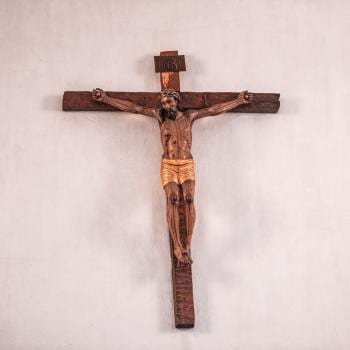
But look what happens when Moses asks God for help. This is so curious, and so terrible. God gives Moses—and the people, incidentally, though they don’t really see what is happening—the central image of the believing life. There is a rock, and Moses is to strike the rock, and water will come out of the rock, and the people will drink. But standing before the rock is, lest you think this is some sort of magic act, God himself. He stands before the rock, so that when the rock is struck, it is really him. When the water bursts forth, it is out of him.
Honestly, it isn’t fair. If I were God, and everybody was yelling at me, I would strike them. And yet he himself is the one who takes the blow.
Like I said, everything comes at a cost. There is nothing free in the universe. Someone pays. When anger, disappointment, and ruinous need fill the throats and mouths of humanity, God himself pays whatever is required, and gives the thing most desperately needed—salvation, water, faith, and worst of all, himself.
Previous Post

March 13, 2020
7 Coronavirus Takes
Next Post
March 16, 2020 Coronavirus Podcast and Links
Browse Our Archives
Select a Category books Catechesis of the Good Shepherd Children in Conversation culture watch Daily Devotions Demotivations with Anne faith alone for the grandparents GAFCON In conversation with children In the News Kitchen Notes Lambeth Learning Notes Life Going On Men are Human Notes from Home Pictures Reading the Bible Saturday Links Sermons Signs of the Apocalypse The Bad Word Association The Prayer of Jonah Travel Notes Uncategorized Witless Wednesdays Work and the Christian
Select a Month June 2024 May 2024 April 2024 March 2024 February 2024 January 2024 November 2023 October 2023 September 2023 August 2023 July 2023 June 2023 May 2023 April 2023 March 2023 February 2023 January 2023 December 2022 November 2022 October 2022 September 2022 July 2022 May 2022 April 2022 March 2022 February 2022 January 2022 December 2021 November 2021 October 2021 September 2021 August 2021 July 2021 June 2021 May 2021 April 2021 March 2021 February 2021 January 2021 December 2020 November 2020 October 2020 September 2020 August 2020 July 2020 June 2020 May 2020 April 2020 March 2020 February 2020 January 2020 December 2019 November 2019 October 2019 September 2019 August 2019 July 2019 June 2019 May 2019 April 2019 March 2019 February 2019 January 2019 December 2018 November 2018 October 2018 September 2018 August 2018 July 2018 June 2018 May 2018 April 2018 March 2018 February 2018 January 2018 December 2017 November 2017 October 2017 September 2017 August 2017 July 2017 June 2017 May 2017 April 2017 March 2017 February 2017 January 2017 December 2016 November 2016 October 2016 September 2016 August 2016 July 2016 June 2016 May 2016 April 2016 March 2016 February 2016 January 2016 December 2015 November 2015 October 2015 September 2015 August 2015 July 2015 June 2015 May 2015 April 2015 March 2015 February 2015 January 2015 December 2014 November 2014 October 2014 September 2014 August 2014 July 2014 June 2014 May 2014 April 2014 March 2014 February 2014 January 2014 December 2013 November 2013 October 2013 September 2013 August 2013 July 2013 June 2013 May 2013 April 2013 March 2013 February 2013 January 2013 December 2012 November 2012 October 2012 September 2012 August 2012 July 2012 June 2012 May 2012 April 2012 March 2012 February 2012 January 2012 December 2011 November 2011 October 2011 September 2011 August 2011 July 2011 June 2011 May 2011 April 2011 March 2011 February 2011 January 2011 December 2010 November 2010 October 2010 September 2010 August 2010 July 2010 June 2010 May 2010 April 2010 March 2010 February 2010 January 2010 December 2009 November 2009 October 2009 September 2009 August 2009 July 2009 June 2009 May 2009 April 2009 March 2009 February 2009 January 2009 December 2008 November 2008 October 2008 September 2008 August 2008 July 2008 June 2008 May 2008 April 2008 March 2008 February 2008 January 2008 December 2007 November 2007 October 2007 September 2007 August 2007 July 2007 June 2007 May 2007 April 2007 March 2007 February 2007 January 2007 December 2006 November 2006 October 2006
Follow Us!
TAKE THE
Religious Wisdom Quiz
What is the collective name of the stories Jesus told?
Select your answer to see how you score.
Gospel Parables Miracles Psalms
Books by This Author Books by Anne Kennedy
Related posts from Preventing Grace


TRENDING AT PATHEOS Evangelical

The REST of Your Life: A Creative Wrestles...
This week I had a conversation with a good friend from church....

How the author of the world's best hymn...
I've been working with John Newton for a while now. This makes...

Long before this Lectio Divina, Psalm 130 - the song - started...

What About the Trees? Another Living Parable
After I finished writing the last article about falling leaves as a...

Why Classical Education Is a Conversation, Not a...
Come and Read: Joy in Classical Education When I was a little...

Cornell University has received a great deal of negative publicity and intense...
view all Evangelical blogs
Ad-Free & Subscriber Log-In Subscription Support
- About Us
- 2026 Calendar
- Videos
- Podcasts
- Library of World Religions
- Faith In Media Tracker
- Advertise With Us
- Write for Us
- Privacy Policy
- Terms of Service
- Do Not Sell My Data
- Contact Us
- Radiant Digital
- Manage Newsletter Subscriptions
- Unsubscribe From Notifications
- Sitemap
Copyright 2008-2026, Patheos. All rights reserved.
Subscription Support Ad-Free & Subscriber Log-In
Follow Patheos