
BuddhistCatholicContemplativeEvangelicalGeneral ChristianHinduJewishLatter-day SaintMuslimNew VisionsProgressive Christian
Beliefs
- Buddhist
- Catholic
- Contemplative
- Evangelical
- General Christian
- Hindu
- Jewish
- Latter-day Saint
- More Voices
- Muslim
- New Visions
- Pagan
- Progressive Christian
Topics
- Religion News
- Food and Religion
- Sports and Religion
- Religious Art
- Religious Music and Entertainment
- Religious Events
- History and Religion
- Style and Religion
- Politics and Religion
- Women in Religion
- Recreation Outdoors and Religion
- Business Finance and Religion
- Careers Workplace and Religion
- Education and Religion
- Family Parenting and Religion
- Health Fitness and Religion
- Home and Religion
- Relationships and Religion
- Technology and Religion
- Travel and Religion
Columnists
- Buddhist Columnists
- Business Finance and Religion Columnists
- Careers Workplace and Religion Columnists
- Catholic Columnists
- Contemplative Columnists
- Education and Religion Columnists
- Evangelists Columnists
- Family Parenting and Religion Columnists
- General Christian Columnists
- Health Fitness and Religion Columnists
- Hindu Columnists
- History and Religion Columnists
- Home and Religion Columnists
- Jewish Columnists
- More Voices Columnists
- Latter Day Columnists
- Muslim Columnists
- New Visions Columnists
- Nonreligious Columnists
- Pagan Columnists
- Politics and Religion Columnists
- Progressive Columnists
- Recreation Outdoors and Religion Columnists
- Relationships and Religion Columnists
- Religion News Columnists
- Religious Art Columnists
- Religious Events Columnists
- Religious Music and Entertainment Columnists
- Sports and Religion Columnists
- Style and Religion Columnists
- Technology and Religion Columnists
- Travel and Religion Columnists
- Women in Religion Columnists
Resource Library
- 2026 Calendar
- Library of World Religions
- The 100 Most Holy Places on Earth
- Patheos Answers
- Podcasts
- Videos
- Faith Leaders Database
- Anglican Episcopalian
- Bahai
- Baptist
- Buddhism
- Christianity
- Confucianism
- Eastern Orthodoxy
- Hinduism
- Holiness and Pentecostal
- ISKCON
- Islam
- Judaism
- Lutheran
- Methodist
- The Church of Jesus Christ of Latter-day Saints
- New Age
- Paganism
- Presbytarian and Reformed
- Protestantism
- Religion Behind the Scenes
- Roman Catholic
- Scientology
- Shia Islam
- Sikhism
- Sufism
- Sunni Islam
- Taoism
- Zen
- See all religions
Research Tools
 Ad-Free & Subscriber Log-In Subscription Support
Ad-Free & Subscriber Log-In Subscription Support
Follow Patheos 

- Trending:
- Forgiveness
- |
- Marriage
- |
- Consciousness
- |
- Death Penalty
- |
- Election
- |
- Halloween
 Preventing Grace
- Home
- Evangelical
- my talk at IV this evening
my talk at IV this evening
Last updated on: November 3, 2015 at 12:27 pm by Anne Kennedy
my talk at IV this evening 2015-11-03T12:27:36-04:00 Anne Kennedy
Patheos Explore the world's faith through different perspectives on religion and spirituality! Patheos has the views of the prevalent religions and spiritualities of the world.
It is so good to be with you this evening.
I am honored, may I even say, humbled, to have been asked.
Won’t you join me first in prayer.
Oh Lord Christ, give us your grace, tonight, and yourself. Make us to see you, first, and then to know you, and then to be changed to be like you. Amen.
So, of course, the theme for tonight is Radical Humility, but my own title,or operating thesis is
Letting Yourself Go For A Taste of Glory.
I expect you’ve heard a lot of the word Radical over the past many months. I am not going to cope with this word much because I believe that the Christian Worldview, that is, the lens that God, through the Bible gives us to interpret and shape the world and our lives, is essentially radical. And it is so because of the word I do want to talk about, and that is Humility. This might strike you as a Bad word. Certainly, anyone who has been a Christian for fifteen minutes or more knows that he ought never to pray for humility because God will surely take him up on that request. So, what is Humility, first, and then how might we understand how it, as a virtue, or an idea, could change us, and certainly the world.
The word Humility comes into English from Latin where it meant ‘of the earth’. We might use the word ‘grounded’ in a similar way, or the expression, ‘down to earth’. The classic Christian definition of Humility is that such a person correctly understands his or her real situation
before God and others. A humble person neither thinks too highly nor too lowly of him or herself but has a right understanding of who he is, of what she is worth. A grounded person, we might, say, not flighty nor arrogant nor down on the self all the time. But this definition is surface and cursory. The virtue, the good personal quality of Humility is actually at the very heart of the Christian life and that it is because it is something profound and real inside of God.
So we will go there in circles, closer and closer in, and in.
When I came to America from Africa for a short six months when I was sixteen, I ran into a kind of thinking that really shocked me. This is probably going to sound judgemental but please, don’t judge me. One of the very basic central qualities of being an American, as far as I could make out,
is that Americans are equal with one another, and in that equality, guaranteed certain rights, certain qualities of life that are grounded in being alive, in being a human person. We hear a lot about life, liberty, and the pursuit of happiness, but in my six month American sojourn, I learned that there were a lot of others–
the right to be talked to a certain way,
the right to make a certain amount of money,
the right to properly packaged food in the store,
the right not to be cut off on the road,
the right to respect and dignity,
the right to the latest kind of shoes or hairdo or jeans,
the right not to be dissed,
the right of students not to be given too much work by their teachers,
the right of teachers not to be hassled by their students.
In church I discovered the right of some to a particular pew,
the right of the usher to stand in a particular place,
the right of teenagers in the youth group
not to have to put up with each other’s stupidity (that’s a nice word for it).
These are all inalienable rights. I was shocked by this because I had just come from a place where easily accessible clean water was by no means a right, but a hope, in some cases a privilege, a desire, and, when gained, a source of real gratitude. Before you cry out that clean water is a right for every human person, I want to bring in the question of God, which will lead us to the question of you, of the potential Christian. My hope is that you will feel a dissonance between where you feel you ought to be, or rather, who you ought to be, and where or who you actually are.
So I hope the lovely person who knows all about technology can flash up a passage from the Bible.
How many here have read the Bible? All of it or some portion?
This great book, the Bible, brings us very close to the character and nature of God–who he is, what kinds of things he has done, what relationship he has with creation and with us. This text here, is from Philippians chapter two. Paul, a follower of Jesus, was in prison when he wrote this. He had traveled around the Roman Empire and spread the news about Jesus, which we will get to in a moment, and as a result of this work, he had been taken and put under house arrest, waiting for a proper trial. This is a letter he wrote to one of the churches he had started in the city of Philippi. He was worried about this church, and the other churches he had started. He wanted to be with them to teach them more about Jesus but he couldn’t be there. He longed for news. He prayed for them all the time. He was stressed out. And so he wrote this letter. In the opening greeting he calls himself a Servant of Jesus Christ. The Greek word is better rendered Slave. Someone who doesn’t even own himself, but who is completely subject, in this case, to Jesus. Paul is anxious and worried for the Philippians because, on the one hand, they aren’t getting on with each other. Their relationships are stressed and troublesome. Some women are bickering all over the town and pulling everyone in to the argument. They aren’t functioning together. And, on the other hand, they are being hassled and persecuted for believing in and following Jesus, for being identified with Jesus, as Christians. Some have probably been killed, others have been imprisoned or tortured. This group of people, the church, is struggling internally and being persecuted externally.
Paul has a solution for them. It’s not going to be the solution we might have. We might say, who makes a better argument? Or, let’s bring in a mediator. Maybe we can come together to resolve our differences. Let’s have a program to help everyone deal with their interpersonal relationships.
And for persecution, maybe the Philippian church should sue, or get together a human rights commission to cope with this grave injustice. Obviously, death is a violation of human rights. No, first Paul comforts them.
So if there is any encouragement in Christ, any comfort from love,
any participation in the Spirit, any affection and sympathy,
The ‘if’ might better be rendered ‘since’,
since there is encouragement in Christ,
since there is comfort from the Love of Christ,
since you have participation with Christ in the Spirit,
since you have affection and sympathy,
You have all these things if you know and love Jesus, you have encouragement, comfort, love, the Spirit, affection and sympathy. You may not feel it, but if you are in Christ, you have these things
therefore, Paul writes,
complete my joy by being jof the same mind,
having the same love, being in full accord and of one mind.
Be all on the same page with each other.
Having the same love,
the same accord,
the same mind–
not picking one person from amongst you and getting behind that person,
but rather having the love of Christ and all having it,
having his mind, his world view, and all having it. This will complete Paul’s joy. It will make him deeply and totally happy. And then, being all on the same page together, the page of Christ, then we can
Do nothing from selfish ambition or conceit, but in humility count others more significant than yourselves.
Conceit might be rendered ‘vain glory’ or ’empty glory’. Let me just pause and say that every time I read this, it sounds ridiculous to me. Do nothing from selfish ambition. Nothing at all. Count others more significant than yourselves. Okay. Sure.
Except that I’m the center of the universe. So my thought life, my actions, my vision for life, my world view… how many times have I said ‘my’? Who could possibly be more significant than me? And yet Paul says blithely, like its no big deal, Don’t act selfishly.
Don’t grab and take what you want from the candy bowl of life.
Don’t do stuff to make yourself feel awesome
don’t keep working on having ‘good self esteem’,
don’t wake up in the morning and think,
what do I need to do to make myself happy, satisfied and successful today, but
In Humility, in a grounded and real way, Count others as more significant than yourselves.
Not that you look at yourself and then at other people and beat yourself into a pulp of inadequacy
because a low opinion of yourself still counts as pride. You’re still thinking about yourself. You’re still at the center. Its still love. It may be sick, twisted dysfunctional love, but that’s what it is.
Still, its a great burden, isn’t it?
Whether you loathe yourself or are pretty satisfied, it’s still all you all the time, lugging your ego around, sheltering it from harm and trial and despair.
Instead of that, says Paul, count others and their needs more highly, see that their needs as surpassing yours. I’m supposed to have learned this, I’m pretty sure, through having a lot of children. I wake up every morning not only with a lot of my own need, but a to do list the size of that black board, and then the needs of a lot of little children insert themselves upon me to be more important than my own. Paul goes on,
Let each of you look not only to his own interests,
but also to the interests of others.
He’s not inviting you to be a busybody, to ‘be up on all the news’, but that if someone needs something you set yourself aside and attend to that person. Not to make yourself feel good, to build yourself up but because its not even about you at all. This is impossible.
It is.
I’ve tried and I can confidently say that this manner of life is not only hard but virtually impossible. We are By Nature oriented towards ourselves. We are the center of our own worlds, our own world views, or own moral systems. To get out of that and live another way is impossible for you. But it is not impossible for God and that is who Paul is going to describe now.
Have this mind among yourselves, which is yours in Christ Jesus, who, though he was in the form of God,
Form means here, in Greek, the full essence and nature of God, in other words, who Christ Jesus, who is God,
did not count equality with God a thing to be grasped,
The Greek for ‘grasped’ might also be rendered ‘seized’. Not just sort of grasping on to something, but seizing it, taking it forcefully. Paul is painting a brush form of two men,
Jesus, who did not grasp at equality, which, being God, was certainly his right, and Adam, our ancient ancestor who reached out and seized the fruit in the garden, the fruit that was supposed to make him Like God, Equal with God.
We are all spiritually in the likeness or form or Adam, reaching out to take what we can get– like Black Friday shoppers of the soul, we rush in and crush each other to seize the latest item from the shelf, taking love or respect or credit or whatever it is we think we need.
The opposite of this is Jesus who did not grab anything
but emptied himself, by taking the form of a servant,
being born in the likeness of men.
He was in the form, he was God, but he took on the form of a servant, or slave, doulos.
He was born in our likeness. We are made in the likeness of God, now he is born in our likeness, a man. And what kind of man? A servant, a slave, someone who is subject, who is lowly, who is abased, who is of the dust.
And being found in human form,
he humbled himself by becoming obedient to the point of death,
even death on a cross.
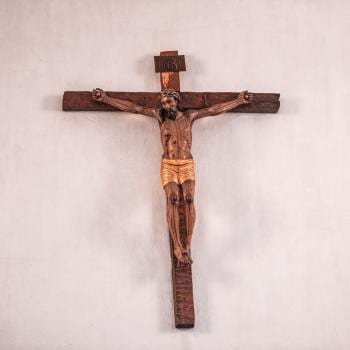
By the time of the writing of this letter, the cross was still an image of utter shame, of humiliation.
I have a lovely latticed cross hanging in my school room that Matt carved for me. It stands for me as a symbol of love, of hope, of forgiveness. On the two cross beams, while I was yet thrashing around grabbing what I need, taking what I can get, shoving people out of the way for my rights,
this person, Jesus, who did not take what he was owed, who put aside the glory and honor of being God, and came to earth who was born, which, let’s not cast a glow of beauty and wonder over that, the business of being born is humiliating–both for the mother, I’ll just speak for myself, and certainly for the baby, naked, helpless.
This person, God,came into total poverty, born not at Wilson Hospital with a phalanx of knowledgeable medical staff, but on the floor of an animal holding pen to a humiliated and despised teenage mother. And from his birth he went on to travel with a group of outcasts and potential trouble makers.
If you had the whole world in your hands, would you solve all the world’s problems this way?
This humiliating beginning and life culminating with the greatest shame a human could suffer in the first century in the roman world. Jesus was wrongfully accused of blasphemy and sedition, he was illegally and unjustly tried, he was flogged, a torture which killed some, and was finally nailed and hung up high on two pieces of wood and left to die. He did this, Paul says, obediently. God the Father asked him to do it and and he did. Willingly.
I gaze up at my lattice cross sometimes while I am screaming at my children or whining to myself about Binghamton’s foul foul weather. My life is such a trial. As I struggle under the burden of myself, because that is what we’re talking about, the self–myself, yourself–we labor to hold ourselves together, to be successful, to do our duty, to love and be loved–Jesus came to take that burden away, to bear it for us. He counted our need as surpassing his own glory. He came to lift it up and carry it away.
Paul is asking that we then, who have had the great burden of self lifted up and healed and loved,
that we do this for one another. We count the other’s needs as greater, as surpassing, and that we lay aside ourselves first for Christ, then for each other. But this vision is not interminable suffering, humiliation and then death on the cross. No, because of what Jesus did,
Therefore God has highly exalted him and bestowed on him the name that is above every name, so that at the name of Jesus every knee should bow, in heaven and on earth and under the earth, and every tongue confess that Jesus Christ is Lord, to the glory of God the Father.
Jesus didn’t die and stay dead. He died and destroyed death. After being dead a couple of days, Jesus, man, and God, in one person, was too big for death to hold on to. Death itself broke apart
and Jesus walked out of the grave and showed himself to his friends and eventually went back to be with the Father. He is in glory. He is highly exalted. And if you are in him, if you have let all the burden of yourself fall away and took hold and grasped him, then you live in his glory. The heaven where he lives is alive in you. You aren’t laboring on alone, you really do have the comfort of Christ, the encouragement of Christ, the love of Christ, the mind of Christ, the surpassing glory of Christ to cover over you and satisfy you. So now, after this work of Christ, whereas before you could not count a single other living person as more important than you, now your glory is Christ
and you can seriously care for others along the way.
You can see that followers of Jesus who carry in their minds and hearts the virtue of humility are no wilting irritating obsequious boring wall flowers who do everything that everyone tells them to. Humility is the nature of God, loving us. Humility is God giving up his glory to come and rescue us from sin and from death. Humility is who God is. He wanted you so much that he was willing to lay aside everything to give you life.
You might see why Christians getting snappy with each other, or not caring for one another is so loathsome. Why those of you who profess to love Jesus, but have not totally let go of yourself, of your plans, the habits of your mind, the attitudes of your heart, need tonight to say a sorry to Jesus and turn around and go back to him.
For those of you who are hearing of Jesus for the first time or in a new way, I said at the beginning that I wanted to talk about letting go of yourself for a taste of glory. In giving your life to Jesus, it is not into the hand of someone who is thinking only of himself. When you give yourself to Jesus, it is to a person who has demonstrated, by the payment of his own life, that he loves you, and that he has the power to care for you. Not only so, but the power of his care and love is covered over with his surpassing and inexhaustible glory.
Previous Post

April 10, 2013
very very busy etc.
Next Post
April 19, 2013 7 quick takes, maybe
Browse Our Archives
Select a Category books Catechesis of the Good Shepherd Children in Conversation culture watch Daily Devotions Demotivations with Anne faith alone for the grandparents GAFCON In conversation with children In the News Kitchen Notes Lambeth Learning Notes Life Going On Men are Human Notes from Home Pictures Reading the Bible Saturday Links Sermons Signs of the Apocalypse The Bad Word Association The Prayer of Jonah Travel Notes Uncategorized Witless Wednesdays Work and the Christian
Select a Month June 2024 May 2024 April 2024 March 2024 February 2024 January 2024 November 2023 October 2023 September 2023 August 2023 July 2023 June 2023 May 2023 April 2023 March 2023 February 2023 January 2023 December 2022 November 2022 October 2022 September 2022 July 2022 May 2022 April 2022 March 2022 February 2022 January 2022 December 2021 November 2021 October 2021 September 2021 August 2021 July 2021 June 2021 May 2021 April 2021 March 2021 February 2021 January 2021 December 2020 November 2020 October 2020 September 2020 August 2020 July 2020 June 2020 May 2020 April 2020 March 2020 February 2020 January 2020 December 2019 November 2019 October 2019 September 2019 August 2019 July 2019 June 2019 May 2019 April 2019 March 2019 February 2019 January 2019 December 2018 November 2018 October 2018 September 2018 August 2018 July 2018 June 2018 May 2018 April 2018 March 2018 February 2018 January 2018 December 2017 November 2017 October 2017 September 2017 August 2017 July 2017 June 2017 May 2017 April 2017 March 2017 February 2017 January 2017 December 2016 November 2016 October 2016 September 2016 August 2016 July 2016 June 2016 May 2016 April 2016 March 2016 February 2016 January 2016 December 2015 November 2015 October 2015 September 2015 August 2015 July 2015 June 2015 May 2015 April 2015 March 2015 February 2015 January 2015 December 2014 November 2014 October 2014 September 2014 August 2014 July 2014 June 2014 May 2014 April 2014 March 2014 February 2014 January 2014 December 2013 November 2013 October 2013 September 2013 August 2013 July 2013 June 2013 May 2013 April 2013 March 2013 February 2013 January 2013 December 2012 November 2012 October 2012 September 2012 August 2012 July 2012 June 2012 May 2012 April 2012 March 2012 February 2012 January 2012 December 2011 November 2011 October 2011 September 2011 August 2011 July 2011 June 2011 May 2011 April 2011 March 2011 February 2011 January 2011 December 2010 November 2010 October 2010 September 2010 August 2010 July 2010 June 2010 May 2010 April 2010 March 2010 February 2010 January 2010 December 2009 November 2009 October 2009 September 2009 August 2009 July 2009 June 2009 May 2009 April 2009 March 2009 February 2009 January 2009 December 2008 November 2008 October 2008 September 2008 August 2008 July 2008 June 2008 May 2008 April 2008 March 2008 February 2008 January 2008 December 2007 November 2007 October 2007 September 2007 August 2007 July 2007 June 2007 May 2007 April 2007 March 2007 February 2007 January 2007 December 2006 November 2006 October 2006
Follow Us!
TAKE THE
Religious Wisdom Quiz
What does "Jezreel" mean?
Select your answer to see how you score.
God reigns God sows God fights God defends
Books by This Author Books by Anne Kennedy
Related posts from Preventing Grace


TRENDING AT PATHEOS Evangelical

The REST of Your Life: A Creative Wrestles...
This week I had a conversation with a good friend from church....

How the author of the world's best hymn...
I've been working with John Newton for a while now. This makes...

Long before this Lectio Divina, Psalm 130 - the song - started...

What About the Trees? Another Living Parable
After I finished writing the last article about falling leaves as a...

Why Classical Education Is a Conversation, Not a...
Come and Read: Joy in Classical Education When I was a little...

Cornell University has received a great deal of negative publicity and intense...
view all Evangelical blogs
Ad-Free & Subscriber Log-In Subscription Support
- About Us
- 2026 Calendar
- Videos
- Podcasts
- Library of World Religions
- Faith In Media Tracker
- Advertise With Us
- Write for Us
- Privacy Policy
- Terms of Service
- Do Not Sell My Data
- Contact Us
- Radiant Digital
- Manage Newsletter Subscriptions
- Unsubscribe From Notifications
- Sitemap
Copyright 2008-2026, Patheos. All rights reserved.
Subscription Support Ad-Free & Subscriber Log-In
Follow Patheos