
BuddhistCatholicContemplativeEvangelicalGeneral ChristianHinduJewishLatter-day SaintMuslimNew VisionsProgressive Christian
Beliefs
- Buddhist
- Catholic
- Contemplative
- Evangelical
- General Christian
- Hindu
- Jewish
- Latter-day Saint
- More Voices
- Muslim
- New Visions
- Pagan
- Progressive Christian
Topics
- Religion News
- Food and Religion
- Sports and Religion
- Religious Art
- Religious Music and Entertainment
- Religious Events
- History and Religion
- Style and Religion
- Politics and Religion
- Women in Religion
- Recreation Outdoors and Religion
- Business Finance and Religion
- Careers Workplace and Religion
- Education and Religion
- Family Parenting and Religion
- Health Fitness and Religion
- Home and Religion
- Relationships and Religion
- Technology and Religion
- Travel and Religion
Columnists
- Buddhist Columnists
- Business Finance and Religion Columnists
- Careers Workplace and Religion Columnists
- Catholic Columnists
- Contemplative Columnists
- Education and Religion Columnists
- Evangelists Columnists
- Family Parenting and Religion Columnists
- General Christian Columnists
- Health Fitness and Religion Columnists
- Hindu Columnists
- History and Religion Columnists
- Home and Religion Columnists
- Jewish Columnists
- More Voices Columnists
- Latter Day Columnists
- Muslim Columnists
- New Visions Columnists
- Nonreligious Columnists
- Pagan Columnists
- Politics and Religion Columnists
- Progressive Columnists
- Recreation Outdoors and Religion Columnists
- Relationships and Religion Columnists
- Religion News Columnists
- Religious Art Columnists
- Religious Events Columnists
- Religious Music and Entertainment Columnists
- Sports and Religion Columnists
- Style and Religion Columnists
- Technology and Religion Columnists
- Travel and Religion Columnists
- Women in Religion Columnists
Resource Library
- 2026 Calendar
- Library of World Religions
- The 100 Most Holy Places on Earth
- Patheos Answers
- Podcasts
- Videos
- Faith Leaders Database
- Anglican Episcopalian
- Bahai
- Baptist
- Buddhism
- Christianity
- Confucianism
- Eastern Orthodoxy
- Hinduism
- Holiness and Pentecostal
- ISKCON
- Islam
- Judaism
- Lutheran
- Methodist
- The Church of Jesus Christ of Latter-day Saints
- New Age
- Paganism
- Presbytarian and Reformed
- Protestantism
- Religion Behind the Scenes
- Roman Catholic
- Scientology
- Shia Islam
- Sikhism
- Sufism
- Sunni Islam
- Taoism
- Zen
- See all religions
Research Tools
 Ad-Free & Subscriber Log-In Subscription Support
Ad-Free & Subscriber Log-In Subscription Support
Follow Patheos 

- Trending:
- Forgiveness
- |
- Marriage
- |
- Consciousness
- |
- Death Penalty
- |
- Election
- |
- Halloween
 Preventing Grace
- Home
- Evangelical
- my sermon from today
my sermon from today
Last updated on: November 3, 2015 at 12:27 pm by Anne Kennedy
my sermon from today 2015-11-03T12:27:37-04:00 Anne Kennedy
Patheos Explore the world's faith through different perspectives on religion and spirituality! Patheos has the views of the prevalent religions and spiritualities of the world.
If you’d like to follow along in the bible we’ll mainly be in John 18 and 19 but I’m going to quickly walk us through the events of Jesus’ trial and execution using all four accounts.
So Jesus entered Jerusalem in triumph on Sunday and went straight to the Tempe to scope it out for the next day. On Monday and Tuesday and Wednesday he entered into serious conflict with the authorities and basically stirred the pot of conflict and anger against him all those three days. On Thursday, before the usual time to celebrate the Passover feast, Jesus joins with the 12 in the upper room to share that memorial meal, but also to teach the disciples, to institute the Eucharist, to wash their feet, to warn them about what was immediately ahead, and to pray his high priestly prayer–to, as we saw last night, love them to the end. It is during this meal that Satan enters into Judas and Jesus sends him away to do what he is going to do.
After the meal Jesus leads his disciples through Jerusalem. He takes his time. The washing of the feet, the sermon preached to his disciples at the Passover Meal and the prayer, in John, is 5 chapters long. If you account for the institution of the Eucharist, which John doesnt include, you have a considerable time in the upper room. Then the leisurely walk through the city. Then they go across the Kidron Valley to what John calls a garden. Jesus is taking his own sweet deliberate time.
Now, none of the other gospel writers call this place a garden. Mark and Matthew give the proper name of a particular place, Gesthemene. Luke use a more general and well known broader appellation, Mount of Olives. But John, using the unspecified, allows this garden to stand as a type, an opposite of another Garden standing at the beginning of time. In that garden the first man walked in the day, in the light, in beauty, in plenty, in peace, in joy. But, there in that garden, surrounded by everything his heart could desire, he chose to walk, and then, to stand, and to be comfortable, and to talk and carry on and commune with wickedness, with Satan. In a single moment, with no struggle, no thought even, he gave over his whole self, the whole earth and all of his children to death. Jesus comes into this second garden. Now it is night. Now there is struggle and pain. Instead of a moment we have a long difficult time. Rather than parlaying with Satan, Jesus seeks the face of his Father. He prays three times, perhaps in three hour blocks–can you not, he reproaches his sleeping friends, pray with me even one hour? In each hour of prayer his will bends more fully to the will of his father. Matthew records the movement in prayer. First, he asks that the cup might be removed. The second time of prayer, he shifts, if it cannot pass unless I drink it, your will be done. The anti type of Adam who stood in conversation with Satan, no struggle, no hint of consideration and then reached out and took that which seemed good to him, Jesus struggles and prays and weeps and bends his will to accept the cup the father gives him.
And at night. All of this at night.
So what of Judas? What has he been up to?
Well, remember that the rulers and authorities had been trying to arrest Jesus for a while but had been unable to. It is a reasonable speculation that they have not made plans to kill Jesus at this time. There isnt time before the Passover. They are probably afraid of him–both his own power and his effect on the crowds. They are biding their time and considering what to do. But then who should come to them that night, in stealth, but Judas. They have already formed a relationship with this man, so close to Jesus, the holder of the money, for heavens sake, but still ready to betray and inform. Judas comes with interesting information. Jesus, he might have said, has just been talking about death. He seems to expect to die. He might be in an arrestable mood. Moreover, he is this moment on the Mount of Olives with only a few friends so there would be no crowd if they want to make an arrest without an outcry.
In the intervening hours of Jesus’ meal and teaching, the prayer, the walk through Jerusalem, and then the hours of prayer in the garden, there have been rushed and wicked goings and comings across the city. Caiaphas had to get an arresting party together. He very possibly went himself to work a deal with Pilate that he would rubber stamp a capital punishment. He had to wake up the 71 strong Sanhedrin and get them ready to hear this case. He rousted his Father in Law, Annas, and got him ready to work. It is as though, with a word, with a will, the city leaps to do his will. The Lord determines the time and course of his death, and those who hate him most leap to obey.
As the preparations are completed, Jesus is confirmed in prayer. Angels come and minister to him, to strengthen him and comfort him. When he is ready, the arresting party arrives. He comes forward to meet them but, strangely, it seems like they don’t know him. He asks them whom they they are looking for and instead of saying, ‘you’ they give his name, Jesus of Nazareth. Jesus responds to them, the Greek is literally, ‘I am’. It is possible he gave this name in Hebrew. That might explain why they draw back and fall to the ground. He has to ask them again who they seek, giving them time to recover themselves. He says again, I am, and then he commands that they let his friends go free. Notice they obey. Certainly they would have wanted to gather the disciples in as witnesses, but they let them go. The Lord stands, sovereign, his arresters obey.
In the chaos of the moment, Peter strikes out with his sword. Put it away, says Jesus to Peter. The flaming sword blocking the way into Eden, the Tree of Life, is sheathed. Jesus leaves the Garden resolutely, he is not driven away.
Once arrested, Jesus is taken to Annas, who ought to be High Priest but who isn’t at this time, where he is illegally questioned directly. In Jewish law in the first century, the accused never had to speak out against himself. That his why Jesus says, ‘why do you ask me? Ask those who heard me.’ He is letting Annas know that he knows the law and will not testify against himself. From there he goes to Caiaphas. Caiaphas is the High Priest put in place by Rome. Here, in front of Caiaphas and the Sanhedrin many more laws are broken. Remember, they haven’t had very much time to get themselves together, and so to execute Jesus before the Passover they are going to have to illegally try and convict him. The first illegality is that this part of the trial happens in the middle of the night. Trials were to be conducted in the day in order to avoid the appearance of injustice and evil. Secondly, there were very strict rules about who could be a witness and the job of the witness. In Matthew 26 we can see that the court wastes a lot of time trying to find witnesses. Legally, the witness of a crime was bound to arrest the perpetrator and then serve as the prosecutor in the trial. It then would fall to the Sanhedrin to either defend or find defenders for the accused. Here they can’t find witnesses who agree and no one comes to Jesus’ defense at all. Finally, it was illegal in Jewish law to convict with a unanimous vote. A unanimous vote bespoke mob emotion and rule, a court in which the accused could find no friend, no defender. The unanimous and therefore illegal vote to convict Jesus comes through a masterfully brilliant move on the part of Caiaphas. The High Priest was never to speak in a capital trial, such as this one, yet here, in desperation, he stands up and puts Jesus to the most sacred oath, the oath of the testimony, I adjure you by the living God, that he is not only the messiah, but also the Son of God. Alone, neither title is troublesome. Any Jewish person could claim to be the son of god in an ordinary sense, and the Jews expected a human political messiah, not a divine one. Taken together, the one interprets thr other and the one who takes them claims to be divine, of one substance with God. As a pious and true man, Jesus willingly takes the oath and strengthens it by reiterating the image in Daniel 7. Remember, he is not bound to speak, but he does. He willingly goes forward, step by step, to death. Caiaphas tears his robes and cries ‘blasphemy’.
From there, in the early morning, Jesus is taken to Pilate. Here, there is good reason to believe that Caiaphas expects a rubber stamp for his night’s work. This might be so because it seems like the Chief Priests are thrown into confusion by Pilate’s questioning and try to appeal to their own goodness as a reason to proceed. Why would Pilate change his mind? During this same night, his wife has had a troubling dream about Jesus, and so Pilate, a weak and superstitious man, decides to try Jesus for true. John ironically notes that those who delivered Jesus to Pilate would not go in to Pilate’s headquarters for fear of being defiled before the Passover. Having been caught off guard by Pilate’s intention to hold a real trial they change the convicting charge from blasphemy, about which Pilate would not have cared, to sedition against Rome and not paying taxes.
Pilate questions Jesus from the temporal seat of judgment. But it is really he who is on trial before Jesus. He asks the questions and Jesus answers them, but the answers reveal the truth at the heart of the universe, that Jesus is king, the king who bears the truth, who witnesses to it, who embodies it. Pilate looks at the truth and flinches. ‘What is truth’ he asks. But he doesn’t want to know. He takes Jesus back to the Jewish rulers and announces his innocence but the moment of reckoning found him a coward, so when the chief priests protest he sends Jesus to Herod. Herod is curious but cruel. When Jesus doesn’t do tricks his soldiers beat and mock him. And send him back to Pilate.
Pilate’s next attempt to free Jesus is to compare him with the most notoriously evil man in Jerusalem–Barabbas. The name Barabbas means ‘son of a father’. He himself is a type, the worst of men, rightfully convicted of murder and sedition, in prison waiting to die. In a twist that seems to surprisePilate, the crowd chooses Barabbas and cries out for Jesus to die. Barabbas is a real man, an exchange is truly made–Jesus stands in the place of Barabbas and dies instead of him. The righteous man dying for the sinner. What happened bodily and visibly for Barabbas is what is offered to those of us who look on, some 2000 years later.
But Pilate still doesn’t want to execute a good man, so he has Jesus flogged, hoping the gathering crowds will come to their senses in front of an obviously innocent and now broken man. His flesh torn, covered in blood, crowned in mockery and robed in contempt, Jesus is stood in front of the crowd. Pilate calls out ‘Behold the man’. A man of sorrows, aquatinted the grief. Is there any sorrow like his sorrow? Any suffering like his? The crowd bays for his blood crying, ‘blasphemy.’
Pilate is running out of time but he tries one more time to get Jesus speak and defend himself. What sort of person chooses to die? What sort of person goes all the way to suffering without crying out or trying to stop it? This person, Jesus, in his glory, in his power, is so steadfast, all of creation does his will, whether in hatred, fear, or in love. Finally, Pilate sits down in judgment seat, the Jewish Rulers before him, and Jesus. And he says this time, ‘behold your king.’ And then, in the moment of greatest irony, greatest tragedy, greatest truth, the chief priests cry out, ‘we have no king but ceasar.’
And so Jesus is taken out to die. As thousands of lambs are that moment being slaughtered in the temple, the volume of blood so great flowing off the altar that it turns the stream running through Jerusalem red, Jesus is hung between two theives. In the final moments of his life, before he gives over his spirit, his own perfect blood flowing down to accomplish what not one single drop of lamb’s blood can do, he says, ‘it is finished’.
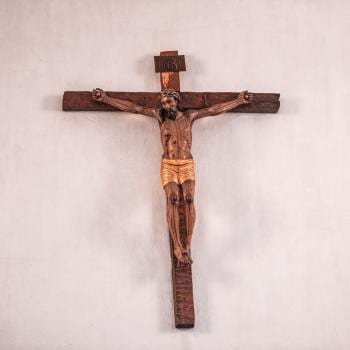
Done. Accomplished. Complete. The light came into the darkness and conquered he darkness, exposing the hearts of men, shining the truth into a world that doesn’t struggle against the darkness, that walks and stands and sits in the way of wickedness, that would rather embrace the thing most hated then repent and turn around, that chooses fear over the truth. We live in this world. It is alive in our minds, in our hearts, it has corrupted our understanding. And yet here comes the man, behold him, he is the king, he comes forward, with power and glory and strength, not flinching, not running away. He comes and embraces the death that is our future. We, imprisoned by sin, like Barabbas, deserving to die, or, like Pilate, averting our eyes from the pain of the truth, or, like Caiaphas, grasping hold of our greatest hate in rejecting Jesus, or like Peter, denying him, or, like Judas, betraying him, we will ultimately obey the king. Yet he, lifted up, dying, his arms stretched out on the hard wood of the cross offers the chance for us to come in humility, love, repentance, willingly. And for those who come now, for those there is no longer any condemnation. The light of truth is married to the grace and mercy of love. Our Lord did this incredible thing out of love, not wanting that you should perish in the prison of your sin. The final people in this moment of greatest sorrow, whom we have not spoken of, looked up at the tree and lived. The thief next to Jesus. The disciple whom Jesus loved. His mother and the other women. I pray that you will leave here this afternoon having looked at the truth without flinching. That you will sit at the foot of the cross and love your Lord who loves you. That you will give yourself to him as completely, as steadfastly as he gave himself to you. If you are his then there is no condemnation, no sin, no darkness, no lie, no wickedness that can separate you from his love. Neither death, nor principalities, nor power can separate you from the love of God in Christ Jesus. Behold the man, your king, your God.
Previous Post

March 24, 2013
a week to think about Jesus and get really really tired
Next Post
March 30, 2013 he is risen
Browse Our Archives
Select a Category books Catechesis of the Good Shepherd Children in Conversation culture watch Daily Devotions Demotivations with Anne faith alone for the grandparents GAFCON In conversation with children In the News Kitchen Notes Lambeth Learning Notes Life Going On Men are Human Notes from Home Pictures Reading the Bible Saturday Links Sermons Signs of the Apocalypse The Bad Word Association The Prayer of Jonah Travel Notes Uncategorized Witless Wednesdays Work and the Christian
Select a Month June 2024 May 2024 April 2024 March 2024 February 2024 January 2024 November 2023 October 2023 September 2023 August 2023 July 2023 June 2023 May 2023 April 2023 March 2023 February 2023 January 2023 December 2022 November 2022 October 2022 September 2022 July 2022 May 2022 April 2022 March 2022 February 2022 January 2022 December 2021 November 2021 October 2021 September 2021 August 2021 July 2021 June 2021 May 2021 April 2021 March 2021 February 2021 January 2021 December 2020 November 2020 October 2020 September 2020 August 2020 July 2020 June 2020 May 2020 April 2020 March 2020 February 2020 January 2020 December 2019 November 2019 October 2019 September 2019 August 2019 July 2019 June 2019 May 2019 April 2019 March 2019 February 2019 January 2019 December 2018 November 2018 October 2018 September 2018 August 2018 July 2018 June 2018 May 2018 April 2018 March 2018 February 2018 January 2018 December 2017 November 2017 October 2017 September 2017 August 2017 July 2017 June 2017 May 2017 April 2017 March 2017 February 2017 January 2017 December 2016 November 2016 October 2016 September 2016 August 2016 July 2016 June 2016 May 2016 April 2016 March 2016 February 2016 January 2016 December 2015 November 2015 October 2015 September 2015 August 2015 July 2015 June 2015 May 2015 April 2015 March 2015 February 2015 January 2015 December 2014 November 2014 October 2014 September 2014 August 2014 July 2014 June 2014 May 2014 April 2014 March 2014 February 2014 January 2014 December 2013 November 2013 October 2013 September 2013 August 2013 July 2013 June 2013 May 2013 April 2013 March 2013 February 2013 January 2013 December 2012 November 2012 October 2012 September 2012 August 2012 July 2012 June 2012 May 2012 April 2012 March 2012 February 2012 January 2012 December 2011 November 2011 October 2011 September 2011 August 2011 July 2011 June 2011 May 2011 April 2011 March 2011 February 2011 January 2011 December 2010 November 2010 October 2010 September 2010 August 2010 July 2010 June 2010 May 2010 April 2010 March 2010 February 2010 January 2010 December 2009 November 2009 October 2009 September 2009 August 2009 July 2009 June 2009 May 2009 April 2009 March 2009 February 2009 January 2009 December 2008 November 2008 October 2008 September 2008 August 2008 July 2008 June 2008 May 2008 April 2008 March 2008 February 2008 January 2008 December 2007 November 2007 October 2007 September 2007 August 2007 July 2007 June 2007 May 2007 April 2007 March 2007 February 2007 January 2007 December 2006 November 2006 October 2006
Follow Us!
TAKE THE
Religious Wisdom Quiz
According to James, what should elders do for someone who is sick?
Select your answer to see how you score.
Give them holy water Fast for them Lay hands on them Pray over them and anoint them with oil
Books by This Author Books by Anne Kennedy
Related posts from Preventing Grace


TRENDING AT PATHEOS Evangelical

The REST of Your Life: A Creative Wrestles...
This week I had a conversation with a good friend from church....

How the author of the world's best hymn...
I've been working with John Newton for a while now. This makes...

Long before this Lectio Divina, Psalm 130 - the song - started...

What About the Trees? Another Living Parable
After I finished writing the last article about falling leaves as a...

Why Classical Education Is a Conversation, Not a...
Come and Read: Joy in Classical Education When I was a little...

Cornell University has received a great deal of negative publicity and intense...
view all Evangelical blogs
Ad-Free & Subscriber Log-In Subscription Support
- About Us
- 2026 Calendar
- Videos
- Podcasts
- Library of World Religions
- Faith In Media Tracker
- Advertise With Us
- Write for Us
- Privacy Policy
- Terms of Service
- Do Not Sell My Data
- Contact Us
- Radiant Digital
- Manage Newsletter Subscriptions
- Unsubscribe From Notifications
- Sitemap
Copyright 2008-2026, Patheos. All rights reserved.
Subscription Support Ad-Free & Subscriber Log-In
Follow Patheos