
BuddhistCatholicContemplativeEvangelicalGeneral ChristianHinduJewishLatter-day SaintMuslimNew VisionsProgressive Christian
Beliefs
- Buddhist
- Catholic
- Contemplative
- Evangelical
- General Christian
- Hindu
- Jewish
- Latter-day Saint
- More Voices
- Muslim
- New Visions
- Pagan
- Progressive Christian
Topics
- Religion News
- Food and Religion
- Sports and Religion
- Religious Art
- Religious Music and Entertainment
- Religious Events
- History and Religion
- Style and Religion
- Politics and Religion
- Women in Religion
- Recreation Outdoors and Religion
- Business Finance and Religion
- Careers Workplace and Religion
- Education and Religion
- Family Parenting and Religion
- Health Fitness and Religion
- Home and Religion
- Relationships and Religion
- Technology and Religion
- Travel and Religion
Columnists
- Buddhist Columnists
- Business Finance and Religion Columnists
- Careers Workplace and Religion Columnists
- Catholic Columnists
- Contemplative Columnists
- Education and Religion Columnists
- Evangelists Columnists
- Family Parenting and Religion Columnists
- General Christian Columnists
- Health Fitness and Religion Columnists
- Hindu Columnists
- History and Religion Columnists
- Home and Religion Columnists
- Jewish Columnists
- More Voices Columnists
- Latter Day Columnists
- Muslim Columnists
- New Visions Columnists
- Nonreligious Columnists
- Pagan Columnists
- Politics and Religion Columnists
- Progressive Columnists
- Recreation Outdoors and Religion Columnists
- Relationships and Religion Columnists
- Religion News Columnists
- Religious Art Columnists
- Religious Events Columnists
- Religious Music and Entertainment Columnists
- Sports and Religion Columnists
- Style and Religion Columnists
- Technology and Religion Columnists
- Travel and Religion Columnists
- Women in Religion Columnists
Resource Library
- 2026 Calendar
- Library of World Religions
- The 100 Most Holy Places on Earth
- Patheos Answers
- Podcasts
- Videos
- Faith Leaders Database
- Anglican Episcopalian
- Bahai
- Baptist
- Buddhism
- Christianity
- Confucianism
- Eastern Orthodoxy
- Hinduism
- Holiness and Pentecostal
- ISKCON
- Islam
- Judaism
- Lutheran
- Methodist
- The Church of Jesus Christ of Latter-day Saints
- New Age
- Paganism
- Presbytarian and Reformed
- Protestantism
- Religion Behind the Scenes
- Roman Catholic
- Scientology
- Shia Islam
- Sikhism
- Sufism
- Sunni Islam
- Taoism
- Zen
- See all religions
Research Tools
 Ad-Free & Subscriber Log-In Subscription Support
Ad-Free & Subscriber Log-In Subscription Support
Follow Patheos 

- Trending:
- Forgiveness
- |
- Marriage
- |
- Consciousness
- |
- Death Penalty
- |
- Election
- |
- Halloween
 Pop Theology
- Home
- Progressive Christian
- Religious Music & Entertainment
- Not So Ridiculous…
Not So Ridiculous…
Last updated on: October 9, 2008 at 8:58 am by J. Ryan Parker
Not So Ridiculous… 2008-10-09T08:58:20-07:00 J. Ryan Parker
Patheos Explore the world's faith through different perspectives on religion and spirituality! Patheos has the views of the prevalent religions and spiritualities of the world.
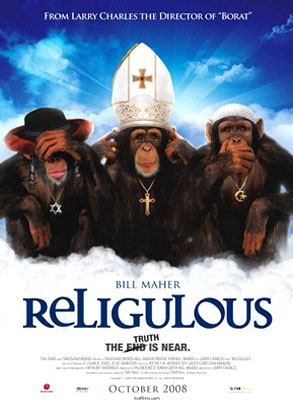
One of the great things about our Constitution is that it guarantees both the freedom of religion and the freedom from religion. Individually, we are free to practice whatever faith we choose or no faith at all. These two freedoms meet head-to-head in Bill Maher and Larry Charles’ new documentary, Religulous.
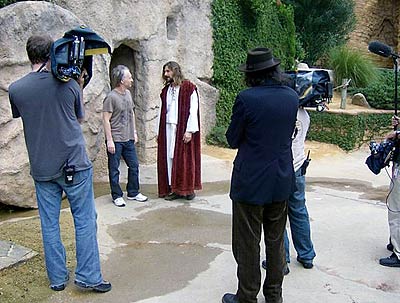 Throughout the first hour and forty minutes of this hour-and-fifty-minute-long film, comedian and talk show host Bill Maher interviews Christians, Jews, Muslims, and “Other,” all of whom are largely fundamentally conservative in their faith. To these believers, he poses questions regarding their faith and beliefs, specifically about the “plausibility” of their sacred stories and the relativity of their moral/ethical guidelines. What the believers’ answers reveal, to a large degree, is a lack of self-examination and a fundamental disconnect with the basics of their sacred texts. To counter these conservative viewpoints, Maher consults more “liberal” members of the same faiths who represent alternative opinions and theological/religious worldviews.
Along with these interviews, the film also provides a glimpse into Maher’s family history and his own faith journey. Maher’s father was Catholic and his mother is Jewish. For thirteen years, he was raised Catholic until his father left the church, for what his mother says was over their use of birth control. Maher described his time in church as something like war…long stretches of boredom with flashes of terror. Maher gradually grew away from the faith of his parents, unable to rationalize the tenets of either Christianity or Judaism with his need for a more intellectual and rational approach. Maher is now something of an agnostic, a vehemently evangelistic one at that. At one point, he says, “I preach the gospel of ‘I don’t know.'” He argues, frequently, that the most appropriate attitude is doubt, because it implies humility. In the end, he argues that we cannot know, and therefore should not claim to know, for certain issues that can so drastically affect the future of the world. For Maher, it is intensely problematic that politicians who seem so assured of the approaching end times have some use or control over nuclear weapons.
Unfortunately, as so often is the case, Maher just can’t help himself. For the last ten minutes of the film, Maher enters into his usual polemical sermonizing on the evils of religion, even going so far this time as to say that for humanity to live, religion must die. He highlights the perilous relationship between end times prophecies and our nuclear capabilities. At the beginning of the film, Maher argues that, before, only God could have destroyed the world, but now, with nuclear armament, we have the power and ability and that religious fervor could provide the motivation. At the end of the film, Maher questions if what little peace and comfort religion provides its adherents is worth the unspeakable suffering that has been propagated in the name of God throughout history.
In the end, to make his claims, Maher must ignore a significant portion of history. His complaints about the suffering caused by religion and in the name of God could not be more accurate. However, he blindly disregards the great social changes that have occurred throughout history with religion or devout religious people as their main catalyst. Gandhi or Martin Luther King, Jr. should immediately spring to mind. After seeing the preview for the film several months ago, a friend commented, “All he’s doing is picking on the low-hanging fruit.” For the most part, this is the case. Maher cannot and does not engage with intellectuals who take their faith and religion seriously, because, for him, the two are oil and water. On his HBO series, if anyone pushes him on his one-sided view of religion, he just bangs the drum even louder.
Despite my fundamental disagreement with his central opinion of religion, I do appreciate the agnostic attitude that characterizes much of his film. I could not agree more with his call for a more doubting, and thus humble, approach to knowledge/belief/faith. However, his doubt overflows with pride. Maher does not seem to be keen on discussing differences between knowledge/intellect and belief/faith and how the two are fundamentally different but can still coincide. Like his religious victims, he conflates the two to the detriment of both. In the end, I also appreciate his strong desire to separate religion and politics, especially the polluting link that is growing increasingly strong between Christianity and nationalism.
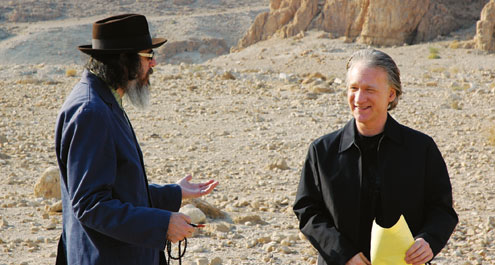 Despite these disagreements, Religulous is still a very enjoyable film, especially if you don’t take yourself too seriously. Director Larry Charles adds some great editorial touches with images from conservative Christian television and film, even though much of it has now become something in the way of stock footage for (mis?)representing all things religious. While Charles and Maher might be taking themselves too seriously, they do show the violent/dangerous results of being too critical of religious zealots, showing news footage of Islamic fundamentalists reactions to Salman Rushdie and Danish filmmaker Theo Van Gogh. Yet a recent Entertainment Weekly interview with Larry Charles reveals that they approach this danger light-heartedly as well. When asked if he was concerned that he could become a new target for angry religious zealots and endure a similar fate like Rushdie or van Gogh, Charles responded, “If we get murdered, it’ll make a great DVD extra.”
Love him or hate him, Bill Maher has made a religious documentary worth seeing. Religulous should be shown in all faith communities and theological schools, because the questions he asks these unsuspecting believers, should be the questions that people of faith ask themselves every day.
Religulous (101 mins.) is rated R for language and some sexual material and is in theaters everywhere…maybe.
Previous Post

October 7, 2008
Fireproof...
Next Post
October 14, 2008 Bad Movie Monday: The Happening
Browse Our Archives
Select a Category Classics DVD Film Music News Pop Culture Events Print Sports Television Uncategorized Video Games
Select a Month March 2017 February 2017 January 2017 December 2016 November 2016 October 2016 September 2016 August 2016 July 2016 June 2016 May 2016 April 2016 March 2016 February 2016 January 2016 December 2015 November 2015 October 2015 September 2015 August 2015 July 2015 June 2015 May 2015 April 2015 March 2015 February 2015 January 2015 December 2014 November 2014 October 2014 September 2014 August 2014 July 2014 June 2014 May 2014 April 2014 March 2014 February 2014 January 2014 December 2013 November 2013 October 2013 September 2013 August 2013 July 2013 June 2013 May 2013 April 2013 March 2013 February 2013 January 2013 December 2012 November 2012 October 2012 September 2012 August 2012 July 2012 June 2012 May 2012 April 2012 March 2012 February 2012 January 2012 December 2011 November 2011 October 2011 September 2011 August 2011 July 2011 June 2011 May 2011 April 2011 March 2011 February 2011 January 2011 December 2010 November 2010 October 2010 September 2010 August 2010 July 2010 June 2010 May 2010 April 2010 March 2010 February 2010 January 2010 December 2009 November 2009 October 2009 September 2009 August 2009 July 2009 June 2009 May 2009 April 2009 March 2009 February 2009 January 2009 December 2008 November 2008 October 2008 September 2008 August 2008 July 2008 June 2008 May 2008 April 2008 March 2008 February 2008 January 2008 December 2007 November 2007 October 2007 September 2007 August 2007 July 2007 June 2007 May 2007 April 2007 March 2007
Follow Us!
TAKE THE
Religious Wisdom Quiz
What nature miracle did Jesus perform during a storm on the sea?
Select your answer to see how you score.
Calmed the wind and waves Fed the crew Turned water to oil Walked on water
Related posts from Pop Theology


At SXSW2017: May It Last: A Portrait of...

At SXSW 2017: "Untold Tales of Armistead Maupin"
TRENDING AT PATHEOS Progressive Christian

Why Christians Have a Sacred Duty to Vote:...
The Bible offers strong support for the sacred duty to vote. Here...

What Being a Modern-Day Apostle Means to Me
In my last column, I discussed the ins and outs of modern-day...

Did Ancient China Once Worship the God of...
Across human history, a common thread weaves through the origins of the...

Love Your Neighbor – Including Earth-Kin: Lev. 19,...
God’s command to love your neighbor means acting in an ethical and...

Lead a Church Study of “Jesus and Lao...
Guest writer Jack Thomas (The Irreverent Reverend) reflects on leading his church...

Principles for Understanding the Apostolic Ministry Today
Whenever people discover that my formal ministry title is "apostle," as in...
view all Progressive Christian blogs
Ad-Free & Subscriber Log-In Subscription Support
- About Us
- 2026 Calendar
- Videos
- Podcasts
- Library of World Religions
- Faith In Media Tracker
- Advertise With Us
- Write for Us
- Privacy Policy
- Terms of Service
- Do Not Sell My Data
- Contact Us
- Radiant Digital
- Manage Newsletter Subscriptions
- Unsubscribe From Notifications
- Sitemap
Copyright 2008-2026, Patheos. All rights reserved.
Subscription Support Ad-Free & Subscriber Log-In
Follow Patheos