
BuddhistCatholicContemplativeEvangelicalGeneral ChristianHinduJewishLatter-day SaintMuslimNew VisionsProgressive Christian
Beliefs
- Buddhist
- Catholic
- Contemplative
- Evangelical
- General Christian
- Hindu
- Jewish
- Latter-day Saint
- More Voices
- Muslim
- New Visions
- Pagan
- Progressive Christian
Topics
- Religion News
- Food and Religion
- Sports and Religion
- Religious Art
- Religious Music and Entertainment
- Religious Events
- History and Religion
- Style and Religion
- Politics and Religion
- Women in Religion
- Recreation Outdoors and Religion
- Business Finance and Religion
- Careers Workplace and Religion
- Education and Religion
- Family Parenting and Religion
- Health Fitness and Religion
- Home and Religion
- Relationships and Religion
- Technology and Religion
- Travel and Religion
Columnists
- Buddhist Columnists
- Business Finance and Religion Columnists
- Careers Workplace and Religion Columnists
- Catholic Columnists
- Contemplative Columnists
- Education and Religion Columnists
- Evangelists Columnists
- Family Parenting and Religion Columnists
- General Christian Columnists
- Health Fitness and Religion Columnists
- Hindu Columnists
- History and Religion Columnists
- Home and Religion Columnists
- Jewish Columnists
- More Voices Columnists
- Latter Day Columnists
- Muslim Columnists
- New Visions Columnists
- Nonreligious Columnists
- Pagan Columnists
- Politics and Religion Columnists
- Progressive Columnists
- Recreation Outdoors and Religion Columnists
- Relationships and Religion Columnists
- Religion News Columnists
- Religious Art Columnists
- Religious Events Columnists
- Religious Music and Entertainment Columnists
- Sports and Religion Columnists
- Style and Religion Columnists
- Technology and Religion Columnists
- Travel and Religion Columnists
- Women in Religion Columnists
Resource Library
- 2026 Calendar
- Library of World Religions
- The 100 Most Holy Places on Earth
- Patheos Answers
- Podcasts
- Videos
- Faith Leaders Database
- Anglican Episcopalian
- Bahai
- Baptist
- Buddhism
- Christianity
- Confucianism
- Eastern Orthodoxy
- Hinduism
- Holiness and Pentecostal
- ISKCON
- Islam
- Judaism
- Lutheran
- Methodist
- The Church of Jesus Christ of Latter-day Saints
- New Age
- Paganism
- Presbytarian and Reformed
- Protestantism
- Religion Behind the Scenes
- Roman Catholic
- Scientology
- Shia Islam
- Sikhism
- Sufism
- Sunni Islam
- Taoism
- Zen
- See all religions
Research Tools
 Ad-Free & Subscriber Log-In Subscription Support
Ad-Free & Subscriber Log-In Subscription Support
Follow Patheos 

- Trending:
- Forgiveness
- |
- Marriage
- |
- Consciousness
- |
- Death Penalty
- |
- Election
- |
- Halloween
 Pop Theology
- Home
- Progressive Christian
- Religious Music & Entertainment
- Seeing the Unseen in MOONLIGHT
Seeing the Unseen in MOONLIGHT
Last updated on: March 2, 2017 at 12:20 pm by J. Ryan Parker
Seeing the Unseen in MOONLIGHT 2017-03-02T12:20:16-08:00 J. Ryan Parker
Patheos Explore the world's faith through different perspectives on religion and spirituality! Patheos has the views of the prevalent religions and spiritualities of the world.
Film has the power to make the invisible visible. It can also force viewers to witness what they have previously refused to see. The critically-acclaimed Moonlight (winner of 3 Academy Awards including Best Picture) does just that, transporting viewers to a place and time and into peoples’ lives that aren’t often the subject of most theatrical releases.
A timeless story of human connection and self-discovery, Moonlight chronicles the life of a young black man, Chiron (played at three points in his life by three different actors), from childhood to adulthood as he struggles to find his place in the world while growing up in a rough neighborhood of Miami. At once a vital portrait of contemporary African American life and an intensely personal and poetic meditation on identity, family, friendship, and love, Moonlight is a groundbreaking piece of cinema that reverberates with deep compassion and universal truths. Anchored by extraordinary performances from a tremendous ensemble cast, director Barry Jenkins’ staggering, singular vision is profoundly moving in its portrayal of the moments, people, and unknowable forces that shape our lives and make us who we are.
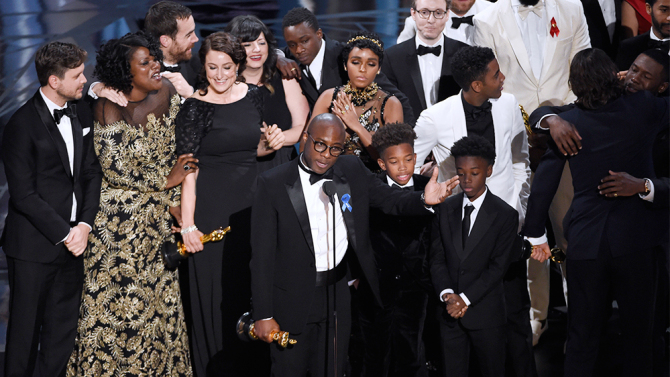
Barry Jenkins, foreground center, and the cast accept the award for best picture for “Moonlight” at the Oscars on Sunday, Feb. 26, 2017, at the Dolby Theatre in Los Angeles. (Photo by Chris Pizzello/Invision/AP)
A recent screening, hosted by My Brother’s Keeper, included a Q and A panel with playwright Tarell Alvin McCraney (on whose play, “In the Moonlight Black Boys Look Blue,” the film is based), director Jenkins, and stars Mahershala Ali and Naomie Harris. Their conversation speaks volumes to the church, especially as it continues to come to grips with its own responses to and engagement with LGBTQ communities.
Much of Moonlight is inspired by McCraney’s own upbringing and experiences in a poverty-stricken community overrun with drug dealers. Having moved out of that community, he realizes that he is now “surrounded by people who do not look like me, who do not come from where I come from, who do not socially locate the way I do, and do not have the same anxieties that I have in the world.” Like Chiron, McCraney’s mother was a drug-addict, and a drug dealer stepped into his life as a sometime father figure, even teaching him how to ride a bike. As the years have passed, McCraney “felt these people slipping away like sand” and knew that he “had to tell this story to show the world that they exist.”
Ali plays Juan, Chiron’s mentor, one of the more complex characters to grace the screen this year and for quite some time. As he mentors and cares for Chiron, yet sells his mother crack, Juan proves that we are all, at some level, victims and violators, individuals in need of redemption yet capable of transforming the lives of those around us for good. Ali praised the rhythm of McCraney and Jenkins’ script and talked about “being a servant to these characters and their stories.” Ali, like his colleagues, was and is drawn to the power of the film to lead to deeper conversations and greater empathy: “People need to take a minute after Moonlight,” Ali quipped.
As someone who doesn’t even drink alcohol, Harris found it difficult to inhabit the role of Paula, Chiron’s crack-addicted and verbally abusive mother, who, essentially, abandons him when he needs her most. Harris talked about finding ways to sympathize with her character: “How does someone become addicted?” Harris remembered that hurt people hurt people and realized that Paula’s abuse and neglect of Chiron likely came from a place of deep personal loss and pain.
In each case, be it McCraney’s writing, Jenkins’ direction, or Ali and Harris’ performances, Moonlight refuses to fall into political or ideological trappings. It is a deeply human narrative, a beautiful and tragic love story. It shows us images that we don’t often see at our local movie theaters: caring gangsters, young gay black men, relationships between two men or a man and a woman that aren’t fetishized or hyperbolized. It gives voice and light to the lives of quiet desperation that so many young LGBTQ individuals lead across our country.
Ali talked about preparing for the challenging role of Juan, and a desire fueled his performance: “I thought about interactions with children and young people. I never want to walk away from an encounter without them feeling uplifted.” This, as much as anything, gets at the heart of Moonlight, a film that depicts bleak situations with such honesty and integrity that its uplifting conclusion doesn’t feel like a betrayal, but rather a transformation.
Previous Post

March 1, 2017
#KillerSerials: THE PATH, S2 Ep7

Browse Our Archives
Select a Category Classics DVD Film Music News Pop Culture Events Print Sports Television Uncategorized Video Games
Select a Month March 2017 February 2017 January 2017 December 2016 November 2016 October 2016 September 2016 August 2016 July 2016 June 2016 May 2016 April 2016 March 2016 February 2016 January 2016 December 2015 November 2015 October 2015 September 2015 August 2015 July 2015 June 2015 May 2015 April 2015 March 2015 February 2015 January 2015 December 2014 November 2014 October 2014 September 2014 August 2014 July 2014 June 2014 May 2014 April 2014 March 2014 February 2014 January 2014 December 2013 November 2013 October 2013 September 2013 August 2013 July 2013 June 2013 May 2013 April 2013 March 2013 February 2013 January 2013 December 2012 November 2012 October 2012 September 2012 August 2012 July 2012 June 2012 May 2012 April 2012 March 2012 February 2012 January 2012 December 2011 November 2011 October 2011 September 2011 August 2011 July 2011 June 2011 May 2011 April 2011 March 2011 February 2011 January 2011 December 2010 November 2010 October 2010 September 2010 August 2010 July 2010 June 2010 May 2010 April 2010 March 2010 February 2010 January 2010 December 2009 November 2009 October 2009 September 2009 August 2009 July 2009 June 2009 May 2009 April 2009 March 2009 February 2009 January 2009 December 2008 November 2008 October 2008 September 2008 August 2008 July 2008 June 2008 May 2008 April 2008 March 2008 February 2008 January 2008 December 2007 November 2007 October 2007 September 2007 August 2007 July 2007 June 2007 May 2007 April 2007 March 2007
Follow Us!
TAKE THE
Religious Wisdom Quiz
What sign did God give Hezekiah to show he would be healed?
Select your answer to see how you score.
A river turned to blood The sun's shadow went backward Fire from heaven Rain in drought
Related posts from Pop Theology
#KillerSerials: THE PATH, S2 Ep. 11

#KillerSerials: THE PATH, S2 Ep. 10

At SXSW2017: May It Last: A Portrait of...
TRENDING AT PATHEOS Progressive Christian

What Being a Modern-Day Apostle Means to Me
In my last column, I discussed the ins and outs of modern-day...

Did Ancient China Once Worship the God of...
Across human history, a common thread weaves through the origins of the...

Love Your Neighbor – Including Earth-Kin: Lev. 19,...
God’s command to love your neighbor means acting in an ethical and...

Lead a Church Study of “Jesus and Lao...
Guest writer Jack Thomas (The Irreverent Reverend) reflects on leading his church...

Pastoral Wisdom for Responding to Sermon Pushback
Getting sermon pushback on your social justice sermon? Learn practical, Proverbs-based strategies...

Principles for Understanding the Apostolic Ministry Today
Whenever people discover that my formal ministry title is "apostle," as in...
view all Progressive Christian blogs
Ad-Free & Subscriber Log-In Subscription Support
- About Us
- 2026 Calendar
- Videos
- Podcasts
- Library of World Religions
- Faith In Media Tracker
- Advertise With Us
- Write for Us
- Privacy Policy
- Terms of Service
- Do Not Sell My Data
- Contact Us
- Radiant Digital
- Manage Newsletter Subscriptions
- Unsubscribe From Notifications
- Sitemap
Copyright 2008-2026, Patheos. All rights reserved.
Subscription Support Ad-Free & Subscriber Log-In
Follow Patheos