
BuddhistCatholicContemplativeEvangelicalGeneral ChristianHinduJewishLatter-day SaintMuslimNew VisionsProgressive Christian
Beliefs
- Buddhist
- Catholic
- Contemplative
- Evangelical
- General Christian
- Hindu
- Jewish
- Latter-day Saint
- More Voices
- Muslim
- New Visions
- Pagan
- Progressive Christian
Topics
- Religion News
- Food and Religion
- Sports and Religion
- Religious Art
- Religious Music and Entertainment
- Religious Events
- History and Religion
- Style and Religion
- Politics and Religion
- Women in Religion
- Recreation Outdoors and Religion
- Business Finance and Religion
- Careers Workplace and Religion
- Education and Religion
- Family Parenting and Religion
- Health Fitness and Religion
- Home and Religion
- Relationships and Religion
- Technology and Religion
- Travel and Religion
Columnists
- Buddhist Columnists
- Business Finance and Religion Columnists
- Careers Workplace and Religion Columnists
- Catholic Columnists
- Contemplative Columnists
- Education and Religion Columnists
- Evangelists Columnists
- Family Parenting and Religion Columnists
- General Christian Columnists
- Health Fitness and Religion Columnists
- Hindu Columnists
- History and Religion Columnists
- Home and Religion Columnists
- Jewish Columnists
- More Voices Columnists
- Latter Day Columnists
- Muslim Columnists
- New Visions Columnists
- Nonreligious Columnists
- Pagan Columnists
- Politics and Religion Columnists
- Progressive Columnists
- Recreation Outdoors and Religion Columnists
- Relationships and Religion Columnists
- Religion News Columnists
- Religious Art Columnists
- Religious Events Columnists
- Religious Music and Entertainment Columnists
- Sports and Religion Columnists
- Style and Religion Columnists
- Technology and Religion Columnists
- Travel and Religion Columnists
- Women in Religion Columnists
Resource Library
- 2026 Calendar
- Library of World Religions
- The 100 Most Holy Places on Earth
- Patheos Answers
- Podcasts
- Videos
- Faith Leaders Database
- Anglican Episcopalian
- Bahai
- Baptist
- Buddhism
- Christianity
- Confucianism
- Eastern Orthodoxy
- Hinduism
- Holiness and Pentecostal
- ISKCON
- Islam
- Judaism
- Lutheran
- Methodist
- The Church of Jesus Christ of Latter-day Saints
- New Age
- Paganism
- Presbytarian and Reformed
- Protestantism
- Religion Behind the Scenes
- Roman Catholic
- Scientology
- Shia Islam
- Sikhism
- Sufism
- Sunni Islam
- Taoism
- Zen
- See all religions
Research Tools
 Ad-Free & Subscriber Log-In Subscription Support
Ad-Free & Subscriber Log-In Subscription Support
Follow Patheos 

- Trending:
- Forgiveness
- |
- Marriage
- |
- Consciousness
- |
- Death Penalty
- |
- Election
- |
- Halloween
 Pop Theology
- Home
- Progressive Christian
- Religious Music & Entertainment
- San Francisco: The Movie
San Francisco: The Movie
Last updated on: September 11, 2016 at 11:34 pm by Richard Lindsay
San Francisco: The Movie 2016-09-11T23:34:36-07:00 Richard Lindsay
Patheos Explore the world's faith through different perspectives on religion and spirituality! Patheos has the views of the prevalent religions and spiritualities of the world.
“I’ve come to the conclusion that there are really only two types of people in San Francisco…’Jeanettes’…and ‘Tonys.’ Jeanettes are people who think that the city’s theme song is ‘San Francisco’ as sung by Jeanette MacDonald. Tonys think it’s Tony Bennett singing ‘I Left My Heart in San Francisco.’ Everyone falls into one camp or another . . . in a manner of speaking.” — Michael Tolliver in Armistead Maupin’s Further Tales of the City.
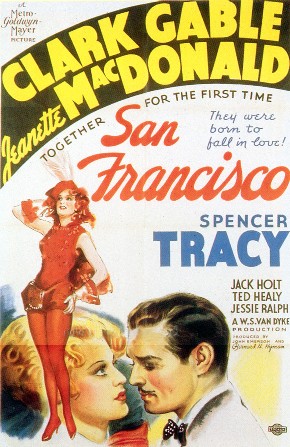 For the last two weeks I have felt what the Israelites must have felt returning from Babylon. Coming back from the far provinces to the Bay Area has sometimes left me bleary-eyed with disbelief, wondering if I’ll awake from the dream of the high-tech metropolis and find myself back in the swamps of South Louisiana.
So just to stop pinching myself and get back into the spirit of what locals call The City, I’ve been watching a series of San Francisco classics on film. Being a “Jeanette,” I thought I should start with San Francisco, the 1936 Clark Gable, Spencer Tracy, and Jeanette MacDonald film that introduced the city’s bouncier, campier theme song. (San Francisco, open your Golden Gate/You’ll let no stranger wait outside your door…)
The story is set in the Barbary Coast—the saloons, brothels, and burlesque theaters that sprung up in the late 19th and early 20th centuries north of Market Street along the Embarcadero, some of it literally built on the carcasses of Gold Rush ships abandoned in harbor.
Clark Gable plays his usual charming cad character, this time as Blackie Norton, king of the Coast and owner of the Paradise Club. His best friend is Father Tim Mullen (Spencer Tracy) a childhood pal who runs a nearby mission for the poor, and still hopes for redemption for Norton. In walks Mary Blake (Jeanette MacDonald), a classically trained singer who’s down on her luck. Blackie offers her a job, but only if she’ll jazz up her act for his theater. Father Mullen sees Mary, still uncorrupted by the bawdy excesses of the Coast, as the key to winning Blackie’s soul.
MacDonald, though beautiful and with obvious vocal talent, grates with her passive Sunday school-girl act. Her heart doesn’t seem to lurch back and forth between the devil Gable and the angel Tracy so much as the two men seem to pull at her in their spiritual tug-of-war. It’s like she doesn’t have a thought in her head except to keep singing. Which she does. Endlessly. When she’s not “jazzing up” the theme song to San Francisco, which is indistinguishable from when she sings it “straight,” she’s performing in the local opera house. The difference between the “high art” of the opera house, and the “low art” of the burlesque theater acts as a metaphor for the polish of civilization wiping away the tarnish of a frontier town. But after Jeanette’s long, looooong, operatic scenes from Faust and La Traviata, we’re ready to go back and see what the can-can girls are up to at the Paradise Club.
Gable is at the height of his powers as a predatory womanizer. “Well sister, what’s your racket?” he asks Mary when she first shows up. “I’m a singer,” she says. “Let’s see your legs!” he says. “I’m a singer!” she insists.
Blackie calls everyone who’s not as smarmily seductive as he is, “suckers.” My favorite use of this term of art is when Blackie tries to enforce his contract on Mary’s performances by bringing in a kind of a legal thug called a “process server.”
“That process server is the meanest man west of the Rocky Mountains. He’d push his mother off a ferryboat for half a dollar. Yeah, he’d turn the air off in a baby’s incubator just to watch the little sucker squirm.”
The city’s resonance with Blackie is obvious when Father Tim calls San Francisco, “The wickedest, most corrupt city, most Godless city in America. Sometimes it frightens me.”
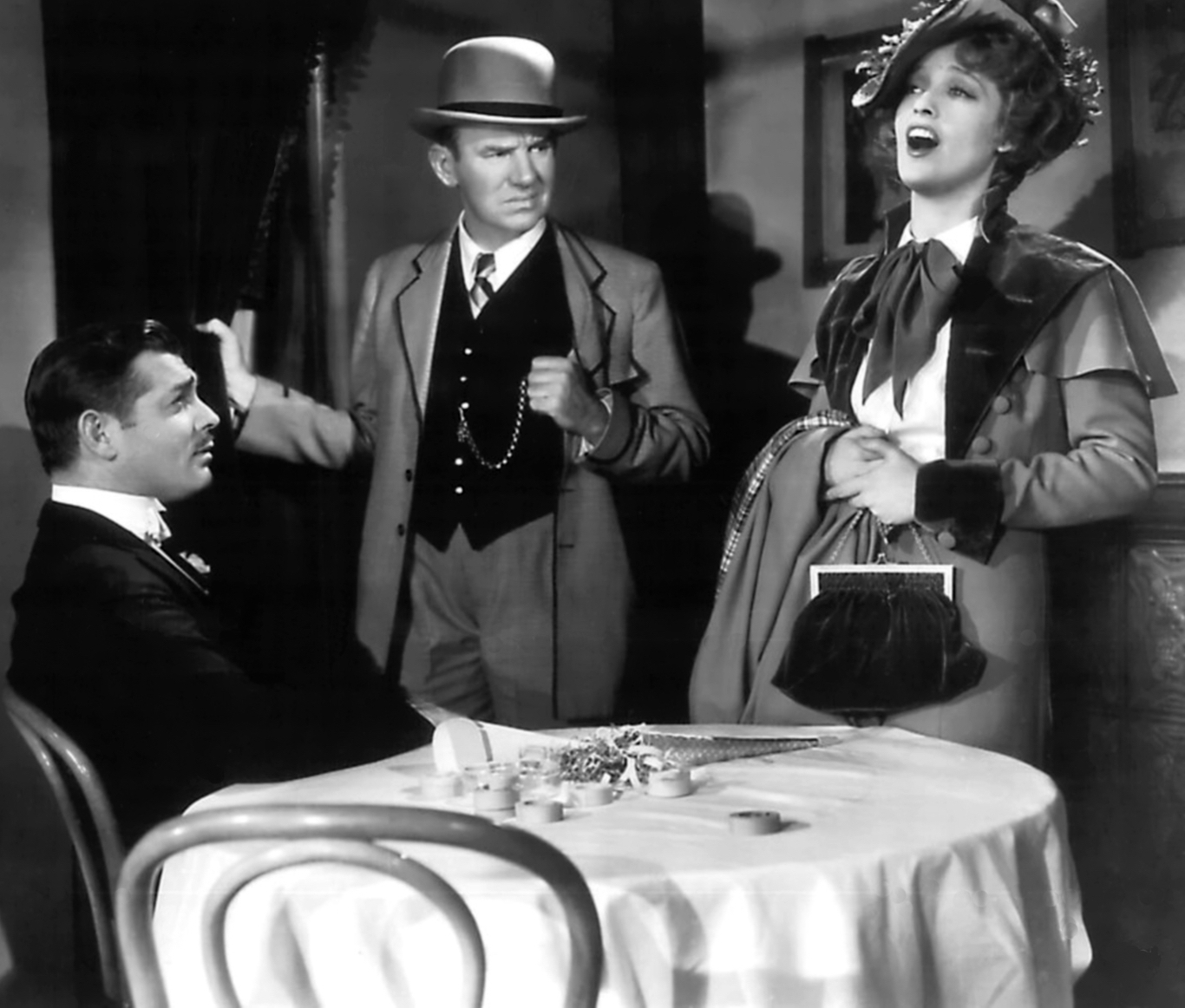
“I’m a singer.” “Well, let’s see your legs.”
But this was the early days of the Hays Code, and no debauched Hollywood production would be complete without some “compensating moral values.” That is, Divine Vengeance opening up a can of whoop-ass on the sinners so they’ll feel some real pain for their evil. Fortunately, God provided the scriptwriters the 1906 earthquake.
Once the shaking starts, the film transforms from a musical-dramedy to a full-on disaster film. And it doesn’t pull any punches. The scenes of the earthquake and its aftermath are spectacular. No jiggling cameras here, MGM built the set to shake and fall apart as central casting went screaming for the doors. The scenes of destruction are not stock footage of buildings coming down, but elaborate models of famous buildings like old San Francisco City Hall crumbling to pieces. As the denizens of the Barbary Coast wander about in realistic states of shock, a vertical fault rises in the middle of the street and underground natural gas lines ignite shooting flame into the air. Soon the whole model city is burning, and the Barbary Coast is turned to ash. This is early Hollywood special effects at its best.
Gable spends the next day and night wandering from relief camp to relief camp looking for Mary. When he finally finds her, she’s singing of course, dewy makeup unblemished, leading a bedraggled choir in “Nearer My God to Thee” as an extra expires. Gable finds himself wanting to kneel in thanks to God, and his priest friend is there to encourage him. God has wiped the sin from the city and from Blackie in on fell swoop. Too bad all those other people had to die in the process.
The film ends on a high note, with the people of San Francisco promising to rebuild, looking over the destroyed city and singing “The Battle Hymn of the Republic,” which transitions into the San Francisco theme song at the end. In the original ending shown in theaters (unfortunately not on the DVD or streaming versions) there were shots of the Golden Gate Bridge being built, which would open the next year. It must have been inspiring to Depression-era audiences to see such a tangible sign of progress rising above a city that was once in ashes.
What resonated for me was the second part of the song’s chorus, the part that goes, “San Francisco, here is your wandering one/Saying I’ll wander no more.” For all her camp Sunday-school sincerity, I’m definitely a Jeanette. And I’m planning on “Wandering no more.”
Perhaps part of the reason for the camp aura that surrounds MacDonald in the movie San Francisco, and the song “San Francisco,” is Judy Garland’s indelible performance, which embellishes on both. Click on the picture to watch the video on YouTube.
Previous Post

September 8, 2016
#KillerSerials: LAST CHANCE U
Next Post

September 19, 2016 #KillerSerials: STRANGER THINGS
Browse Our Archives
Select a Category Classics DVD Film Music News Pop Culture Events Print Sports Television Uncategorized Video Games
Select a Month March 2017 February 2017 January 2017 December 2016 November 2016 October 2016 September 2016 August 2016 July 2016 June 2016 May 2016 April 2016 March 2016 February 2016 January 2016 December 2015 November 2015 October 2015 September 2015 August 2015 July 2015 June 2015 May 2015 April 2015 March 2015 February 2015 January 2015 December 2014 November 2014 October 2014 September 2014 August 2014 July 2014 June 2014 May 2014 April 2014 March 2014 February 2014 January 2014 December 2013 November 2013 October 2013 September 2013 August 2013 July 2013 June 2013 May 2013 April 2013 March 2013 February 2013 January 2013 December 2012 November 2012 October 2012 September 2012 August 2012 July 2012 June 2012 May 2012 April 2012 March 2012 February 2012 January 2012 December 2011 November 2011 October 2011 September 2011 August 2011 July 2011 June 2011 May 2011 April 2011 March 2011 February 2011 January 2011 December 2010 November 2010 October 2010 September 2010 August 2010 July 2010 June 2010 May 2010 April 2010 March 2010 February 2010 January 2010 December 2009 November 2009 October 2009 September 2009 August 2009 July 2009 June 2009 May 2009 April 2009 March 2009 February 2009 January 2009 December 2008 November 2008 October 2008 September 2008 August 2008 July 2008 June 2008 May 2008 April 2008 March 2008 February 2008 January 2008 December 2007 November 2007 October 2007 September 2007 August 2007 July 2007 June 2007 May 2007 April 2007 March 2007
Follow Us!
TAKE THE
Religious Wisdom Quiz
Which Old Testament book does not mention God?
Select your answer to see how you score.
Esther Song of Solomon Ecclesiastes Ruth
Related posts from Pop Theology
The Mastodon In The Room: A Conversation with...

#KillerSerials: THE PATH, S2 Ep. 11


At SXSW2017: Music Festival Day 5
TRENDING AT PATHEOS Progressive Christian

Why Christians Have a Sacred Duty to Vote:...
The Bible offers strong support for the sacred duty to vote. Here...

What Being a Modern-Day Apostle Means to Me
In my last column, I discussed the ins and outs of modern-day...

Did Ancient China Once Worship the God of...
Across human history, a common thread weaves through the origins of the...

Love Your Neighbor – Including Earth-Kin: Lev. 19,...
God’s command to love your neighbor means acting in an ethical and...

Lead a Church Study of “Jesus and Lao...
Guest writer Jack Thomas (The Irreverent Reverend) reflects on leading his church...

Principles for Understanding the Apostolic Ministry Today
Whenever people discover that my formal ministry title is "apostle," as in...
view all Progressive Christian blogs
Ad-Free & Subscriber Log-In Subscription Support
- About Us
- 2026 Calendar
- Videos
- Podcasts
- Library of World Religions
- Faith In Media Tracker
- Advertise With Us
- Write for Us
- Privacy Policy
- Terms of Service
- Do Not Sell My Data
- Contact Us
- Radiant Digital
- Manage Newsletter Subscriptions
- Unsubscribe From Notifications
- Sitemap
Copyright 2008-2026, Patheos. All rights reserved.
Subscription Support Ad-Free & Subscriber Log-In
Follow Patheos