
BuddhistCatholicContemplativeEvangelicalGeneral ChristianHinduJewishLatter-day SaintMuslimNew VisionsProgressive Christian
Beliefs
- Buddhist
- Catholic
- Contemplative
- Evangelical
- General Christian
- Hindu
- Jewish
- Latter-day Saint
- More Voices
- Muslim
- New Visions
- Pagan
- Progressive Christian
Topics
- Religion News
- Food and Religion
- Sports and Religion
- Religious Art
- Religious Music and Entertainment
- Religious Events
- History and Religion
- Style and Religion
- Politics and Religion
- Women in Religion
- Recreation Outdoors and Religion
- Business Finance and Religion
- Careers Workplace and Religion
- Education and Religion
- Family Parenting and Religion
- Health Fitness and Religion
- Home and Religion
- Relationships and Religion
- Technology and Religion
- Travel and Religion
Columnists
- Buddhist Columnists
- Business Finance and Religion Columnists
- Careers Workplace and Religion Columnists
- Catholic Columnists
- Contemplative Columnists
- Education and Religion Columnists
- Evangelists Columnists
- Family Parenting and Religion Columnists
- General Christian Columnists
- Health Fitness and Religion Columnists
- Hindu Columnists
- History and Religion Columnists
- Home and Religion Columnists
- Jewish Columnists
- More Voices Columnists
- Latter Day Columnists
- Muslim Columnists
- New Visions Columnists
- Nonreligious Columnists
- Pagan Columnists
- Politics and Religion Columnists
- Progressive Columnists
- Recreation Outdoors and Religion Columnists
- Relationships and Religion Columnists
- Religion News Columnists
- Religious Art Columnists
- Religious Events Columnists
- Religious Music and Entertainment Columnists
- Sports and Religion Columnists
- Style and Religion Columnists
- Technology and Religion Columnists
- Travel and Religion Columnists
- Women in Religion Columnists
Resource Library
- 2026 Calendar
- Library of World Religions
- The 100 Most Holy Places on Earth
- Patheos Answers
- Podcasts
- Videos
- Faith Leaders Database
- Anglican Episcopalian
- Bahai
- Baptist
- Buddhism
- Christianity
- Confucianism
- Eastern Orthodoxy
- Hinduism
- Holiness and Pentecostal
- ISKCON
- Islam
- Judaism
- Lutheran
- Methodist
- The Church of Jesus Christ of Latter-day Saints
- New Age
- Paganism
- Presbytarian and Reformed
- Protestantism
- Religion Behind the Scenes
- Roman Catholic
- Scientology
- Shia Islam
- Sikhism
- Sufism
- Sunni Islam
- Taoism
- Zen
- See all religions
Research Tools
 Ad-Free & Subscriber Log-In Subscription Support
Ad-Free & Subscriber Log-In Subscription Support
Follow Patheos 

- Trending:
- Forgiveness
- |
- Marriage
- |
- Consciousness
- |
- Death Penalty
- |
- Election
- |
- Halloween
 Pop Theology
- Home
- Progressive Christian
- Religious Music & Entertainment
- Movie Review: HIGH RISE
Movie Review: HIGH RISE
Last updated on: September 8, 2016 at 9:56 am by J. Ryan Parker
Movie Review: HIGH RISE 2016-09-08T09:56:24-07:00 J. Ryan Parker
Patheos Explore the world's faith through different perspectives on religion and spirituality! Patheos has the views of the prevalent religions and spiritualities of the world.
It’s time for another Pop Theology conversation. This time, Benjamin Griffin and Ryan Parker discuss the new Netflix arrival, High Rise, Ben Wheatley’s adaptation of the novel by J. G. Ballard.
In High Rise, doctor Robert Laing (Tom Hiddleston) moves into a luxurious, 1970s London skyscraper that features a wealth of modern conveniences. As its residents become more closed off from the outside world, the infrastructure begins to fail (power outages, wine shortages (!), and the like) and tensions between the stratified classes become apparent. The building soon descends into violent chaos. High Rise also stars Jeremy Irons, Sienna Miller, and Elisabeth Moss.

RP: High Rise is a hot mess. It’s hot because it looks good and features some inspired shots/sequences throughout. I’m also a sucker for a dystopian/apocalyptic narrative, especially one like this that finds the seeds of our destruction in the current moment, or as Laing puts it, “We are living in a future that’s already happened.” But it’s a mess because the themes of class warfare, wealth inequality, etc. are so heavy-handed. Unless this heavy-handedness is the point or is pointing to something else and I’m just missing it. It’s also regrettable how poorly the film treats women, which makes its potentially pro-feminist conclusion–the mass stabbing of Wilder–feel hollow.
On a side note, our friends in the UK actually live in an apartment complex that is economically stratified. They’re in the middle, and now I’m scared to go stay with them.
BG: I will give you that it’s heavy handed but I don’t think it’s a bad thing. I’m hard pressed to even think of a dystopian/class warfare sort of movie that isn’t. Snowpiecer was heavy handed – hell, even A Clockwork Orange is! What I found so marvelous about how High Rise handled it’s themes, however, is that the characters seemingly went out of their way to ignore the chaos that unfolds around them. It’s a class warfare movie that fights to maintain its class. For me, this made the movie an exciting and unnerving trip.
But, yes, the women/feminist issue is alarming but I think it might be intentional. The movie takes place in a 70’s sort of atmosphere, a time where the “women’s lib” movement was in full swing and still barely taken seriously. So, while the men are all barreling forward as if nothings changed, the women are, in little ways, taking power for themselves (often in the form of Tom Hiddleston’s Dr. Laing) culminating in the mass stabbing. My only problem there is that I think the wrong man got stabbed.
Also, economically stratified apartments are inherently creepy to me. I would probably take the apartments from “Attack the Block” over the one in “High Rise” even if I were at the top.
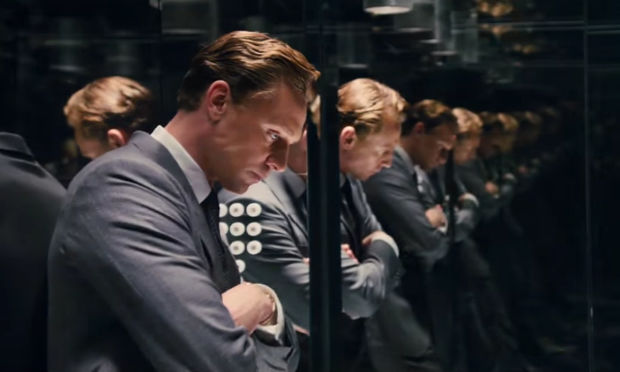
RP: Good point on heavy-handedness. Who do you think should have been stabbed?!
One of the reasons that I love dystopian and post-apocalyptic films is, often, their production value. I think this is an area where High Rise excels. From a production standpoint, I’m always curious about budgets and location shooting vs. shooting on a sound stage. This is one of those films where I think a “making of” featurette would be just as interesting.
Also, I find it interesting, although not at all surprising, that religion (in any form, but particularly institutionalized) is completely absent from the film. Although, given the comparatively recent and rapid decline of religious institutions in Great Britain, it would have been interesting to see one floor devoted to the Church of England or some sort of cult. There is that painting in the Architect’s apartment that seems to have a cult motif, and the whole upperclass feels like a cult. I was wondering if they were going to sacrifice or rape Elizabeth Moss’ character. Rosemary’s Baby anyone?
BG: Well, it might be a bit on the nose, but I think the Architect deserved it most. It was his mess to begin with and one that he allowed to fester either through ignorance or sheer will. I think Wilder was chaotic neutral at best but had decent intentions at the start in hoping to depose the king. It’s too bad he lost his mind/soul trying to figure out how to do so. The Architect, however, never seemed to have a heart from the start.
The religious question is an interesting one but, to be honest, one that I hadn’t considered while watching the film. Perhaps it’s because of the secularization of Great Britain that I hadn’t expected it or maybe because the film itself seems to be so solely concerned with the economic state that nothing else really matters. But, I guess you’re right, that is their religion. Their professions–doctor, actress, filmmaker–only mean as much as where it gets them and, even then, some of them seem to be born into cult regardless. But it does raise an interesting question about the baby–had they rescued the baby to bring it up to their status? What was with that horrifying scene where she was brought up to the top? I was certainly fearing a sacrifice of some sort only to be jarringly met with a birth ringing through the ducts of the building.
RP: If we squint, we could see The Architect as some sort of divine figure, which would certainly put to shame many atonement theories that portray a helpless humanity against an imperfect, weak, twisted, and/or foolish deity. Sticking the different classes in a high rise apartment and telling them to get along (or toying with them with power outages or wine shortages) echoes the Garden of Eden and God putting Adam and Eve there but telling them not to partake of that one tree.
But we’ve hinted at it and the spiritual themes seem apparent. When you remove an impetus to sacrifice of self and care for the least of these, all we are left with are those empty orgies and some pretty rotten hangovers.
BG: Getting some Gnostic vibes from that assessment–are they trapped by their dependence upon the material, the vain, and the selfish? Then again, I wouldn’t say Laing was any more free than when he began trying to win the social approval of the high rise. Which actually raises an interesting question – who was he even? What did he want or get out of his interaction with the high rise (aside from some roast dog, I suppose…)?
RP: That’s another great question (and potential shortcoming of the film). Who were any of these people? They were more archetypes than real, breathing characters, which is, perhaps, why our inability to fully identify with Laing all the more frustrating.
BG: But you could argue that the disconnect from identifiable characters made the experience all the more dizzying and enjoyable. Thinking about it all day really makes me want to watch it again!
RP: Speaking of watching it again, when you told me that you had seen the film for the first time, you were thrilled by the soundtrack. What about it grabbed your attention?
BG: Oh the soundtrack! I am still aglow from the soundtrack. For a majority of the film it maintains this wonderfully classic, orchestral score, one that seemingly belongs in an old school romance. Aside from a couple of delightful and disorienting foreign disco tunes that purposefully disrupt the flow of the film, the soundtrack has this lovely air to it that bucks against the unfolding chaos in a really magical way. The best soundtracks function as a secondary script to a movie and this one, I thought, mirrored perfectly the characters’ relentless maintaining of social airs as everything broke down around them.
Previous Post

September 7, 2016
Book Review: THE NEW MUTANTS
Next Post

September 8, 2016 #KillerSerials: LAST CHANCE U
Browse Our Archives
Select a Category Classics DVD Film Music News Pop Culture Events Print Sports Television Uncategorized Video Games
Select a Month March 2017 February 2017 January 2017 December 2016 November 2016 October 2016 September 2016 August 2016 July 2016 June 2016 May 2016 April 2016 March 2016 February 2016 January 2016 December 2015 November 2015 October 2015 September 2015 August 2015 July 2015 June 2015 May 2015 April 2015 March 2015 February 2015 January 2015 December 2014 November 2014 October 2014 September 2014 August 2014 July 2014 June 2014 May 2014 April 2014 March 2014 February 2014 January 2014 December 2013 November 2013 October 2013 September 2013 August 2013 July 2013 June 2013 May 2013 April 2013 March 2013 February 2013 January 2013 December 2012 November 2012 October 2012 September 2012 August 2012 July 2012 June 2012 May 2012 April 2012 March 2012 February 2012 January 2012 December 2011 November 2011 October 2011 September 2011 August 2011 July 2011 June 2011 May 2011 April 2011 March 2011 February 2011 January 2011 December 2010 November 2010 October 2010 September 2010 August 2010 July 2010 June 2010 May 2010 April 2010 March 2010 February 2010 January 2010 December 2009 November 2009 October 2009 September 2009 August 2009 July 2009 June 2009 May 2009 April 2009 March 2009 February 2009 January 2009 December 2008 November 2008 October 2008 September 2008 August 2008 July 2008 June 2008 May 2008 April 2008 March 2008 February 2008 January 2008 December 2007 November 2007 October 2007 September 2007 August 2007 July 2007 June 2007 May 2007 April 2007 March 2007
Follow Us!
TAKE THE
Religious Wisdom Quiz
True or False: The fruit of the Spirit includes love, joy, peace, and twelve other qualities.
Select your answer to see how you score.
TRUE FALSE
Related posts from Pop Theology


At SXSW2017: May It Last: A Portrait of...

At SXSW 2017: "Untold Tales of Armistead Maupin"
TRENDING AT PATHEOS Progressive Christian

Why Christians Have a Sacred Duty to Vote:...
The Bible offers strong support for the sacred duty to vote. Here...

What Being a Modern-Day Apostle Means to Me
In my last column, I discussed the ins and outs of modern-day...

Did Ancient China Once Worship the God of...
Across human history, a common thread weaves through the origins of the...

Love Your Neighbor – Including Earth-Kin: Lev. 19,...
God’s command to love your neighbor means acting in an ethical and...

Lead a Church Study of “Jesus and Lao...
Guest writer Jack Thomas (The Irreverent Reverend) reflects on leading his church...

Principles for Understanding the Apostolic Ministry Today
Whenever people discover that my formal ministry title is "apostle," as in...
view all Progressive Christian blogs
Ad-Free & Subscriber Log-In Subscription Support
- About Us
- 2026 Calendar
- Videos
- Podcasts
- Library of World Religions
- Faith In Media Tracker
- Advertise With Us
- Write for Us
- Privacy Policy
- Terms of Service
- Do Not Sell My Data
- Contact Us
- Radiant Digital
- Manage Newsletter Subscriptions
- Unsubscribe From Notifications
- Sitemap
Copyright 2008-2026, Patheos. All rights reserved.
Subscription Support Ad-Free & Subscriber Log-In
Follow Patheos