
BuddhistCatholicContemplativeEvangelicalGeneral ChristianHinduJewishLatter-day SaintMuslimNew VisionsProgressive Christian
Beliefs
- Buddhist
- Catholic
- Contemplative
- Evangelical
- General Christian
- Hindu
- Jewish
- Latter-day Saint
- More Voices
- Muslim
- New Visions
- Pagan
- Progressive Christian
Topics
- Religion News
- Food and Religion
- Sports and Religion
- Religious Art
- Religious Music and Entertainment
- Religious Events
- History and Religion
- Style and Religion
- Politics and Religion
- Women in Religion
- Recreation Outdoors and Religion
- Business Finance and Religion
- Careers Workplace and Religion
- Education and Religion
- Family Parenting and Religion
- Health Fitness and Religion
- Home and Religion
- Relationships and Religion
- Technology and Religion
- Travel and Religion
Columnists
- Buddhist Columnists
- Business Finance and Religion Columnists
- Careers Workplace and Religion Columnists
- Catholic Columnists
- Contemplative Columnists
- Education and Religion Columnists
- Evangelists Columnists
- Family Parenting and Religion Columnists
- General Christian Columnists
- Health Fitness and Religion Columnists
- Hindu Columnists
- History and Religion Columnists
- Home and Religion Columnists
- Jewish Columnists
- More Voices Columnists
- Latter Day Columnists
- Muslim Columnists
- New Visions Columnists
- Nonreligious Columnists
- Pagan Columnists
- Politics and Religion Columnists
- Progressive Columnists
- Recreation Outdoors and Religion Columnists
- Relationships and Religion Columnists
- Religion News Columnists
- Religious Art Columnists
- Religious Events Columnists
- Religious Music and Entertainment Columnists
- Sports and Religion Columnists
- Style and Religion Columnists
- Technology and Religion Columnists
- Travel and Religion Columnists
- Women in Religion Columnists
Resource Library
- 2026 Calendar
- Library of World Religions
- The 100 Most Holy Places on Earth
- Patheos Answers
- Podcasts
- Videos
- Faith Leaders Database
- Anglican Episcopalian
- Bahai
- Baptist
- Buddhism
- Christianity
- Confucianism
- Eastern Orthodoxy
- Hinduism
- Holiness and Pentecostal
- ISKCON
- Islam
- Judaism
- Lutheran
- Methodist
- The Church of Jesus Christ of Latter-day Saints
- New Age
- Paganism
- Presbytarian and Reformed
- Protestantism
- Religion Behind the Scenes
- Roman Catholic
- Scientology
- Shia Islam
- Sikhism
- Sufism
- Sunni Islam
- Taoism
- Zen
- See all religions
Research Tools
 Ad-Free & Subscriber Log-In Subscription Support
Ad-Free & Subscriber Log-In Subscription Support
Follow Patheos 

- Trending:
- Forgiveness
- |
- Marriage
- |
- Consciousness
- |
- Death Penalty
- |
- Election
- |
- Halloween
 Pop Theology
- Home
- Progressive Christian
- Religious Music & Entertainment
- What Jonathan Strange & Mr. Norrell Says about the Church
What Jonathan Strange & Mr. Norrell Says about the Church
Last updated on: May 29, 2016 at 11:52 pm by Richard Lindsay
What Jonathan Strange & Mr. Norrell Says about the Church 2016-05-29T23:52:01-07:00 Richard Lindsay
Patheos Explore the world's faith through different perspectives on religion and spirituality! Patheos has the views of the prevalent religions and spiritualities of the world.
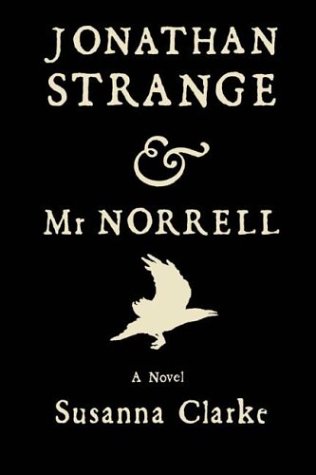 Susanna Clarke’s fantasy novel Jonathan Strange & Mr. Norrell begins in a peculiar place for a story about magic. As it commences in 1806, magic has ceased to be done in England for 300 years. There are magicians, but they meet in societies and discuss magic. They are theoretical magicians, not practical magicians. And in fact the doing of magic has become a bit disrespectable—associated with parlor tricks and fortune-telling done by grimy street performers. Thus, the “Learned Society of York Magicians” is taken aback when a newcomer named John Segundus shows up at their meeting having the temerity to ask why—Why has magic not been done in England for 300 years?
The book, published in 2004, was a runaway success–winning the Hugo award for science fiction/fantasy and being nominated for the Man Booker Prize. Probably not a lot of books achieve that kind of cross-genre acclaim.
It is written in the style of a 19th century novel, combining the fantastical elements of magic with a comedy of manners. It outlines an alternative history of England, including the Napoleonic Wars, debates in Parliament, and the madness of King George III, as if all of these events were affected by the reemergence of English magic.
Gilbert Norrell makes the first appearance despite his counterpart’s top billing in the title. An introvert and a bookworm, he has been hoarding books on magic in his country estate in Yorkshire for decades. At the prodding of the Society’s new upstart member, Segundus, he makes a bet with the Society. He will perform an actual act of magic, if they will cease calling themselves magicians. On the appointed day, never leaving his precious library, he demonstrates his magic to the Society by making hundreds of stone statues and carvings in York Minster Cathedral come alive and talk. In a scene straight out of Acts, chapter 2, the statues all begin babbling in their various tongues—mainly Old English and Latin—protesting and arguing about terrible deeds done in the Cathedral the last 400 years. Like the Pentecost moment, this is the new birth of the spirit of magic in England.
Norrell reluctantly moves to London to begin promoting his magic, which he thinks will aid the English government, military, and economy. He wishes to establish magic of a “modern” sort—industrious, practical, by-the-book, and avoiding any entanglements with ancient magic, including fairies and the Medieval magical ruler of England, the Raven King. He soon gains an apprentice, Jonathan Strange. Strange is an idle gentleman of some means who stumbles onto magic when his wife insists he find a suitable profession. He is as brilliant and rash as Norrell is careful. Despite Norrell’s clinical teaching, Strange soon finds himself drawn to the wild and ancient sources of English magic, which he accesses by traveling into the land of Fairie through mirrors which act as doorways. Their disagreement on methods soon leads Strange and Norrell to separation, rupture, and rivalry.
In June 2015 the BBC and BBC America debuted a miniseries of the story. Finding a copy of the series is a little like digging up ancient books on magic—it is not streaming anywhere. If you want to see it, you will have to renew your Netflix DVD subscription, or practice some dark arts on certain torrenting web sites. I assure you, your effort will be rewarded.
This is one of the few examples where it’s better to see the movie before reading the book. It pays to get a handle on the contours of the story before diving into Clarke’s 800-page fantasy history with its copious whimsically “researched” footnotes.
The TV miniseries offers the special effects orgy you would expect. Seeing stone figures talk and the French navy befuddled by a fleet of ships made out of rain is interesting for the sake of the story, but seems kind of un-magical these days, as we know CGI when we see it.
What brings the miniseries to life is Eddie Marsan’s Norell and Bertie Carvel’s Strange. Marsan plays Norrell as a curmudgeonly introvert with a pitch-perfect Yorkshire accent. He hoards his books and is paranoid even of his own pupil. Carvel plays Strange as a blithe novice with a “what the hell, let’s try it” cheerfulness. It is through his experiences as the Duke of Wellington’s magician in battles with Napoleon that he begins to see the darker possibilities of his chosen profession. When Strange’s wife, Arabella (Charlotte Riley, excellent) is abducted into the land of Fairie, Strange’s attempts to find her lead him further into dark magic and madness.
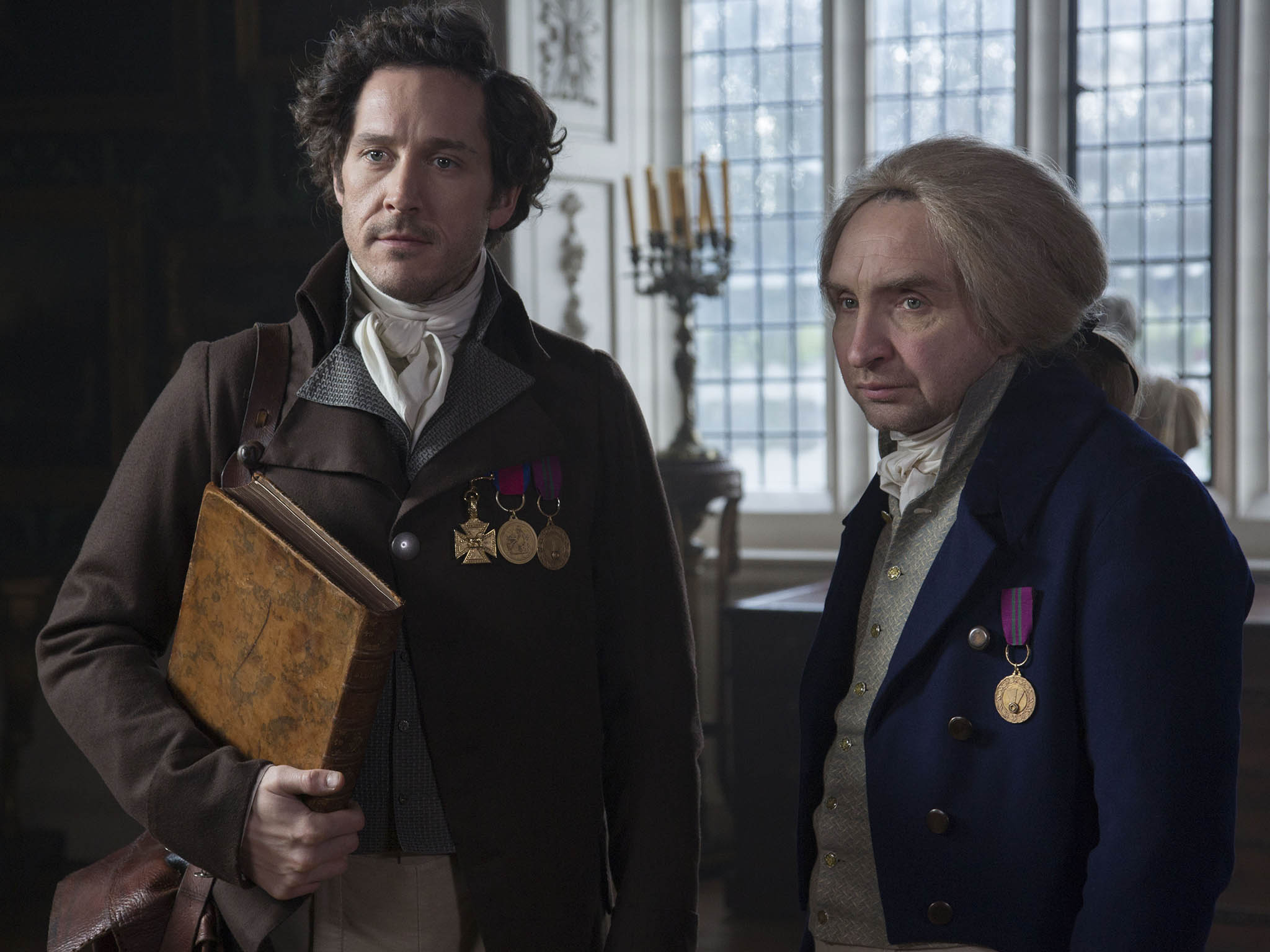
Bertie Carvel (left), as Strange, and Eddie Marsan (right), as Norrell in the 2015 BBC production of Jonathan Strange & Mr. Norrell.
The film is expertly staged as a nineteenth century costume drama, but dark and brooding, without the misty nostalgia of a Merchant-Ivory kind of production. The taut writing brings the magical action to a frightening climax, so much so that as a Louisiana thunderstorm was raging outside as the series was ending, Fred and I were hiding under the sofa pillows.
Various biographies refer to Susanna Clarke as the daughter of a Methodist minister. And she has a knack for portraying the rise and fall of institutions, their schisms, factions, and prejudices. Interestingly, in Jonathan Strange & Mr. Norrell, magic exists right alongside the Church and all the other institutions of English life. In fact, Arabella’s bother is a clergyman, and seems to have no objection to her marrying a magician. Yet, as is typical of the religious and colonial chauvinism of the times, “Christian” and “human” are used interchangeably. No one questions why these terms of existential respect are not extended to other Beings like the fairies.
The conflict between Norrell and Strange (and their later followers, “Norrellites” and “Strangeites”) could represent so many philosophical disagreements throughout history: Platonism versus Aristotalianism, Enlightenment rationality versus Romantic feeling, scholasticism versus reformation. I see Norrell as a by-the-book Presbyterian and Strange as adding that extra dash of the Holy Spirit, perhaps the “experience” found in the Wesleyan Quadrilateral, or the charismatic practice of evangelicals.
What strikes me most about the book and the series, however, is the state of magic at the beginning of the story. It is a dead tradition—“theoretical” not “practical.” I can’t help but think of it as a critique of the sclerotic institution of the Church. It has become frozen in time like the statues at York Minster. When it does speak it spouts its ancient language to an uncomprehending society and argues about controversies that have long ceased to be important.
I don’t think it’s too much of a spoiler to say that eventually, Strange and Norrell find they must help each other—that they correct each others’ excesses and play off each others’ strengths. Coming from a “Norrellite” Christian tradition, I long for some of the “Strangite” elan, a “what-the-hell-let’s-try it” spirit of adventure, especially in our worship practices and our theology. Meanwhile, there is a movement of evangelicals in the Emergent Church trying to introduce ritual, tradition, and scholastic rigor to their branch of Christianity.
In the end, the book and the movie suggest it is no coincidence that Strange and Norrell have come along at a time when English magic is at its lowest point—when it has become a purely theoretical, and thus, irrelevant institution. The ancient forces of English magic had long prophesied their coming for those who were willing to listen. The two magicians may have believed they were creating magic anew, but in fact they were summoned by a magic greater than themselves.
This is the great hope for those of us who wish to see our own theoretical institutions become practical again. Although we may feel we can do our part in the reinvention and reformation of the Church, we do not bear the responsibility alone. We are being summoned to this work by Someone greater than ourselves.
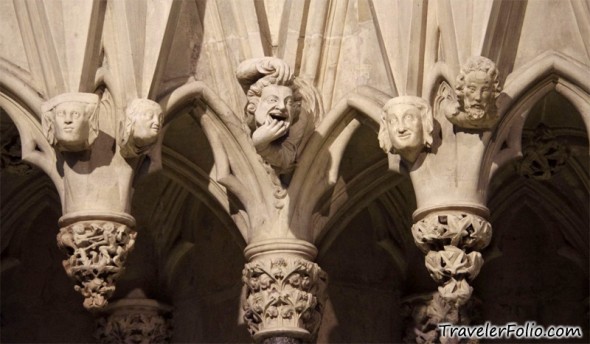
Some of the stone figures in York Minster that Mr. Norrell brought to life. Any resemblance to Church politics is purely coincidental.
Previous Post

May 27, 2016
Comics Review: CLEAN ROOM #1-6
Next Post
May 31, 2016 #KillerSerials: PREACHER, Pilot
Browse Our Archives
Select a Category Classics DVD Film Music News Pop Culture Events Print Sports Television Uncategorized Video Games
Select a Month March 2017 February 2017 January 2017 December 2016 November 2016 October 2016 September 2016 August 2016 July 2016 June 2016 May 2016 April 2016 March 2016 February 2016 January 2016 December 2015 November 2015 October 2015 September 2015 August 2015 July 2015 June 2015 May 2015 April 2015 March 2015 February 2015 January 2015 December 2014 November 2014 October 2014 September 2014 August 2014 July 2014 June 2014 May 2014 April 2014 March 2014 February 2014 January 2014 December 2013 November 2013 October 2013 September 2013 August 2013 July 2013 June 2013 May 2013 April 2013 March 2013 February 2013 January 2013 December 2012 November 2012 October 2012 September 2012 August 2012 July 2012 June 2012 May 2012 April 2012 March 2012 February 2012 January 2012 December 2011 November 2011 October 2011 September 2011 August 2011 July 2011 June 2011 May 2011 April 2011 March 2011 February 2011 January 2011 December 2010 November 2010 October 2010 September 2010 August 2010 July 2010 June 2010 May 2010 April 2010 March 2010 February 2010 January 2010 December 2009 November 2009 October 2009 September 2009 August 2009 July 2009 June 2009 May 2009 April 2009 March 2009 February 2009 January 2009 December 2008 November 2008 October 2008 September 2008 August 2008 July 2008 June 2008 May 2008 April 2008 March 2008 February 2008 January 2008 December 2007 November 2007 October 2007 September 2007 August 2007 July 2007 June 2007 May 2007 April 2007 March 2007
Follow Us!
TAKE THE
Religious Wisdom Quiz
Who was called by God to leave his home and go to a land God would show him?
Select your answer to see how you score.
Noah Abram Moses Jacob
Related posts from Pop Theology


At SXSW2017: May It Last: A Portrait of...

At SXSW 2017: "Untold Tales of Armistead Maupin"
TRENDING AT PATHEOS Progressive Christian

Why Christians Have a Sacred Duty to Vote:...
The Bible offers strong support for the sacred duty to vote. Here...

What Being a Modern-Day Apostle Means to Me
In my last column, I discussed the ins and outs of modern-day...

Did Ancient China Once Worship the God of...
Across human history, a common thread weaves through the origins of the...

Love Your Neighbor – Including Earth-Kin: Lev. 19,...
God’s command to love your neighbor means acting in an ethical and...

Lead a Church Study of “Jesus and Lao...
Guest writer Jack Thomas (The Irreverent Reverend) reflects on leading his church...

Principles for Understanding the Apostolic Ministry Today
Whenever people discover that my formal ministry title is "apostle," as in...
view all Progressive Christian blogs
Ad-Free & Subscriber Log-In Subscription Support
- About Us
- 2026 Calendar
- Videos
- Podcasts
- Library of World Religions
- Faith In Media Tracker
- Advertise With Us
- Write for Us
- Privacy Policy
- Terms of Service
- Do Not Sell My Data
- Contact Us
- Radiant Digital
- Manage Newsletter Subscriptions
- Unsubscribe From Notifications
- Sitemap
Copyright 2008-2026, Patheos. All rights reserved.
Subscription Support Ad-Free & Subscriber Log-In
Follow Patheos