
BuddhistCatholicContemplativeEvangelicalGeneral ChristianHinduJewishLatter-day SaintMuslimNew VisionsProgressive Christian
Beliefs
- Buddhist
- Catholic
- Contemplative
- Evangelical
- General Christian
- Hindu
- Jewish
- Latter-day Saint
- More Voices
- Muslim
- New Visions
- Pagan
- Progressive Christian
Topics
- Religion News
- Food and Religion
- Sports and Religion
- Religious Art
- Religious Music and Entertainment
- Religious Events
- History and Religion
- Style and Religion
- Politics and Religion
- Women in Religion
- Recreation Outdoors and Religion
- Business Finance and Religion
- Careers Workplace and Religion
- Education and Religion
- Family Parenting and Religion
- Health Fitness and Religion
- Home and Religion
- Relationships and Religion
- Technology and Religion
- Travel and Religion
Columnists
- Buddhist Columnists
- Business Finance and Religion Columnists
- Careers Workplace and Religion Columnists
- Catholic Columnists
- Contemplative Columnists
- Education and Religion Columnists
- Evangelists Columnists
- Family Parenting and Religion Columnists
- General Christian Columnists
- Health Fitness and Religion Columnists
- Hindu Columnists
- History and Religion Columnists
- Home and Religion Columnists
- Jewish Columnists
- More Voices Columnists
- Latter Day Columnists
- Muslim Columnists
- New Visions Columnists
- Nonreligious Columnists
- Pagan Columnists
- Politics and Religion Columnists
- Progressive Columnists
- Recreation Outdoors and Religion Columnists
- Relationships and Religion Columnists
- Religion News Columnists
- Religious Art Columnists
- Religious Events Columnists
- Religious Music and Entertainment Columnists
- Sports and Religion Columnists
- Style and Religion Columnists
- Technology and Religion Columnists
- Travel and Religion Columnists
- Women in Religion Columnists
Resource Library
- 2026 Calendar
- Library of World Religions
- The 100 Most Holy Places on Earth
- Patheos Answers
- Podcasts
- Videos
- Faith Leaders Database
- Anglican Episcopalian
- Bahai
- Baptist
- Buddhism
- Christianity
- Confucianism
- Eastern Orthodoxy
- Hinduism
- Holiness and Pentecostal
- ISKCON
- Islam
- Judaism
- Lutheran
- Methodist
- The Church of Jesus Christ of Latter-day Saints
- New Age
- Paganism
- Presbytarian and Reformed
- Protestantism
- Religion Behind the Scenes
- Roman Catholic
- Scientology
- Shia Islam
- Sikhism
- Sufism
- Sunni Islam
- Taoism
- Zen
- See all religions
Research Tools
 Ad-Free & Subscriber Log-In Subscription Support
Ad-Free & Subscriber Log-In Subscription Support
Follow Patheos 

- Trending:
- Forgiveness
- |
- Marriage
- |
- Consciousness
- |
- Death Penalty
- |
- Election
- |
- Halloween
 Pop Theology
- Home
- Progressive Christian
- Religious Music & Entertainment
- “The Wise Kids” and the Apocalypse of Young Adulthood
“The Wise Kids” and the Apocalypse of Young Adulthood
Last updated on: April 15, 2016 at 1:33 pm by Richard Lindsay
“The Wise Kids” and the Apocalypse of Young Adulthood 2016-04-15T13:33:11-07:00 Richard Lindsay
Patheos Explore the world's faith through different perspectives on religion and spirituality! Patheos has the views of the prevalent religions and spiritualities of the world.
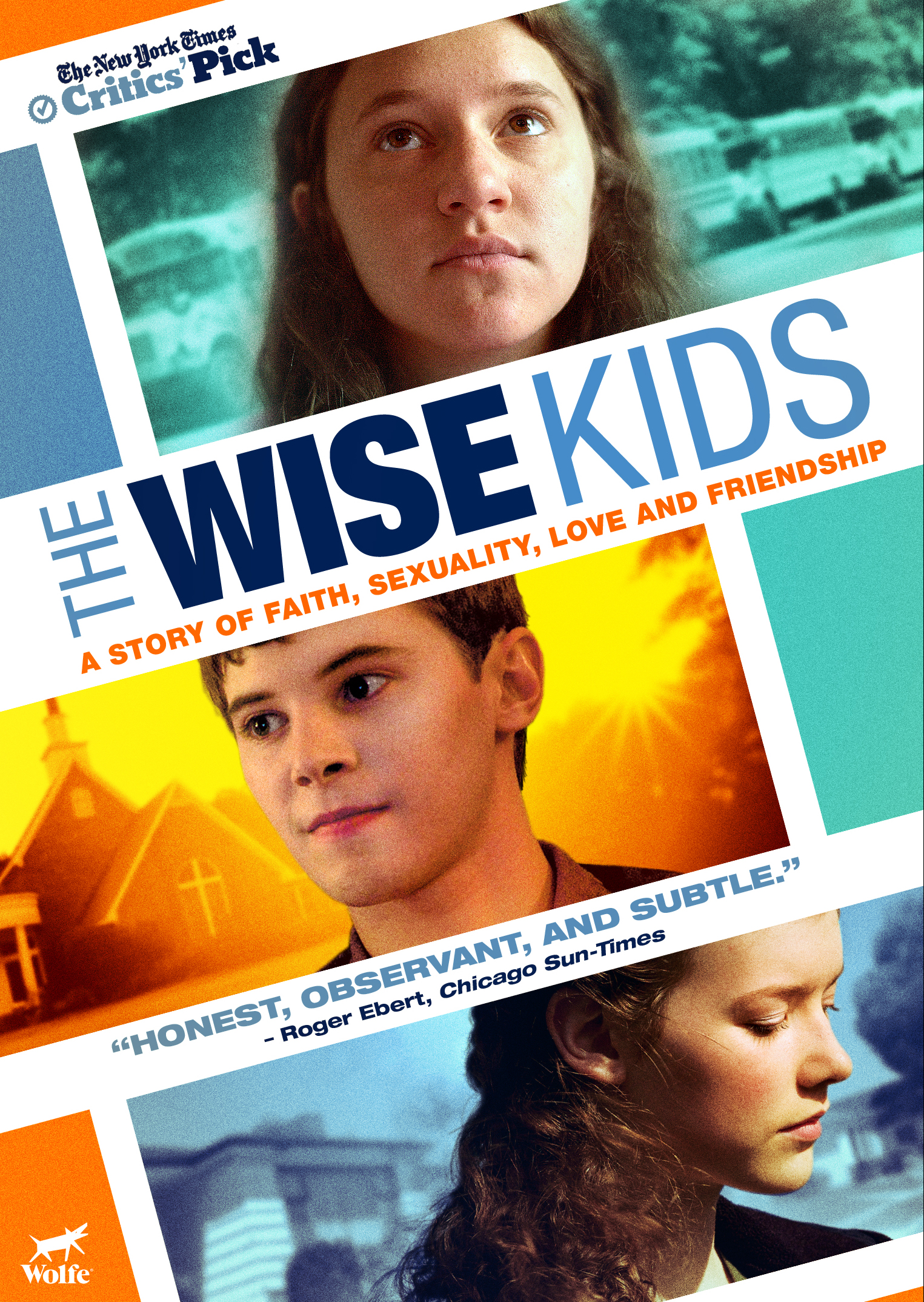 “…And lo, I am with you always, even to the end of the age.” Matthew 28:20.
I am of the notion that there is not a singular Apocalypse. Apocalypses happen multiple times in one’s life: those moments when the ground beneath you shakes and the veil of reality rips, and whether you’re ready for it or not, one age is over and a new one begins.
For many young adults, the first great apocalypse is high school graduation. The highly structured environment of high school begins to rupture and fall away. Friendships and family relationships strain and you cross the threshold between your life as a child and your life as an adult. Some people find this stage of life exhilarating. I found it terrifying.
The Wise Kids, written and directed by Stephen Cone, is about three seniors facing the graduation apocalypse, and the interminable purgatory between college admissions letters and freshman orientation. Though the film came out in 2011, it’s now widely available on Netflix. And this review is in anticipation of Cone’s most recent film, Henry Gamble’s Birthday Party, dealing with similar themes, which will be out on DVD May 3rd.
The three Wise Kids are members of a Baptist church in Charleston, South Carolina. They include Brea (Molly Kunz) the preacher’s kid who is having doubts about her faith, Tim (Tyler Ross) a creative and seemingly self-possessed young gay man on the verge of coming out, and Laura (Allison Torem) a holy roller who tends to describe God in superlatives like “awesome” and “amazing.” Rounding out the film’s major characters are Austin, the church’s closeted musical director (played by Cone), and his wife Elizabeth (Sadieh Rifai).
The film is a slice-of-life melodrama in which the center of gravity falls on each of the characters in turn. And perhaps here the apocalyptic metaphor works as well. In Greek, apokálypsis means an “uncovering” or “revealing,” and Cone “uncovers” each of the characters slowly and carefully as the film moves on.
With Brea it starts with sideways glances during one of Laura’s interminable prayers. Then she forgets the words to a hymn she’s singing in front of the church with the choir. In her part as Mary Magdalene in the church’s passion play, she just can’t seem to capture the enthusiasm of seeing the risen Jesus (played by the teenage boy in church with the longest, darkest hair, of course). Her spirit reels when she furtively Googles “religions before Christianity” and finds that other religions have virgin birth narratives.
She and Tim seem to be in cahoots throughout the film, sharing secretive looks, already developing that close bond that forms between gay men and girls that disappoint their fathers. The two are not-so-secretly planning to go to New York City for college, to unheard-of exotic worlds like The New School and NYU. Tim keeps getting outed by other people in the film, but seems to take it in stride. His widower father knows and seems to accept him, and Tim sees no conflict between his sexuality and his faith.
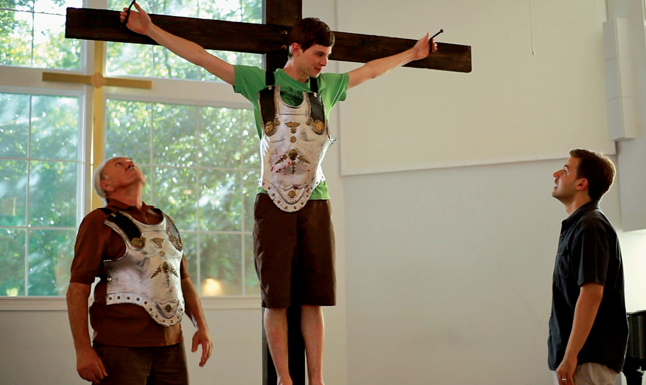
Tyler Ross (cross) and Stephen Cone (right) in The Wise Kids (Photo: Cone Arts).
Laura is the messiest of the characters, and the one I identified with most. She’s planning on going to the local Christian college, and is distressed by the changes in her ordered cosmos this apocalypse of graduation and college has brought about. When she finds out that Tim is gay, she ardently prays for him to change. Her plea to Brea as her friend gets ready to escape to New York is not so much a witnessing as begging: “I want you in heaven with me, Brea. So bad…so bad. And I know you’re getting away from all this…but don’t leave it [your faith] lightly.”
As Austin the music director, Stephen Cone wears the rictus grin of someone who has been hiding from himself, and everyone else, his whole life. He seems to have an attraction to Tim, but it’s hard to tell if it’s erotic or just a painful projection of what might have been had he come out earlier. His wife Elizabeth suffers silently through his pratfall attempts at affection, convinced she must be doing something wrong. The pastor and congregation don’t see their private struggle, and mostly seem thrilled with the music and drama Austin puts together every week at church.
Films like this can only be “independent,” because nobody takes faith this seriously in Hollywood. Cone finds the humanity in these characters’ spiritual struggles and doesn’t judge which one is on the “genuine” path. Okay, Laura probably needs meds as much as Jesus, and no gay man should be thirty, with a wife, and still not out of the closet. But these characters’ faith is not treated as a malady. The several remarkable scenes of people praying in the film reveal things about them, rather than being used as proof of hypocrisy, or as a feckless last-ditch attempt to change fate.
The film ends as the three seniors—now college freshmen—return for Christmas, their adult personas already solidifying, a new sense of confidence erasing the fears of the previous summer. And perhaps that’s what we miss about the potential good that comes from these moments of personal apocalypse. So often we think in terms of the loss of the world that’s ending, and not the potential of the world that is to come.
Previous Post
April 15, 2016
THE BIRTH OF A NATION Trailer
Next Post

April 18, 2016 Book Review: ON PURPOSE
Browse Our Archives
Select a Category Classics DVD Film Music News Pop Culture Events Print Sports Television Uncategorized Video Games
Select a Month March 2017 February 2017 January 2017 December 2016 November 2016 October 2016 September 2016 August 2016 July 2016 June 2016 May 2016 April 2016 March 2016 February 2016 January 2016 December 2015 November 2015 October 2015 September 2015 August 2015 July 2015 June 2015 May 2015 April 2015 March 2015 February 2015 January 2015 December 2014 November 2014 October 2014 September 2014 August 2014 July 2014 June 2014 May 2014 April 2014 March 2014 February 2014 January 2014 December 2013 November 2013 October 2013 September 2013 August 2013 July 2013 June 2013 May 2013 April 2013 March 2013 February 2013 January 2013 December 2012 November 2012 October 2012 September 2012 August 2012 July 2012 June 2012 May 2012 April 2012 March 2012 February 2012 January 2012 December 2011 November 2011 October 2011 September 2011 August 2011 July 2011 June 2011 May 2011 April 2011 March 2011 February 2011 January 2011 December 2010 November 2010 October 2010 September 2010 August 2010 July 2010 June 2010 May 2010 April 2010 March 2010 February 2010 January 2010 December 2009 November 2009 October 2009 September 2009 August 2009 July 2009 June 2009 May 2009 April 2009 March 2009 February 2009 January 2009 December 2008 November 2008 October 2008 September 2008 August 2008 July 2008 June 2008 May 2008 April 2008 March 2008 February 2008 January 2008 December 2007 November 2007 October 2007 September 2007 August 2007 July 2007 June 2007 May 2007 April 2007 March 2007
Follow Us!
TAKE THE
Religious Wisdom Quiz
To which king did Isaiah deliver the prophecy of 15 extra years of life?
Select your answer to see how you score.
Manasseh Josiah Hezekiah Ahab
Related posts from Pop Theology


At SXSW2017: May It Last: A Portrait of...

At SXSW 2017: "Untold Tales of Armistead Maupin"
TRENDING AT PATHEOS Progressive Christian

Why Christians Have a Sacred Duty to Vote:...
The Bible offers strong support for the sacred duty to vote. Here...

What Being a Modern-Day Apostle Means to Me
In my last column, I discussed the ins and outs of modern-day...

Did Ancient China Once Worship the God of...
Across human history, a common thread weaves through the origins of the...

Love Your Neighbor – Including Earth-Kin: Lev. 19,...
God’s command to love your neighbor means acting in an ethical and...

Lead a Church Study of “Jesus and Lao...
Guest writer Jack Thomas (The Irreverent Reverend) reflects on leading his church...

Principles for Understanding the Apostolic Ministry Today
Whenever people discover that my formal ministry title is "apostle," as in...
view all Progressive Christian blogs
Ad-Free & Subscriber Log-In Subscription Support
- About Us
- 2026 Calendar
- Videos
- Podcasts
- Library of World Religions
- Faith In Media Tracker
- Advertise With Us
- Write for Us
- Privacy Policy
- Terms of Service
- Do Not Sell My Data
- Contact Us
- Radiant Digital
- Manage Newsletter Subscriptions
- Unsubscribe From Notifications
- Sitemap
Copyright 2008-2026, Patheos. All rights reserved.
Subscription Support Ad-Free & Subscriber Log-In
Follow Patheos