
BuddhistCatholicContemplativeEvangelicalGeneral ChristianHinduJewishLatter-day SaintMuslimNew VisionsProgressive Christian
Beliefs
- Buddhist
- Catholic
- Contemplative
- Evangelical
- General Christian
- Hindu
- Jewish
- Latter-day Saint
- More Voices
- Muslim
- New Visions
- Pagan
- Progressive Christian
Topics
- Religion News
- Food and Religion
- Sports and Religion
- Religious Art
- Religious Music and Entertainment
- Religious Events
- History and Religion
- Style and Religion
- Politics and Religion
- Women in Religion
- Recreation Outdoors and Religion
- Business Finance and Religion
- Careers Workplace and Religion
- Education and Religion
- Family Parenting and Religion
- Health Fitness and Religion
- Home and Religion
- Relationships and Religion
- Technology and Religion
- Travel and Religion
Columnists
- Buddhist Columnists
- Business Finance and Religion Columnists
- Careers Workplace and Religion Columnists
- Catholic Columnists
- Contemplative Columnists
- Education and Religion Columnists
- Evangelists Columnists
- Family Parenting and Religion Columnists
- General Christian Columnists
- Health Fitness and Religion Columnists
- Hindu Columnists
- History and Religion Columnists
- Home and Religion Columnists
- Jewish Columnists
- More Voices Columnists
- Latter Day Columnists
- Muslim Columnists
- New Visions Columnists
- Nonreligious Columnists
- Pagan Columnists
- Politics and Religion Columnists
- Progressive Columnists
- Recreation Outdoors and Religion Columnists
- Relationships and Religion Columnists
- Religion News Columnists
- Religious Art Columnists
- Religious Events Columnists
- Religious Music and Entertainment Columnists
- Sports and Religion Columnists
- Style and Religion Columnists
- Technology and Religion Columnists
- Travel and Religion Columnists
- Women in Religion Columnists
Resource Library
- 2026 Calendar
- Library of World Religions
- The 100 Most Holy Places on Earth
- Patheos Answers
- Podcasts
- Videos
- Faith Leaders Database
- Anglican Episcopalian
- Bahai
- Baptist
- Buddhism
- Christianity
- Confucianism
- Eastern Orthodoxy
- Hinduism
- Holiness and Pentecostal
- ISKCON
- Islam
- Judaism
- Lutheran
- Methodist
- The Church of Jesus Christ of Latter-day Saints
- New Age
- Paganism
- Presbytarian and Reformed
- Protestantism
- Religion Behind the Scenes
- Roman Catholic
- Scientology
- Shia Islam
- Sikhism
- Sufism
- Sunni Islam
- Taoism
- Zen
- See all religions
Research Tools
 Ad-Free & Subscriber Log-In Subscription Support
Ad-Free & Subscriber Log-In Subscription Support
Follow Patheos 

- Trending:
- Forgiveness
- |
- Marriage
- |
- Consciousness
- |
- Death Penalty
- |
- Election
- |
- Halloween
 Pop Theology
- Home
- Progressive Christian
- Religious Music & Entertainment
- “The Witch”: A Theological Horror Story
“The Witch”: A Theological Horror Story
Last updated on: March 9, 2016 at 3:49 pm by Richard Lindsay
“The Witch”: A Theological Horror Story 2016-03-09T15:49:38-08:00 Richard Lindsay
Patheos Explore the world's faith through different perspectives on religion and spirituality! Patheos has the views of the prevalent religions and spiritualities of the world.
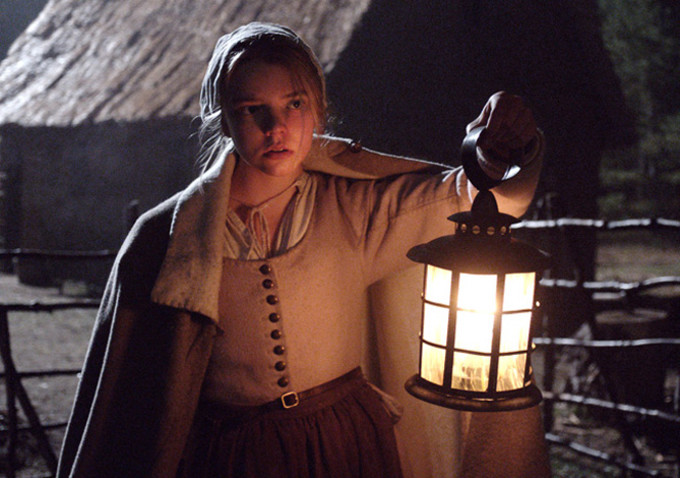
Anna Taylor-Joy, the Puritan daughter Thomasin in The Witch. (A27)
You have solemnly professed before God, Angels and Men, that the Cause of your leaving your Country, Kindred and Fathers houses, and transporting your selves with your Wives, Little Ones and Substance over the vast Ocean into this waste and howling Wilderness, was your Liberty to walk in the Faith of the Gospel with all good Conscience according to the Order of the Gospel… “A Brief Recognition of New England’s Errand into the Wilderness” – Samuel Danforth
The problem for Pilgrim William’s family, facing expulsion from their small New England village at the beginning of The Witch, starts at a church tribunal in which the father paraphrases this passage from Samuel Danforth’s 17th century sermon. William has apparently been stubborn and obstinate to the leaders of the local church—and thus to the leaders of the community—who have to remind him he is the one on trial, not they.
Unable to admit fault, his family soon finds themselves—his wife, an infant boy, two young twins, a preteen son and a teenage daughter—with all their possessions packed on a cart leaving what passes for civilization behind them as they embark on their own “errand into the wilderness.”
The Witch, directed by Robert Eggers, is a horror story grounded in Calvinism. As much as the Puritan family at the center of the story is hounded by witches and spirits in the dark woods of their new home, it is their extreme and unswerving fundamentalism that ultimately leads to their breakdown.
Jump-scare and fangoria buffs will find themselves disappointed in the slow, psychological dismantling of this family, punctuated only by brief supernatural nightmarish images. But fans of The Shining will see engaging parallels in the story, and viewers of Michael Haneke’s The White Ribbon will recognize the sense of foreboding and suffocating moral judgment.
As William and his family try to survive on their own, they succeed in setting up a homestead, but their first crop of corn has failed, and will not get them through the winter. Rather than facing the reality that they must return to the colony and beg forgiveness, William lets his own stubborn pride interfere with his family’s needs, insisting they all pray and ask forgiveness for their sins that God will give them the grace to survive.
The first terror to strike the family is when the eldest daughter, Thomasin (Anna Taylor-Joy, the beating heart of the film) is playing peek-a-boo outside with the infant Samuel, and she opens her eyes to find he has been snatched away into the woods. The family is bereft, but does not seem to blame Thomasin, at least not at first, rationalizing that it must have been a wolf that took the baby, rather than a more sinister presence. But from that point onward, a sense of menace settles over the family.
Strange things begin happening with animals. A hare (a classic harbinger of evil) makes an appearance out of the woods, and despite their desperation for meat, William and oldest son Caleb (Ralph Ineson and Harvey Scrimshaw, respectively) cannot find a way to kill it. The family dog runs off into the woods and is found disemboweled. The twins, a boy and a girl seemingly of the Satanic pre-K set, report having conversations with the family’s dusky he-goat, Black Phillip.
Lies begin to creep into the family’s dynamic, as William has sold his wife Katherine’s (Kate Dickie) silver chalice, a family heirloom, for hunting traps, but refuses to tell her he knows where it is.
As the catastrophes pile up, the family’s mistrust begins to fall on Thomasin. Something about her sheer, wide-eyed femaleness seems a threat—whether it’s her developing breasts that tempt her pubescent brother, or the blood that spills from the udder of one of the goats, symbolizing her biological womanhood. The parents begin to make plans to take her back to the colony and place her in servitude to another family there.
The mystery of the Puritan witch hunts is how Medieval fear of the supernatural could exist alongside what was at the time, the most literate society in the world. This was a community in which both boys and girls were educated for the purpose of being able to read and interpret the Bible for themselves. Within twenty-four years of landing in an implacable wilderness, Puritans had started a seminary for the training of ministers in the advanced study of Hebrew, Greek, and Latin. Think about the logic here: “First we’ll figure out how not to starve, then we’ll start Harvard.”
The key is in the theology. The same Calvinism that insisted on education for the sake of reading scripture also saw God as the absolute cause of all events, for good or for ill. If one experienced illness or misfortune, the Puritan instinct was to drop to your knees and ask God’s forgiveness for whatever sins you had committed—sometimes even thanking God for the grace of testing your faith. If things began going wrong for the community on a mass scale, there must be greater forces afoot, like the presence of bewitched minions of the devil. Most often these were thought to be the spiritually weak and intellectually stunted, which according to Puritan society meant teenage girls.
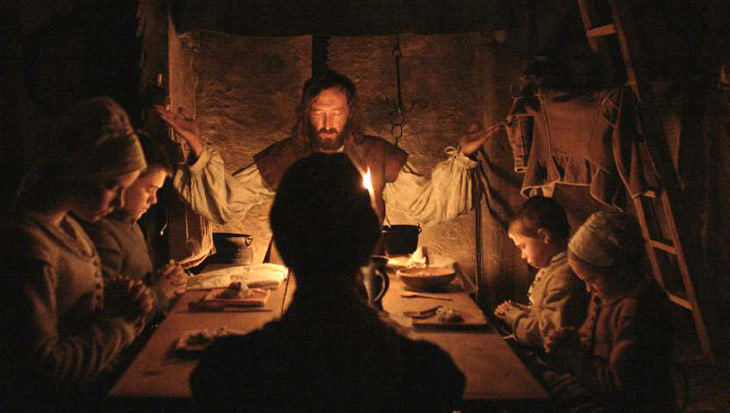
Errant, into the wilderness. (A27)
Things begin to go horribly awry for William’s family when the son Caleb disappears in the woods and comes back possessed by evil spirits. He writhes on the floor of the house, muttering anathemas against God. Finally, he coughs up a bloody apple, evidently placed in his mouth by the witch we now know is living in the woods. All eyes fall on Thomasin, who continues to profess her innocence and—curse that girl with a brain—reminds her parents that the family’s problems have been caused by them, not the children.
As the final act of the film spirals out of control, you find yourself wishing Thomasin had a feminist collective to join. That she could just hitchhike her way to the Womyns Fest and leave all this parochial patriarchy behind. In some ways, that’s what she ends up doing before it’s all over.
Eggers researched this film to the teeth, and the period details are absolutely correct, right down to the language the characters use, which suggests Elizabethan English. The cinematography, shot in striking chiaroscuro with natural and candle light, shades the emotional darkness with hues of gray and brown.
But the film is also absolutely current. To this day, there is no more contested space— politically, morally, theologically—than a woman’s body.
Don’t think people believe in witches today? Ask why conservatives are shutting down women’s healthcare centers across the country. Ask why Malala Yousafzai was shot in the head for having the audacity to seek an education. Ask why the thought of a woman in the White House still terrifies a significant portion of the electorate.
Women’s bodies present an existential threat to patriarchy, because they control the forces of life. There is something in our still male-dominated world that fears giving these bodies too much power over their own lives or the lives of others. As if Eve had usurped the authority of Adam over life and death, rather than just tempting him with knowledge. The threat of female agency is as alive today as it was to the Puritans.
Previous Post
March 3, 2016
#KillerSerials: The People v. OJ Simpson, Ep. 5
Next Post

March 10, 2016 #KillerSerials: The People v. OJ Simpson, Ep. 6
Browse Our Archives
Select a Category Classics DVD Film Music News Pop Culture Events Print Sports Television Uncategorized Video Games
Select a Month March 2017 February 2017 January 2017 December 2016 November 2016 October 2016 September 2016 August 2016 July 2016 June 2016 May 2016 April 2016 March 2016 February 2016 January 2016 December 2015 November 2015 October 2015 September 2015 August 2015 July 2015 June 2015 May 2015 April 2015 March 2015 February 2015 January 2015 December 2014 November 2014 October 2014 September 2014 August 2014 July 2014 June 2014 May 2014 April 2014 March 2014 February 2014 January 2014 December 2013 November 2013 October 2013 September 2013 August 2013 July 2013 June 2013 May 2013 April 2013 March 2013 February 2013 January 2013 December 2012 November 2012 October 2012 September 2012 August 2012 July 2012 June 2012 May 2012 April 2012 March 2012 February 2012 January 2012 December 2011 November 2011 October 2011 September 2011 August 2011 July 2011 June 2011 May 2011 April 2011 March 2011 February 2011 January 2011 December 2010 November 2010 October 2010 September 2010 August 2010 July 2010 June 2010 May 2010 April 2010 March 2010 February 2010 January 2010 December 2009 November 2009 October 2009 September 2009 August 2009 July 2009 June 2009 May 2009 April 2009 March 2009 February 2009 January 2009 December 2008 November 2008 October 2008 September 2008 August 2008 July 2008 June 2008 May 2008 April 2008 March 2008 February 2008 January 2008 December 2007 November 2007 October 2007 September 2007 August 2007 July 2007 June 2007 May 2007 April 2007 March 2007
Follow Us!
TAKE THE
Religious Wisdom Quiz
Who took Jesus’ body and placed it in a tomb?
Select your answer to see how you score.
Peter John Joseph of Arimathea Nicodemus
Related posts from Pop Theology


At SXSW2017: May It Last: A Portrait of...

At SXSW 2017: "Untold Tales of Armistead Maupin"
TRENDING AT PATHEOS Progressive Christian

Why Christians Have a Sacred Duty to Vote:...
The Bible offers strong support for the sacred duty to vote. Here...

What Being a Modern-Day Apostle Means to Me
In my last column, I discussed the ins and outs of modern-day...

Did Ancient China Once Worship the God of...
Across human history, a common thread weaves through the origins of the...

Love Your Neighbor – Including Earth-Kin: Lev. 19,...
God’s command to love your neighbor means acting in an ethical and...

Lead a Church Study of “Jesus and Lao...
Guest writer Jack Thomas (The Irreverent Reverend) reflects on leading his church...

Principles for Understanding the Apostolic Ministry Today
Whenever people discover that my formal ministry title is "apostle," as in...
view all Progressive Christian blogs
Ad-Free & Subscriber Log-In Subscription Support
- About Us
- 2026 Calendar
- Videos
- Podcasts
- Library of World Religions
- Faith In Media Tracker
- Advertise With Us
- Write for Us
- Privacy Policy
- Terms of Service
- Do Not Sell My Data
- Contact Us
- Radiant Digital
- Manage Newsletter Subscriptions
- Unsubscribe From Notifications
- Sitemap
Copyright 2008-2026, Patheos. All rights reserved.
Subscription Support Ad-Free & Subscriber Log-In
Follow Patheos