
BuddhistCatholicContemplativeEvangelicalGeneral ChristianHinduJewishLatter-day SaintMuslimNew VisionsProgressive Christian
Beliefs
- Buddhist
- Catholic
- Contemplative
- Evangelical
- General Christian
- Hindu
- Jewish
- Latter-day Saint
- More Voices
- Muslim
- New Visions
- Pagan
- Progressive Christian
Topics
- Religion News
- Food and Religion
- Sports and Religion
- Religious Art
- Religious Music and Entertainment
- Religious Events
- History and Religion
- Style and Religion
- Politics and Religion
- Women in Religion
- Recreation Outdoors and Religion
- Business Finance and Religion
- Careers Workplace and Religion
- Education and Religion
- Family Parenting and Religion
- Health Fitness and Religion
- Home and Religion
- Relationships and Religion
- Technology and Religion
- Travel and Religion
Columnists
- Buddhist Columnists
- Business Finance and Religion Columnists
- Careers Workplace and Religion Columnists
- Catholic Columnists
- Contemplative Columnists
- Education and Religion Columnists
- Evangelists Columnists
- Family Parenting and Religion Columnists
- General Christian Columnists
- Health Fitness and Religion Columnists
- Hindu Columnists
- History and Religion Columnists
- Home and Religion Columnists
- Jewish Columnists
- More Voices Columnists
- Latter Day Columnists
- Muslim Columnists
- New Visions Columnists
- Nonreligious Columnists
- Pagan Columnists
- Politics and Religion Columnists
- Progressive Columnists
- Recreation Outdoors and Religion Columnists
- Relationships and Religion Columnists
- Religion News Columnists
- Religious Art Columnists
- Religious Events Columnists
- Religious Music and Entertainment Columnists
- Sports and Religion Columnists
- Style and Religion Columnists
- Technology and Religion Columnists
- Travel and Religion Columnists
- Women in Religion Columnists
Resource Library
- 2026 Calendar
- Library of World Religions
- The 100 Most Holy Places on Earth
- Patheos Answers
- Podcasts
- Videos
- Faith Leaders Database
- Anglican Episcopalian
- Bahai
- Baptist
- Buddhism
- Christianity
- Confucianism
- Eastern Orthodoxy
- Hinduism
- Holiness and Pentecostal
- ISKCON
- Islam
- Judaism
- Lutheran
- Methodist
- The Church of Jesus Christ of Latter-day Saints
- New Age
- Paganism
- Presbytarian and Reformed
- Protestantism
- Religion Behind the Scenes
- Roman Catholic
- Scientology
- Shia Islam
- Sikhism
- Sufism
- Sunni Islam
- Taoism
- Zen
- See all religions
Research Tools
 Ad-Free & Subscriber Log-In Subscription Support
Ad-Free & Subscriber Log-In Subscription Support
Follow Patheos 

- Trending:
- Forgiveness
- |
- Marriage
- |
- Consciousness
- |
- Death Penalty
- |
- Election
- |
- Halloween
 Pop Theology
- Home
- Progressive Christian
- Religious Music & Entertainment
- HUMAN ACTS: A Review
HUMAN ACTS: A Review
Last updated on: March 28, 2016 at 11:34 am by J. Ryan Parker
HUMAN ACTS: A Review 2016-03-28T11:34:50-07:00 J. Ryan Parker
Patheos Explore the world's faith through different perspectives on religion and spirituality! Patheos has the views of the prevalent religions and spiritualities of the world.
With The Vegetarian, readers have found in Han Kang a writer of immense talent. From the basis of one character’s small, private decision, she wove a haunting narrative that is as beautiful as it is frightening and as political as it is personal. For Human Acts, her next book available in English (and as with The Vegetarian, also translated by Deborah Smith), Kang starts with a monumental, national event (though one likely unfamiliar to most Western readers), the Gwangju Uprising. Here, Kang proves again that she belongs in conversations about the most important authors working today and further reveals her prophetic insight into what it means to be human, both individually and collectively.
On May 18, 1980, students at Jeonnam University in Gwangju, South Korea, and other citizens in the area protested for greater democratization. The authoritarian government responded swiftly and harshly by sending in special forces who used clubs, bayonnets, and live ammunition on the crowds. The disruption lasted for nine days. “Official” reports listed around 200 casualties, but foreign journalists have argued that that number should actually be closer to 2,000.
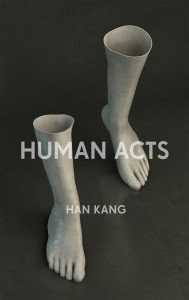 Human Acts opens with a teenage boy, Dong-ho, searching for the corpse of his friend as the uprising comes to a close. This is followed by an editor trying to navigate strict censorship laws around this event in and publish a play about it 1985. In 1990, an academic persuades a prisoner to recount his experiences of torture for his thesis. In 2002, a factory worker recounts both her past torture and the ways it continuously haunts her. In 2010, Dong-ho’s mother recalls the loss of her son. In the epilogue, Kang reveals her personal connection to these tragic events. Each of these characters offer both different vantage points into that historic event and different perspectives on suffering, loss, and grief.
Human Acts is a more difficult read than The Vegetarian, largely because it is both based in nightmarish fact and because it bounces around in time. There is a forward chronological trajectory to the novel, but each section moves freely between the past and its present. In this way, Kang, like Faulkner, reminds us, “The past isn’t dead. It isn’t even past.” Though based on a singular event, Kang’s book has universal appeal. And though this blemish on human history is smaller than, say, acts of genocide, its suffering and grief it produces is no less profound, and Kang captures all of it with great pathos. And though the event took place in 1980, it has echoes even now, reminding us of just how quickly violence can overtake us.
Reading Human Acts is a gut-wrenching experience. Kang’s vivid descriptions of a giant pile of rotting corpses, torture, and gun violence haunt every beautiful sequence of love, longing, and connection. What’s even more unnerving, as an American reader, is how even a quick online search about this moment in history will reveal the United States governments’ support of the special forces that silenced these cries for democracy.
Like The Vegetarian, Human Acts leaves us with lingering questions about what it means to be human. Is our capacity for violence and creative means of torture a defining trait? Or is it our ability to endure those horrors or our willingness to sacrifice ourselves for others that makes us human? In a country that has a brutally violent past (and present), how do we remember? How do we integrate survivors’ stories into our moving forward? In a time fraught with political discord and violence on all fronts, Human Acts is a must-read novel that shines light on what we have lost…and what we are losing.
Previous Post

March 25, 2016
New Songs for Springtime
Next Post

March 31, 2016 #KillerSerials: The People v. OJ Simpson, Ep. 9
Browse Our Archives
Select a Category Classics DVD Film Music News Pop Culture Events Print Sports Television Uncategorized Video Games
Select a Month March 2017 February 2017 January 2017 December 2016 November 2016 October 2016 September 2016 August 2016 July 2016 June 2016 May 2016 April 2016 March 2016 February 2016 January 2016 December 2015 November 2015 October 2015 September 2015 August 2015 July 2015 June 2015 May 2015 April 2015 March 2015 February 2015 January 2015 December 2014 November 2014 October 2014 September 2014 August 2014 July 2014 June 2014 May 2014 April 2014 March 2014 February 2014 January 2014 December 2013 November 2013 October 2013 September 2013 August 2013 July 2013 June 2013 May 2013 April 2013 March 2013 February 2013 January 2013 December 2012 November 2012 October 2012 September 2012 August 2012 July 2012 June 2012 May 2012 April 2012 March 2012 February 2012 January 2012 December 2011 November 2011 October 2011 September 2011 August 2011 July 2011 June 2011 May 2011 April 2011 March 2011 February 2011 January 2011 December 2010 November 2010 October 2010 September 2010 August 2010 July 2010 June 2010 May 2010 April 2010 March 2010 February 2010 January 2010 December 2009 November 2009 October 2009 September 2009 August 2009 July 2009 June 2009 May 2009 April 2009 March 2009 February 2009 January 2009 December 2008 November 2008 October 2008 September 2008 August 2008 July 2008 June 2008 May 2008 April 2008 March 2008 February 2008 January 2008 December 2007 November 2007 October 2007 September 2007 August 2007 July 2007 June 2007 May 2007 April 2007 March 2007
Follow Us!
TAKE THE
Religious Wisdom Quiz
What happened to Lot's wife as they fled Sodom?
Select your answer to see how you score.
She died by fire She fell into a well She turned into a pillar of salt She became blind
Related posts from Pop Theology


#KillerSerials: An Interview with Kutter Callaway

Book Review: MUSLIMS AND THE MAKING OF AMERICA

TRENDING AT PATHEOS Progressive Christian

What Being a Modern-Day Apostle Means to Me
In my last column, I discussed the ins and outs of modern-day...

Did Ancient China Once Worship the God of...
Across human history, a common thread weaves through the origins of the...

Love Your Neighbor – Including Earth-Kin: Lev. 19,...
God’s command to love your neighbor means acting in an ethical and...

Lead a Church Study of “Jesus and Lao...
Guest writer Jack Thomas (The Irreverent Reverend) reflects on leading his church...

Pastoral Wisdom for Responding to Sermon Pushback
Getting sermon pushback on your social justice sermon? Learn practical, Proverbs-based strategies...

Principles for Understanding the Apostolic Ministry Today
Whenever people discover that my formal ministry title is "apostle," as in...
view all Progressive Christian blogs
Ad-Free & Subscriber Log-In Subscription Support
- About Us
- 2026 Calendar
- Videos
- Podcasts
- Library of World Religions
- Faith In Media Tracker
- Advertise With Us
- Write for Us
- Privacy Policy
- Terms of Service
- Do Not Sell My Data
- Contact Us
- Radiant Digital
- Manage Newsletter Subscriptions
- Unsubscribe From Notifications
- Sitemap
Copyright 2008-2026, Patheos. All rights reserved.
Subscription Support Ad-Free & Subscriber Log-In
Follow Patheos