
BuddhistCatholicContemplativeEvangelicalGeneral ChristianHinduJewishLatter-day SaintMuslimNew VisionsProgressive Christian
Beliefs
- Buddhist
- Catholic
- Contemplative
- Evangelical
- General Christian
- Hindu
- Jewish
- Latter-day Saint
- More Voices
- Muslim
- New Visions
- Pagan
- Progressive Christian
Topics
- Religion News
- Food and Religion
- Sports and Religion
- Religious Art
- Religious Music and Entertainment
- Religious Events
- History and Religion
- Style and Religion
- Politics and Religion
- Women in Religion
- Recreation Outdoors and Religion
- Business Finance and Religion
- Careers Workplace and Religion
- Education and Religion
- Family Parenting and Religion
- Health Fitness and Religion
- Home and Religion
- Relationships and Religion
- Technology and Religion
- Travel and Religion
Columnists
- Buddhist Columnists
- Business Finance and Religion Columnists
- Careers Workplace and Religion Columnists
- Catholic Columnists
- Contemplative Columnists
- Education and Religion Columnists
- Evangelists Columnists
- Family Parenting and Religion Columnists
- General Christian Columnists
- Health Fitness and Religion Columnists
- Hindu Columnists
- History and Religion Columnists
- Home and Religion Columnists
- Jewish Columnists
- More Voices Columnists
- Latter Day Columnists
- Muslim Columnists
- New Visions Columnists
- Nonreligious Columnists
- Pagan Columnists
- Politics and Religion Columnists
- Progressive Columnists
- Recreation Outdoors and Religion Columnists
- Relationships and Religion Columnists
- Religion News Columnists
- Religious Art Columnists
- Religious Events Columnists
- Religious Music and Entertainment Columnists
- Sports and Religion Columnists
- Style and Religion Columnists
- Technology and Religion Columnists
- Travel and Religion Columnists
- Women in Religion Columnists
Resource Library
- 2026 Calendar
- Library of World Religions
- The 100 Most Holy Places on Earth
- Patheos Answers
- Podcasts
- Videos
- Faith Leaders Database
- Anglican Episcopalian
- Bahai
- Baptist
- Buddhism
- Christianity
- Confucianism
- Eastern Orthodoxy
- Hinduism
- Holiness and Pentecostal
- ISKCON
- Islam
- Judaism
- Lutheran
- Methodist
- The Church of Jesus Christ of Latter-day Saints
- New Age
- Paganism
- Presbytarian and Reformed
- Protestantism
- Religion Behind the Scenes
- Roman Catholic
- Scientology
- Shia Islam
- Sikhism
- Sufism
- Sunni Islam
- Taoism
- Zen
- See all religions
Research Tools
 Ad-Free & Subscriber Log-In Subscription Support
Ad-Free & Subscriber Log-In Subscription Support
Follow Patheos 

- Trending:
- Forgiveness
- |
- Marriage
- |
- Consciousness
- |
- Death Penalty
- |
- Election
- |
- Halloween
 Pop Theology
- Home
- Progressive Christian
- Religious Music & Entertainment
- DAREDEVIL and the Dignity of Villains
DAREDEVIL and the Dignity of Villains
Last updated on: March 25, 2016 at 10:48 am by J. Ryan Parker
DAREDEVIL and the Dignity of Villains 2016-03-25T10:48:43-07:00 J. Ryan Parker
Patheos Explore the world's faith through different perspectives on religion and spirituality! Patheos has the views of the prevalent religions and spiritualities of the world.
After a lengthy absence, Netflix’s critically-acclaimed series, Daredevil, returned for its second season last week. It sustains the gritty–yet beautiful–look of the first season and expands on its moral and religious themes. Where Matt Murdock/Daredevil’s internal struggle took center stage in the first season, this second season considers the dignity of the human person, even the most heinous criminals.
In the second season of Daredevil, Wilson Fisk’s (Vincent D’Onofrio) absence has left a vacuum in the criminal underbelly of New York. As gangs being to meet and discuss how to take advantage of this opportunity, they are slaughtered en masse. Police refer to an armed militia, but any fan of the series will quickly know it’s one man, Frank Castle, a.k.a. Punisher (John Bernthal), Daredevil’s latest nemesis. While he initially sounds like a Travis Bickle for the Netflix generation–a psychologically unhinged anti-hero on a quest to rid the city of its scum–he’s more complicated than that. Frank is a decorated war hero that has suffered unspeakable tragedy, the brutal murder of his wife and children and an attempt on his own life.
Alongside Punisher’s emergence is the return of one of Murdock’s (Charlie Cox) old flames, Elektra Natchios (Elodie Yung), which coincides with the rise of a powerful organization known as The Hand. They seek to take control of Black Sky, a weapon of unimaginable power. Daredevil and Elektra’s teacher, Stick (Scott Glenn), also returns, providing insight into The Hand, Black Sky, and Elektra. Murdock is quickly distracted by Elektra’s arrival and his duties as Daredevil, which frustrates his partners at Nelson and Murdock. Foggy (Elden Henson) and Karen (Deborah Ann Woll) are left to their own devices to defend the indefensible Frank Castle as he stands trial for multiple homicides.
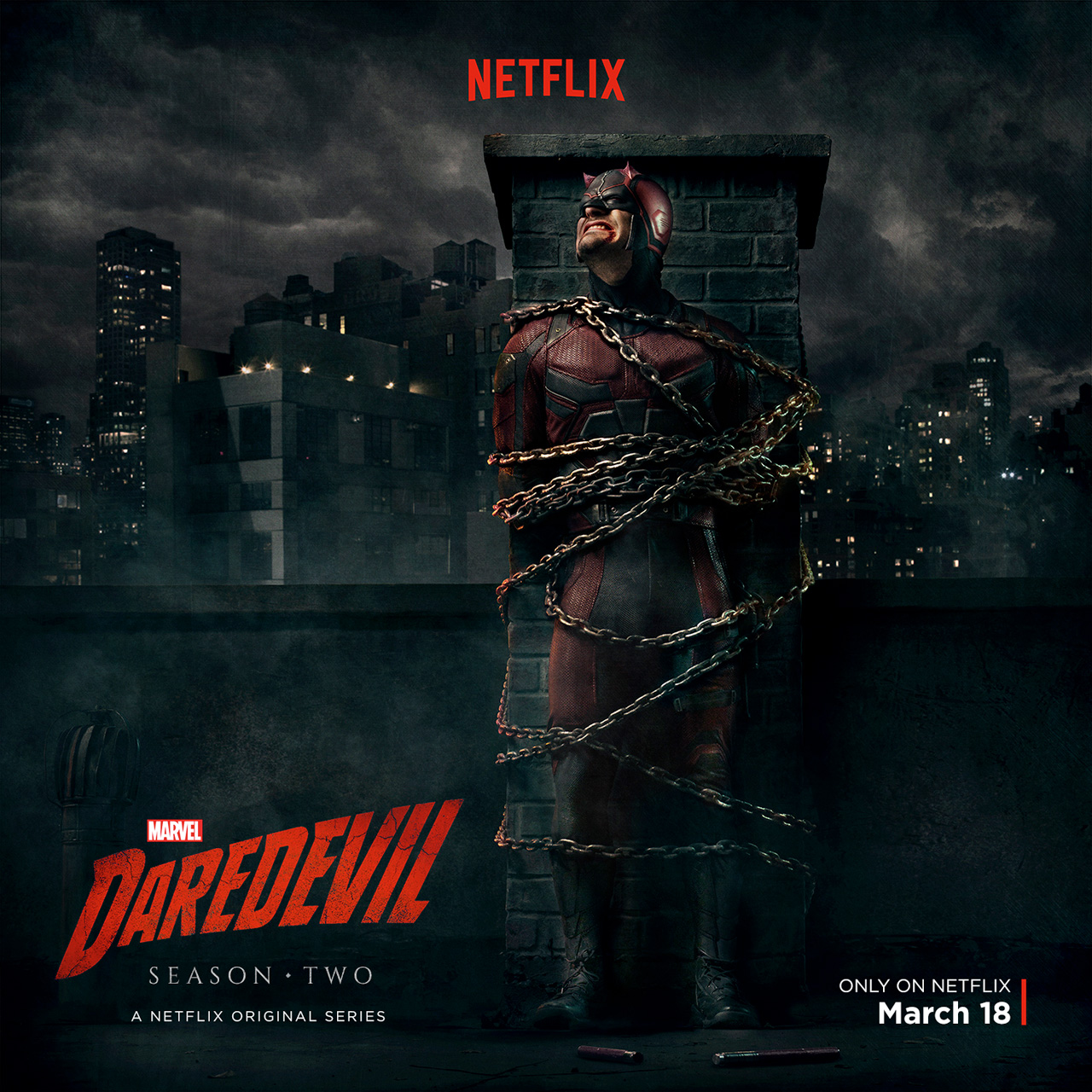
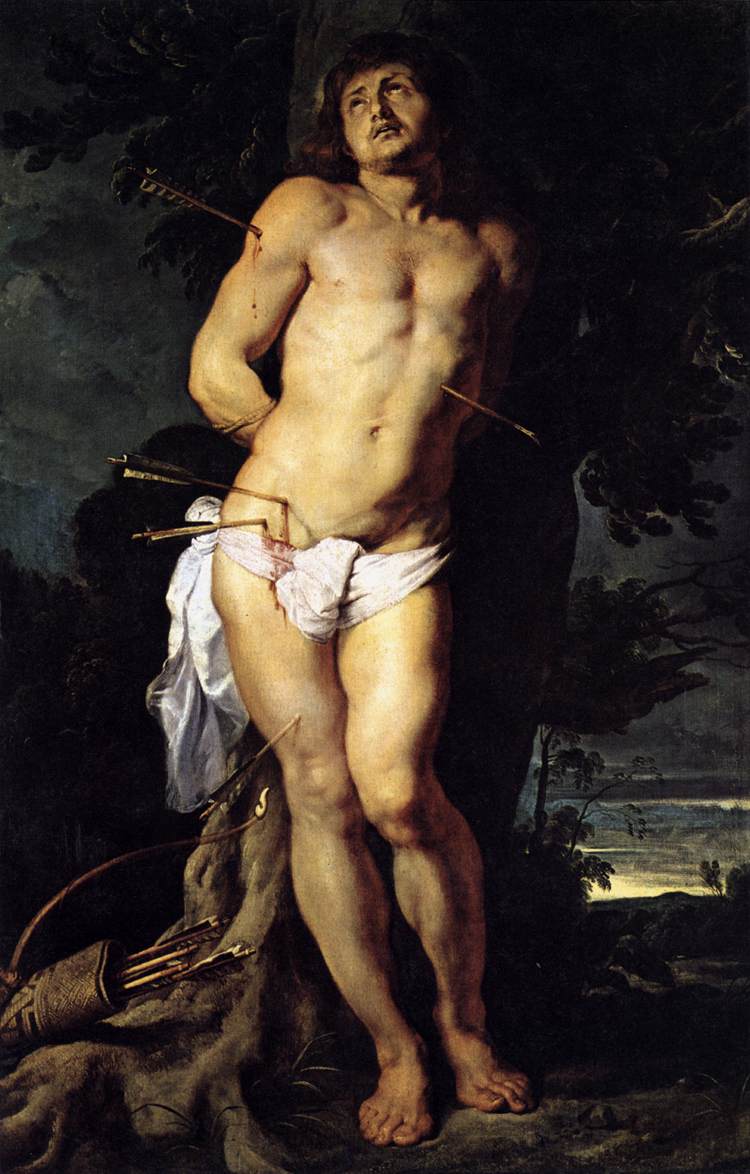
(Above, Daredevil, like St. Sebastian, is abused for forcing the powers-that-be to confront their sins.)
What makes the second season of Daredevil so interesting from the start–aside from the high production value and stunning cinematography–is its sustained reflection on the tension of whether humans are inherently good or evil. So much of Murdock/Daredevil’s actions in this second season seem to be motivated by Catholic social teaching on the dignity of the human person. Not only does Daredevil refuse to kill (even though his beat downs of the criminals of Hell’s Kitchen probably leave them wishing they were dead), Murdock (with Foggy and Karen) fights the death penalty that the State would inflict on Castle. He tells both Punisher and the State, “You don’t get to make that call.” Murdock, Foggy, and Karen even refuse to cop to an insanity plea, knowing that while Castle is broken, to do so would disrespect those who could actually resort to that defense.
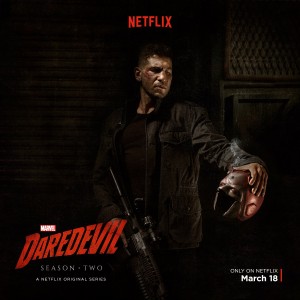
To be or not to be.
Daredevil doesn’t just treat its villains with dignity through its lead character and his alter-ego. Father Lantom (Peter McRobbie), Murdock’s priest, gives the eulogy at Grotto’s funeral. In it, he claims that the death of an individual is also the death of an entire world…the loss of a whole web of connections. In a genre that dispatches “bad guys” without a second thought, this is a welcome pause. Even though Wilson Fisk and Frank Castle commit heinous crimes, they are never cardboard villains, but rather the center of webs that stretch in many directions. They both endure great trauma in their lives, Wilson as the child of an abusive home and Frank as a veteran of wars abroad and a victim of State-sanctioned violence at home. The series doesn’t excuse their actions, but it does attempt to explain them, and it also reminds us that we should take great care in how we talk about those who do–or would do–us harm. When Daredevil tries to reason with Punisher, he is forced to admit that he has never been to war. Punisher, a former Catholic himself, tells him, “Then don’t talk about it.”
Murdock’s greatest battle over the dignity of the human person might lie in his own internal conflict. He continues to question what he does: is he losing part of his humanity by being Daredevil? Is being the “half-measure” that Punisher accuses him of being enough? Later in the season, nurse Claire Temple (Rosario Dawson) reminds Daredevil, “You’re talking to someone who patches up the same three crackheads every night.” This is a lighter reminder of what Daredevil told Punisher, even the most hardened criminals deserve a second chance to be good…to attain redemption.
But while Murdock/Daredevil’s faith–in God and humanity–motivates him to do good, it also curiously blinds him to the ways in which others use a similar faith to wreak havoc on the world. The Hand places its collective faith in the Black Sky, but Daredevil dismisses all of this as a myth and fails to recognize that there are many others that would view his Catholic faith in the same way. Elektra and Stick try to convince him that what’s important is not whether the “myth” is true, but rather that people believe it’s true and are willing to do something about it. SPOILER ALERT: As Elektra learns that she is, in fact, the Black Sky that The Hand seeks to use, she sacrifices herself in order to keep them from bringing further destruction upon the city. In this way, Daredevil becomes a reflection on religious extremism and violence as a corruption of faith juxtaposed to the essence of all major faith traditions that call us to sacrifice ourselves in service of others.
All episodes of Daredevil are currently streaming on Netflix.
Previous Post
March 25, 2016
#KillerSerials: The People v. OJ Simpson, Ep. 8
Next Post

March 25, 2016 New Songs for Springtime
Browse Our Archives
Select a Category Classics DVD Film Music News Pop Culture Events Print Sports Television Uncategorized Video Games
Select a Month March 2017 February 2017 January 2017 December 2016 November 2016 October 2016 September 2016 August 2016 July 2016 June 2016 May 2016 April 2016 March 2016 February 2016 January 2016 December 2015 November 2015 October 2015 September 2015 August 2015 July 2015 June 2015 May 2015 April 2015 March 2015 February 2015 January 2015 December 2014 November 2014 October 2014 September 2014 August 2014 July 2014 June 2014 May 2014 April 2014 March 2014 February 2014 January 2014 December 2013 November 2013 October 2013 September 2013 August 2013 July 2013 June 2013 May 2013 April 2013 March 2013 February 2013 January 2013 December 2012 November 2012 October 2012 September 2012 August 2012 July 2012 June 2012 May 2012 April 2012 March 2012 February 2012 January 2012 December 2011 November 2011 October 2011 September 2011 August 2011 July 2011 June 2011 May 2011 April 2011 March 2011 February 2011 January 2011 December 2010 November 2010 October 2010 September 2010 August 2010 July 2010 June 2010 May 2010 April 2010 March 2010 February 2010 January 2010 December 2009 November 2009 October 2009 September 2009 August 2009 July 2009 June 2009 May 2009 April 2009 March 2009 February 2009 January 2009 December 2008 November 2008 October 2008 September 2008 August 2008 July 2008 June 2008 May 2008 April 2008 March 2008 February 2008 January 2008 December 2007 November 2007 October 2007 September 2007 August 2007 July 2007 June 2007 May 2007 April 2007 March 2007
Follow Us!
TAKE THE
Religious Wisdom Quiz
Who said, "Faith without works is dead"?
Select your answer to see how you score.
Peter James Paul John
Related posts from Pop Theology
The Mastodon In The Room: A Conversation with...

#KillerSerials: THE PATH, S2 Ep. 11

At SXSW2017: Music Festival Day 5
At SXSW2017: Music Festival Day 4
TRENDING AT PATHEOS Progressive Christian

Why Christians Have a Sacred Duty to Vote:...
The Bible offers strong support for the sacred duty to vote. Here...

What Being a Modern-Day Apostle Means to Me
In my last column, I discussed the ins and outs of modern-day...

Did Ancient China Once Worship the God of...
Across human history, a common thread weaves through the origins of the...

Love Your Neighbor – Including Earth-Kin: Lev. 19,...
God’s command to love your neighbor means acting in an ethical and...

Lead a Church Study of “Jesus and Lao...
Guest writer Jack Thomas (The Irreverent Reverend) reflects on leading his church...

Principles for Understanding the Apostolic Ministry Today
Whenever people discover that my formal ministry title is "apostle," as in...
view all Progressive Christian blogs
Ad-Free & Subscriber Log-In Subscription Support
- About Us
- 2026 Calendar
- Videos
- Podcasts
- Library of World Religions
- Faith In Media Tracker
- Advertise With Us
- Write for Us
- Privacy Policy
- Terms of Service
- Do Not Sell My Data
- Contact Us
- Radiant Digital
- Manage Newsletter Subscriptions
- Unsubscribe From Notifications
- Sitemap
Copyright 2008-2026, Patheos. All rights reserved.
Subscription Support Ad-Free & Subscriber Log-In
Follow Patheos