
BuddhistCatholicContemplativeEvangelicalGeneral ChristianHinduJewishLatter-day SaintMuslimNew VisionsProgressive Christian
Beliefs
- Buddhist
- Catholic
- Contemplative
- Evangelical
- General Christian
- Hindu
- Jewish
- Latter-day Saint
- More Voices
- Muslim
- New Visions
- Pagan
- Progressive Christian
Topics
- Religion News
- Food and Religion
- Sports and Religion
- Religious Art
- Religious Music and Entertainment
- Religious Events
- History and Religion
- Style and Religion
- Politics and Religion
- Women in Religion
- Recreation Outdoors and Religion
- Business Finance and Religion
- Careers Workplace and Religion
- Education and Religion
- Family Parenting and Religion
- Health Fitness and Religion
- Home and Religion
- Relationships and Religion
- Technology and Religion
- Travel and Religion
Columnists
- Buddhist Columnists
- Business Finance and Religion Columnists
- Careers Workplace and Religion Columnists
- Catholic Columnists
- Contemplative Columnists
- Education and Religion Columnists
- Evangelists Columnists
- Family Parenting and Religion Columnists
- General Christian Columnists
- Health Fitness and Religion Columnists
- Hindu Columnists
- History and Religion Columnists
- Home and Religion Columnists
- Jewish Columnists
- More Voices Columnists
- Latter Day Columnists
- Muslim Columnists
- New Visions Columnists
- Nonreligious Columnists
- Pagan Columnists
- Politics and Religion Columnists
- Progressive Columnists
- Recreation Outdoors and Religion Columnists
- Relationships and Religion Columnists
- Religion News Columnists
- Religious Art Columnists
- Religious Events Columnists
- Religious Music and Entertainment Columnists
- Sports and Religion Columnists
- Style and Religion Columnists
- Technology and Religion Columnists
- Travel and Religion Columnists
- Women in Religion Columnists
Resource Library
- 2026 Calendar
- Library of World Religions
- The 100 Most Holy Places on Earth
- Patheos Answers
- Podcasts
- Videos
- Faith Leaders Database
- Anglican Episcopalian
- Bahai
- Baptist
- Buddhism
- Christianity
- Confucianism
- Eastern Orthodoxy
- Hinduism
- Holiness and Pentecostal
- ISKCON
- Islam
- Judaism
- Lutheran
- Methodist
- The Church of Jesus Christ of Latter-day Saints
- New Age
- Paganism
- Presbytarian and Reformed
- Protestantism
- Religion Behind the Scenes
- Roman Catholic
- Scientology
- Shia Islam
- Sikhism
- Sufism
- Sunni Islam
- Taoism
- Zen
- See all religions
Research Tools
 Ad-Free & Subscriber Log-In Subscription Support
Ad-Free & Subscriber Log-In Subscription Support
Follow Patheos 

- Trending:
- Forgiveness
- |
- Marriage
- |
- Consciousness
- |
- Death Penalty
- |
- Election
- |
- Halloween
 Pop Theology
- Home
- Progressive Christian
- Religious Music & Entertainment
- THE LEFTOVERS (Season 2) and The Arbitrariness of Life
THE LEFTOVERS (Season 2) and The Arbitrariness of Life
Last updated on: January 14, 2016 at 4:28 pm by J. Ryan Parker
THE LEFTOVERS (Season 2) and The Arbitrariness of Life 2016-01-14T16:28:13-08:00 J. Ryan Parker
Patheos Explore the world's faith through different perspectives on religion and spirituality! Patheos has the views of the prevalent religions and spiritualities of the world.
In his list of the best TV series of 2015, Tim Goodman, TV critic for The Hollywood Reporter, listed The Leftovers as the second best series behind Fargo. On a standard Top 10 list, this would have been a lofty rating, but with 46 shows (!) on his list, it’s even higher praise. That Goodman confesses to leaving 15 shows off the list is further proof that we’re in, as he calls it, the platinum age of television. Like Goodman, Fargo and The Leftovers were, by far, my favorite series of the year (and 2014 as well). They are both examples of near flawless execution at every stage of production from writing to direction to acting to editing. They weave complex narratives and unweave those plots methodically. They are both examples of moral storytelling and both have, at their thematic center, the arbitrariness and ambiguity of life and how we flawed and bound human beings make meaning out of it.
The second season of The Leftovers is full of specific references to biblical characters and myths from the Christian tradition. My friend and fellow Leftovers fan John Bucher has written about them frequently for HBO’s accompanying blog, Watching the Leftovers. There are several other avenues through which to explore the series from a Christian (or religious) perspective. It features one of the most haunting depictions of a possible afterlife that recalls the dread of C. S. Lewis’ The Great Divorce. The Leftovers has much to say about the role of organized religion in the world today and how we, as people of faith, minister to victims around us. In one scene, a character destroys a radio when she hears a Christian talk show host tell a caller, “Jesus was the original departure.” The recent, brief conversations about prayer and empty platitudes in light of many politicians’ responses to the shootings in San Bernardino should come to mind. While these analyses add depth to our viewing experience, I’d like to pull the focus back a bit to look at the series from a broader perspective and consider the series, with specific attention to the second season, as a collection of responses (some religious, but most not) to the arbitrariness of life.
Though primarily set in the new location of Jarden, TX, much of the second season of The Leftovers deals with the events that took place in Mapleton, NY, four years after The Departure, the sudden disappearance of 2% of the world’s population (140 million people). Kevin Garvey, girlfriend Nora, his daughter Jill, and adopted daughter Lilly move to Jarden because they believe life will be safer there. Jarden experienced no departures, resulting in the foundation of Miracle National Park to protect the premises. Now, people from all over the world flock to Jarden as pilgrims, buying tchotchkes, interacting with the locals, and taking tours, all in the hopes that it will either shed light on their experiences of loss or keep them safe from future occurrences.
The Garveys move in next door to the Murphys, husband John, wife Erika, daughter Evangeline (Evie), and son Michael. On their first night in town, Evie and two of her friends mysteriously disappear. To make matters worse, Kevin wakes up at the “scene of the crime,” with no knowledge of how he got there. As he comes to, he has a vision of the deceased Patti Levin, the founder of the Guilty Remnant, a cult whose chain-smoking, white-clothes-attired members serve as living reminders of the tragic Departure. Patti appears to Kevin throughout much of the second season, goading and antagonizing him, and these visions ultimately spur him on a suicidal spiritual journey to break her hold on his life.
What could be more arbitrary than the Departure? It has no rhyme or reason: good people and bad people are taken and left behind; people of all faiths depart or remain; nearly every town loses residents, but Jarden doesn’t. For those left behind, life toils on, but the events of October 14th have robbed it of meaning or at least demands a re-definition of what everything really means. Victims (those who lost loved ones) will never forget, and, to varying degrees, they integrate the Departure into their lives, some with daily remembrances and others with yearly memorial observances. The Guilty Remnant requires more, and as the second season draws to a close, we see that they are not only the memory of terror, but the terror of memory. They are not afraid to use violence, much of it psychological, to encourage this remembering.
On the surface, life is great in Jarden. High school kids sing a painfully upbeat song about God preserving their community. Congregants thank God for this protection. Residents sell paraphernalia to visiting tourists. On the other hand, just beneath this shiny veneer, all is not well. Being the only community unaffected by the Departure carries a heavy burden, and not all residents are so quick to accept miraculous explanations. John Murphy doesn’t want to have any talk of miracles and is frustrated by the influx of pilgrims. He is vigilant in preventing residents from financially exploiting them and harshly punishes those who do. Yet his world is turned upside down when his daughter Evie disappears. Did she depart? Was she kidnapped? Faced with this mystery, John doubles down on his vigilant logic and conducts his own manhunt.
On the other hand, his wife Erika and son Michael are, to degrees, more willing to entertain supernatural possibilities. A regular churchgoer, Erika also tests a local legend that is tied to the land: she places a bird in a box, buries it, and returns three days later to see if it’s still alive. Their son Michael, also an active member of their church, maintains a relationship with his grandfather (against his parents orders), who is, perhaps, the most spiritually-attuned resident in Jarden, quick to believe in the supernatural and mystically aware of people’s struggles.
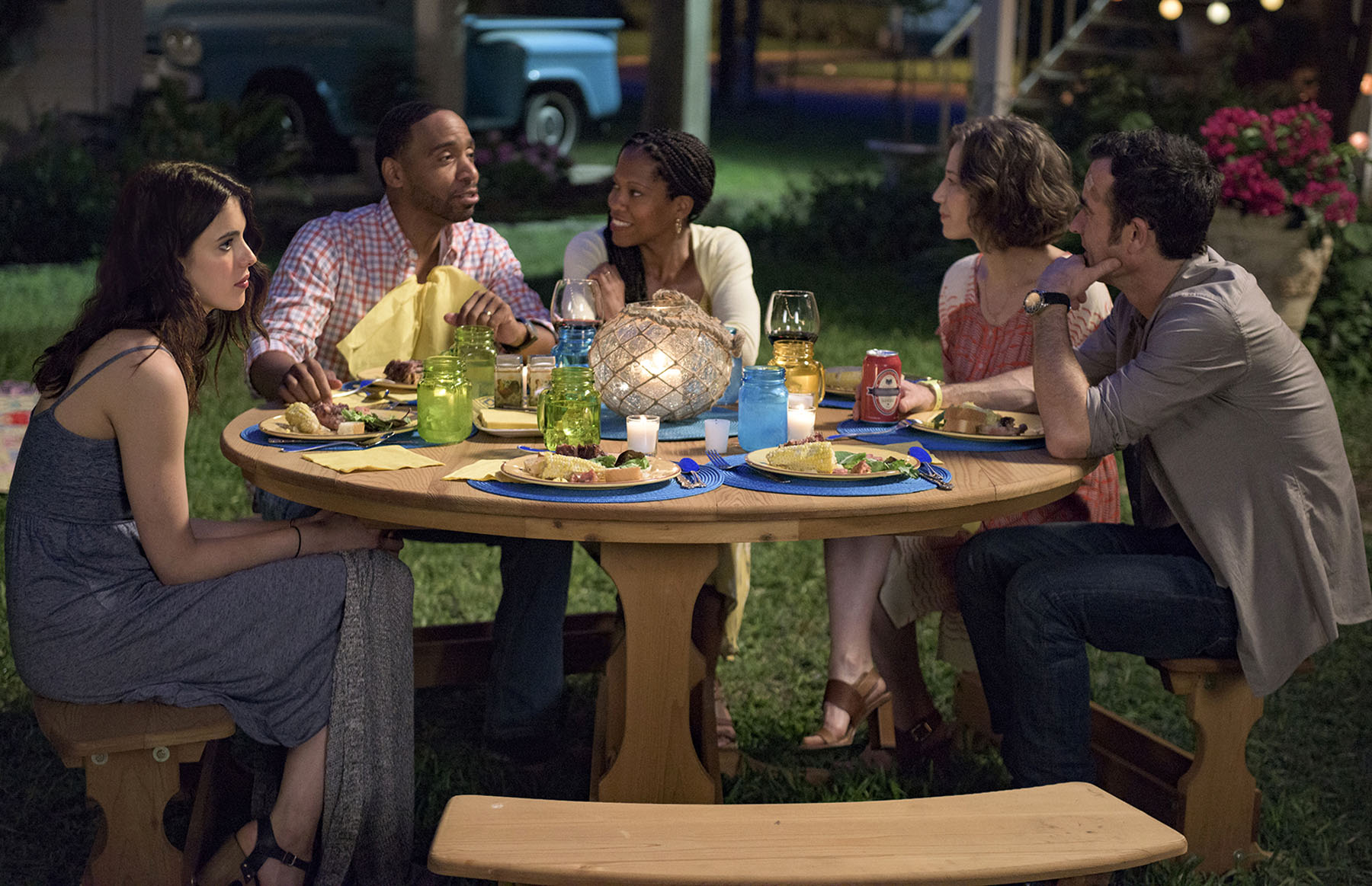
With neighbors like these… (Image courtesy of HBO)
Matt Jamison (the Episcopal priest from the first season) and his wife Mary have also moved to Jarden. Mary is in something of a vegetative state, and Matt is her primary caregiver, but on one of their first nights in Jarden, she wakes up and they spend the night talking. He believes that Jarden caused this brief miracle and tries to replicate the events of that day and night to get her to wake up again. He engages in a series of rituals in an effort to call back the Divine.
Nora (Matt’s sister and Kevin’s girlfriend) is the rock of the series and offers the most steadfast response to the Departure and the events in Jarden. A victim among victims (she experienced a certain level of national acclaim in the first season as her husband and two children departed), she suffers that tragedy daily but has, with some degree of success, gotten on with her life. Yet scientists’ investigations into what happened in the Departure and why no on disappeared from Jarden and the questions of Jarden’s residents following Evie’s disappearance shake her core and she falters and begins to wonder if she is the lens through which these tragedies happen.
While most of the characters responses to the Departure feel inadequate, like most of our responses to tragedy in the real world, it doesn’t mean that the series, like life, doesn’t have meaning or anything to offer us. The Leftovers is full of scenes of horrific violence and great beauty. The cold opens throughout the season are especially moving, but none more so than the one for the fifth episode, “No Room in the Inn,” which is as beautiful and heartbreaking depiction of marital love as I’ve ever seen. That episode also overflows with biblical references, not just to the story of Mary and Joseph. Episode 8, “International Assassin,” challenges viewers to think about how we view, speak about, and interact with our enemies. How would picturing them as children (re)shape these interactions? Closely tied to this, the Guilty Remnant forces us viewers to think about how we remember (and respond to) the unexplainable tragedies of life. Do we allow them to continue to terrorize us? Do we use them to justify terrorizing others?
Viewers who want answers and explanations will be put off by The Leftovers, especially in light of co-creator DamonLindeloff admitting that they will never explain the Departure. Several lingering questions plague fans at the end of the second season, and John Bucher has already outlined ten reasons why we desperately need a third season, which was recently greenlit, thanks in no small part to devout fan support. But given the ways in which various characters respond to the unexplainable, the series’ definitive position might be found in its opening theme song by Iris DeMent. As she offers pithy versions of various descriptions of the afterlife, she concludes, “I guess I’ll just let the mystery be.” In a beautiful touching moment in the finale, John helps a wounded Kevin. As the enormity of the events weigh on him, John begins to weep as he confesses, “I don’t understand.” Kevin responds, “It’s okay.”
Previous Post

January 8, 2016
We Awaken to the Force Awakening
Next Post

January 24, 2016 At Sundance: LOVE AND FRIENDSHIP
Browse Our Archives
Select a Category Classics DVD Film Music News Pop Culture Events Print Sports Television Uncategorized Video Games
Select a Month March 2017 February 2017 January 2017 December 2016 November 2016 October 2016 September 2016 August 2016 July 2016 June 2016 May 2016 April 2016 March 2016 February 2016 January 2016 December 2015 November 2015 October 2015 September 2015 August 2015 July 2015 June 2015 May 2015 April 2015 March 2015 February 2015 January 2015 December 2014 November 2014 October 2014 September 2014 August 2014 July 2014 June 2014 May 2014 April 2014 March 2014 February 2014 January 2014 December 2013 November 2013 October 2013 September 2013 August 2013 July 2013 June 2013 May 2013 April 2013 March 2013 February 2013 January 2013 December 2012 November 2012 October 2012 September 2012 August 2012 July 2012 June 2012 May 2012 April 2012 March 2012 February 2012 January 2012 December 2011 November 2011 October 2011 September 2011 August 2011 July 2011 June 2011 May 2011 April 2011 March 2011 February 2011 January 2011 December 2010 November 2010 October 2010 September 2010 August 2010 July 2010 June 2010 May 2010 April 2010 March 2010 February 2010 January 2010 December 2009 November 2009 October 2009 September 2009 August 2009 July 2009 June 2009 May 2009 April 2009 March 2009 February 2009 January 2009 December 2008 November 2008 October 2008 September 2008 August 2008 July 2008 June 2008 May 2008 April 2008 March 2008 February 2008 January 2008 December 2007 November 2007 October 2007 September 2007 August 2007 July 2007 June 2007 May 2007 April 2007 March 2007
Follow Us!
TAKE THE
Religious Wisdom Quiz
What did Jesus use to heal blind man?
Select your answer to see how you score.
Cloth Mud and saliva Oil Water
Related posts from Pop Theology

#KillerSerials: THE PATH, S2 Ep. 11

#KillerSerials: THE PATH, S2 Ep. 10

TRENDING AT PATHEOS Progressive Christian

Why Christians Have a Sacred Duty to Vote:...
The Bible offers strong support for the sacred duty to vote. Here...

What Being a Modern-Day Apostle Means to Me
In my last column, I discussed the ins and outs of modern-day...

Did Ancient China Once Worship the God of...
Across human history, a common thread weaves through the origins of the...

Love Your Neighbor – Including Earth-Kin: Lev. 19,...
God’s command to love your neighbor means acting in an ethical and...

Lead a Church Study of “Jesus and Lao...
Guest writer Jack Thomas (The Irreverent Reverend) reflects on leading his church...

Principles for Understanding the Apostolic Ministry Today
Whenever people discover that my formal ministry title is "apostle," as in...
view all Progressive Christian blogs
Ad-Free & Subscriber Log-In Subscription Support
- About Us
- 2026 Calendar
- Videos
- Podcasts
- Library of World Religions
- Faith In Media Tracker
- Advertise With Us
- Write for Us
- Privacy Policy
- Terms of Service
- Do Not Sell My Data
- Contact Us
- Radiant Digital
- Manage Newsletter Subscriptions
- Unsubscribe From Notifications
- Sitemap
Copyright 2008-2026, Patheos. All rights reserved.
Subscription Support Ad-Free & Subscriber Log-In
Follow Patheos