
BuddhistCatholicContemplativeEvangelicalGeneral ChristianHinduJewishLatter-day SaintMuslimNew VisionsProgressive Christian
Beliefs
- Buddhist
- Catholic
- Contemplative
- Evangelical
- General Christian
- Hindu
- Jewish
- Latter-day Saint
- More Voices
- Muslim
- New Visions
- Pagan
- Progressive Christian
Topics
- Religion News
- Food and Religion
- Sports and Religion
- Religious Art
- Religious Music and Entertainment
- Religious Events
- History and Religion
- Style and Religion
- Politics and Religion
- Women in Religion
- Recreation Outdoors and Religion
- Business Finance and Religion
- Careers Workplace and Religion
- Education and Religion
- Family Parenting and Religion
- Health Fitness and Religion
- Home and Religion
- Relationships and Religion
- Technology and Religion
- Travel and Religion
Columnists
- Buddhist Columnists
- Business Finance and Religion Columnists
- Careers Workplace and Religion Columnists
- Catholic Columnists
- Contemplative Columnists
- Education and Religion Columnists
- Evangelists Columnists
- Family Parenting and Religion Columnists
- General Christian Columnists
- Health Fitness and Religion Columnists
- Hindu Columnists
- History and Religion Columnists
- Home and Religion Columnists
- Jewish Columnists
- More Voices Columnists
- Latter Day Columnists
- Muslim Columnists
- New Visions Columnists
- Nonreligious Columnists
- Pagan Columnists
- Politics and Religion Columnists
- Progressive Columnists
- Recreation Outdoors and Religion Columnists
- Relationships and Religion Columnists
- Religion News Columnists
- Religious Art Columnists
- Religious Events Columnists
- Religious Music and Entertainment Columnists
- Sports and Religion Columnists
- Style and Religion Columnists
- Technology and Religion Columnists
- Travel and Religion Columnists
- Women in Religion Columnists
Resource Library
- 2026 Calendar
- Library of World Religions
- The 100 Most Holy Places on Earth
- Patheos Answers
- Podcasts
- Videos
- Faith Leaders Database
- Anglican Episcopalian
- Bahai
- Baptist
- Buddhism
- Christianity
- Confucianism
- Eastern Orthodoxy
- Hinduism
- Holiness and Pentecostal
- ISKCON
- Islam
- Judaism
- Lutheran
- Methodist
- The Church of Jesus Christ of Latter-day Saints
- New Age
- Paganism
- Presbytarian and Reformed
- Protestantism
- Religion Behind the Scenes
- Roman Catholic
- Scientology
- Shia Islam
- Sikhism
- Sufism
- Sunni Islam
- Taoism
- Zen
- See all religions
Research Tools
 Ad-Free & Subscriber Log-In Subscription Support
Ad-Free & Subscriber Log-In Subscription Support
Follow Patheos 

- Trending:
- Forgiveness
- |
- Marriage
- |
- Consciousness
- |
- Death Penalty
- |
- Election
- |
- Halloween
 Pop Theology
- Home
- Progressive Christian
- Religious Music & Entertainment
- MOVIE REVIEW: The End of the Tour
MOVIE REVIEW: The End of the Tour
Last updated on: August 3, 2015 at 11:12 am by J. Ryan Parker
MOVIE REVIEW: The End of the Tour 2015-08-03T11:12:21-07:00 J. Ryan Parker
Patheos Explore the world's faith through different perspectives on religion and spirituality! Patheos has the views of the prevalent religions and spiritualities of the world.
Back in the summer of 2011, my friend Ernest Myers and I observed “June of Jest” by challenging each other to read Infinite Jest in one month. We were long out of college and not looking to impress anyone other than ourselves. It was a joy to read it alongside a friend and to have someone to share the burden with. As I watched The End of the Tour, based on Rolling Stone journalist David Lipsky’s five-day interview with David Foster Wallace in 1996 as the promotional tour for Infinite Jest came to an end, I recalled that month and how the joy of reading Wallace’s book with a friend contrasted sharply with his experiences of loneliness and depression in the midst of his brilliant creativity.
Lipsky (Jesse Eisenberg) and Wallace (Jason Segel), both writers, fall into deep conversation as soon as Lipsky arrives at Wallace’s snow-bound, rural Indiana home. It continues as they drive to the airport, fly to Minneapolis, spend a couple of nights there, and fly back. They talk about many things, the brilliance of the first Die Hard film, the unfortunate reality that we can’t constantly consume junk food, the nature of fame, reality, and creativity, Wallace’s addictive personality, the image-obsessed society we’re becoming, and the list goes on and on. The End of the Tour is grounded in a tight script by Donald Margulies, based on Lipsky’s book, Although of Course You End Up Becoming Yourself. James Ponsoldt directs with such skill that the single conversation at the heart of the film never feels boring or bogged down. Eisenberg is solid, but this is clearly Segel’s film as he gives a performance worthy of all the praise it’s receiving. The film revels in Wallace’s flaws, brilliance, and prophetic vision. I’m still processing it and will likely do so for days to come, starting all over once I see it again. For now, a few themes stand out, specifically the ways in which we all struggle with our “mirrored” selves, the necessity of empathy, the significance of place, and the surprising role that the Church can still play in all this.
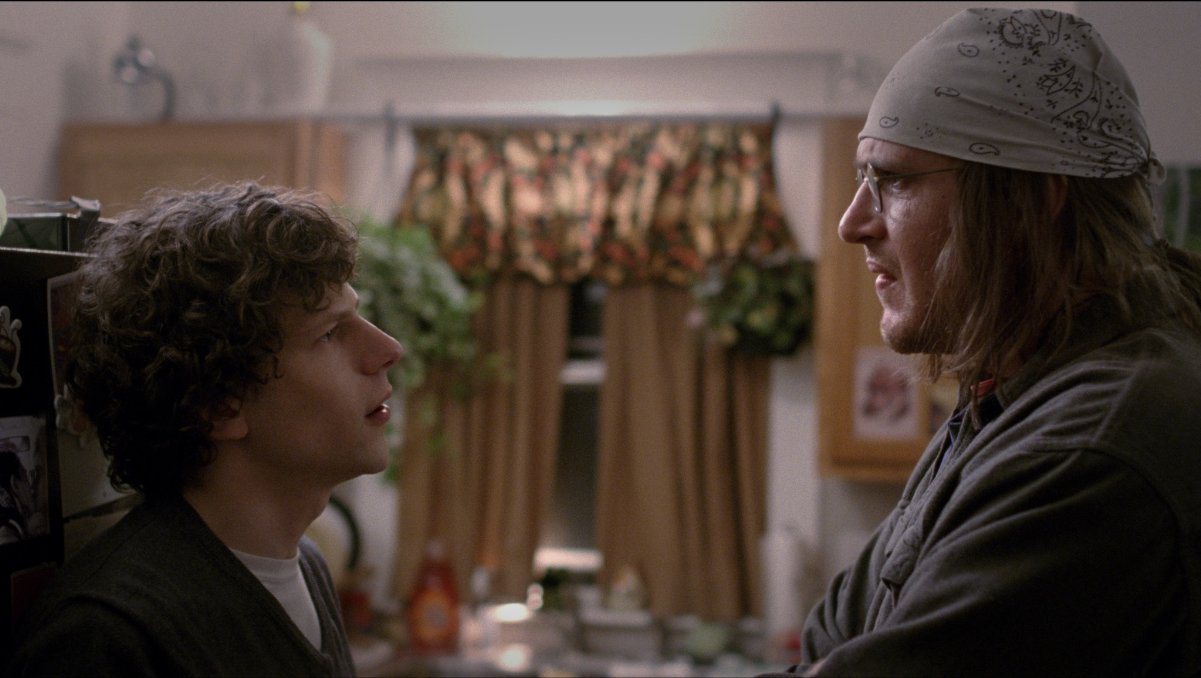
The Wallace given us in The End of the Tour is one that, to put it bluntly, struggles with the “mirrored self,” to paraphrase Foucault. Wallace is at war with his own identity and a host of idealized selves that he and others construct. Like we all do, he crafts an image of himself that he cannot fully live up to. At the same time, fans, critics, and writers like Lipsky project a version of Wallace, fueled by his very fame that they help create, against which he also struggles. This tension permeates every aspect of his life from work to relationships to friendships. He is constantly suspicious of people’s intentions: are they in love with him, do they want to be friends with him, or are they in love with what he represents or the image of him they have created? Wallace needs isolation to work, but he craves a long-lasting relationship, telling Lipsky that it would be great to have a wife to share these experiences with.
We are also presented with a man of profound empathy. In one scene, Lipsky and Wallace are arguing, and Lipsky accuses Wallace of putting on a humble front. He’s patronizing everyone by making them think he’s less intelligent than they are, when, if Infinite Jest is any indication, he’s a certifiable genius. Wallace snaps back in defense and argues that regarding everyone with whom he comes in contact as possessors of fascinating stories is a hell of a lot better way to move through life than believing you’re better than everyone else, an outlook that instantly cuts off any potential conversations. Such a worldview recalls Paul’s admonition in Philippians to “regard others as better than [yourself].” Perhaps this is part of what made Wallace’s writing so great and authentic, even in its outsized narratives.
The notion of place (where we plant ourselves) seems to be closely related to this. Some of the more striking images of the film are of the two Davids driving along long stretches of suburban Indiana roads between rows of fast food joints and chain department stores. Lipsky asks Wallace why he isn’t in New York, and Wallace sharply responds by critiquing it as a place polluted by the constant hiss of inflating and deflating egos. But he’s also aware of his own addictive personality and ego and the likelihood that he would be sucked into that din as well. Perhaps his fast food surroundings are Wallace’s Walden Pond, a place that provides some distance from the barrage of constructed images, even as its “safety” and “reality” are constructs too.
Finally, even though the specter of Wallace’s death hangs over the entire film and contributes to its impact, his life, in a small way, is a testament to the Church’s ability to speak into these struggles. Wallace, like so many brilliant creatives, suffered from and was fueled by depression. But he found solace in, of all places, a Baptist church. The film concludes with Lipsky flying back to New York, and Wallace dancing his heart out with a friend at the local church. In a world of mirrored selves that lack empathy and a sense of belonging, perhaps the Church is a port in the storm, reminding us of our true identity, cultivating in us a deep sense of empathy, and providing a therapeutic place where we can dance in celebration of these realities.
We are inching closer to the world that Wallace feared, when we will be wholly consumed by the images around us, participating in virtual realities that separate us once and for all. We are being fed, Wallace says, a host of images and stories by people who do not love us. It’s a vision that echoes last night’s episode of True Detective, “Black Maps and Motel Rooms,” in which Vera tells Ani, “Everything is fucking.” Thankfully, in The End of the Tour, we have a filmmaker and film that not only loves its subject matter, but loves its audience enough to gift us a conversation worth having.
The End of the Tour (106 mins.) is in limited release and is rated R for language.
Previous Post
July 29, 2015
The Netflix-ization of the Church
Next Post

August 13, 2015 Killer Serials: MR. ROBOT, Season 1, Eps. 5-8
Browse Our Archives
Select a Category Classics DVD Film Music News Pop Culture Events Print Sports Television Uncategorized Video Games
Select a Month March 2017 February 2017 January 2017 December 2016 November 2016 October 2016 September 2016 August 2016 July 2016 June 2016 May 2016 April 2016 March 2016 February 2016 January 2016 December 2015 November 2015 October 2015 September 2015 August 2015 July 2015 June 2015 May 2015 April 2015 March 2015 February 2015 January 2015 December 2014 November 2014 October 2014 September 2014 August 2014 July 2014 June 2014 May 2014 April 2014 March 2014 February 2014 January 2014 December 2013 November 2013 October 2013 September 2013 August 2013 July 2013 June 2013 May 2013 April 2013 March 2013 February 2013 January 2013 December 2012 November 2012 October 2012 September 2012 August 2012 July 2012 June 2012 May 2012 April 2012 March 2012 February 2012 January 2012 December 2011 November 2011 October 2011 September 2011 August 2011 July 2011 June 2011 May 2011 April 2011 March 2011 February 2011 January 2011 December 2010 November 2010 October 2010 September 2010 August 2010 July 2010 June 2010 May 2010 April 2010 March 2010 February 2010 January 2010 December 2009 November 2009 October 2009 September 2009 August 2009 July 2009 June 2009 May 2009 April 2009 March 2009 February 2009 January 2009 December 2008 November 2008 October 2008 September 2008 August 2008 July 2008 June 2008 May 2008 April 2008 March 2008 February 2008 January 2008 December 2007 November 2007 October 2007 September 2007 August 2007 July 2007 June 2007 May 2007 April 2007 March 2007
Follow Us!
TAKE THE
Religious Wisdom Quiz
What theme is central to both Isaiah and Jeremiah's prophecies?
Select your answer to see how you score.
Judgment and restoration Genealogy Priestly leadership Military conquest
Related posts from Pop Theology


At SXSW2017: May It Last: A Portrait of...

At SXSW 2017: "Untold Tales of Armistead Maupin"
TRENDING AT PATHEOS Progressive Christian

Why Christians Have a Sacred Duty to Vote:...
The Bible offers strong support for the sacred duty to vote. Here...

What Being a Modern-Day Apostle Means to Me
In my last column, I discussed the ins and outs of modern-day...

Did Ancient China Once Worship the God of...
Across human history, a common thread weaves through the origins of the...

Love Your Neighbor – Including Earth-Kin: Lev. 19,...
God’s command to love your neighbor means acting in an ethical and...

Lead a Church Study of “Jesus and Lao...
Guest writer Jack Thomas (The Irreverent Reverend) reflects on leading his church...

Principles for Understanding the Apostolic Ministry Today
Whenever people discover that my formal ministry title is "apostle," as in...
view all Progressive Christian blogs
Ad-Free & Subscriber Log-In Subscription Support
- About Us
- 2026 Calendar
- Videos
- Podcasts
- Library of World Religions
- Faith In Media Tracker
- Advertise With Us
- Write for Us
- Privacy Policy
- Terms of Service
- Do Not Sell My Data
- Contact Us
- Radiant Digital
- Manage Newsletter Subscriptions
- Unsubscribe From Notifications
- Sitemap
Copyright 2008-2026, Patheos. All rights reserved.
Subscription Support Ad-Free & Subscriber Log-In
Follow Patheos