
BuddhistCatholicContemplativeEvangelicalGeneral ChristianHinduJewishLatter-day SaintMuslimNew VisionsProgressive Christian
Beliefs
- Buddhist
- Catholic
- Contemplative
- Evangelical
- General Christian
- Hindu
- Jewish
- Latter-day Saint
- More Voices
- Muslim
- New Visions
- Pagan
- Progressive Christian
Topics
- Religion News
- Food and Religion
- Sports and Religion
- Religious Art
- Religious Music and Entertainment
- Religious Events
- History and Religion
- Style and Religion
- Politics and Religion
- Women in Religion
- Recreation Outdoors and Religion
- Business Finance and Religion
- Careers Workplace and Religion
- Education and Religion
- Family Parenting and Religion
- Health Fitness and Religion
- Home and Religion
- Relationships and Religion
- Technology and Religion
- Travel and Religion
Columnists
- Buddhist Columnists
- Business Finance and Religion Columnists
- Careers Workplace and Religion Columnists
- Catholic Columnists
- Contemplative Columnists
- Education and Religion Columnists
- Evangelists Columnists
- Family Parenting and Religion Columnists
- General Christian Columnists
- Health Fitness and Religion Columnists
- Hindu Columnists
- History and Religion Columnists
- Home and Religion Columnists
- Jewish Columnists
- More Voices Columnists
- Latter Day Columnists
- Muslim Columnists
- New Visions Columnists
- Nonreligious Columnists
- Pagan Columnists
- Politics and Religion Columnists
- Progressive Columnists
- Recreation Outdoors and Religion Columnists
- Relationships and Religion Columnists
- Religion News Columnists
- Religious Art Columnists
- Religious Events Columnists
- Religious Music and Entertainment Columnists
- Sports and Religion Columnists
- Style and Religion Columnists
- Technology and Religion Columnists
- Travel and Religion Columnists
- Women in Religion Columnists
Resource Library
- 2026 Calendar
- Library of World Religions
- The 100 Most Holy Places on Earth
- Patheos Answers
- Podcasts
- Videos
- Faith Leaders Database
- Anglican Episcopalian
- Bahai
- Baptist
- Buddhism
- Christianity
- Confucianism
- Eastern Orthodoxy
- Hinduism
- Holiness and Pentecostal
- ISKCON
- Islam
- Judaism
- Lutheran
- Methodist
- The Church of Jesus Christ of Latter-day Saints
- New Age
- Paganism
- Presbytarian and Reformed
- Protestantism
- Religion Behind the Scenes
- Roman Catholic
- Scientology
- Shia Islam
- Sikhism
- Sufism
- Sunni Islam
- Taoism
- Zen
- See all religions
Research Tools
 Ad-Free & Subscriber Log-In Subscription Support
Ad-Free & Subscriber Log-In Subscription Support
Follow Patheos 

- Trending:
- Forgiveness
- |
- Marriage
- |
- Consciousness
- |
- Death Penalty
- |
- Election
- |
- Halloween
 Pop Theology
- Home
- Progressive Christian
- Religious Music & Entertainment
- Richard’s Book Is Here! + Part One of Popping Collars
Richard’s Book Is Here! + Part One of Popping Collars
Last updated on: June 30, 2015 at 11:37 am by Richard Lindsay
Richard’s Book Is Here! + Part One of Popping Collars 2015-06-30T11:37:24-07:00 Richard Lindsay
Patheos Explore the world's faith through different perspectives on religion and spirituality! Patheos has the views of the prevalent religions and spiritualities of the world.
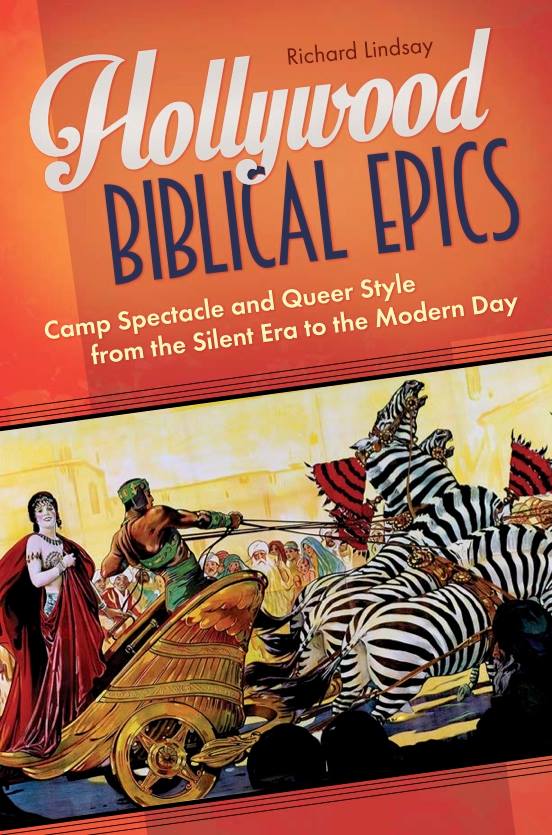 So the big day has arrived. My book, Hollywood Biblical Epics: Camp Spectacle and Queer Style from the Silent Era to the Modern Day, drops today. Get it on Amazon or anywhere fine books are sold….online. With a title like that they’re not exactly going to have it at your local Books-A-Million.
To celebrate, I want to post an excerpt and a link to a recent appearance I made on the “Popping Collars” podcast explaining some of what the book is about and my interest in popular culture and biblical epics.
“Popping Collars” was started by two of my former students, the (now) Reverends Greg Knight and Betsy Gonzalez. They were part of the first class of “Pop Goes Religion: Religion and Popular Culture” at Graduate Theological Union in Berkeley when I was a doctoral student there. It’s really rewarding when you see what your former students are up to, and especially rewarding when you discover they’re making podcasts about the theological significance of Mad Men.
Here’s the link to the whole podcast, which is much more entertaining than reading a transcript.
Here’s a not-at-all accurate transcript, so listen to the podcast if you want to hear what we really said.
This is Part I — I’ll post Part II later this week.
Popping Collars Podcast #20: “Once More with Passion”
Betsy Gonzalez and Greg Knight: So tell us where you interest in combining popular culture and religion came from.
Richard Lindsay: Some of this came from my natural interest in popular culture and that I’m always looking for ways to make faith more relevant. I come from a Presbyterian background. I love the Presbyterians—they’re my family of origin. They’ve given me a strong grounding in scripture and theology. But one of the things they don’t always do well at least in the more moderate to liberal churches is address (popular) culture. At times they hold their scriptural interpretation and theology aloof from culture. And I think it’s a reason for mainline church decline. I think we’ve kind of left culture to the evangelicals. We’ve kind of said to the evangelicals you all can deal with popular culture we don’t want to dirty our hands with that.
Some of the neo-orthodox theology that reigns in the Presbyterian Church really doesn’t have a lot of use for culture. It’s kind of like, “We are really about the Kingdom of God and the only revelation we can derive is from Scripture.”
And yet I find myself all the time finding revelation–and even divine revelation–in popular culture. I find myself watching films or listening to songs and it feels like God talks to me through those things. And this isn’t in the way that “Helter-Skelter” talked to Charles Manson or anything like that. I actually feel something coming from those different sources.
Greg Knight: Yeah, I remember in one of the early classes, you brought up Harry Potter and you were like, “We can’t just have conversations where the Catholic Church comes out and says there’s no value here. Don’t watch Harry Potter just ignore it.“
A lot of people set up these false dichotomies like science versus religion or popular culture versus religion. It’s got to be a conversation otherwise you’re losing the touch points that people have. Popular culture is a huge touchstone for people to gravitate towards. It’s a common language.
Betsy Gonzalez: I was super happy when U2 got brought up early, when I knew that we’re hitting that first or second class and we’re going deeper and wider. That’s when I was like, “This is excellent.”
It’s this ability to train my radar to really start to see all the different ways that faith and culture were intertwined together. Because I’m taking all the seminary classes and I’m actually bringing them into this great love of culture and we can actually have them talk back and forth.
I love that you have taken a real homiletical edge with it as well. That’s a great place to bring things into the conversation, and that’s where I find I pull on it the most. That and teaching high school kids. It just helps make it alive because culture moves fast.
Richard Lindsay: My whole thing in terms of teaching the course was rather than seeing the Church or religion as being in a higher place and popular culture in a lower place, I thought, “Let’s even that out so religion in popular culture can have a conversation on equal ground.”
And then let’s even take it even a step further and say that there may be times when popular culture speaks to issues of faith or spirituality better than traditional religion does. And we need to listen for those moments as well. We need to listen for those moments when the flow is reversed and popular culture can teach us something new about our faith.
We transition to talking about biblical epics…
Greg Knight: I remember from the class some of the depictions of the Bible movies. We got to see the great clip of the drunk John Wayne up on the hill delivering the centurion’s lines.
Richard Lindsay: Yes, from The Greatest Story Ever Told.
(Note: In the 1965 biblical epic The Greatest Story Ever Told, John Wayne plays the centurion who stands under the cross and drawls, “Surely this man was the Son of God.”)
Greg Knight: The thing that blew my mind was the camp elements in The Passion of the Christ. I always thought [The Passion] was just a straight-up horror movie, like something Cronenberg would’ve done. But when you brought up the camp elements of the Herod scene I was like, “Wait, you’re right! There is a tie to all of these crazy Ten Commandments-type films.” There’s this thread of camp that kind of runs through there. I was hoping you could explain for us what makes something camp.
Richard Lindsay: Camp is a difficult term to define. There was a famous essay by Susan Sontag in the 1960s that talked about camp [*Notes on ‘*Camp’] Camp is something that is over the top that is exorbitant, but in a very ironic kind of way.
Sontag just kind of lists all these things that she considers to be camp and it’s everything from horror movies to the Palace at Versailles to everything Oscar Wilde ever wrote. She talks about it as having “A private, zany experience of the world.” She was proposing it as kind of a middle rung between low art and high art.
Greg Knight: Is it necessary for camp to be self-realized? Can you accidentally fall into camp?
Richard Lindsay: Oh yes, you can accidentally fall into camp and actually what Susan Sontag said is that’s the more rewarding camp—when somebody is camp and they don’t know it.
What I would say is that a lot of the biblical epics are unintentional camp. They have this bizarre, over-the-top theatricality. They have this bizarre mix of sex and violence and piety—so the camp is unintentional.
More discussion of camp in biblical epics. We then begin discussing how influential biblical films are in shaping our notions of scripture.
Betsy Gonzalez: We don’t realize it until we start talking about this how much we have structured our experiences of Scripture through these biblical epics. Especially these movies that are on every year at Passover/Easter, and you start reading Scripture through the visuals, especially if you’re a visual person.
Richard Lindsay: When you have visual versus text and you’re a visual person the visual is always going to supersede the text. The visual is going to stick inside your head a lot more clearly, especially if it’s spectacle. And these films are spectacle all over the place.
Then you get to the point where you can’t really tell the difference. Is that something I saw in a Cecil B. DeMille film or something I heard at Sunday school or something I actually read in the Bible? Some people see that as a great tragedy and they say we shouldn’t make these films or we shouldn’t watch these films because they’re just going to screw with our attempts at understanding the Bible. I think you should just go with it. As far as I’m concerned Moses looked like Charlton Heston. I can’t get that out of my head and why should I bother?
Previous Post

June 30, 2015
Killer Serials: ORANGE IS THE NEW BLACK, Season 3, Eps. 7-9
Next Post
July 1, 2015 Popping Collars Part II: "Jesus becomes a monster for us and with us"
Browse Our Archives
Select a Category Classics DVD Film Music News Pop Culture Events Print Sports Television Uncategorized Video Games
Select a Month March 2017 February 2017 January 2017 December 2016 November 2016 October 2016 September 2016 August 2016 July 2016 June 2016 May 2016 April 2016 March 2016 February 2016 January 2016 December 2015 November 2015 October 2015 September 2015 August 2015 July 2015 June 2015 May 2015 April 2015 March 2015 February 2015 January 2015 December 2014 November 2014 October 2014 September 2014 August 2014 July 2014 June 2014 May 2014 April 2014 March 2014 February 2014 January 2014 December 2013 November 2013 October 2013 September 2013 August 2013 July 2013 June 2013 May 2013 April 2013 March 2013 February 2013 January 2013 December 2012 November 2012 October 2012 September 2012 August 2012 July 2012 June 2012 May 2012 April 2012 March 2012 February 2012 January 2012 December 2011 November 2011 October 2011 September 2011 August 2011 July 2011 June 2011 May 2011 April 2011 March 2011 February 2011 January 2011 December 2010 November 2010 October 2010 September 2010 August 2010 July 2010 June 2010 May 2010 April 2010 March 2010 February 2010 January 2010 December 2009 November 2009 October 2009 September 2009 August 2009 July 2009 June 2009 May 2009 April 2009 March 2009 February 2009 January 2009 December 2008 November 2008 October 2008 September 2008 August 2008 July 2008 June 2008 May 2008 April 2008 March 2008 February 2008 January 2008 December 2007 November 2007 October 2007 September 2007 August 2007 July 2007 June 2007 May 2007 April 2007 March 2007
Follow Us!
TAKE THE
Religious Wisdom Quiz
What does "Beersheba" mean?
Select your answer to see how you score.
Valley of Water House of the King Well of the Oath Blessed Field
Related posts from Pop Theology
The Mastodon In The Room: A Conversation with...


At SXSW2017: Music Festival Day 5
At SXSW2017: Music Festival Day 4
TRENDING AT PATHEOS Progressive Christian

Why Christians Have a Sacred Duty to Vote:...
The Bible offers strong support for the sacred duty to vote. Here...

What Being a Modern-Day Apostle Means to Me
In my last column, I discussed the ins and outs of modern-day...

Did Ancient China Once Worship the God of...
Across human history, a common thread weaves through the origins of the...

Love Your Neighbor – Including Earth-Kin: Lev. 19,...
God’s command to love your neighbor means acting in an ethical and...

Lead a Church Study of “Jesus and Lao...
Guest writer Jack Thomas (The Irreverent Reverend) reflects on leading his church...

Principles for Understanding the Apostolic Ministry Today
Whenever people discover that my formal ministry title is "apostle," as in...
view all Progressive Christian blogs
Ad-Free & Subscriber Log-In Subscription Support
- About Us
- 2026 Calendar
- Videos
- Podcasts
- Library of World Religions
- Faith In Media Tracker
- Advertise With Us
- Write for Us
- Privacy Policy
- Terms of Service
- Do Not Sell My Data
- Contact Us
- Radiant Digital
- Manage Newsletter Subscriptions
- Unsubscribe From Notifications
- Sitemap
Copyright 2008-2026, Patheos. All rights reserved.
Subscription Support Ad-Free & Subscriber Log-In
Follow Patheos