
BuddhistCatholicContemplativeEvangelicalGeneral ChristianHinduJewishLatter-day SaintMuslimNew VisionsProgressive Christian
Beliefs
- Buddhist
- Catholic
- Contemplative
- Evangelical
- General Christian
- Hindu
- Jewish
- Latter-day Saint
- More Voices
- Muslim
- New Visions
- Pagan
- Progressive Christian
Topics
- Religion News
- Food and Religion
- Sports and Religion
- Religious Art
- Religious Music and Entertainment
- Religious Events
- History and Religion
- Style and Religion
- Politics and Religion
- Women in Religion
- Recreation Outdoors and Religion
- Business Finance and Religion
- Careers Workplace and Religion
- Education and Religion
- Family Parenting and Religion
- Health Fitness and Religion
- Home and Religion
- Relationships and Religion
- Technology and Religion
- Travel and Religion
Columnists
- Buddhist Columnists
- Business Finance and Religion Columnists
- Careers Workplace and Religion Columnists
- Catholic Columnists
- Contemplative Columnists
- Education and Religion Columnists
- Evangelists Columnists
- Family Parenting and Religion Columnists
- General Christian Columnists
- Health Fitness and Religion Columnists
- Hindu Columnists
- History and Religion Columnists
- Home and Religion Columnists
- Jewish Columnists
- More Voices Columnists
- Latter Day Columnists
- Muslim Columnists
- New Visions Columnists
- Nonreligious Columnists
- Pagan Columnists
- Politics and Religion Columnists
- Progressive Columnists
- Recreation Outdoors and Religion Columnists
- Relationships and Religion Columnists
- Religion News Columnists
- Religious Art Columnists
- Religious Events Columnists
- Religious Music and Entertainment Columnists
- Sports and Religion Columnists
- Style and Religion Columnists
- Technology and Religion Columnists
- Travel and Religion Columnists
- Women in Religion Columnists
Resource Library
- 2026 Calendar
- Library of World Religions
- The 100 Most Holy Places on Earth
- Patheos Answers
- Podcasts
- Videos
- Faith Leaders Database
- Anglican Episcopalian
- Bahai
- Baptist
- Buddhism
- Christianity
- Confucianism
- Eastern Orthodoxy
- Hinduism
- Holiness and Pentecostal
- ISKCON
- Islam
- Judaism
- Lutheran
- Methodist
- The Church of Jesus Christ of Latter-day Saints
- New Age
- Paganism
- Presbytarian and Reformed
- Protestantism
- Religion Behind the Scenes
- Roman Catholic
- Scientology
- Shia Islam
- Sikhism
- Sufism
- Sunni Islam
- Taoism
- Zen
- See all religions
Research Tools
 Ad-Free & Subscriber Log-In Subscription Support
Ad-Free & Subscriber Log-In Subscription Support
Follow Patheos 

- Trending:
- Forgiveness
- |
- Marriage
- |
- Consciousness
- |
- Death Penalty
- |
- Election
- |
- Halloween
 Pop Theology
- Home
- Progressive Christian
- Religious Music & Entertainment
- ME AND EARL AND THE DYING GIRL: Or Why We Should Celebrate the Rise of the Nones
ME AND EARL AND THE DYING GIRL: Or Why We Should Celebrate the Rise of the Nones
Last updated on: June 10, 2015 at 8:48 am by J. Ryan Parker
ME AND EARL AND THE DYING GIRL: Or Why We Should Celebrate the Rise of the Nones 2015-06-10T08:48:27-07:00 J. Ryan Parker
Patheos Explore the world's faith through different perspectives on religion and spirituality! Patheos has the views of the prevalent religions and spiritualities of the world.
A few weeks ago, the Pew Research Center released their latest study on America’s changing religious landscape, which finds that young folks are not attending–or leaving–the church in droves. The “Nones” (or as George Clooney’s character, Ulysses Everett McGill, referred to himself in O Brother, Where Art Thou?, the “unaffiliated”) are on the rise. Christians of all stripes continue to speculate and worry about what this means for our future…another case of what Richard Lindsay likes to call BWAK (“but what about the kids?!”). If you get a chance to see the latest indie darling, Me and Earl and the Dying Girl, a smart, hilarious film that feels as timely as it is timeless, it might just give you hope that the kids, indeed, will be alright.
The Me in Me and Earl is Greg (Thomas Mann), a high school senior who belongs to no religion, I mean clique. However, like his sociologist father (Nick Offerman), he’s an astute observer of the social strata in which he lives and moves. He and his best friend Earl (RJ Cyler) are obsessed with not only watching films, but remaking, renaming, and starring in their own no-budget remakes of their favorite classics. Greg’s mother (Connie Britton) worries that Greg doesn’t have enough friends and pushes him to pay a visit to Rachel (Olivia Cooke), a fellow senior who has recently been diagnosed with leukemia. He whines a bit but eventually gives in.
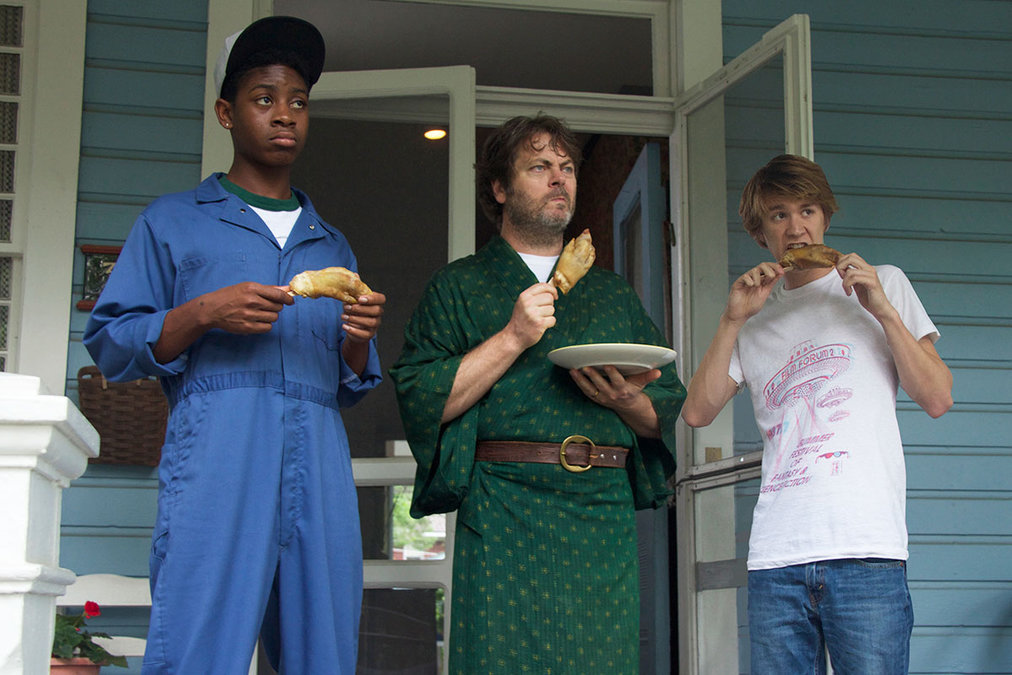
Greg and Rachel form a fast friendship. Their lengthy conversations would feel at home in any high school dramedy, but, somehow, feel more fresh and honest here. While Earl humorously encourages Greg to pursue more physical contact with any girl he encounters, he is perhaps more aware than anyone else of the deep emotional (and spiritual?) bonds that Greg and Rachel develop. A smart, promising student, Greg foregoes his schoolwork to spend more time with Rachel and dedicates his and Earl’s next film to her. Rachel sees that this is jeopardizing Greg’s college future and pushes him away (even as her condition gets worse). But Earl pushes Greg back, leading to one of the more beautiful scenes in film this year.
Me and Earl and the Dying Girl benefits from an intelligent script that is smartly shot. There are creative cinematic flourishes, but director Alfonso Gomez-Rejon and cinematographer Chung-hoon Chung know when to be still and let the script and actors do their thing, resulting in this great Scott Pilgrim vs. the World and old Hollywood mashup. And the actors are certainly stellar at doing their thing, as everyone turns in strong performances, but especially Cyler and Cooke. As a film itself and the filmmaking it features, Me and Earl and the Dying Girl reminds us that no-budget and low-budget filmmaking are still extremely fruitful avenues for creativity and spiritual connection.

Me and Earl and the Dying Girl has much to say about religion and spirituality, even though none of its characters participate in organized religion or profess any type of faith, as traditionally defined. If we place it in conversation with the recent Pew findings, it is especially interesting. Greg is a “None” in the sense that he identifies with none of the cliques (religions) that make up his school’s social network, be it goths, nerds, jocks, etc. On the other hand, he sees value and worth in them all and knows just enough to communicate with and navigate between them in a friendly and peaceful manner. While his inability to commit might be a cause of concern for an older generation (his mother), there is a depth and intelligence in his ability to move seamlessly from one group to the next. He, like the Nones, doesn’t want to be tied down and certainly doesn’t want to be associated with groups that marginalize others. What would an entire high school of Gregs look like? Or better yet, what would it look like if more members of traditional cliques acted a little more like Greg?
In his book, Film as Religion: Myths, Morals, and Rituals, film and religion scholar John Lyden argues that popular films perform a religious function in our culture and, like more formal religious institutions, provide us with ways to view the world and values to confront it. Film-watching and filmmaking might be the closest thing that Greg and Earl have to a religion. They celebrate and revere the classics, but they are no mindless devotees. Rather than simply passively accepting what these films have to tell them about the world in which they live and how to move through it, they take these sacred texts and remake them, drawing meaning from those stories, but giving them new life and meaning through their interpretations. And in Rachel’s case, Greg and Earl’s film is more life-altering than any old Hollywood or art house film could ever be.
I understand, but don’t necessarily resonate with, those who wring their hands over the Pew findings out of fear for the future…and the children. It’s important to remember that churches and religious folk don’t have the market cornered on values, and that many families and kids are quietly serving their communities without any traditional religious input. I would agree, however, that “values” need to be planted and nurtured, and in Me and Earl and the Dying Girl, Greg’s mother is an example of this necessity as she forces Earl out of his comfort zone. Eventually diving into his mother’s “assignment” wholeheartedly, Greg’s schoolwork declines. But what he lacks in grades, he more than makes up for in empathy, compassion, and, I would argue, spiritual development. Should more of our schools offer courses on empathy and compassion? What if more high school seniors could boast recommendation letters like the one Rachel writes for Greg?
Me and Earl and the Dying Girl is a strong reminder that even though they might not look like us, sound like us, or believe like us, the Nones have much to teach us, if we would just listen…and watch.
Me and Early and the Dying Girl (105 mins.) is rated PG-13 for sexual content, drug material, language, and some thematic elements and is in theaters everywhere Friday, July 12.
me and earl and the dying girl
Previous Post

June 1, 2015
Grief, Revenge, and Other Ghosts of the Past in Netflix's BLOODLINE
Next Post

June 15, 2015 Cross+Roads Faith and Film Renewal: Review of "Louder Than Bombs"
Browse Our Archives
Select a Category Classics DVD Film Music News Pop Culture Events Print Sports Television Uncategorized Video Games
Select a Month March 2017 February 2017 January 2017 December 2016 November 2016 October 2016 September 2016 August 2016 July 2016 June 2016 May 2016 April 2016 March 2016 February 2016 January 2016 December 2015 November 2015 October 2015 September 2015 August 2015 July 2015 June 2015 May 2015 April 2015 March 2015 February 2015 January 2015 December 2014 November 2014 October 2014 September 2014 August 2014 July 2014 June 2014 May 2014 April 2014 March 2014 February 2014 January 2014 December 2013 November 2013 October 2013 September 2013 August 2013 July 2013 June 2013 May 2013 April 2013 March 2013 February 2013 January 2013 December 2012 November 2012 October 2012 September 2012 August 2012 July 2012 June 2012 May 2012 April 2012 March 2012 February 2012 January 2012 December 2011 November 2011 October 2011 September 2011 August 2011 July 2011 June 2011 May 2011 April 2011 March 2011 February 2011 January 2011 December 2010 November 2010 October 2010 September 2010 August 2010 July 2010 June 2010 May 2010 April 2010 March 2010 February 2010 January 2010 December 2009 November 2009 October 2009 September 2009 August 2009 July 2009 June 2009 May 2009 April 2009 March 2009 February 2009 January 2009 December 2008 November 2008 October 2008 September 2008 August 2008 July 2008 June 2008 May 2008 April 2008 March 2008 February 2008 January 2008 December 2007 November 2007 October 2007 September 2007 August 2007 July 2007 June 2007 May 2007 April 2007 March 2007
Follow Us!
TAKE THE
Religious Wisdom Quiz
What does "Rabboni" mean?
Select your answer to see how you score.
Savior Master Holy One My Teacher
Related posts from Pop Theology


At SXSW2017: May It Last: A Portrait of...

At SXSW 2017: "Untold Tales of Armistead Maupin"
TRENDING AT PATHEOS Progressive Christian

Why Christians Have a Sacred Duty to Vote:...
The Bible offers strong support for the sacred duty to vote. Here...

What Being a Modern-Day Apostle Means to Me
In my last column, I discussed the ins and outs of modern-day...

Did Ancient China Once Worship the God of...
Across human history, a common thread weaves through the origins of the...

Love Your Neighbor – Including Earth-Kin: Lev. 19,...
God’s command to love your neighbor means acting in an ethical and...

Lead a Church Study of “Jesus and Lao...
Guest writer Jack Thomas (The Irreverent Reverend) reflects on leading his church...

Principles for Understanding the Apostolic Ministry Today
Whenever people discover that my formal ministry title is "apostle," as in...
view all Progressive Christian blogs
Ad-Free & Subscriber Log-In Subscription Support
- About Us
- 2026 Calendar
- Videos
- Podcasts
- Library of World Religions
- Faith In Media Tracker
- Advertise With Us
- Write for Us
- Privacy Policy
- Terms of Service
- Do Not Sell My Data
- Contact Us
- Radiant Digital
- Manage Newsletter Subscriptions
- Unsubscribe From Notifications
- Sitemap
Copyright 2008-2026, Patheos. All rights reserved.
Subscription Support Ad-Free & Subscriber Log-In
Follow Patheos