
BuddhistCatholicContemplativeEvangelicalGeneral ChristianHinduJewishLatter-day SaintMuslimNew VisionsProgressive Christian
Beliefs
- Buddhist
- Catholic
- Contemplative
- Evangelical
- General Christian
- Hindu
- Jewish
- Latter-day Saint
- More Voices
- Muslim
- New Visions
- Pagan
- Progressive Christian
Topics
- Religion News
- Food and Religion
- Sports and Religion
- Religious Art
- Religious Music and Entertainment
- Religious Events
- History and Religion
- Style and Religion
- Politics and Religion
- Women in Religion
- Recreation Outdoors and Religion
- Business Finance and Religion
- Careers Workplace and Religion
- Education and Religion
- Family Parenting and Religion
- Health Fitness and Religion
- Home and Religion
- Relationships and Religion
- Technology and Religion
- Travel and Religion
Columnists
- Buddhist Columnists
- Business Finance and Religion Columnists
- Careers Workplace and Religion Columnists
- Catholic Columnists
- Contemplative Columnists
- Education and Religion Columnists
- Evangelists Columnists
- Family Parenting and Religion Columnists
- General Christian Columnists
- Health Fitness and Religion Columnists
- Hindu Columnists
- History and Religion Columnists
- Home and Religion Columnists
- Jewish Columnists
- More Voices Columnists
- Latter Day Columnists
- Muslim Columnists
- New Visions Columnists
- Nonreligious Columnists
- Pagan Columnists
- Politics and Religion Columnists
- Progressive Columnists
- Recreation Outdoors and Religion Columnists
- Relationships and Religion Columnists
- Religion News Columnists
- Religious Art Columnists
- Religious Events Columnists
- Religious Music and Entertainment Columnists
- Sports and Religion Columnists
- Style and Religion Columnists
- Technology and Religion Columnists
- Travel and Religion Columnists
- Women in Religion Columnists
Resource Library
- 2026 Calendar
- Library of World Religions
- The 100 Most Holy Places on Earth
- Patheos Answers
- Podcasts
- Videos
- Faith Leaders Database
- Anglican Episcopalian
- Bahai
- Baptist
- Buddhism
- Christianity
- Confucianism
- Eastern Orthodoxy
- Hinduism
- Holiness and Pentecostal
- ISKCON
- Islam
- Judaism
- Lutheran
- Methodist
- The Church of Jesus Christ of Latter-day Saints
- New Age
- Paganism
- Presbytarian and Reformed
- Protestantism
- Religion Behind the Scenes
- Roman Catholic
- Scientology
- Shia Islam
- Sikhism
- Sufism
- Sunni Islam
- Taoism
- Zen
- See all religions
Research Tools
 Ad-Free & Subscriber Log-In Subscription Support
Ad-Free & Subscriber Log-In Subscription Support
Follow Patheos 

- Trending:
- Forgiveness
- |
- Marriage
- |
- Consciousness
- |
- Death Penalty
- |
- Election
- |
- Halloween
 Pop Theology
- Home
- Progressive Christian
- Religious Music & Entertainment
- The Multiple Meanings of “Pride”
The Multiple Meanings of “Pride”
Last updated on: May 11, 2015 at 3:03 pm by Richard Lindsay
The Multiple Meanings of “Pride” 2015-05-11T15:03:17-07:00 Richard Lindsay
Patheos Explore the world's faith through different perspectives on religion and spirituality! Patheos has the views of the prevalent religions and spiritualities of the world.
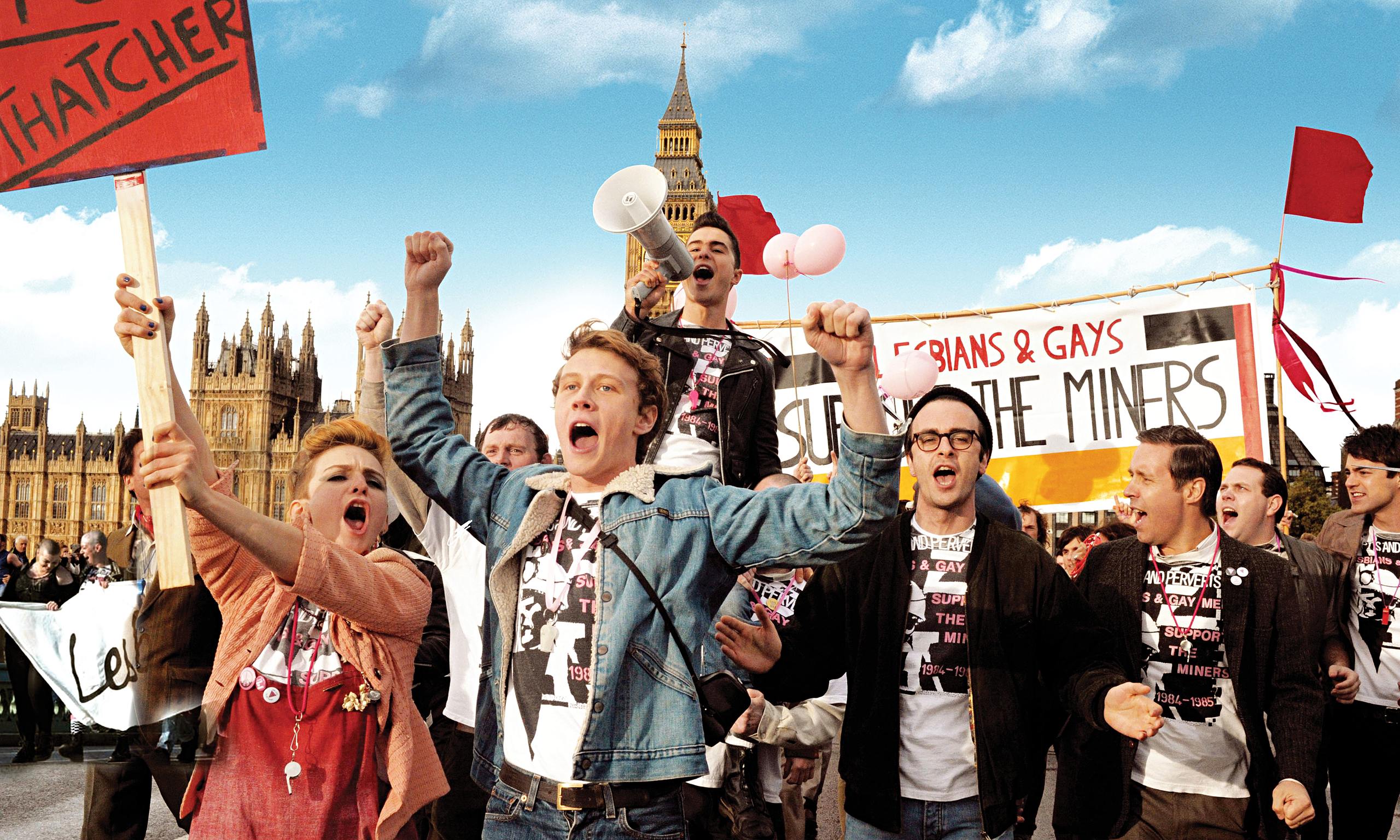 The British coal miner’s strike of 1984-85 has been fodder for several small but scrappy films in the last twenty years, including Brassed Off (1996), Billy Elliott (2000) and the steel-industry based but still scrappy The Full Monty (1997).
Joining this award-winning lineup is Pride (2014), which won a BAFTA and the heretofore unheard-of “Queer Palm” at Cannes, and is now out on DVD and streaming video on demand.
What’s fascinating about these four films is that although they seem to be about the decline of industrial Britain, they end up as explorations of gender and sexuality, particularly the crisis of masculinity when working-class men’s occupations are taken away from them.
Pride contrasts with the other films in that it is a true story. At the 1984 Gay Pride march in London, several commie queers (literally) began carrying buckets to collect funds for striking coal miners for food and supplies as they faced down the Thatcher administration.
The film picks up at the unlikely first meeting of Lesbians and Gays Support the Miners (LGSM), founded by a fresh-faced Northern Irishman, Mark Ashton (Ben Schnetzer) and London lefty Mike Jackson (Joseph Gilgun). The first hurdle to be overcome as they meet in a London gay bookshop–called Gay’s the Word–is their own skepticism. Ashton, cast as the charismatic leader of the group, helps the assembled punks and misfits see the connections between their lot and the miners’: the miners and the gays are abused by the police; the miners and the gays are hated by the government and the tabloid press.
Once sufficient numbers of big city queers are convinced of the need for solidarity with the miners, they have to find some miners who are willing to accept their help. After multiple calls to union halls are met with hasty hang-ups, they finally succeed in connecting with the humble burghers of the Welsh town of Onllwyn.
The motley crew that finally descends on Onllwyn to meet with the union and town leaders consists of the queer communists, the gay bookshop owners, a gay youngster from the suburbs just coming out, and three very punk lesbians. If you want to imagine a parallel, think of 1980s ACT UP and Queer Nation New Yorkers encountering coal miners in Eastern Kentucky or Tennessee.
Clash-of-worlds comedy ensues, as “the gays and lesbians” (which actually becomes their group moniker) face a blend of horror and curiosity. Fortunately, the village has Hefina (Imelda Staunton) of the women’s auxiliary and Cliff (Bill Nighy), a distinguished local poet, as wise town elders to encourage the rural locals to come out of their shells and embrace their unlikely supporters.
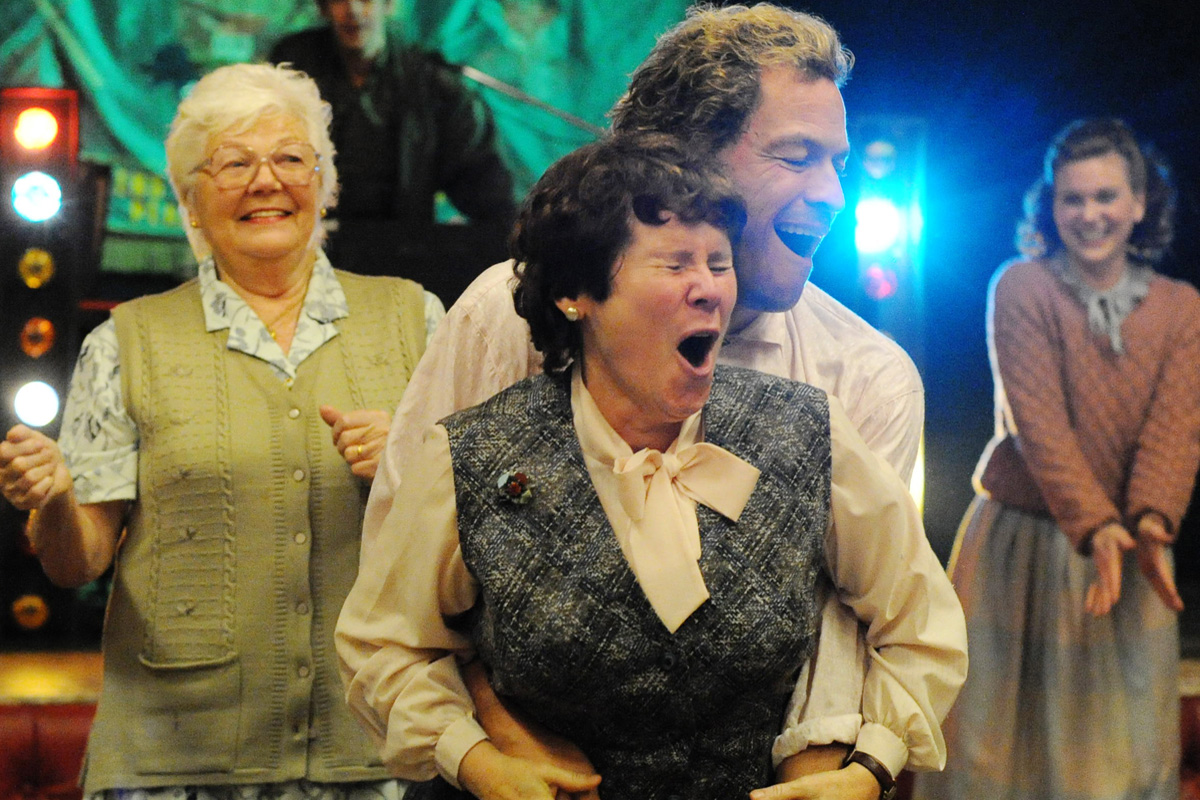
Progressive Pepper Pot: Imelda Staunton and Dominic West in one of the obligatory dance scenes.
As Hefina says to her reticent son during the first meeting at the union hall, “What the hell to you think you’re doing? Get out there and find a gay or a lesbian right now.”
Other townspeople are curious as to whether it’s a requirement for lesbians to be vegetarian. It’s even worse than they’d imagined: some of them are vegan.
Soon, Jonathan Blake (played by the beguiling Dominic West, of The Wire), an actor and one of the bookstore owners, has started a dance party with some local girls who are desperate for disco. The local boys, who are desperate for the local girls, approach Jonathan for dance lessons. Pints all around and everyone is having fun, except for a local Christian family that literally hides behind curtains while plotting against the perverts that have invaded their town.
Most of the townspeople learn to appreciate the gays and lesbians, and see them as a breath of fresh air. Of course there are more dance sequences, with Imelda Staunton leading her posse of pepper pots onto the disco floor to cut up with half-naked gay men when the cultural exchange shifts to London. These scenes are maybe a little too obvious in coming, but they form a magnificent time capsule of the mid-80s music scene in Britain. It’s a rare film that can seamlessly weave Pete Seeger, The Smiths, Frankie Goes to Hollywood, and the Welsh choral music tradition into one soundtrack.
One of the remarkable cultural touchstones portrayed in the film was a benefit concert called “Pits and Perverts” at the Electric Ballroom in London that featured the iconic gay New Wave band Bronski Beat. The benefit raised more than £5,000 for the miners and helped galvanize a political coalition between union and gay rights activists.
Two subplots demonstrate the extent to which the political is personal. The other bookshop owner, Gethin Roberts (played by Andrew Scott of Sherlock fame) is a Welshman who has to face home and family once he’s away from the queer cocoon of London. The coming out drama is extended by the youngest LGSM member, Joe Bromley (George McKay; we don’t find out Joe’s actual last name beyond the nickname “Bromley” the group gives him, which is the name of the suburb where he’s from.) At twenty, Joe is still below the age of consent for gay men according to national law in Britain at the time. As his lesbian friend, Steph, says, “Victory to the minors.”
These more personal subplots actually might have been handled better. Gethin’s reunion with his mother, which is supposedly after a gap of sixteen years, seems so easy you wonder what really came between them. Joe’s family places him under “house arrest,” and as his mother explains to him, she has the law on her side. But Joe’s parents are such caricatures—Dad worried about his “poofter” son and Mom worried about what the family will think—that it’s hard to take them seriously.
Still, the story of societal and economic outcasts finding friendship across barriers of class and culture is a moving one. Both groups face an existential crisis. “Without that pit, these villages are finished,” Bill Nighy intones in his mesmerizing lugubriousness.
And for the gays, when not facing street violence or the billy clubs of the police, the shadow of AIDS stalks their every move. Mark Ashton
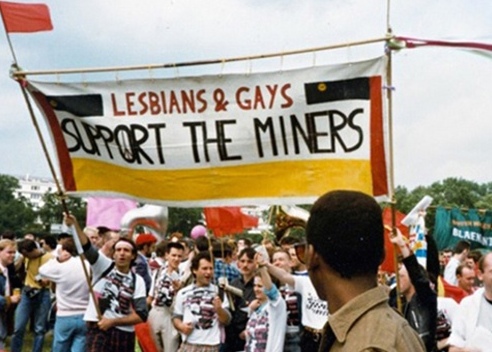
Lesbians & Gay Support the Miners at Gay Pride London 1985.
died at age 26, Jonathan Blake was the second person diagnosed with HIV in the UK, and is, remarkably, still alive at age 65.
Still fascinating is the way these British industrial dramadies have cast the decline of the working class as a crisis of masculinity. In Brassed Off, it was the stubborn pride of Danny Ormondroyd (the late Pete Postlethwaite) that kept the colliery band going even when the colliery was closed. In Billy Elliott, it was the conflict between Billy and his father and older brother, who wanted him to box, when all he wanted to do was dance. In The Full Monty, the Sheffield steelworkers saw their manhood as a dead end of evolution, so did the only “work” they felt they were still good for, which was stripping off for the local ladies. In Pride, the miners have to accept help from men they deem to be perverts, degenerates, failures of masculinity.
Somehow, it always comes down to hard men accepting something “soft” about themselves—their own vulnerability, their need for artistic expression, or just their need for help. The “Pride” of the title could be Gay Pride, or Union Pride, or simply the pride of place of the human heart in the face of annihilating technologies of power.
For a fantastic documentary from the era of Lesbians and Gays Support the Miners, see this video: “All Out! Dancing in Dulais.”
Previous Post

April 29, 2015
Cross Roads: Faith and Film Renewal, Tribeca Overview
Next Post

May 12, 2015 Cross Roads: Faith and Renewal, Getting Lost in Cannes
Browse Our Archives
Select a Category Classics DVD Film Music News Pop Culture Events Print Sports Television Uncategorized Video Games
Select a Month March 2017 February 2017 January 2017 December 2016 November 2016 October 2016 September 2016 August 2016 July 2016 June 2016 May 2016 April 2016 March 2016 February 2016 January 2016 December 2015 November 2015 October 2015 September 2015 August 2015 July 2015 June 2015 May 2015 April 2015 March 2015 February 2015 January 2015 December 2014 November 2014 October 2014 September 2014 August 2014 July 2014 June 2014 May 2014 April 2014 March 2014 February 2014 January 2014 December 2013 November 2013 October 2013 September 2013 August 2013 July 2013 June 2013 May 2013 April 2013 March 2013 February 2013 January 2013 December 2012 November 2012 October 2012 September 2012 August 2012 July 2012 June 2012 May 2012 April 2012 March 2012 February 2012 January 2012 December 2011 November 2011 October 2011 September 2011 August 2011 July 2011 June 2011 May 2011 April 2011 March 2011 February 2011 January 2011 December 2010 November 2010 October 2010 September 2010 August 2010 July 2010 June 2010 May 2010 April 2010 March 2010 February 2010 January 2010 December 2009 November 2009 October 2009 September 2009 August 2009 July 2009 June 2009 May 2009 April 2009 March 2009 February 2009 January 2009 December 2008 November 2008 October 2008 September 2008 August 2008 July 2008 June 2008 May 2008 April 2008 March 2008 February 2008 January 2008 December 2007 November 2007 October 2007 September 2007 August 2007 July 2007 June 2007 May 2007 April 2007 March 2007
Follow Us!
TAKE THE
Religious Wisdom Quiz
In Philemon, what does Paul call Onesimus?
Select your answer to see how you score.
My friend My brother My very heart My helper
Related posts from Pop Theology


At SXSW2017: May It Last: A Portrait of...

At SXSW 2017: "Untold Tales of Armistead Maupin"
TRENDING AT PATHEOS Progressive Christian

Why Christians Have a Sacred Duty to Vote:...
The Bible offers strong support for the sacred duty to vote. Here...

What Being a Modern-Day Apostle Means to Me
In my last column, I discussed the ins and outs of modern-day...

Did Ancient China Once Worship the God of...
Across human history, a common thread weaves through the origins of the...

Love Your Neighbor – Including Earth-Kin: Lev. 19,...
God’s command to love your neighbor means acting in an ethical and...

Lead a Church Study of “Jesus and Lao...
Guest writer Jack Thomas (The Irreverent Reverend) reflects on leading his church...

Principles for Understanding the Apostolic Ministry Today
Whenever people discover that my formal ministry title is "apostle," as in...
view all Progressive Christian blogs
Ad-Free & Subscriber Log-In Subscription Support
- About Us
- 2026 Calendar
- Videos
- Podcasts
- Library of World Religions
- Faith In Media Tracker
- Advertise With Us
- Write for Us
- Privacy Policy
- Terms of Service
- Do Not Sell My Data
- Contact Us
- Radiant Digital
- Manage Newsletter Subscriptions
- Unsubscribe From Notifications
- Sitemap
Copyright 2008-2026, Patheos. All rights reserved.
Subscription Support Ad-Free & Subscriber Log-In
Follow Patheos