
BuddhistCatholicContemplativeEvangelicalGeneral ChristianHinduJewishLatter-day SaintMuslimNew VisionsProgressive Christian
Beliefs
- Buddhist
- Catholic
- Contemplative
- Evangelical
- General Christian
- Hindu
- Jewish
- Latter-day Saint
- More Voices
- Muslim
- New Visions
- Pagan
- Progressive Christian
Topics
- Religion News
- Food and Religion
- Sports and Religion
- Religious Art
- Religious Music and Entertainment
- Religious Events
- History and Religion
- Style and Religion
- Politics and Religion
- Women in Religion
- Recreation Outdoors and Religion
- Business Finance and Religion
- Careers Workplace and Religion
- Education and Religion
- Family Parenting and Religion
- Health Fitness and Religion
- Home and Religion
- Relationships and Religion
- Technology and Religion
- Travel and Religion
Columnists
- Buddhist Columnists
- Business Finance and Religion Columnists
- Careers Workplace and Religion Columnists
- Catholic Columnists
- Contemplative Columnists
- Education and Religion Columnists
- Evangelists Columnists
- Family Parenting and Religion Columnists
- General Christian Columnists
- Health Fitness and Religion Columnists
- Hindu Columnists
- History and Religion Columnists
- Home and Religion Columnists
- Jewish Columnists
- More Voices Columnists
- Latter Day Columnists
- Muslim Columnists
- New Visions Columnists
- Nonreligious Columnists
- Pagan Columnists
- Politics and Religion Columnists
- Progressive Columnists
- Recreation Outdoors and Religion Columnists
- Relationships and Religion Columnists
- Religion News Columnists
- Religious Art Columnists
- Religious Events Columnists
- Religious Music and Entertainment Columnists
- Sports and Religion Columnists
- Style and Religion Columnists
- Technology and Religion Columnists
- Travel and Religion Columnists
- Women in Religion Columnists
Resource Library
- 2026 Calendar
- Library of World Religions
- The 100 Most Holy Places on Earth
- Patheos Answers
- Podcasts
- Videos
- Faith Leaders Database
- Anglican Episcopalian
- Bahai
- Baptist
- Buddhism
- Christianity
- Confucianism
- Eastern Orthodoxy
- Hinduism
- Holiness and Pentecostal
- ISKCON
- Islam
- Judaism
- Lutheran
- Methodist
- The Church of Jesus Christ of Latter-day Saints
- New Age
- Paganism
- Presbytarian and Reformed
- Protestantism
- Religion Behind the Scenes
- Roman Catholic
- Scientology
- Shia Islam
- Sikhism
- Sufism
- Sunni Islam
- Taoism
- Zen
- See all religions
Research Tools
 Ad-Free & Subscriber Log-In Subscription Support
Ad-Free & Subscriber Log-In Subscription Support
Follow Patheos 

- Trending:
- Forgiveness
- |
- Marriage
- |
- Consciousness
- |
- Death Penalty
- |
- Election
- |
- Halloween
 Pop Theology
- Home
- Progressive Christian
- Religious Music & Entertainment
- Timbuktu
Timbuktu
Last updated on: March 5, 2015 at 12:30 pm by J. Ryan Parker
Timbuktu 2015-03-05T12:30:10-08:00 J. Ryan Parker
Patheos Explore the world's faith through different perspectives on religion and spirituality! Patheos has the views of the prevalent religions and spiritualities of the world.
The recent Oscar-nominated foreign language film, Timbuktu, is the most important film of the decade. I know that such comments often sound like grandstanding, but I’m actually tempering my praise. It could be one of the most important films of any decade. With the rise of radical Islamic fundamentalism in ISIL, Timbuktu‘s story couldn’t be more timely, but the ways in which writer/director Abderrahmane Sissako tells his story give it a timelessness that only the most talented of directors can achieve.
Set in the titular village, the film focuses on a group of invading jihadists and their imposition of Sharia law on its residents, most of whom are devout Muslims. While Westerners fear sporadic outbursts of violence, these are the people who daily suffer under this monotonous, inexplicable, and irrational tyranny. Public laughter, music, and football are outlawed, and both men and women must adhere to strict dress codes. The film is built around two persistent juxtapositions: the banality and brutality of fundamentalist Islam and the peaceful lives of devout Muslims and the beauty of these lives and their surroundings and the horrors of the violence they endure. A peaceful imam challenges these invaders with his interpretations of the Quran, but they either look at him like deer in headlights or volley back their own self-serving interpretations. The centerpiece of the film is a small family–father Kidane (Ibrahim Ahmed), mother Satima (Toulou Kiki), daughter Toya (Layla Walet Mohamed), and adopted son Issan (Mehdi A. G. Mohamed)–that lives on the outskirts of the village. They live in a large tent, but they’ve also got cell phones and a cow named GPS. The wife wants to run away, but the father is hopeful that the jihadists will move on. Their oppressors would, along with music, laughter, sport, and beauty, eradicate this family’s peaceful existence as well. Sissako leaves it up to us to determine if they are successful in doing so.
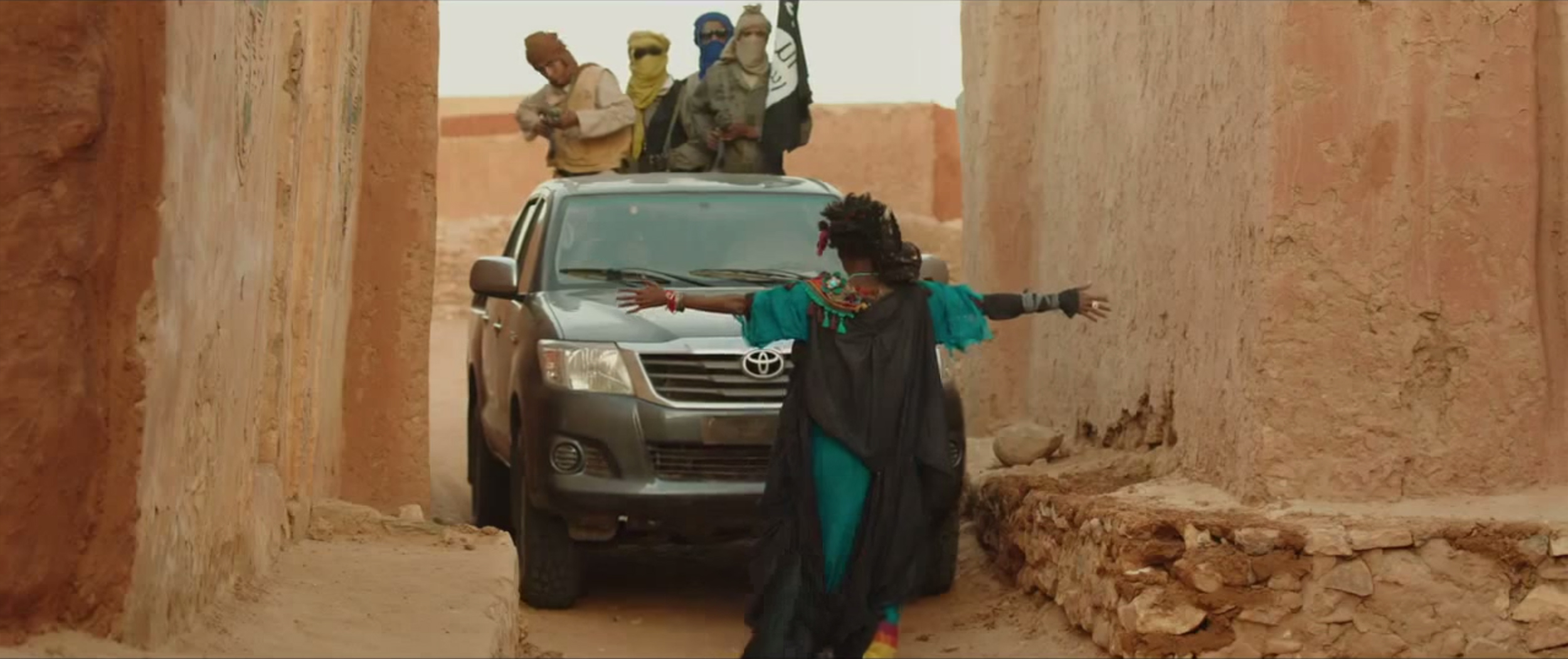
Sissako’s film demands to be seen because it resist any liberal sermonizing or conservative demonizing of Islam. This is a simple, yet profoundly disturbing, narrative beautifully told. Warning: there are images of severe brutality for the most absurd of “offenses” as an unmarried couple is stoned to death or a young woman receives 40 lashes for singing in her home. Yet these are paired with shots that are unparalleled in their composition and beauty. A haunting and accusatory figure, Zabou (Kettly Noel), glides throughout the village, silently resisting or openly ridiculing her oppressors. It’s tempting to see her as a divine figure, but that would frustrate the narrative because she never really does anything to stop the brutality.
Sissako also takes a sophisticated approach to the jihadist villains here. They are not the “reel bad Arabs” of recent cinema history, but rather elusive, complex individuals. They are all too familiar, because they are consumed by the worries and pleasures that consume us, which makes their participation in such a “movement” all the more puzzling and fearful. While Sissako doesn’t explain why the men join these ranks–and the film is probably better for it–we get the sense that power, greed, and lust are motivating factors. Of course, we’re not strangers to these feelings either–or the hypocrisy that accompanies them.
Timbuktu is a window into a world and a struggle that we far too often simplify. Its complexity is cause for both despair and hope.
You can find a list of cities and release dates for Timbuktu here.
Previous Post

February 4, 2015
On Mardi Gras with the Mystic Krewe of Apollo de Lafayette
Next Post
March 30, 2015 Book Review: DID GOD KILL JESUS?
Browse Our Archives
Select a Category Classics DVD Film Music News Pop Culture Events Print Sports Television Uncategorized Video Games
Select a Month March 2017 February 2017 January 2017 December 2016 November 2016 October 2016 September 2016 August 2016 July 2016 June 2016 May 2016 April 2016 March 2016 February 2016 January 2016 December 2015 November 2015 October 2015 September 2015 August 2015 July 2015 June 2015 May 2015 April 2015 March 2015 February 2015 January 2015 December 2014 November 2014 October 2014 September 2014 August 2014 July 2014 June 2014 May 2014 April 2014 March 2014 February 2014 January 2014 December 2013 November 2013 October 2013 September 2013 August 2013 July 2013 June 2013 May 2013 April 2013 March 2013 February 2013 January 2013 December 2012 November 2012 October 2012 September 2012 August 2012 July 2012 June 2012 May 2012 April 2012 March 2012 February 2012 January 2012 December 2011 November 2011 October 2011 September 2011 August 2011 July 2011 June 2011 May 2011 April 2011 March 2011 February 2011 January 2011 December 2010 November 2010 October 2010 September 2010 August 2010 July 2010 June 2010 May 2010 April 2010 March 2010 February 2010 January 2010 December 2009 November 2009 October 2009 September 2009 August 2009 July 2009 June 2009 May 2009 April 2009 March 2009 February 2009 January 2009 December 2008 November 2008 October 2008 September 2008 August 2008 July 2008 June 2008 May 2008 April 2008 March 2008 February 2008 January 2008 December 2007 November 2007 October 2007 September 2007 August 2007 July 2007 June 2007 May 2007 April 2007 March 2007
Follow Us!
TAKE THE
Religious Wisdom Quiz
True or False: Hebrews teaches that Jesus is the same yesterday, today, and forever.
Select your answer to see how you score.
FALSE TRUE
Related posts from Pop Theology


At SXSW2017: May It Last: A Portrait of...

At SXSW 2017: "Untold Tales of Armistead Maupin"
TRENDING AT PATHEOS Progressive Christian

Why Christians Have a Sacred Duty to Vote:...
The Bible offers strong support for the sacred duty to vote. Here...

What Being a Modern-Day Apostle Means to Me
In my last column, I discussed the ins and outs of modern-day...

Did Ancient China Once Worship the God of...
Across human history, a common thread weaves through the origins of the...

Love Your Neighbor – Including Earth-Kin: Lev. 19,...
God’s command to love your neighbor means acting in an ethical and...

Lead a Church Study of “Jesus and Lao...
Guest writer Jack Thomas (The Irreverent Reverend) reflects on leading his church...

Principles for Understanding the Apostolic Ministry Today
Whenever people discover that my formal ministry title is "apostle," as in...
view all Progressive Christian blogs
Ad-Free & Subscriber Log-In Subscription Support
- About Us
- 2026 Calendar
- Videos
- Podcasts
- Library of World Religions
- Faith In Media Tracker
- Advertise With Us
- Write for Us
- Privacy Policy
- Terms of Service
- Do Not Sell My Data
- Contact Us
- Radiant Digital
- Manage Newsletter Subscriptions
- Unsubscribe From Notifications
- Sitemap
Copyright 2008-2026, Patheos. All rights reserved.
Subscription Support Ad-Free & Subscriber Log-In
Follow Patheos