
BuddhistCatholicContemplativeEvangelicalGeneral ChristianHinduJewishLatter-day SaintMuslimNew VisionsProgressive Christian
Beliefs
- Buddhist
- Catholic
- Contemplative
- Evangelical
- General Christian
- Hindu
- Jewish
- Latter-day Saint
- More Voices
- Muslim
- New Visions
- Pagan
- Progressive Christian
Topics
- Religion News
- Food and Religion
- Sports and Religion
- Religious Art
- Religious Music and Entertainment
- Religious Events
- History and Religion
- Style and Religion
- Politics and Religion
- Women in Religion
- Recreation Outdoors and Religion
- Business Finance and Religion
- Careers Workplace and Religion
- Education and Religion
- Family Parenting and Religion
- Health Fitness and Religion
- Home and Religion
- Relationships and Religion
- Technology and Religion
- Travel and Religion
Columnists
- Buddhist Columnists
- Business Finance and Religion Columnists
- Careers Workplace and Religion Columnists
- Catholic Columnists
- Contemplative Columnists
- Education and Religion Columnists
- Evangelists Columnists
- Family Parenting and Religion Columnists
- General Christian Columnists
- Health Fitness and Religion Columnists
- Hindu Columnists
- History and Religion Columnists
- Home and Religion Columnists
- Jewish Columnists
- More Voices Columnists
- Latter Day Columnists
- Muslim Columnists
- New Visions Columnists
- Nonreligious Columnists
- Pagan Columnists
- Politics and Religion Columnists
- Progressive Columnists
- Recreation Outdoors and Religion Columnists
- Relationships and Religion Columnists
- Religion News Columnists
- Religious Art Columnists
- Religious Events Columnists
- Religious Music and Entertainment Columnists
- Sports and Religion Columnists
- Style and Religion Columnists
- Technology and Religion Columnists
- Travel and Religion Columnists
- Women in Religion Columnists
Resource Library
- 2026 Calendar
- Library of World Religions
- The 100 Most Holy Places on Earth
- Patheos Answers
- Podcasts
- Videos
- Faith Leaders Database
- Anglican Episcopalian
- Bahai
- Baptist
- Buddhism
- Christianity
- Confucianism
- Eastern Orthodoxy
- Hinduism
- Holiness and Pentecostal
- ISKCON
- Islam
- Judaism
- Lutheran
- Methodist
- The Church of Jesus Christ of Latter-day Saints
- New Age
- Paganism
- Presbytarian and Reformed
- Protestantism
- Religion Behind the Scenes
- Roman Catholic
- Scientology
- Shia Islam
- Sikhism
- Sufism
- Sunni Islam
- Taoism
- Zen
- See all religions
Research Tools
 Ad-Free & Subscriber Log-In Subscription Support
Ad-Free & Subscriber Log-In Subscription Support
Follow Patheos 

- Trending:
- Forgiveness
- |
- Marriage
- |
- Consciousness
- |
- Death Penalty
- |
- Election
- |
- Halloween
 Pop Theology
- Home
- Progressive Christian
- Religious Music & Entertainment
- ‘The Silver Chalice’ and the Bible in our Minds
‘The Silver Chalice’ and the Bible in our Minds
Last updated on: January 5, 2015 at 3:31 pm by Richard Lindsay
‘The Silver Chalice’ and the Bible in our Minds 2015-01-05T15:31:28-08:00 Richard Lindsay
Patheos Explore the world's faith through different perspectives on religion and spirituality! Patheos has the views of the prevalent religions and spiritualities of the world.
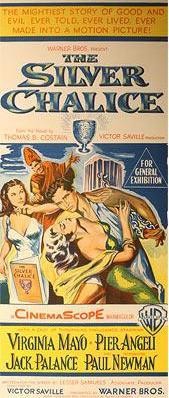 If one stores a collection of images of a particular literary figure, or setting, or style of costume, that collection is not stored mentally in chronological order. It does not matter whether I have seen Rita Hayworth’s Salome before viewing Gustave Moreau’s painting or after reading the version in the Gospel of Mark. All the representations collide and coalesce in my construction of the figure of Salome. In our postmodern image culture, readers are also spectators. — Alice Bach*
This is one of the central quotes supporting my dissertation, which I’m working with Praeger to publish this spring. Biblical scholar Alice Bach’s point is that with so many images, interpretations, and representations of the Bible available to us in a multimedia culture—from film to television to “Bible-Zines”, Internet preachers and podcasts—it’s often difficult to remember where we got the Biblical narratives in our heads. There’s the written Bible on the page, and then there’s the “Head Bible” we carry around with us at all times.
I’ve become increasingly fascinated with the “Head Bible,” which for many of us may be a combination of actual Bible readings, sermons, half-correct teachings from fifth-grade Sunday School teachers, Cecil B. DeMille, and the lyrics from Jesus Christ Superstar.
During recent holiday family time, I was compelled by my brother, Rob, who enjoys collecting and watching obscure and forgotten Hollywood films, to watch a biblical turkey called The Silver Chalice. This 1954 film was the first starring role for Paul Newman, and he came to regret it so deeply that he once took out an ad encouraging people not to watch it when it showed on television.
The only thing to recommend about the movie is its unconventional set design, which is a spare and modernist evocation of the Roman Empire, and an excellent score by Franz Waxman. Otherwise, it’s a lesson in tedium, with torturously wooden acting and screenwriting.
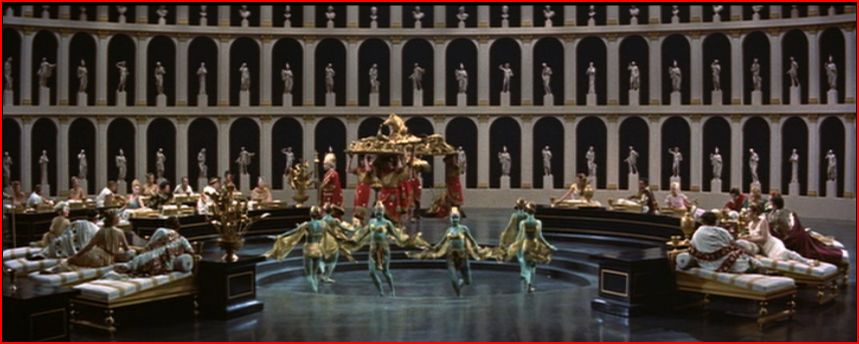
The Silver Chalice: at least the sets were cool.
The story involves Basil (played by Newman), a young slave from Antioch who is engaged to carve a chalice in silver to encase the small bowl used by Christ in the Last Supper. His work becomes a personal struggle of faith, as he attempts to “see” the disciples and Jesus, many of whom he has never met, to carve their faces into the Chalice. Eventually he goes to Jerusalem and Rome on his quest.
In a mostly unrelated plot, Simon the Magician (Jack Palance) a minor character from the book of Acts, attempts to win the worship of the Roman people through feats of magic. His female assistant, Helena (Virginia Mayo), tries to hold back his dangerous ambitions. He is a very powerful man, and, as Helena warns in one of the more memorable bad lines of the film, “It is not for nothing that he is called Simon the Magician.” The final act for Simon’s growing following will be for him to build a tower and create the illusion of himself flying. He hopes will cause all of the Christians to start following him and stop following his rival, the Apostle Peter, who denounced him for attempting to buy the power of the Holy Spirit.
Eventually, and I’m not spoiling the ending here, because you will never feel the need to watch this film in its entirety, Simon’s hubris gets the best of him. In a (highly campy) event staged for Emperor Nero himself, Simon appears before all of Rome for his flying feat. The problem is, by this point, he has begun to believe he actually is the Messiah, and that he can really fly without the apparatus he had built to create the illusion of flying. Dressed in what could only be described as a red unitard with black sperm designs on it, he throws himself off the tower, crashing to the ground and killing himself.
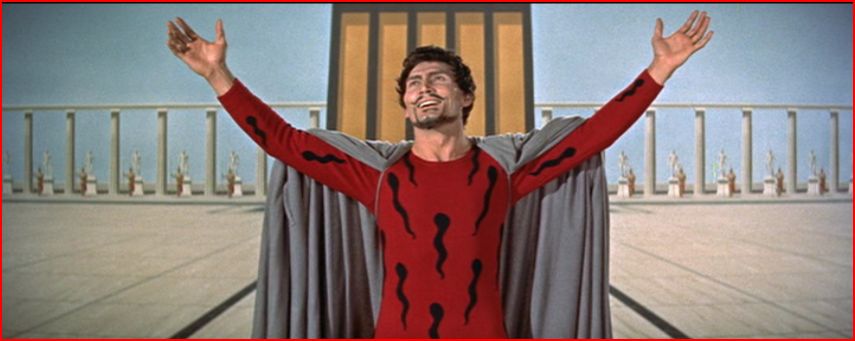
Simon the Magician, who donned a sperm-covered unitard and hurled himself off a tower in front of Nero after trying to buy the Holy Spirit from Peter and…this is all in the Bible, right?
What was infinitely more fascinating than the film was the family discussion surrounding it. As my brother and I were watching, my mom came in, saw Palance as Simon on the screen and said, “Oh, he throws himself off a tower, right?”
My brother Rob exclaimed, “Thanks for blowing the ending, Mom!”
My mom said, “I didn’t blow the ending, that’s what it says in the Bible.”
Now my mother is about as educated as a layperson can get in terms of scripture. A lifelong churchgoer, she has taught Bible studies at our church, and once won a national award for her grasp of Bible trivia. (There was a large traveling trophy involved; it was a source of great pride for our family.) If my mom says something is in the Bible, it’s usually in the Bible.
A quick lookup of the account of Simon the Magician (sometimes called Simon the Sorcerer or Simon Magus) in Acts 8:9-25, revealed that Simon did indeed have a confrontation with Peter, and did indeed ask to buy the powers of healing and miracles the apostles were performing. He most definitely did NOT throw himself off the tower in the Biblical story. In fact, the story ends with Peter and the apostles admonishing Simon and the magician repenting, saying, “Pray to the Lord for me so that nothing you have said may happen to me.”
That’s it. End of story. No crotch-hugging sperm suit for Simon.
Although there are early Christian traditions and some medieval legends that suggest Simon attempted to fly and was killed by his hubris, it is likely my Bible-expert mom got her memory of Simon’s fate from The Silver Chalice. Or, as Paul Newman described it, “The worst movie of the 1950’s.”
This is remarkable, because if an educated lay biblical scholar like my mom can still occasionally mix up the Bible and biblical epics, there’s little chance the rest of us won’t do the same with greater frequency. This is why I argue that, for all Christians’ claims to be knowledgeable about the Bible, what most people carry around in their brain representing the Bible is vastly different from what’s in the printed scripture. Because of this, culturally and cognitively, biblical epics could be said to be scripture—no matter how they defy biblical accuracy, or good taste.
The existence of camp in biblical films queers the whole canon of biblical narrative. It places flamboyant characters in the midst of the stately pageant of scripture and saves us from over-seriousness. I think this is a good thing. In order for the Bible or any other element of religion to be real to us, it must be so ingrained in us that it can be the subject of our daily discussions, our entertainment, or even the butt of our jokes. It must be part of the stuff of everyday life.
From now on, in my little world, in the Bible in my head, whenever I think of Simon the Magician in Acts, I’m going to think of Jack Palance in a sperm-covered unitard. That makes me very happy.
* Quote is from: Alice Bach, “’Throw Them to the Lions, Sire’: Transforming Biblical Narratives into Hollywood Spectaculars,” in “Biblical Glamour and Hollywood Glitz,” ed. Alice Bach, Semeia: an Experimental Journal for Biblical Criticism 74 (1996): 1.
Previous Post
December 21, 2014
Notes on 'Exodus: Gods and Kings'
Next Post
January 8, 2015 Ryan Parker Reviews 'Selma'
Browse Our Archives
Select a Category Classics DVD Film Music News Pop Culture Events Print Sports Television Uncategorized Video Games
Select a Month March 2017 February 2017 January 2017 December 2016 November 2016 October 2016 September 2016 August 2016 July 2016 June 2016 May 2016 April 2016 March 2016 February 2016 January 2016 December 2015 November 2015 October 2015 September 2015 August 2015 July 2015 June 2015 May 2015 April 2015 March 2015 February 2015 January 2015 December 2014 November 2014 October 2014 September 2014 August 2014 July 2014 June 2014 May 2014 April 2014 March 2014 February 2014 January 2014 December 2013 November 2013 October 2013 September 2013 August 2013 July 2013 June 2013 May 2013 April 2013 March 2013 February 2013 January 2013 December 2012 November 2012 October 2012 September 2012 August 2012 July 2012 June 2012 May 2012 April 2012 March 2012 February 2012 January 2012 December 2011 November 2011 October 2011 September 2011 August 2011 July 2011 June 2011 May 2011 April 2011 March 2011 February 2011 January 2011 December 2010 November 2010 October 2010 September 2010 August 2010 July 2010 June 2010 May 2010 April 2010 March 2010 February 2010 January 2010 December 2009 November 2009 October 2009 September 2009 August 2009 July 2009 June 2009 May 2009 April 2009 March 2009 February 2009 January 2009 December 2008 November 2008 October 2008 September 2008 August 2008 July 2008 June 2008 May 2008 April 2008 March 2008 February 2008 January 2008 December 2007 November 2007 October 2007 September 2007 August 2007 July 2007 June 2007 May 2007 April 2007 March 2007
Follow Us!
TAKE THE
Religious Wisdom Quiz
True or False: Hebrews teaches that Jesus is the same yesterday, today, and forever.
Select your answer to see how you score.
FALSE TRUE
Related posts from Pop Theology


At SXSW2017: May It Last: A Portrait of...

At SXSW 2017: "Untold Tales of Armistead Maupin"
TRENDING AT PATHEOS Progressive Christian

Why Christians Have a Sacred Duty to Vote:...
The Bible offers strong support for the sacred duty to vote. Here...

What Being a Modern-Day Apostle Means to Me
In my last column, I discussed the ins and outs of modern-day...

Did Ancient China Once Worship the God of...
Across human history, a common thread weaves through the origins of the...

Love Your Neighbor – Including Earth-Kin: Lev. 19,...
God’s command to love your neighbor means acting in an ethical and...

Lead a Church Study of “Jesus and Lao...
Guest writer Jack Thomas (The Irreverent Reverend) reflects on leading his church...

Principles for Understanding the Apostolic Ministry Today
Whenever people discover that my formal ministry title is "apostle," as in...
view all Progressive Christian blogs
Ad-Free & Subscriber Log-In Subscription Support
- About Us
- 2026 Calendar
- Videos
- Podcasts
- Library of World Religions
- Faith In Media Tracker
- Advertise With Us
- Write for Us
- Privacy Policy
- Terms of Service
- Do Not Sell My Data
- Contact Us
- Radiant Digital
- Manage Newsletter Subscriptions
- Unsubscribe From Notifications
- Sitemap
Copyright 2008-2026, Patheos. All rights reserved.
Subscription Support Ad-Free & Subscriber Log-In
Follow Patheos