
BuddhistCatholicContemplativeEvangelicalGeneral ChristianHinduJewishLatter-day SaintMuslimNew VisionsProgressive Christian
Beliefs
- Buddhist
- Catholic
- Contemplative
- Evangelical
- General Christian
- Hindu
- Jewish
- Latter-day Saint
- More Voices
- Muslim
- New Visions
- Pagan
- Progressive Christian
Topics
- Religion News
- Food and Religion
- Sports and Religion
- Religious Art
- Religious Music and Entertainment
- Religious Events
- History and Religion
- Style and Religion
- Politics and Religion
- Women in Religion
- Recreation Outdoors and Religion
- Business Finance and Religion
- Careers Workplace and Religion
- Education and Religion
- Family Parenting and Religion
- Health Fitness and Religion
- Home and Religion
- Relationships and Religion
- Technology and Religion
- Travel and Religion
Columnists
- Buddhist Columnists
- Business Finance and Religion Columnists
- Careers Workplace and Religion Columnists
- Catholic Columnists
- Contemplative Columnists
- Education and Religion Columnists
- Evangelists Columnists
- Family Parenting and Religion Columnists
- General Christian Columnists
- Health Fitness and Religion Columnists
- Hindu Columnists
- History and Religion Columnists
- Home and Religion Columnists
- Jewish Columnists
- More Voices Columnists
- Latter Day Columnists
- Muslim Columnists
- New Visions Columnists
- Nonreligious Columnists
- Pagan Columnists
- Politics and Religion Columnists
- Progressive Columnists
- Recreation Outdoors and Religion Columnists
- Relationships and Religion Columnists
- Religion News Columnists
- Religious Art Columnists
- Religious Events Columnists
- Religious Music and Entertainment Columnists
- Sports and Religion Columnists
- Style and Religion Columnists
- Technology and Religion Columnists
- Travel and Religion Columnists
- Women in Religion Columnists
Resource Library
- 2026 Calendar
- Library of World Religions
- The 100 Most Holy Places on Earth
- Patheos Answers
- Podcasts
- Videos
- Faith Leaders Database
- Anglican Episcopalian
- Bahai
- Baptist
- Buddhism
- Christianity
- Confucianism
- Eastern Orthodoxy
- Hinduism
- Holiness and Pentecostal
- ISKCON
- Islam
- Judaism
- Lutheran
- Methodist
- The Church of Jesus Christ of Latter-day Saints
- New Age
- Paganism
- Presbytarian and Reformed
- Protestantism
- Religion Behind the Scenes
- Roman Catholic
- Scientology
- Shia Islam
- Sikhism
- Sufism
- Sunni Islam
- Taoism
- Zen
- See all religions
Research Tools
 Ad-Free & Subscriber Log-In Subscription Support
Ad-Free & Subscriber Log-In Subscription Support
Follow Patheos 

- Trending:
- Forgiveness
- |
- Marriage
- |
- Consciousness
- |
- Death Penalty
- |
- Election
- |
- Halloween
 Pop Theology
- Home
- Progressive Christian
- Religious Music & Entertainment
- Notes on ‘Exodus: Gods and Kings’
Notes on ‘Exodus: Gods and Kings’
Last updated on: December 21, 2014 at 1:59 am by Richard Lindsay
Notes on ‘Exodus: Gods and Kings’ 2014-12-21T01:59:05-08:00 Richard Lindsay
Patheos Explore the world's faith through different perspectives on religion and spirituality! Patheos has the views of the prevalent religions and spiritualities of the world.
Ryan Parker already has an excellent review of this film, which actually involves interviews with Christian Bale and Ridley Scott. Not being able to add much to that by way of review, let me just mention a few points of observation on viewing Exodus: Gods and Kings:
1.) There are predictable cries of ‘foul’ from some evangelical Christians for this film. The fact that the film follows the highlights of the Exodus story and shows the destruction of pagan gods at the hands of the One True God of the Hebrews is not enough. Many reviews on Internet Movie Database objected to such “inaccuracies” as Moses not having a rod that turns into a snake; the film’s attempt to explain natural causes for the Plagues of Egypt; the overplaying of the relationship between Moses and Rameses; and not starring Charlton Heston or being directed by Mel Gibson. It seems some evangelical Christians will only accept overly literalistic biblical films being made by overtly conservative Christians that pound the audience over the head with their “gospel” message. The idea that a great figure of the Bible might go through a faith journey, might somehow evolve spiritually, is too much complexity for them to bear.
As for the biblical accuracy of previous renditions of the Exodus story, I would ask viewers who believe Cecil B. DeMille portrayed the “true story” on screen nearly 60 years ago to find biblical references for the following lines from The Ten Commandments:
- “Oh Moses, Moses, You stubborn, splendid, adorable fool!”
- “Why, you treacherous, sharp-clawed little peacock!”
- “I don’t believe it’s only the thunder of a mountain that moves your heart!”
- “Moses…Your hair!”
2.) Objections to be taken more seriously have come from activists who have noted that the major characters in Exodus are played by white actors. It almost seems in choosing a blue-eyed Moses and Joshua that Ridley Scott is trying to mimic the biblical epic style of the 1950’s rather than portraying actual Egyptians or Semitic peoples. You can read one of the blog entries that has gone viral here, David Dennis, Jr.’s “Why You Probably Shouldn’t Go See Ridley Scott’s Pretty Racist Exodus Movie.”
Since the author didn’t see the film, much of the observation about white and black roles in the film is made from watching a trailer, or even from a single screen grab of the film. The blog makes a good point about film “colonization.” It does seem that black actors are cast in the “lower” roles of guards and assassins.
For the record, however, quite a few important players are not “white” in the sense of being Northern European. María Valverde, a Spanish actress, plays Moses’ wife Zipporah, which is a major role in this version. Ben Kingsley, who is half Indian, plays the Hebrew elder Nun. An Israeli actress, Hiam Abbass, plays Moses’ mother Bithia. Indira Varma is also half Indian, and plays the High Priestess (a scene-stealing role). Queen Nefertari is played by an Iranian actress, Golshifteh Farahani.
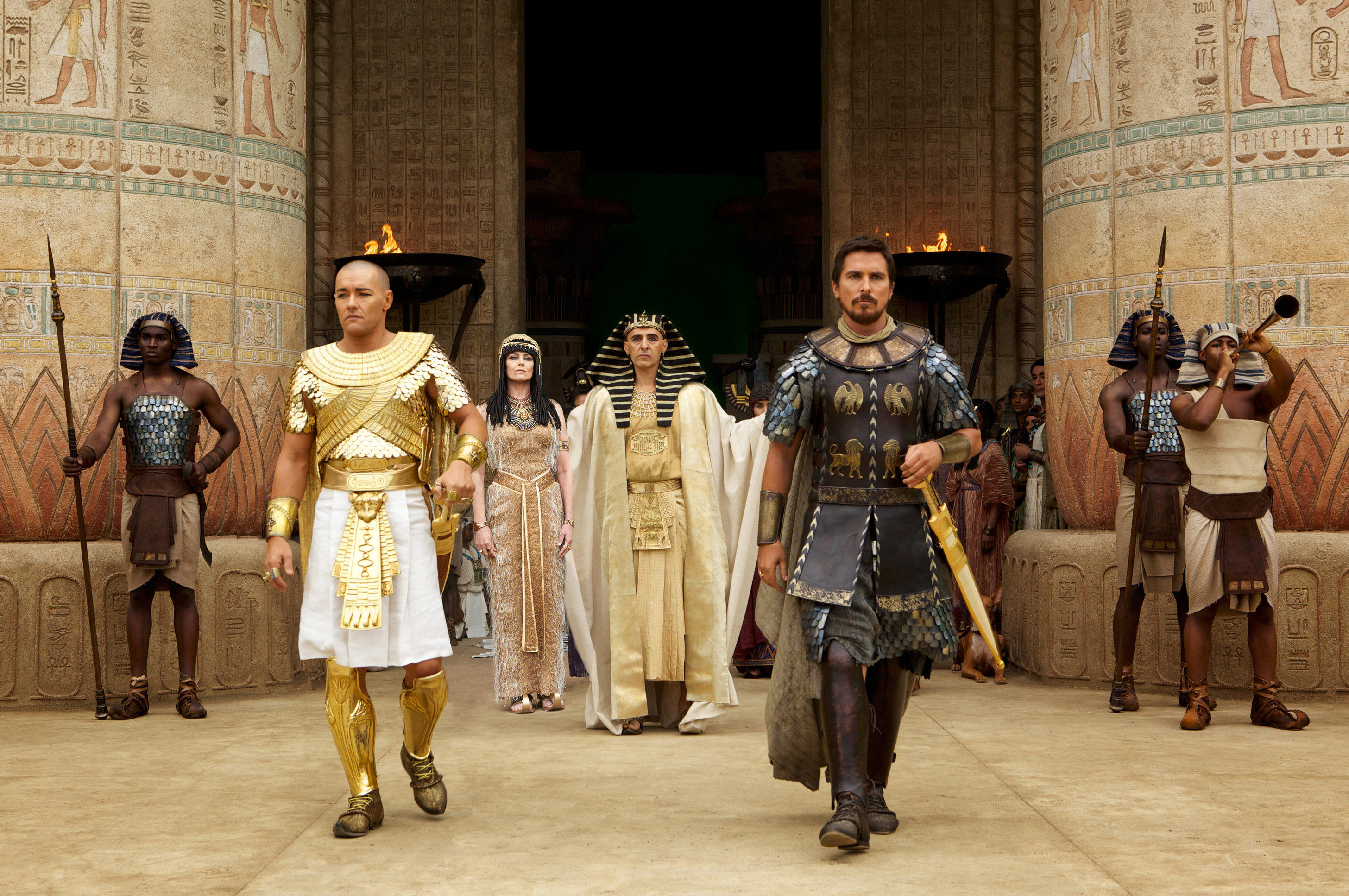
Twitter Activists: Based on this screen shot, I can tell this film is racist–you must not see it!
Me: John Turturro and Sigourney Weaver are playing the Pharaoh and his wife? I HAVE to see it!
3.) I don’t wish to defend Ridley Scott’s casting of the major characters, but I do object to the hashtag activism of the so-called “boycott” of this film. (I wonder how many of the “boycotters” were planning on seeing the film anyway.) It seems the way many modern activists show disapproval is in calling for boycott, cancellation, firing, disengagement, or otherwise shutting down racially objectionable material or people. This is not the way to change things. As human beings, we tend to change by relationships and engagement rather than condemnation and isolation. I’m not sure what kind of relationship activists can have with Ridley Scott or Christian Bale, but would it kill them to see the movie before they conclude it’s racist? How does shutting it down lead to the end of white structural racism? And as for telling me as an individual viewer “You probably shouldn’t” see this film, please don’t tell me which films I should or should not see on penalty of being accused of supporting racism. If I choose morally-informed engagement over morally-superior detachment, that is my choice.
4.) I don’t care who should have been cast as the old Pharaoh Seti and his wife Tuya, I desperately want to see the prequel with John Turturro and Sigourney Weaver in the roles. Weaver, as usual, steals every scene she’s in, especially with the line (referring to Moses): “I didn’t say I wanted him exiled…I said I wanted him dead.”
5.) The film shows Moses undergoing a remarkable journey of faith from being a skeptical Egyptian to a believing Hebrew. This “middle section” between Moses the Prince of Egypt and Moses the prophet has always been the most interesting part of the story to me. How does one go from a prince to a chosen position of identification with the oppressed?
This message comes across in the DeMille classic – although nobody remembers that part of the film. And it comes across even more strongly in the Ridley Scott version. Anyone who decides not to see it based on the casting is cheating themselves out of a truly moving story of faith, identity, and liberation.
6.) The best line in the film is during the scene where Moses is carving the Ten Commandments (do we really believe they were written by the finger of God?) and the messenger of God notes that Moses doesn’t always agree with him. Moses acknowledges this. But then the Messenger says, “But we’re still talking.” This is one of the most honest acknowledgements of what a relationship with God is like that I have ever seen in a film.
7.) That being said, none of this process of Moses struggling with faith in a singular, all-powerful God, the Prince of Egypt story, the “brotherhood” with Rameses, the queens and palaces, the Hebrews building the monuments of Egypt—none of it—is in the Bible. This is storytelling. It is midrash. And it’s amazing to me, having watched Exodus movies from DeMille’s first silent version in 1923, to his 1956 classic, to Ridley Scott, how similar the story is that Hollywood tells each time. It’s full of chariots, massive sets, casts of thousands, action sequences, and of course—always—the climactic moment of the parting of the Red Sea with the Egyptians in hot pursuit. It’s gorgeous eye candy with some Sunday School lessons thrown in. The Exodus on screen is its own thing, and its spectacle is so arresting that what’s in the Bible will always take second place in our mind’s eye.
8.) Just for fun (and to show how little has changed in telling this story), here’s the parting of the Red Sea in DeMille’s 1923 version of The Ten Commandments. This was shot at the Guadalupe-Nipomo dunes in California, near Stinson Beach. The Red Sea was parted with the help of some creative reverse footage, and a lot of Jell-O.
Previous Post

November 23, 2014
Disquiet Time: A Review
Next Post

January 5, 2015 'The Silver Chalice' and the Bible in our Minds
Browse Our Archives
Select a Category Classics DVD Film Music News Pop Culture Events Print Sports Television Uncategorized Video Games
Select a Month March 2017 February 2017 January 2017 December 2016 November 2016 October 2016 September 2016 August 2016 July 2016 June 2016 May 2016 April 2016 March 2016 February 2016 January 2016 December 2015 November 2015 October 2015 September 2015 August 2015 July 2015 June 2015 May 2015 April 2015 March 2015 February 2015 January 2015 December 2014 November 2014 October 2014 September 2014 August 2014 July 2014 June 2014 May 2014 April 2014 March 2014 February 2014 January 2014 December 2013 November 2013 October 2013 September 2013 August 2013 July 2013 June 2013 May 2013 April 2013 March 2013 February 2013 January 2013 December 2012 November 2012 October 2012 September 2012 August 2012 July 2012 June 2012 May 2012 April 2012 March 2012 February 2012 January 2012 December 2011 November 2011 October 2011 September 2011 August 2011 July 2011 June 2011 May 2011 April 2011 March 2011 February 2011 January 2011 December 2010 November 2010 October 2010 September 2010 August 2010 July 2010 June 2010 May 2010 April 2010 March 2010 February 2010 January 2010 December 2009 November 2009 October 2009 September 2009 August 2009 July 2009 June 2009 May 2009 April 2009 March 2009 February 2009 January 2009 December 2008 November 2008 October 2008 September 2008 August 2008 July 2008 June 2008 May 2008 April 2008 March 2008 February 2008 January 2008 December 2007 November 2007 October 2007 September 2007 August 2007 July 2007 June 2007 May 2007 April 2007 March 2007
Follow Us!
TAKE THE
Religious Wisdom Quiz
What was Paul’s profession before becoming an apostle?
Select your answer to see how you score.
Tax Collector Tentmaker Fisherman Carpenter
Related posts from Pop Theology


At SXSW2017: May It Last: A Portrait of...

At SXSW 2017: "Untold Tales of Armistead Maupin"
TRENDING AT PATHEOS Progressive Christian

Why Christians Have a Sacred Duty to Vote:...
The Bible offers strong support for the sacred duty to vote. Here...

What Being a Modern-Day Apostle Means to Me
In my last column, I discussed the ins and outs of modern-day...

Did Ancient China Once Worship the God of...
Across human history, a common thread weaves through the origins of the...

Love Your Neighbor – Including Earth-Kin: Lev. 19,...
God’s command to love your neighbor means acting in an ethical and...

Lead a Church Study of “Jesus and Lao...
Guest writer Jack Thomas (The Irreverent Reverend) reflects on leading his church...

Principles for Understanding the Apostolic Ministry Today
Whenever people discover that my formal ministry title is "apostle," as in...
view all Progressive Christian blogs
Ad-Free & Subscriber Log-In Subscription Support
- About Us
- 2026 Calendar
- Videos
- Podcasts
- Library of World Religions
- Faith In Media Tracker
- Advertise With Us
- Write for Us
- Privacy Policy
- Terms of Service
- Do Not Sell My Data
- Contact Us
- Radiant Digital
- Manage Newsletter Subscriptions
- Unsubscribe From Notifications
- Sitemap
Copyright 2008-2026, Patheos. All rights reserved.
Subscription Support Ad-Free & Subscriber Log-In
Follow Patheos