
BuddhistCatholicContemplativeEvangelicalGeneral ChristianHinduJewishLatter-day SaintMuslimNew VisionsProgressive Christian
Beliefs
- Buddhist
- Catholic
- Contemplative
- Evangelical
- General Christian
- Hindu
- Jewish
- Latter-day Saint
- More Voices
- Muslim
- New Visions
- Pagan
- Progressive Christian
Topics
- Religion News
- Food and Religion
- Sports and Religion
- Religious Art
- Religious Music and Entertainment
- Religious Events
- History and Religion
- Style and Religion
- Politics and Religion
- Women in Religion
- Recreation Outdoors and Religion
- Business Finance and Religion
- Careers Workplace and Religion
- Education and Religion
- Family Parenting and Religion
- Health Fitness and Religion
- Home and Religion
- Relationships and Religion
- Technology and Religion
- Travel and Religion
Columnists
- Buddhist Columnists
- Business Finance and Religion Columnists
- Careers Workplace and Religion Columnists
- Catholic Columnists
- Contemplative Columnists
- Education and Religion Columnists
- Evangelists Columnists
- Family Parenting and Religion Columnists
- General Christian Columnists
- Health Fitness and Religion Columnists
- Hindu Columnists
- History and Religion Columnists
- Home and Religion Columnists
- Jewish Columnists
- More Voices Columnists
- Latter Day Columnists
- Muslim Columnists
- New Visions Columnists
- Nonreligious Columnists
- Pagan Columnists
- Politics and Religion Columnists
- Progressive Columnists
- Recreation Outdoors and Religion Columnists
- Relationships and Religion Columnists
- Religion News Columnists
- Religious Art Columnists
- Religious Events Columnists
- Religious Music and Entertainment Columnists
- Sports and Religion Columnists
- Style and Religion Columnists
- Technology and Religion Columnists
- Travel and Religion Columnists
- Women in Religion Columnists
Resource Library
- 2026 Calendar
- Library of World Religions
- The 100 Most Holy Places on Earth
- Patheos Answers
- Podcasts
- Videos
- Faith Leaders Database
- Anglican Episcopalian
- Bahai
- Baptist
- Buddhism
- Christianity
- Confucianism
- Eastern Orthodoxy
- Hinduism
- Holiness and Pentecostal
- ISKCON
- Islam
- Judaism
- Lutheran
- Methodist
- The Church of Jesus Christ of Latter-day Saints
- New Age
- Paganism
- Presbytarian and Reformed
- Protestantism
- Religion Behind the Scenes
- Roman Catholic
- Scientology
- Shia Islam
- Sikhism
- Sufism
- Sunni Islam
- Taoism
- Zen
- See all religions
Research Tools
 Ad-Free & Subscriber Log-In Subscription Support
Ad-Free & Subscriber Log-In Subscription Support
Follow Patheos 

- Trending:
- Forgiveness
- |
- Marriage
- |
- Consciousness
- |
- Death Penalty
- |
- Election
- |
- Halloween
 Pop Theology
- Home
- Progressive Christian
- Religious Music & Entertainment
- The Violence of History
The Violence of History
Last updated on: October 16, 2014 at 8:41 am by J. Ryan Parker
The Violence of History 2014-10-16T08:41:55-07:00 J. Ryan Parker
Patheos Explore the world's faith through different perspectives on religion and spirituality! Patheos has the views of the prevalent religions and spiritualities of the world.
Within the genre of war films lies a sub-genre devoted to anti-war war films, films that are so honest and earnest in their depiction of battle that they make us question our own sanity for ever sending women and men into such conditions. David Ayer‘s latest film, Fury, falls into that category.
April 1945. The war is winding down, but not before many more people have to die. Allied forces are taking heavy damage and casualties thanks to the superior German tanks and artillery. Don “Wardaddy” Collier (Brad Pitt) leads a tank unit of battle-hardened soldiers, Boyd “Bible” Swan (Shia LaBeouf), Trini “Gordo” Garcia (Michael Pena), Grady Travis (John Bernthal), and rookie Norman Ellison (Logan Lerman). Bible, Gordo, and Grady have killed Nazis with Wardaddy from Africa through Western Europe and now in Germany. They soldier on through unbelievably harsh conditions, experiencing horrific victories and various levels of defeat. Along with two other tank units, Wardaddy and his men are ordered to protect a vital crossroads. Along the way, a mighty German Tiger tank destroys the other two units, leaving Wardaddy and his men alone to face over 300 heavily-armed Nazi soldiers in an epic shootout.
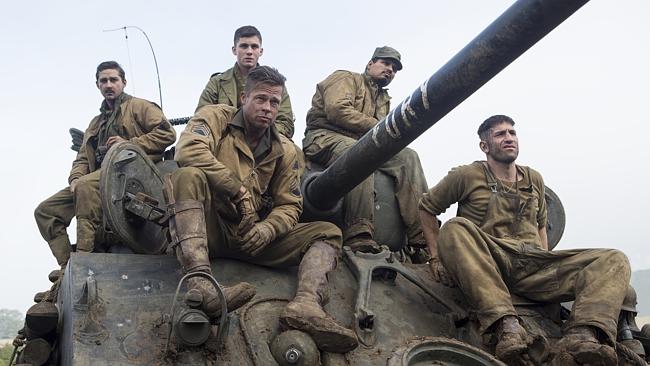
Technically, Fury is a marvel. The sound effects and design make it feel like you’re inside the tank with these soldiers. The cinematography is as bleak as the subject matter deserves, capturing the harsh conditions in which these men lived and fought. The makeup artists are at their best here, heightening the actors’ haggard appearances. On par with Saving Private Ryan, the brutality of battles depicted in Fury belongs among the most gruesome war films of all time.
Two more notes on the setting of the film are worth mentioning. Writer/director Ayer explains:
It’s a different world from your usual war movie, where we celebrate victorious campaigns like the invasion of the European continent, or D-Day, or the Battle of the Bulge, these famous battles that American troops have taken part in. One of the forgotten time periods is this last gasp of the Nazi empire, with an American army that has been fighting for years and is on its last reserves of manpower. The men are exhausted. In World War II, you fought until you either won or died, or were grievously injured and got sent home.
It’s almost hard to believe, but everything that happens in the film only takes place over a 24-hour period. This end-of-the-war setting and the shorter time frame of the narrative heightens the emotional and psychological impact of the film.
And it is the emotional and psychological damage of war that is at the heart of Fury, thanks in part to some brilliant performances, particularly from LaBeouf, Berenthal, and Pena. I don’t know what Ayer did, but he got one of the best performance from LaBeouf that the young actor has ever delivered. As a fervently religious soldier, Bible shapes his experiences with theological assertions and quotations of scripture. But he’s not so confident in these beliefs that we don’t see the horrors of what he’s done and endured making room for some doubt. Grady also shares in Bible’s religion but is quicker to throw himself into the evils of war. He’s a fairly even-keel character in the sense that he was probably as tough, violent, and cynical before the war as he is when the body count escalates. We don’t doubt him for a second when he surveys his hellish surroundings and responds with a smile, “Best job I ever had.” Gordo seems like he’s taking it all in stride with a “This is what we’re here to do” attitude, but it feels like he could snap at any moment, medicating with alcohol as he does. Norman, as the last-minute replacement in the Fury tank (and point-of-entry into the narrative for many viewers), undergoes the most radical (and speedy) transformation from a relative pacifist to a bona-fide Nazi-killer.
Their fearless leader, Wardaddy, keeps his chiseled chin up. Although he can walk the moral high road no better than those under his command, he tries to rise above the chaos around him whenever possible. There’s a brilliant, though lengthy, scene in which Wardaddy and Norman quietly take over a flat belonging to two German women. He asks the older woman to cook a meal while he cleans up and shaves. Norman and the younger woman enjoy time alone in the adjoining bedroom. As the four of them sit down for their meal, Grady, Gordo, and Bible noisily invade the room and ruin the meal by telling a particularly brutal story about one of their past campaigns. They throw Wardaddy’s sense of propriety and superiority right back in his face by forcing him to remember their roles in the slaughter.
Fury raises numerous points about redemption, separation and assimilation, integrity, and good vs. evil, most of which I discuss in my interview with Ayer. There is a bleakness about Fury that a WWII film demands. Kevin Vance, one of the military technical advisers on the film, says, “In most World War II movies, we have this association with ‘the good war’–and it is–but over 60 million people died in World War II. That’s a dichotomy that hasn’t been fully explored, and that’s what David demanded of this film.” Fury, and other films like it that explore this reality, bring us back to that sub-genre of anti-war war films that might be traced all the way back to All Quiet on the Western Front. While Fury‘s unflinching representation of man-made death and destruction is not without some inconsistencies, it still forces us to question why we continue to walk such a destructive path.
Fury (135 mins.), rated R for strong sequences of war violence, some grisly images, and language throughout, opens in theaters everywhere October 17.
Previous Post

September 18, 2014
BORGMAN: Movie Review
Next Post
October 31, 2014 Left Behind: It's as Bad as We Feared
Browse Our Archives
Select a Category Classics DVD Film Music News Pop Culture Events Print Sports Television Uncategorized Video Games
Select a Month March 2017 February 2017 January 2017 December 2016 November 2016 October 2016 September 2016 August 2016 July 2016 June 2016 May 2016 April 2016 March 2016 February 2016 January 2016 December 2015 November 2015 October 2015 September 2015 August 2015 July 2015 June 2015 May 2015 April 2015 March 2015 February 2015 January 2015 December 2014 November 2014 October 2014 September 2014 August 2014 July 2014 June 2014 May 2014 April 2014 March 2014 February 2014 January 2014 December 2013 November 2013 October 2013 September 2013 August 2013 July 2013 June 2013 May 2013 April 2013 March 2013 February 2013 January 2013 December 2012 November 2012 October 2012 September 2012 August 2012 July 2012 June 2012 May 2012 April 2012 March 2012 February 2012 January 2012 December 2011 November 2011 October 2011 September 2011 August 2011 July 2011 June 2011 May 2011 April 2011 March 2011 February 2011 January 2011 December 2010 November 2010 October 2010 September 2010 August 2010 July 2010 June 2010 May 2010 April 2010 March 2010 February 2010 January 2010 December 2009 November 2009 October 2009 September 2009 August 2009 July 2009 June 2009 May 2009 April 2009 March 2009 February 2009 January 2009 December 2008 November 2008 October 2008 September 2008 August 2008 July 2008 June 2008 May 2008 April 2008 March 2008 February 2008 January 2008 December 2007 November 2007 October 2007 September 2007 August 2007 July 2007 June 2007 May 2007 April 2007 March 2007
Follow Us!
TAKE THE
Religious Wisdom Quiz
What did the Israelites carry through the wilderness that symbolized God's presence?
Select your answer to see how you score.
Burning torch Golden Calf Scroll of Moses Ark of the Covenant
Related posts from Pop Theology


At SXSW2017: May It Last: A Portrait of...

At SXSW 2017: "Untold Tales of Armistead Maupin"
TRENDING AT PATHEOS Progressive Christian

Why Christians Have a Sacred Duty to Vote:...
The Bible offers strong support for the sacred duty to vote. Here...

What Being a Modern-Day Apostle Means to Me
In my last column, I discussed the ins and outs of modern-day...

Did Ancient China Once Worship the God of...
Across human history, a common thread weaves through the origins of the...

Love Your Neighbor – Including Earth-Kin: Lev. 19,...
God’s command to love your neighbor means acting in an ethical and...

Lead a Church Study of “Jesus and Lao...
Guest writer Jack Thomas (The Irreverent Reverend) reflects on leading his church...

Principles for Understanding the Apostolic Ministry Today
Whenever people discover that my formal ministry title is "apostle," as in...
view all Progressive Christian blogs
Ad-Free & Subscriber Log-In Subscription Support
- About Us
- 2026 Calendar
- Videos
- Podcasts
- Library of World Religions
- Faith In Media Tracker
- Advertise With Us
- Write for Us
- Privacy Policy
- Terms of Service
- Do Not Sell My Data
- Contact Us
- Radiant Digital
- Manage Newsletter Subscriptions
- Unsubscribe From Notifications
- Sitemap
Copyright 2008-2026, Patheos. All rights reserved.
Subscription Support Ad-Free & Subscriber Log-In
Follow Patheos