
BuddhistCatholicContemplativeEvangelicalGeneral ChristianHinduJewishLatter-day SaintMuslimNew VisionsProgressive Christian
Beliefs
- Buddhist
- Catholic
- Contemplative
- Evangelical
- General Christian
- Hindu
- Jewish
- Latter-day Saint
- More Voices
- Muslim
- New Visions
- Pagan
- Progressive Christian
Topics
- Religion News
- Food and Religion
- Sports and Religion
- Religious Art
- Religious Music and Entertainment
- Religious Events
- History and Religion
- Style and Religion
- Politics and Religion
- Women in Religion
- Recreation Outdoors and Religion
- Business Finance and Religion
- Careers Workplace and Religion
- Education and Religion
- Family Parenting and Religion
- Health Fitness and Religion
- Home and Religion
- Relationships and Religion
- Technology and Religion
- Travel and Religion
Columnists
- Buddhist Columnists
- Business Finance and Religion Columnists
- Careers Workplace and Religion Columnists
- Catholic Columnists
- Contemplative Columnists
- Education and Religion Columnists
- Evangelists Columnists
- Family Parenting and Religion Columnists
- General Christian Columnists
- Health Fitness and Religion Columnists
- Hindu Columnists
- History and Religion Columnists
- Home and Religion Columnists
- Jewish Columnists
- More Voices Columnists
- Latter Day Columnists
- Muslim Columnists
- New Visions Columnists
- Nonreligious Columnists
- Pagan Columnists
- Politics and Religion Columnists
- Progressive Columnists
- Recreation Outdoors and Religion Columnists
- Relationships and Religion Columnists
- Religion News Columnists
- Religious Art Columnists
- Religious Events Columnists
- Religious Music and Entertainment Columnists
- Sports and Religion Columnists
- Style and Religion Columnists
- Technology and Religion Columnists
- Travel and Religion Columnists
- Women in Religion Columnists
Resource Library
- 2026 Calendar
- Library of World Religions
- The 100 Most Holy Places on Earth
- Patheos Answers
- Podcasts
- Videos
- Faith Leaders Database
- Anglican Episcopalian
- Bahai
- Baptist
- Buddhism
- Christianity
- Confucianism
- Eastern Orthodoxy
- Hinduism
- Holiness and Pentecostal
- ISKCON
- Islam
- Judaism
- Lutheran
- Methodist
- The Church of Jesus Christ of Latter-day Saints
- New Age
- Paganism
- Presbytarian and Reformed
- Protestantism
- Religion Behind the Scenes
- Roman Catholic
- Scientology
- Shia Islam
- Sikhism
- Sufism
- Sunni Islam
- Taoism
- Zen
- See all religions
Research Tools
 Ad-Free & Subscriber Log-In Subscription Support
Ad-Free & Subscriber Log-In Subscription Support
Follow Patheos 

- Trending:
- Forgiveness
- |
- Marriage
- |
- Consciousness
- |
- Death Penalty
- |
- Election
- |
- Halloween
 Pop Theology
- Home
- Progressive Christian
- Religious Music & Entertainment
- A Match Made in Heaven…Even If It Looks Like Hell
A Match Made in Heaven…Even If It Looks Like Hell
Last updated on: August 5, 2014 at 1:12 pm by J. Ryan Parker
A Match Made in Heaven…Even If It Looks Like Hell 2014-08-05T13:12:55-07:00 J. Ryan Parker
Patheos Explore the world's faith through different perspectives on religion and spirituality! Patheos has the views of the prevalent religions and spiritualities of the world.
Last week, I had the good fortune to interview Brendan Gleeson and John Michael McDonagh around the release of their film, Calvary. Unfortunately, I didn’t get to speak to them at the same time, so I’ve tried to blend them together into something of a conversation. There are big spoilers throughout, so if you care about that stuff, check it out after you see the film. You can also read my review of the film here.
Ryan Parker: What was your experience of religion (broadly speaking) growing up?
Brendan Gleeson: I make it a rule to not talk about my religious beliefs now because I don’t want people to think I have an agenda in the work that I do. However, I had something of a normal upbringing. My family was Catholic, and I attended Christian Brothers Schools, so I didn’t have to do too much preparation for this role. It was all very familiar to me.
RP: So ministers like Father James were familiar to you?
BG: In a general sense, yes. It was all encapsulated by my parents’ faith, which was simpler then. You either go with the church or not. What the church said really was gospel. That’s an older sense, and I tried to bring that to this role, even though it was a more modern setting. I had an inspirational mentor in school in Pat Grogan. When I looked back on [Calvary], I realized I was probably flying a flag for him.
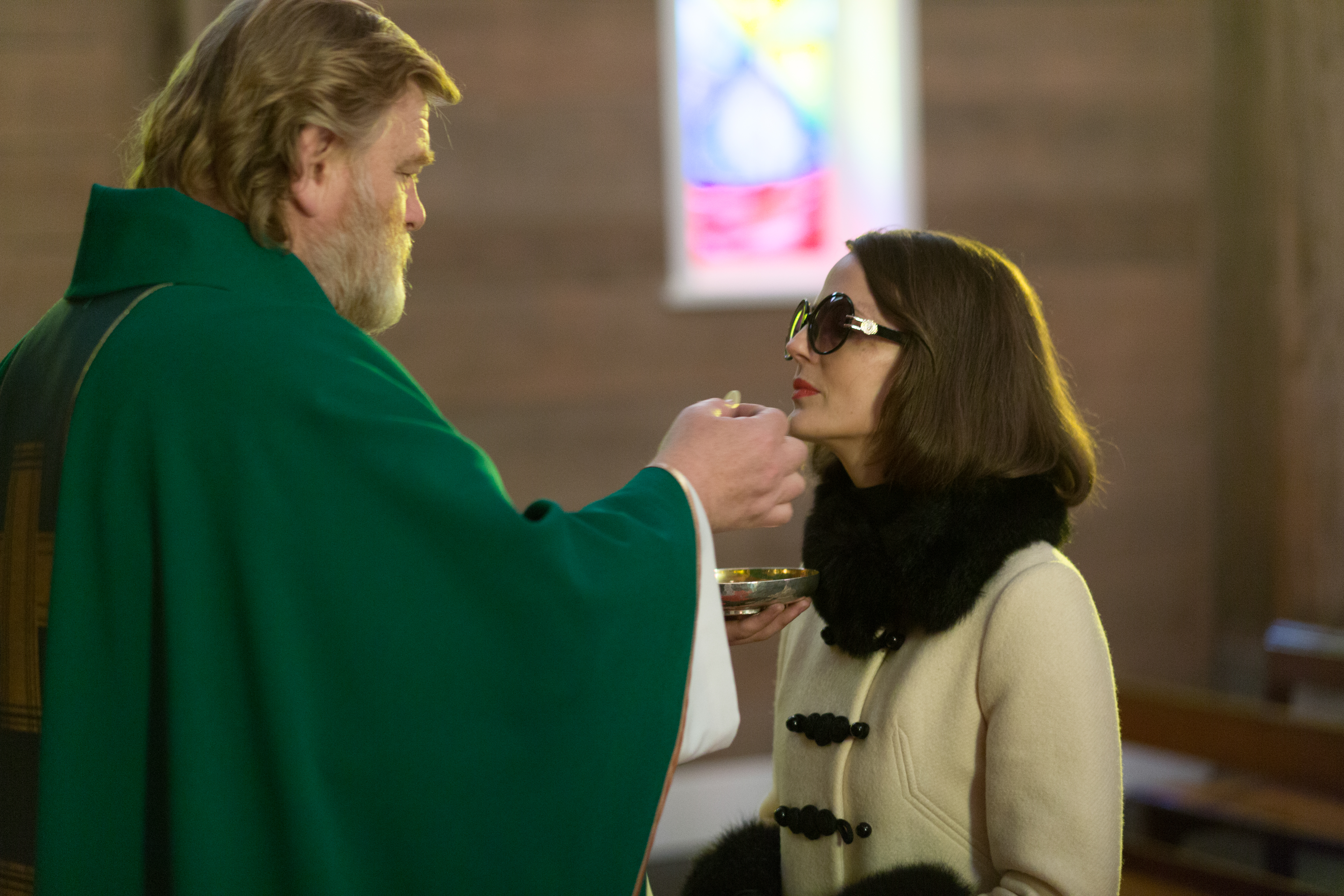
Father James (Brendan Gleeson) dispenses communion in Calvary.
RP: Is there a place for people like Father James in our world today? Because in the film, it’s plain to see that, even though the villagers know they’re a mess, they certainly don’t want his help. They’d rather spit the communion back in his face, so to speak.
BG: I don’t know if you have siblings, but I grew up with an older brother, and I would go at him until he broke. I think there’s something to that with Father James. The members of the community pour their pain on top of him and try to justify it by making him crumble, but secretly, they don’t want him to. If he breaks, then they have nothing to hope for. Cynicism, disillusionment, and despair carry a caveat at the end of the film. Reconnecting with what is good would be impossible without him.
John Michael McDonagh: Yeah. I’m not certain about this, but my feeling is that maybe a lot of people who would have entered the church or the religious institution [do so] because, generally speaking, they want to help people and help their community. We may find that those people, because of all the scandals attached to these institutions, now do other, different forms of community work or spiritual work [rather than aligning] themselves with a specific creed or religious institution. But those impulses to help mankind have different outlets. Possibly that’s a good thing. I don’t know.
RP: So there is hope?
JMM: I think so. Let’s take a specific character in the film like Dylan Moran’s rich man Fitzgerald, who’s making supercilious comments all the time about how much money he’s got. He’s being quite confrontational on the face of it, and he’s kind of an appalling human being. But if you notice his journey in the movie, by the end of it, he’s the only who’s actually asked for help. He comes to see Father James on the cliff face at the end, and we realize that he’s actually suffering. All the masks have fallen. So if a character like that can asked to be helped and saved, then hopefully there’s hope for everybody. Take Aiden Gillen’s doctor. He’s really abusive. At the same time, he’s helping people in his community. He’s saving lives as a doctor. The important story he tells towards the end about the child whose operation went wrong…the subtext of that could be that he was really affected by that when it happened. […] If an act like that can turn [you] into a negative person, another act can turn you back. And the priest tells Veronica that no one is a lost cause. At the end, in the conversation, he says it’s not too late. So I think that’s a subtext throughout the movie, and it’s there in all the characters.
BG: Yes. [Father James] lives on in his daughter. They have connected even though he abandoned her twice. And SPOILER O’Dowd’s character picking up the phone wasn’t a foregone conclusion. But having him do that has us staring up at the end of the film rather than down.
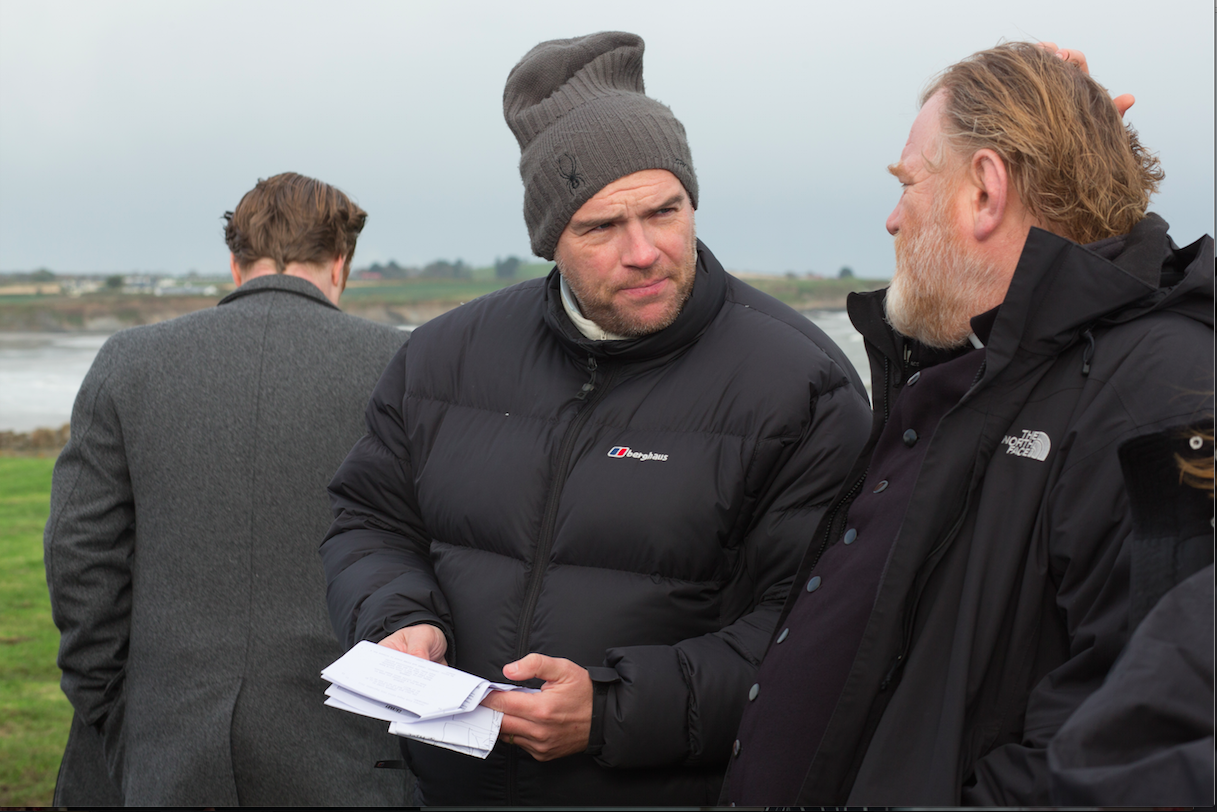
John Michael McDonagh and Gleeson on the set of Calvary.
RP: Brendan talked about the scene at the end where Fiona visits the prison. Did you ever envision a different ending?
JMM: I always wanted to have a montage of the characters in that kind of It’s a Wonderful Life sense. Once Father James is gone, what does that mean to everyone else. We’re not sure what it means. Some of those characters will carry on being the same as they are. But some may have changed. But I also wanted it to end on a moment of hope. I felt the film was somber enough. I wanted the final shot to be kind of a grace note. One thing I did change to make it more hopeful was when she motions for the killer to pick up the phone. In the original draft he doesn’t, but again, I wanted the film to end on a much more hopeful aspect. Shooting that scene on the beach, the performance was so emotional that I wanted to keep it going. [The killer has] destroyed the priest, but he’s also destroyed himself. But by picking up the phone, he may have still saved himself.
RP: Could you say a bit about the state of the villagers in the film? As I watched the film, I began to see them as these larger-than-life characters almost representative of major moral and ethical shortcomings.
JMM: They weren’t trying to be symbolic of anything. If you try to create a work of art, if it’s rich and dense enough, the audience can get whatever meanings out of it they want. It should be open to multiple interpretations. I think, you know, I do tend to create heightened, non-naturalistic characters. They are all a little idiosyncratic and eccentric. It’s interesting, since I’ve been doing this press tour, in Chicago I spoke to an Episcopalian minister and in Dallas a Methodist minister, and they both couldn’t understand why the characters were being referred to as heightened, because they meet those sorts of people every day. To them it was realism. I was kind of happy to hear that. Maybe I shouldn’t talk about these characters as being heightened. Maybe you meet any one of these any day of your life. And these ministers were both saying that people are very angry, and they’re trying to help people who are very angry toward them and church institutions, which I found interesting because you’re telling a story that you hope is parochial, but you also hope it is universal.
RP: Calvary can easily be seen as an indictment against the church, but the inclusion of these rowdy villagers seems to point to something else.
BG: It is the church, but it’s not just the church. It’s the individual as well. The individual has a responsibility to not slip into disillusionment and despair, and you see that throughout the film.
RP: There are so many sharp lines of dialogue that convey the themes of the film. In fact, it’s one of my favorite aspects of both this and The Guard. Is there one that means the most to you or that conveys more of what you were getting at with this film?
BG: Father James’ line, “Forgiveness is highly underrated.” That’s a big one. It seems that the church has forgotten the essentials and become obsessed with minor rules and regulations. That would be the one.
JMM: I really like the dialogue between Fr. James and his daughter Fiona in the confessional. It’s a philosophical discussion, but it’s also a discussion between a father and a daughter and the daughter is in a lot of pain. It also hints at the fact that they’re both literate, erudite people, very intellectual people. She is her father’s daughter. I think that then resonates at the end, that she takes on the mantel of her father really. I like that scene.
RP: I’d like to shift the conversation a bit and talk about your larger body of work, which, in many ways, is similar to your brother’s (Martin McDonagh) in its darkly comedic tone.
JMM: I like writing really dark scenes. I like the scene with Domnhall Gleeson [in Calvary]. There are some very very dark things being said there. I like broadly humorous scenes as well. I like the scene when Dylan Moran takes down the painting and does something awful to it. Obviously the whole film is very tonally comic and tonally tragic. I like writing both of those sorts of sequences. When I’m sitting alone in a room three or four hours a day writing a script, I’m trying to keep myself interested as much as some prospective audience, so I write scenes that amuse me in one way or another.
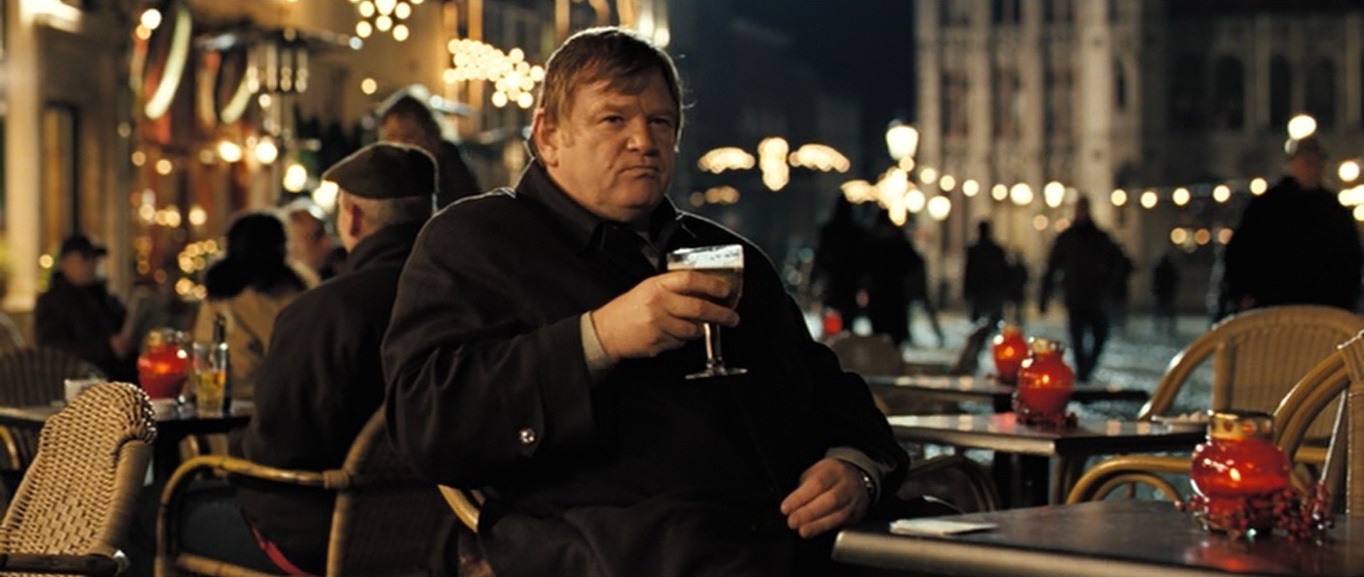
Gleeson as Ken in In Bruges.
RP: Putting this film in conversation with The Guard, I am a big fan these film because they provide fully realized worlds. By that, I mean that when the narrative promises something, the characters follow up on it. There are no easy ways out. I think this is also true of Martin’s work in In Bruges and 7 Psychopaths.
BG: Every character in these films could have a separate story all their own. [The McDonaghs] are brave in where they bring us. I was in a short with Martin, and I thought he was taking it too far. He told me, “All my work is about love.” Now, there might be hard stuff around it, but it’s all about love.
JMM: Yeah exactly. I take that as a huge compliment. The main thing for me is I’ve found a lot of movies, after the first 10 minutes, you know what the ending will be. You may as well not sit through the rest of the movie. Hopefully, I think with myself and my brother’s movies, because of that tone that switches back and forth between the comedic and the tragic, the audience is slightly wrong-footed all the time, so they’re never quite sure where it will go or how far it will go. We both have that in common. The conclusion of [Calvary] was a sort of discovery. I always knew that was going to be the conclusion, but I never had the identity of the killer until two-thirds of the way through. That’s when you’re kind of working things out as you’re getting to that stage. I always know what I’m going to do at the start of a film and what I’m going to do at the end, so I never waver from that course.
RP: Three films, In Bruges, The Guard, and Calvary have similar settings and similar lead characters. Brendan seems to always play characters that see the world as it really is, or sees something that no one else sees. Both these lead characters and the writing behind them seems to serve a priestly function.
BG: Yes. There’s an arc to what actors do. […] I try to find humanity in all the characters I play. No one sees themselves as a devil. If I’m playing a good man, I try to find the faults in that character too. I just try to make them as human as possible.
JMM: Brendan likes to say that art makes you feel less alone. I’ve always felt that was a good quote.
Previous Post
August 1, 2014
The Good and the Reviled
Next Post

August 11, 2014 Summer Silliness: Sharknado 2 & Black Jesus
Browse Our Archives
Select a Category Classics DVD Film Music News Pop Culture Events Print Sports Television Uncategorized Video Games
Select a Month March 2017 February 2017 January 2017 December 2016 November 2016 October 2016 September 2016 August 2016 July 2016 June 2016 May 2016 April 2016 March 2016 February 2016 January 2016 December 2015 November 2015 October 2015 September 2015 August 2015 July 2015 June 2015 May 2015 April 2015 March 2015 February 2015 January 2015 December 2014 November 2014 October 2014 September 2014 August 2014 July 2014 June 2014 May 2014 April 2014 March 2014 February 2014 January 2014 December 2013 November 2013 October 2013 September 2013 August 2013 July 2013 June 2013 May 2013 April 2013 March 2013 February 2013 January 2013 December 2012 November 2012 October 2012 September 2012 August 2012 July 2012 June 2012 May 2012 April 2012 March 2012 February 2012 January 2012 December 2011 November 2011 October 2011 September 2011 August 2011 July 2011 June 2011 May 2011 April 2011 March 2011 February 2011 January 2011 December 2010 November 2010 October 2010 September 2010 August 2010 July 2010 June 2010 May 2010 April 2010 March 2010 February 2010 January 2010 December 2009 November 2009 October 2009 September 2009 August 2009 July 2009 June 2009 May 2009 April 2009 March 2009 February 2009 January 2009 December 2008 November 2008 October 2008 September 2008 August 2008 July 2008 June 2008 May 2008 April 2008 March 2008 February 2008 January 2008 December 2007 November 2007 October 2007 September 2007 August 2007 July 2007 June 2007 May 2007 April 2007 March 2007
Follow Us!
TAKE THE
Religious Wisdom Quiz
What does James say about faith without works?
Select your answer to see how you score.
Faith is only for the righteous. Faith alone is enough. Works without faith is dead. Faith without works is dead.
Related posts from Pop Theology


At SXSW2017: May It Last: A Portrait of...

At SXSW 2017: "Untold Tales of Armistead Maupin"
TRENDING AT PATHEOS Progressive Christian

What Being a Modern-Day Apostle Means to Me
In my last column, I discussed the ins and outs of modern-day...

Did Ancient China Once Worship the God of...
Across human history, a common thread weaves through the origins of the...

Love Your Neighbor – Including Earth-Kin: Lev. 19,...
God’s command to love your neighbor means acting in an ethical and...

Lead a Church Study of “Jesus and Lao...
Guest writer Jack Thomas (The Irreverent Reverend) reflects on leading his church...

Pastoral Wisdom for Responding to Sermon Pushback
Getting sermon pushback on your social justice sermon? Learn practical, Proverbs-based strategies...

Principles for Understanding the Apostolic Ministry Today
Whenever people discover that my formal ministry title is "apostle," as in...
view all Progressive Christian blogs
Ad-Free & Subscriber Log-In Subscription Support
- About Us
- 2026 Calendar
- Videos
- Podcasts
- Library of World Religions
- Faith In Media Tracker
- Advertise With Us
- Write for Us
- Privacy Policy
- Terms of Service
- Do Not Sell My Data
- Contact Us
- Radiant Digital
- Manage Newsletter Subscriptions
- Unsubscribe From Notifications
- Sitemap
Copyright 2008-2026, Patheos. All rights reserved.
Subscription Support Ad-Free & Subscriber Log-In
Follow Patheos