
BuddhistCatholicContemplativeEvangelicalGeneral ChristianHinduJewishLatter-day SaintMuslimNew VisionsProgressive Christian
Beliefs
- Buddhist
- Catholic
- Contemplative
- Evangelical
- General Christian
- Hindu
- Jewish
- Latter-day Saint
- More Voices
- Muslim
- New Visions
- Pagan
- Progressive Christian
Topics
- Religion News
- Food and Religion
- Sports and Religion
- Religious Art
- Religious Music and Entertainment
- Religious Events
- History and Religion
- Style and Religion
- Politics and Religion
- Women in Religion
- Recreation Outdoors and Religion
- Business Finance and Religion
- Careers Workplace and Religion
- Education and Religion
- Family Parenting and Religion
- Health Fitness and Religion
- Home and Religion
- Relationships and Religion
- Technology and Religion
- Travel and Religion
Columnists
- Buddhist Columnists
- Business Finance and Religion Columnists
- Careers Workplace and Religion Columnists
- Catholic Columnists
- Contemplative Columnists
- Education and Religion Columnists
- Evangelists Columnists
- Family Parenting and Religion Columnists
- General Christian Columnists
- Health Fitness and Religion Columnists
- Hindu Columnists
- History and Religion Columnists
- Home and Religion Columnists
- Jewish Columnists
- More Voices Columnists
- Latter Day Columnists
- Muslim Columnists
- New Visions Columnists
- Nonreligious Columnists
- Pagan Columnists
- Politics and Religion Columnists
- Progressive Columnists
- Recreation Outdoors and Religion Columnists
- Relationships and Religion Columnists
- Religion News Columnists
- Religious Art Columnists
- Religious Events Columnists
- Religious Music and Entertainment Columnists
- Sports and Religion Columnists
- Style and Religion Columnists
- Technology and Religion Columnists
- Travel and Religion Columnists
- Women in Religion Columnists
Resource Library
- 2026 Calendar
- Library of World Religions
- The 100 Most Holy Places on Earth
- Patheos Answers
- Podcasts
- Videos
- Faith Leaders Database
- Anglican Episcopalian
- Bahai
- Baptist
- Buddhism
- Christianity
- Confucianism
- Eastern Orthodoxy
- Hinduism
- Holiness and Pentecostal
- ISKCON
- Islam
- Judaism
- Lutheran
- Methodist
- The Church of Jesus Christ of Latter-day Saints
- New Age
- Paganism
- Presbytarian and Reformed
- Protestantism
- Religion Behind the Scenes
- Roman Catholic
- Scientology
- Shia Islam
- Sikhism
- Sufism
- Sunni Islam
- Taoism
- Zen
- See all religions
Research Tools
 Ad-Free & Subscriber Log-In Subscription Support
Ad-Free & Subscriber Log-In Subscription Support
Follow Patheos 

- Trending:
- Forgiveness
- |
- Marriage
- |
- Consciousness
- |
- Death Penalty
- |
- Election
- |
- Halloween
 Pop Theology
- Home
- Progressive Christian
- Religious Music & Entertainment
- Inter-Species Peacekeeping
Inter-Species Peacekeeping
Last updated on: July 11, 2014 at 12:29 pm by J. Ryan Parker
Inter-Species Peacekeeping 2014-07-11T12:29:37-07:00 J. Ryan Parker
Patheos Explore the world's faith through different perspectives on religion and spirituality! Patheos has the views of the prevalent religions and spiritualities of the world.
I was just as surprised as everyone else by the success of 2011’s Rise of the Planet of the Apes. The latest installment of the franchise, Dawn of the Planet of the Apes, had more to live up to and, thankfully, hits every note with perfect special effects, a smart script, and a thought-provoking narrative.
Ten years after the events of Rise, the majority of the human population has been wiped out by the simian flu, a man-made virus. Survivors hunker dow in ruined cities throughout the world. We focus on one in San Francisco lead by Dreyfus (Gary Oldman). Across the bay, in Muir Woods, thrives a growing ape community. Caesar (the young ape from Rise), now older and wiser with a broader vocabulary, leads this peaceful community. A cornerstone of their teaching is that ape will not kill ape.
When the humans’ power supply begins to run low, they venture into the forest in search of alternative energy resources, notably a hydro-electric dam. Along the way, they encounter the apes. The two communities eventually strike a deal: the apes will allow human access to the dam on one condition, no guns. This is a tentative peace, especially when another ape, Koba, realizes that the humans are stock-piling weapons. On top of the threat from humans, Caesar must negotiate power struggles within his community too.
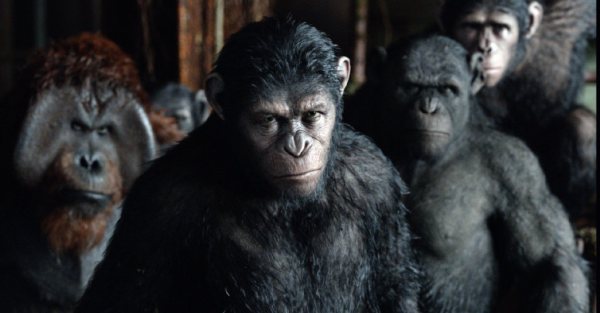
Caesar and the stars of the show.
Dawn has a slower pace than its predecessor, but it never feels like it drags. When you have such a smart script/story, you can get by with smaller stars, so to speak. Jason Clarke, Kerri Russell, and, of course, Oldman, all do a fine job, but the CGI apes, lead by Andy Serkis as Caesar, are the stars of the show. They feel real and diverse and never distracting. The post-apocalyptic San Francisco and the Muir Woods refuge benefit from strong production design.
There are numerous themes at play in Dawn, the most notable of which is the nature of peace, how it is earned, managed, and, unfortunately, lost. The tension between Caesar/Koba and Malcolm (Clarke)/Dreyfus represent two different approaches to inter- and intra-communal relations with Caesar/Malcolm practicing a cautious, peacemaking approach and Koba/Dreyfus embodying a shoot-first-and-ask-questions-later mentality. Caesar, himself, is a clear example of the importance of being a peace-maker rather than a pacifist. His effort to keep the peace reveals that it takes hard work, patience, and sacrifice. His response to weapons is particularly important as he destroys them rather than confiscating and using them like Koba. There will likely be more than a few viewers who see parallels between Caesar and Jesus.

Koba’s actions and manipulation ignite a war.
Dawn shows the tenuous nature of peace given the absurdity of violence. Like so many major real-world events, the catastrophic event in Dawn starts with miscommunication, betrayal, or a pointless, smaller act of violence. A level of vigilance is necessary to earn and manage whatever peace there might be between opposing sides. Dawn also shows that no matter how different we may all seem, we’re just alike. Of course, this is why we might so quickly resort to violence: rather than facing our own failures, we’d rather just punish others for their own.
Dawn of the Planet of the Apes (130 mins.) is rated Rated PG-13 for intense sequences of sci-fi violence and action and brief strong language and is in theaters everywhere.
Previous Post

July 9, 2014
The Mystery Continues
Next Post

July 14, 2014 This Is a Test
Browse Our Archives
Select a Category Classics DVD Film Music News Pop Culture Events Print Sports Television Uncategorized Video Games
Select a Month March 2017 February 2017 January 2017 December 2016 November 2016 October 2016 September 2016 August 2016 July 2016 June 2016 May 2016 April 2016 March 2016 February 2016 January 2016 December 2015 November 2015 October 2015 September 2015 August 2015 July 2015 June 2015 May 2015 April 2015 March 2015 February 2015 January 2015 December 2014 November 2014 October 2014 September 2014 August 2014 July 2014 June 2014 May 2014 April 2014 March 2014 February 2014 January 2014 December 2013 November 2013 October 2013 September 2013 August 2013 July 2013 June 2013 May 2013 April 2013 March 2013 February 2013 January 2013 December 2012 November 2012 October 2012 September 2012 August 2012 July 2012 June 2012 May 2012 April 2012 March 2012 February 2012 January 2012 December 2011 November 2011 October 2011 September 2011 August 2011 July 2011 June 2011 May 2011 April 2011 March 2011 February 2011 January 2011 December 2010 November 2010 October 2010 September 2010 August 2010 July 2010 June 2010 May 2010 April 2010 March 2010 February 2010 January 2010 December 2009 November 2009 October 2009 September 2009 August 2009 July 2009 June 2009 May 2009 April 2009 March 2009 February 2009 January 2009 December 2008 November 2008 October 2008 September 2008 August 2008 July 2008 June 2008 May 2008 April 2008 March 2008 February 2008 January 2008 December 2007 November 2007 October 2007 September 2007 August 2007 July 2007 June 2007 May 2007 April 2007 March 2007
Follow Us!
TAKE THE
Religious Wisdom Quiz
Who lived in Ur of the Chaldeans before God called him?
Select your answer to see how you score.
Lot Jacob Abram Isaac
Related posts from Pop Theology


At SXSW2017: May It Last: A Portrait of...

At SXSW 2017: "Untold Tales of Armistead Maupin"
TRENDING AT PATHEOS Progressive Christian

Why Christians Have a Sacred Duty to Vote:...
The Bible offers strong support for the sacred duty to vote. Here...

What Being a Modern-Day Apostle Means to Me
In my last column, I discussed the ins and outs of modern-day...

Did Ancient China Once Worship the God of...
Across human history, a common thread weaves through the origins of the...

Love Your Neighbor – Including Earth-Kin: Lev. 19,...
God’s command to love your neighbor means acting in an ethical and...

Lead a Church Study of “Jesus and Lao...
Guest writer Jack Thomas (The Irreverent Reverend) reflects on leading his church...

Principles for Understanding the Apostolic Ministry Today
Whenever people discover that my formal ministry title is "apostle," as in...
view all Progressive Christian blogs
Ad-Free & Subscriber Log-In Subscription Support
- About Us
- 2026 Calendar
- Videos
- Podcasts
- Library of World Religions
- Faith In Media Tracker
- Advertise With Us
- Write for Us
- Privacy Policy
- Terms of Service
- Do Not Sell My Data
- Contact Us
- Radiant Digital
- Manage Newsletter Subscriptions
- Unsubscribe From Notifications
- Sitemap
Copyright 2008-2026, Patheos. All rights reserved.
Subscription Support Ad-Free & Subscriber Log-In
Follow Patheos