
BuddhistCatholicContemplativeEvangelicalGeneral ChristianHinduJewishLatter-day SaintMuslimNew VisionsProgressive Christian
Beliefs
- Buddhist
- Catholic
- Contemplative
- Evangelical
- General Christian
- Hindu
- Jewish
- Latter-day Saint
- More Voices
- Muslim
- New Visions
- Pagan
- Progressive Christian
Topics
- Religion News
- Food and Religion
- Sports and Religion
- Religious Art
- Religious Music and Entertainment
- Religious Events
- History and Religion
- Style and Religion
- Politics and Religion
- Women in Religion
- Recreation Outdoors and Religion
- Business Finance and Religion
- Careers Workplace and Religion
- Education and Religion
- Family Parenting and Religion
- Health Fitness and Religion
- Home and Religion
- Relationships and Religion
- Technology and Religion
- Travel and Religion
Columnists
- Buddhist Columnists
- Business Finance and Religion Columnists
- Careers Workplace and Religion Columnists
- Catholic Columnists
- Contemplative Columnists
- Education and Religion Columnists
- Evangelists Columnists
- Family Parenting and Religion Columnists
- General Christian Columnists
- Health Fitness and Religion Columnists
- Hindu Columnists
- History and Religion Columnists
- Home and Religion Columnists
- Jewish Columnists
- More Voices Columnists
- Latter Day Columnists
- Muslim Columnists
- New Visions Columnists
- Nonreligious Columnists
- Pagan Columnists
- Politics and Religion Columnists
- Progressive Columnists
- Recreation Outdoors and Religion Columnists
- Relationships and Religion Columnists
- Religion News Columnists
- Religious Art Columnists
- Religious Events Columnists
- Religious Music and Entertainment Columnists
- Sports and Religion Columnists
- Style and Religion Columnists
- Technology and Religion Columnists
- Travel and Religion Columnists
- Women in Religion Columnists
Resource Library
- 2026 Calendar
- Library of World Religions
- The 100 Most Holy Places on Earth
- Patheos Answers
- Podcasts
- Videos
- Faith Leaders Database
- Anglican Episcopalian
- Bahai
- Baptist
- Buddhism
- Christianity
- Confucianism
- Eastern Orthodoxy
- Hinduism
- Holiness and Pentecostal
- ISKCON
- Islam
- Judaism
- Lutheran
- Methodist
- The Church of Jesus Christ of Latter-day Saints
- New Age
- Paganism
- Presbytarian and Reformed
- Protestantism
- Religion Behind the Scenes
- Roman Catholic
- Scientology
- Shia Islam
- Sikhism
- Sufism
- Sunni Islam
- Taoism
- Zen
- See all religions
Research Tools
 Ad-Free & Subscriber Log-In Subscription Support
Ad-Free & Subscriber Log-In Subscription Support
Follow Patheos 

- Trending:
- Forgiveness
- |
- Marriage
- |
- Consciousness
- |
- Death Penalty
- |
- Election
- |
- Halloween
 Pop Theology
- Home
- Progressive Christian
- Religious Music & Entertainment
- Victim and Violator
Victim and Violator
Last updated on: June 6, 2014 at 4:11 pm by J. Ryan Parker
Victim and Violator 2014-06-06T16:11:43-07:00 J. Ryan Parker
Patheos Explore the world's faith through different perspectives on religion and spirituality! Patheos has the views of the prevalent religions and spiritualities of the world.
If an origin story is done well, it often gives us the opportunity to consider a familiar tale in a new light. The risk, however, is in the possibility of “corrupting” that story for legions of its most die-hard fans. Not surprisingly, this was never a danger for me with Disney’s Maleficent, an origin story of the Sleeping Beauty villain that I found simultaneously boring and intriguing.
Maleficent (Angelina Jolie), as a child, is a beautiful young fairy with large, powerful wings. She soars above her domain, the Moors, and interacts playfully with the creatures with whom she shares it. Next to the Moors is a kingdom ruled by a greedy king bent on expanding his empire, even as the peaceful residents of the Moors are content to live and let live. The young Maleficent falls in love with the human, would-be thief Stephan until kingdom aspirations draw him away. Stephan grows up and distant from Maleficent. After a failed invasion of the Moors, the king promises to name as his successor the man who defeats Maleficent. Stephan (Sharlto Copley) reunites with Maleficent, poisons her, removes her wings, but does not kill her. Stephan becomes king and has a daughter, Aurora. On Aurora’s christening day, Maleficent appears and places a curse on her. She will prick her finger on the needle of a loom before her 16th birthday and fall into a deep sleep only to be awakened by true love’s kiss. The king sends his daughter into hiding under the care of three pixies until the day after her 16th birthday. Eventually, Aurora (Elle Fanning) returns to her father’s castle and inadvertently plays into Maleficent’s curse.

Maleficent (Angelina Jolie) pre-de-winged.
Unfortunately, I found much of the film to be a bore. With the right part, Jolie is certainly a captivating actress, and there seemed to be much to look forward to with this pairing. However, all of the performances felt flat and uninspired. There were a couple of shots in which the elements of makeup, costume, lighting, and staging combined to create a classic, animated Disney effect, but these were too few and far between. Despite these disappointments, there were a couple of elements to the narrative that added a twist to the story that I found oddly compelling. SPOILERS FROM HERE ON OUT.
Unlike the Maleficent of Sleeping Beauty, the character here is much more complex. At the beginning of the film, the narrator says that the people of the kingdom have been waiting for either a hero or a villain to unite them. I was reminded briefly of Tony Campollo’s assertion that a movement can survive without a leader, but not without a devil. Even though the king demonized Maleficent and the other inhabitants of the Moors, Maleficent only becomes a villain to the kingdom after she has been victimized by Stephan and pronounces the curse on Aurora. Taking refuge in the Moors, Maleficent turns it from a place of beauty to one of gloom. However, as the film progresses, she becomes the hero, breaking the curse that she initially placed on Aurora (more on this below). As such, Maleficent is both hero and villain, victim and violator. As we all are. I find this to be a more realistic portrayal of villainy than most cartoon representations. NOTE: I am well aware of some fans’ hatred of this narrative shift and the thematic changes that follow, but I think it’s more of what we need in such stories today.
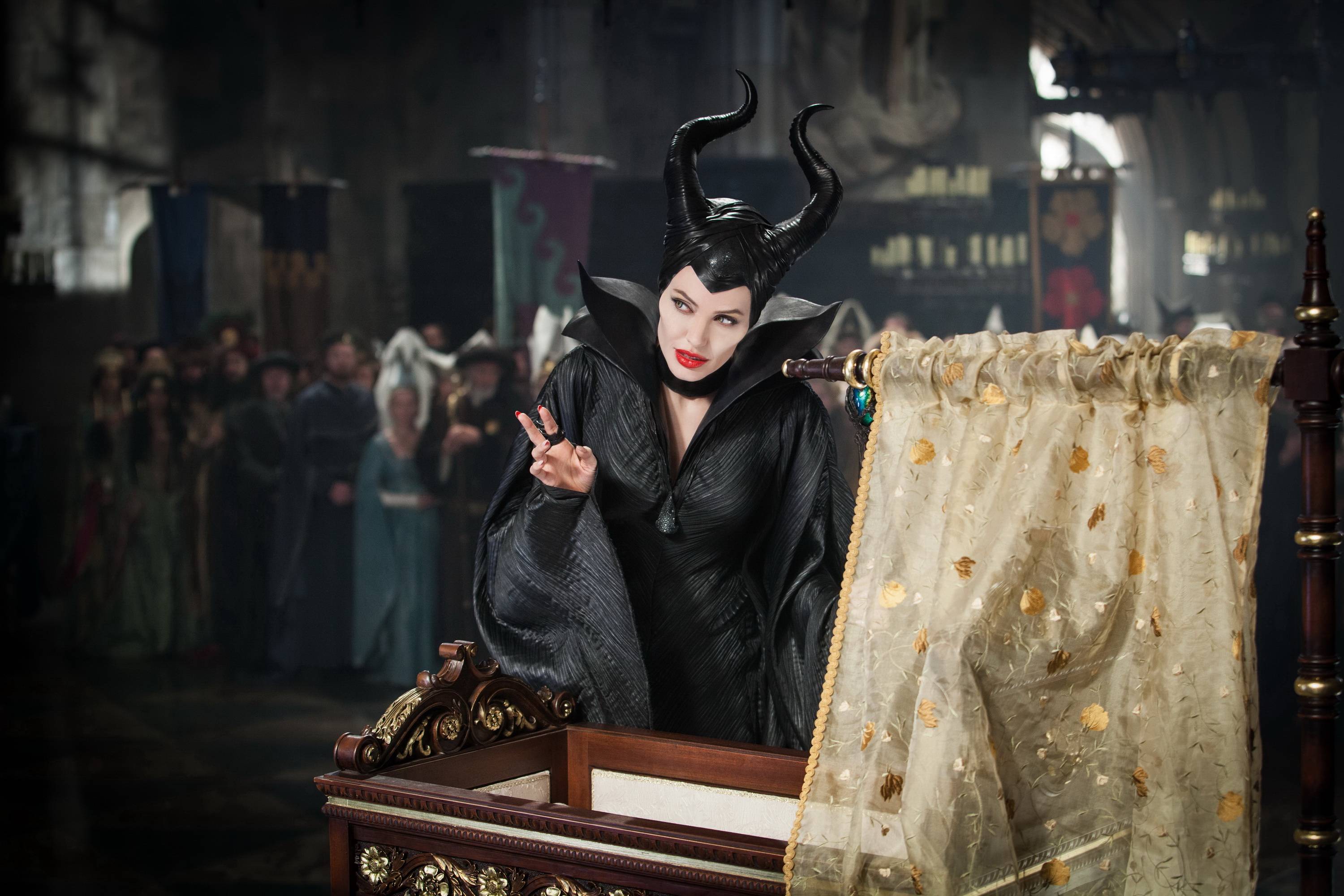
Maleficent pronounces the curse on an infant Aurora.
Second, Maleficent only places Aurora under a curse because she has been spurned and disfigured by her own former “lover.” Therefore, in her mind, true love cannot exist. Like so many of us, Maleficent paradoxically particularizes and universalizes her own experience, e.g. true love looks specifically like this, and because it doesn’t exist for me, it doesn’t (or cannot) exist for anyone. Yet a funny thing happens to Maleficent as the film progresses. She hovers around Aurora, secretly helping the pixies care for her as both an infant and a young girl. Something of a cold friendship develops between Maleficent and Aurora as she becomes a teenager, and Maleficent begins to regret the curse she placed on her. She tries to withdraw it but cannot. When Prince Phillip (Brenton Thwaites) makes his ultimately pointless arrival on the scene, Maleficent is confident that his “meet cute” with Aurora translates into true love. When the pixies force Prince Phillip to kiss the sleeping Aurora, nothing happens. Saddened at the possibility that all is lost, Maleficent bends down, kisses Aurora on the forehead, and breaks the spell.
It might be trite if it weren’t so damn important, but here we have an image of what it might mean to love our enemies and those who seek to harm us. Unaware of the condition in which Maleficent has placed her, Aurora grows up loving Maleficent as a fairy godmother. It is this reaction that begins to melt Maleficent’s cold heart and causes her to give love in return. Of course, as in most films like this, the message is mixed because Maleficent extends no such emotion to King Stephan.
Nevertheless, these two narrative twists go hand in hand. It’s far easier to love someone, to be in relationship with them, even when they appear to be our enemy, if we realize that they, like us, have both hurt and been hurt by others. While Maleficent lacks some of the charm and whimsy of the original Sleeping Beauty, this origin story with a twist opens up a classic fairy tale for places of reflection that its predecessor lacks.
Maleficent (97 mins.) is rated PG for sequences of fantasy action and violence, including frightening images, and is in theaters everywhere.
Previous Post

May 30, 2014
Notes on 'Godzilla'
Next Post

June 10, 2014 If At First You Don't Succeed...
Browse Our Archives
Select a Category Classics DVD Film Music News Pop Culture Events Print Sports Television Uncategorized Video Games
Select a Month March 2017 February 2017 January 2017 December 2016 November 2016 October 2016 September 2016 August 2016 July 2016 June 2016 May 2016 April 2016 March 2016 February 2016 January 2016 December 2015 November 2015 October 2015 September 2015 August 2015 July 2015 June 2015 May 2015 April 2015 March 2015 February 2015 January 2015 December 2014 November 2014 October 2014 September 2014 August 2014 July 2014 June 2014 May 2014 April 2014 March 2014 February 2014 January 2014 December 2013 November 2013 October 2013 September 2013 August 2013 July 2013 June 2013 May 2013 April 2013 March 2013 February 2013 January 2013 December 2012 November 2012 October 2012 September 2012 August 2012 July 2012 June 2012 May 2012 April 2012 March 2012 February 2012 January 2012 December 2011 November 2011 October 2011 September 2011 August 2011 July 2011 June 2011 May 2011 April 2011 March 2011 February 2011 January 2011 December 2010 November 2010 October 2010 September 2010 August 2010 July 2010 June 2010 May 2010 April 2010 March 2010 February 2010 January 2010 December 2009 November 2009 October 2009 September 2009 August 2009 July 2009 June 2009 May 2009 April 2009 March 2009 February 2009 January 2009 December 2008 November 2008 October 2008 September 2008 August 2008 July 2008 June 2008 May 2008 April 2008 March 2008 February 2008 January 2008 December 2007 November 2007 October 2007 September 2007 August 2007 July 2007 June 2007 May 2007 April 2007 March 2007
Follow Us!
TAKE THE
Religious Wisdom Quiz
What does "Sabbath" mean?
Select your answer to see how you score.
Worship Sacrifice Rest Holy
Related posts from Pop Theology


At SXSW2017: May It Last: A Portrait of...

At SXSW 2017: "Untold Tales of Armistead Maupin"
TRENDING AT PATHEOS Progressive Christian

Why Christians Have a Sacred Duty to Vote:...
The Bible offers strong support for the sacred duty to vote. Here...

What Being a Modern-Day Apostle Means to Me
In my last column, I discussed the ins and outs of modern-day...

Did Ancient China Once Worship the God of...
Across human history, a common thread weaves through the origins of the...

Love Your Neighbor – Including Earth-Kin: Lev. 19,...
God’s command to love your neighbor means acting in an ethical and...

Lead a Church Study of “Jesus and Lao...
Guest writer Jack Thomas (The Irreverent Reverend) reflects on leading his church...

Principles for Understanding the Apostolic Ministry Today
Whenever people discover that my formal ministry title is "apostle," as in...
view all Progressive Christian blogs
Ad-Free & Subscriber Log-In Subscription Support
- About Us
- 2026 Calendar
- Videos
- Podcasts
- Library of World Religions
- Faith In Media Tracker
- Advertise With Us
- Write for Us
- Privacy Policy
- Terms of Service
- Do Not Sell My Data
- Contact Us
- Radiant Digital
- Manage Newsletter Subscriptions
- Unsubscribe From Notifications
- Sitemap
Copyright 2008-2026, Patheos. All rights reserved.
Subscription Support Ad-Free & Subscriber Log-In
Follow Patheos