
BuddhistCatholicContemplativeEvangelicalGeneral ChristianHinduJewishLatter-day SaintMuslimNew VisionsProgressive Christian
Beliefs
- Buddhist
- Catholic
- Contemplative
- Evangelical
- General Christian
- Hindu
- Jewish
- Latter-day Saint
- More Voices
- Muslim
- New Visions
- Pagan
- Progressive Christian
Topics
- Religion News
- Food and Religion
- Sports and Religion
- Religious Art
- Religious Music and Entertainment
- Religious Events
- History and Religion
- Style and Religion
- Politics and Religion
- Women in Religion
- Recreation Outdoors and Religion
- Business Finance and Religion
- Careers Workplace and Religion
- Education and Religion
- Family Parenting and Religion
- Health Fitness and Religion
- Home and Religion
- Relationships and Religion
- Technology and Religion
- Travel and Religion
Columnists
- Buddhist Columnists
- Business Finance and Religion Columnists
- Careers Workplace and Religion Columnists
- Catholic Columnists
- Contemplative Columnists
- Education and Religion Columnists
- Evangelists Columnists
- Family Parenting and Religion Columnists
- General Christian Columnists
- Health Fitness and Religion Columnists
- Hindu Columnists
- History and Religion Columnists
- Home and Religion Columnists
- Jewish Columnists
- More Voices Columnists
- Latter Day Columnists
- Muslim Columnists
- New Visions Columnists
- Nonreligious Columnists
- Pagan Columnists
- Politics and Religion Columnists
- Progressive Columnists
- Recreation Outdoors and Religion Columnists
- Relationships and Religion Columnists
- Religion News Columnists
- Religious Art Columnists
- Religious Events Columnists
- Religious Music and Entertainment Columnists
- Sports and Religion Columnists
- Style and Religion Columnists
- Technology and Religion Columnists
- Travel and Religion Columnists
- Women in Religion Columnists
Resource Library
- 2026 Calendar
- Library of World Religions
- The 100 Most Holy Places on Earth
- Patheos Answers
- Podcasts
- Videos
- Faith Leaders Database
- Anglican Episcopalian
- Bahai
- Baptist
- Buddhism
- Christianity
- Confucianism
- Eastern Orthodoxy
- Hinduism
- Holiness and Pentecostal
- ISKCON
- Islam
- Judaism
- Lutheran
- Methodist
- The Church of Jesus Christ of Latter-day Saints
- New Age
- Paganism
- Presbytarian and Reformed
- Protestantism
- Religion Behind the Scenes
- Roman Catholic
- Scientology
- Shia Islam
- Sikhism
- Sufism
- Sunni Islam
- Taoism
- Zen
- See all religions
Research Tools
 Ad-Free & Subscriber Log-In Subscription Support
Ad-Free & Subscriber Log-In Subscription Support
Follow Patheos 

- Trending:
- Forgiveness
- |
- Marriage
- |
- Consciousness
- |
- Death Penalty
- |
- Election
- |
- Halloween
 Pop Theology
- Home
- Progressive Christian
- Religious Music & Entertainment
- Cross-Watching ‘Looking’ and ‘Tales of the City’
Cross-Watching ‘Looking’ and ‘Tales of the City’
Last updated on: March 10, 2014 at 9:13 am by Richard Lindsay
Cross-Watching ‘Looking’ and ‘Tales of the City’ 2014-03-10T09:13:50-07:00 Richard Lindsay
Patheos Explore the world's faith through different perspectives on religion and spirituality! Patheos has the views of the prevalent religions and spiritualities of the world.
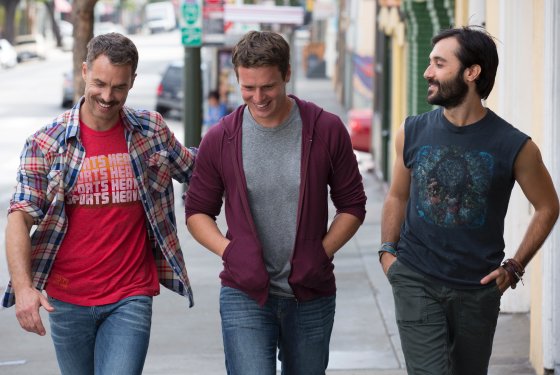
The Three Ages of (Gay) Man: Looking cast, L-R: Dom (Murray Bartlett), Patrick (Jonathan Groff), Agustín (Frankie J. Alvarez).
Perhaps it’s fitting for a television show located in San Francisco that such a fault line should have formed through the HBO series Looking. As the first extended gay male drama on a mainstream channel since the early aughts’ Queer as Folk, the show was bound to be a lightning rod. But where QAF was controversial for its mere existence, not to mention its graphic portrayal of gay sex, Looking is creating a different kind of controversy. Perhaps, wonder viewers, the gay lives in the show are too conventional—perhaps even boring.
More specifically, “This show is bereft of levity and crawls at a snail’s pace with claustrophobic camerawork that feels like a Dateline re-enactment shot by Ingmar Bergman,” according to Mick Stingley of Esquire.
The characters are sort of a Three Ages of (Gay) Man. Patrick (Jonathan Groff) is a 20-something naïf and video game designer who can’t decide whether he wants to be serious or wants to hook up, Augustín is a 30-something artist who’s in a relationship but still wants to play around, and Dom is a 40-something waiter who is ancient in gay years and had better find someone soon. (As Dom laments, “On your 40th birthday, Grindr e-mails you a death certificate.”)
I actually find their adventures, or whatever you want to call them, interesting in a slice-of-life, gays-in-the-age-of-equality kind of way. Critics like The Daily Beast’s Tim Teeman, who calls Looking’s understated performances “homo mumblecore,” have complained that the characters are self-absorbed and prematurely post-political:
“There is no notion of San Francisco’s tumultuous and venerable gay history. The men just use its bars and cruise its streets; sexuality, the show makes clear, is now just part of the service industry.”
I hate to say this, but I’ve dated in New York and San Francisco, and this blithe non-awareness amongst the gay male set is pretty typical. It’s difficult to date in the big gay cities because there are so many options. Dating apps like Grindr or other Web sites begin to seem like an endless menu, with users wondering what’s for dessert before they’ve even decided on a main course. For better or for worse, Looking’s shallow and privileged gay male characters seem accurate.
The show isn’t bereft of some old-fashioned gay charm; even post-political gays still have wit.
Observing a gay bachelor party that involves both grooms cavorting with a scantily-clad dancer, Dom shakes his head and remarks, “The Lord told us a bachelor party was supposed to be between one man and one stripper.”
Patrick’s perusing through a gay dating site brings up a now-perennial question: “Is this guy really attractive? I can’t tell. Instagram filters have ruined everything.”
Another comment from Patrick after meeting one of Augustín’s friends at the Folsom Street Fair: “He did have something, that guy. But maybe it was just the jockstrap.”
But if Looking is just a little too post-identity-politics for some viewers, a good series to watch for contrast is Armisted Maupin’s Tales of the City, now available on Hulu.
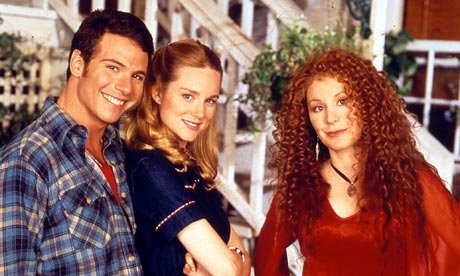
The young stars of Tales of the City: L-R: Michael “Mouse” Tolliver (Marcus D’Amico), Mary Ann Singleton (Laura Linney), and Mona Ramsey (Chloe Webb).
A genuine part of San Francisco’s “tumultuous and venerable gay history,” Tales started out as a newspaper serial in the San Francisco Chronicle in the mid-1970’s*.* With the initial episodes collected into three books, it introduced readers to an unforgettable set of characters in post-hippy San Francisco, when the City was in its first flush of gay liberation. (Maupin eventually wrote a total of nine books, the last of which, The Days of Anna Madrigal, was just released this January.)
The first Tales book was made into a controversial and critically acclaimed mini-series on PBS in 1993 that was among the first on American television to show two men in bed and to have well-drawn and non-tragic transgender character. If you’ve ever wondered how PBS went from a universally beloved network of children’s shows and British dramas to the bête noire of the Republican Right, Tales of the City had a lot to do with it. The controversy was so great that the subsequent two books weren’t made until 1998 and 2001, and were produced by Showtime and Channel Four, rather than Public Television.
Some characters in Tales are types that would be familiar to viewers of Looking—Patrick seems to be the direct gay offspring of Michael “Mouse” Tolliver (played by Marcus D’Amico initially, Paul Hopkins in the subsequent series). Like Patrick, Mouse is romantic and clueless, desiring happiness but unable to grab it when it’s right in front of him.
Mouse has a certain innocence, but isn’t nearly so fresh-off-the-farm as Mary Ann Singleton (Laura Linney) a girl who up and decides to move to San Francisco from Cleveland. As both Tales and Looking point out, the question of “Where are you from?” takes on peculiar meaning in San Francisco, as no one seems to actually be from the city.
The first installment of Tales follows Mary Ann as she leaves her Midwestern roots behind and moves into a boarding house on Russian Hill presided over by Anna Madrigal (played to acclaim by Olympia Dukakis). Mrs. Madrigal is a mysterious and perceptive mother hen to her brood of boarding house bohemians, doling out advice and homegrown joints in equal measure.
A notable exchange: As Mary Ann is moving in, she asks Mrs. Madrigal if she has any objection to pets. Mrs. Madrigal answers, “Dear, I have no objection to anything.”
Mary Ann is quickly plunged into a world of disco clubs, casual sex, and recreational drugs, and she has to wise up quick. In one scene, someone asks her if she wants some coke, and she says, “No thanks, I’m on a diet. Do you have some Fresca?” At another point, she finds herself having to explain her new friend Mouse during a phone call to her mother in Cleveland, “Mom, he’s a homosexual. You know what those are, they have them on television now.”
Other denizens of Mrs. Madrigal’s 28 Barbary Lane include Mona Ramsey, a bisexual California flake who flits from one source of meaning to the next, and Brian Hawkins, a womanizer with a heart of gold.
The daily dramas of the Barbary Lane crew play against the veritable soap opera of the Halcyon clan, a San Mateo (ahem, Hillsborough) family of no humble means, including patriarch Edgar, matriarch Francis, lost daughter DeDe, and no-good son-in-law Beauchamp (pronounced “Beecham”).
The PBS mini-series is stocked with breakout performances from actors that would go on to 90’s fame, including Linney, Parker Posey, Janeane Garofalo, and Thomas Gibson (Dharma and Greg), and liberally spiced with cameos like Ian McKellan, Rod Steiger, Father Guido Sarducci, and County Joe McDonald.
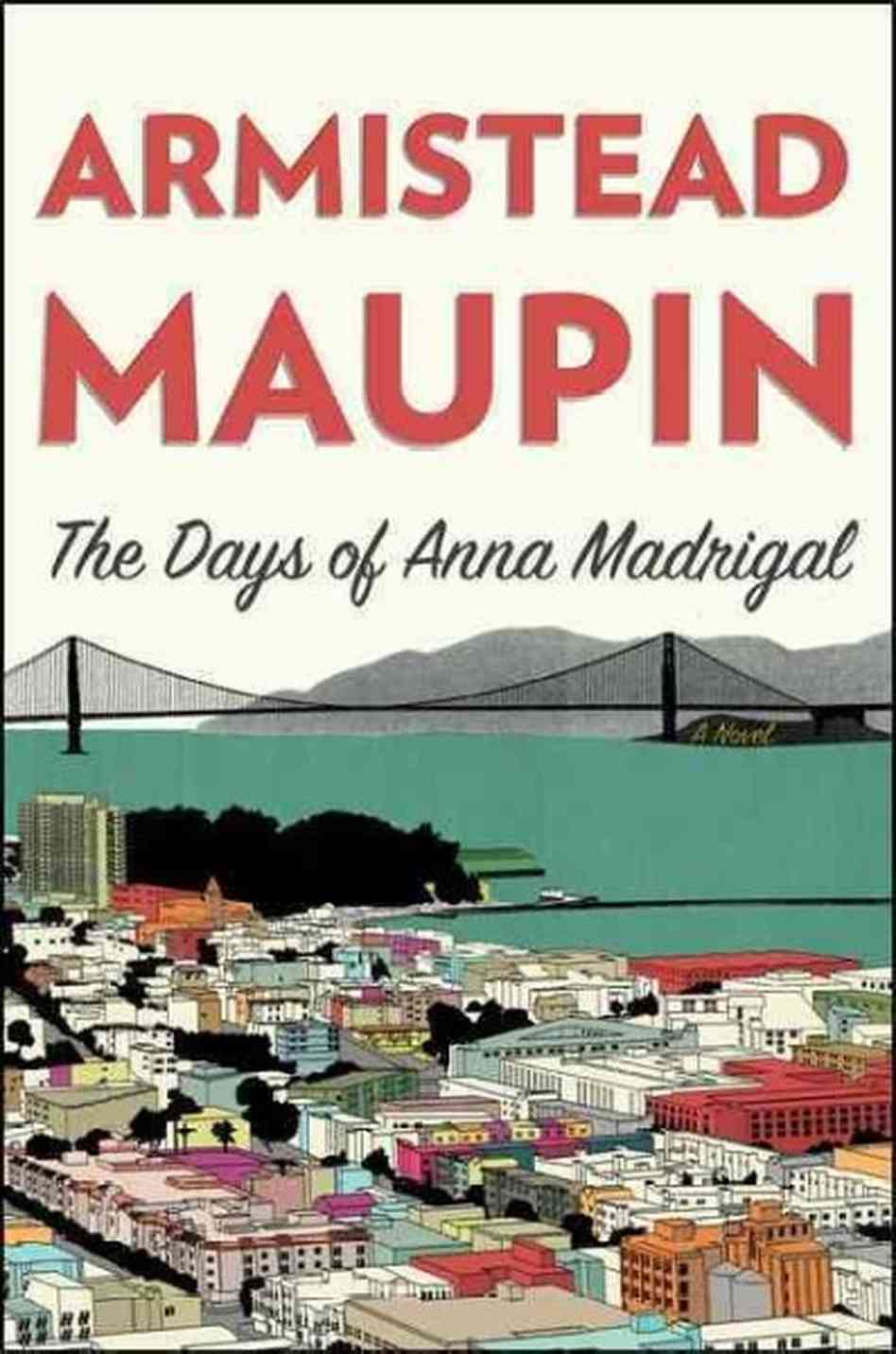
The last of the Tales of the City books, released this January. Anna Madrigal, now in her 90’s, reflects on her life as she prepares to go to Burning Man.
The plots of the first three books/mini-series are absurd, culminating in almost Nancy Drew-style mysteries, with Mary Ann breaking up a child pornography ring, discovering an Episcopal cannibalism cult, and saving DeDe Halcyon and her children from the second coming of Jim Jones. The characters continually cross paths despite inhabiting different scenes and social strata, like San Francisco is the biggest small town in the world. The revelations of the plot are not nearly as interesting as the characters themselves—each with secrets to be plumbed and their own needs for liberation and new life.
And of course, the biggest Character of them all is the City itself. A place of drag nuns, jockey shorts contests, disco roller rinks, and pot-smoking transgender landladies.
Perhaps that’s what the draws Looking and Tales together—the search for life and liberation in a city that is perpetually and colorfully remaking itself. Tales celebrates San Francisco as a pre-AIDS sanctuary for nonconformists; the Great Gray City of Love becoming the Great City of Gay Love. Looking celebrates the City after apocalyptic crises of AIDS and the social and racial upheavals of the 60’s and 70’s; a world-leading city of innovation and tolerance. It’s still a place to find a purpose, to find an alternative family, to find a self.
Previous Post
February 19, 2014
Making (Religious) Meaning out of (Pop) Music
Next Post

March 13, 2014 SXSW Film: The First Half
Browse Our Archives
Select a Category Classics DVD Film Music News Pop Culture Events Print Sports Television Uncategorized Video Games
Select a Month March 2017 February 2017 January 2017 December 2016 November 2016 October 2016 September 2016 August 2016 July 2016 June 2016 May 2016 April 2016 March 2016 February 2016 January 2016 December 2015 November 2015 October 2015 September 2015 August 2015 July 2015 June 2015 May 2015 April 2015 March 2015 February 2015 January 2015 December 2014 November 2014 October 2014 September 2014 August 2014 July 2014 June 2014 May 2014 April 2014 March 2014 February 2014 January 2014 December 2013 November 2013 October 2013 September 2013 August 2013 July 2013 June 2013 May 2013 April 2013 March 2013 February 2013 January 2013 December 2012 November 2012 October 2012 September 2012 August 2012 July 2012 June 2012 May 2012 April 2012 March 2012 February 2012 January 2012 December 2011 November 2011 October 2011 September 2011 August 2011 July 2011 June 2011 May 2011 April 2011 March 2011 February 2011 January 2011 December 2010 November 2010 October 2010 September 2010 August 2010 July 2010 June 2010 May 2010 April 2010 March 2010 February 2010 January 2010 December 2009 November 2009 October 2009 September 2009 August 2009 July 2009 June 2009 May 2009 April 2009 March 2009 February 2009 January 2009 December 2008 November 2008 October 2008 September 2008 August 2008 July 2008 June 2008 May 2008 April 2008 March 2008 February 2008 January 2008 December 2007 November 2007 October 2007 September 2007 August 2007 July 2007 June 2007 May 2007 April 2007 March 2007
Follow Us!
TAKE THE
Religious Wisdom Quiz
Who said, "For unto us a child is born, unto us a son is given"?
Select your answer to see how you score.
David Isaiah Zechariah Micah
Related posts from Pop Theology

#KillerSerials: THE PATH, S2 Ep. 11
#KillerSerials: THE PATH, S2 Ep. 10

#KillerSerials: THE PATH S2, E8
TRENDING AT PATHEOS Progressive Christian

Why Christians Have a Sacred Duty to Vote:...
The Bible offers strong support for the sacred duty to vote. Here...

What Being a Modern-Day Apostle Means to Me
In my last column, I discussed the ins and outs of modern-day...

Did Ancient China Once Worship the God of...
Across human history, a common thread weaves through the origins of the...

Love Your Neighbor – Including Earth-Kin: Lev. 19,...
God’s command to love your neighbor means acting in an ethical and...

Lead a Church Study of “Jesus and Lao...
Guest writer Jack Thomas (The Irreverent Reverend) reflects on leading his church...

Principles for Understanding the Apostolic Ministry Today
Whenever people discover that my formal ministry title is "apostle," as in...
view all Progressive Christian blogs
Ad-Free & Subscriber Log-In Subscription Support
- About Us
- 2026 Calendar
- Videos
- Podcasts
- Library of World Religions
- Faith In Media Tracker
- Advertise With Us
- Write for Us
- Privacy Policy
- Terms of Service
- Do Not Sell My Data
- Contact Us
- Radiant Digital
- Manage Newsletter Subscriptions
- Unsubscribe From Notifications
- Sitemap
Copyright 2008-2026, Patheos. All rights reserved.
Subscription Support Ad-Free & Subscriber Log-In
Follow Patheos