
BuddhistCatholicContemplativeEvangelicalGeneral ChristianHinduJewishLatter-day SaintMuslimNew VisionsProgressive Christian
Beliefs
- Buddhist
- Catholic
- Contemplative
- Evangelical
- General Christian
- Hindu
- Jewish
- Latter-day Saint
- More Voices
- Muslim
- New Visions
- Pagan
- Progressive Christian
Topics
- Religion News
- Food and Religion
- Sports and Religion
- Religious Art
- Religious Music and Entertainment
- Religious Events
- History and Religion
- Style and Religion
- Politics and Religion
- Women in Religion
- Recreation Outdoors and Religion
- Business Finance and Religion
- Careers Workplace and Religion
- Education and Religion
- Family Parenting and Religion
- Health Fitness and Religion
- Home and Religion
- Relationships and Religion
- Technology and Religion
- Travel and Religion
Columnists
- Buddhist Columnists
- Business Finance and Religion Columnists
- Careers Workplace and Religion Columnists
- Catholic Columnists
- Contemplative Columnists
- Education and Religion Columnists
- Evangelists Columnists
- Family Parenting and Religion Columnists
- General Christian Columnists
- Health Fitness and Religion Columnists
- Hindu Columnists
- History and Religion Columnists
- Home and Religion Columnists
- Jewish Columnists
- More Voices Columnists
- Latter Day Columnists
- Muslim Columnists
- New Visions Columnists
- Nonreligious Columnists
- Pagan Columnists
- Politics and Religion Columnists
- Progressive Columnists
- Recreation Outdoors and Religion Columnists
- Relationships and Religion Columnists
- Religion News Columnists
- Religious Art Columnists
- Religious Events Columnists
- Religious Music and Entertainment Columnists
- Sports and Religion Columnists
- Style and Religion Columnists
- Technology and Religion Columnists
- Travel and Religion Columnists
- Women in Religion Columnists
Resource Library
- 2026 Calendar
- Library of World Religions
- The 100 Most Holy Places on Earth
- Patheos Answers
- Podcasts
- Videos
- Faith Leaders Database
- Anglican Episcopalian
- Bahai
- Baptist
- Buddhism
- Christianity
- Confucianism
- Eastern Orthodoxy
- Hinduism
- Holiness and Pentecostal
- ISKCON
- Islam
- Judaism
- Lutheran
- Methodist
- The Church of Jesus Christ of Latter-day Saints
- New Age
- Paganism
- Presbytarian and Reformed
- Protestantism
- Religion Behind the Scenes
- Roman Catholic
- Scientology
- Shia Islam
- Sikhism
- Sufism
- Sunni Islam
- Taoism
- Zen
- See all religions
Research Tools
 Ad-Free & Subscriber Log-In Subscription Support
Ad-Free & Subscriber Log-In Subscription Support
Follow Patheos 

- Trending:
- Forgiveness
- |
- Marriage
- |
- Consciousness
- |
- Death Penalty
- |
- Election
- |
- Halloween
 Pop Theology
- Home
- Progressive Christian
- Religious Music & Entertainment
- Boring but Beautiful
Boring but Beautiful
Last updated on: December 24, 2013 at 12:55 pm by J. Ryan Parker
Boring but Beautiful 2013-12-24T12:55:45-08:00 J. Ryan Parker
Patheos Explore the world's faith through different perspectives on religion and spirituality! Patheos has the views of the prevalent religions and spiritualities of the world.
The biggest lie being perpetrated this holiday season (aside from the hyper-commercialization of Christmas) is that Saving Mr. Banks is a delightful holiday film for the entire family. While it might be appropriate for viewers of all ages, it’s far from the case that all age groups will love the film. Marry Poppins was/is fun for the whole family. Saving Mr. Banks relies heavily on familiarity with said Disney classic, knowledge that many younger (and increasingly older) viewers might not have. Yet in this boring, and occasionally convoluted, mess, there is a beautiful articulation of the power of stories to (re)shape our lives.
Saving Mr. Banks is about Walt Disney’s wooing of P. L. Travers, the author of the Mary Poppins books, in order to obtain the film rights to her literary creation. It’s also about Ms. Travers’ attempts to rebuff Disney’s efforts at every front. Mary Poppins holds a special place in Ms. Travers’ heart because of the character’s affiliation with both pleasant and tragic childhood memories. These memories have also shut Mrs. Travers off from the world around her, trapping her in intense feelings of anger, sadness, guilt, and regret. Walt and his team of filmmakers try to crack the case, so to speak, in an effort to figure out what makes Mrs. Travers tick and how they can best convince her to surrender the rights to her stories.
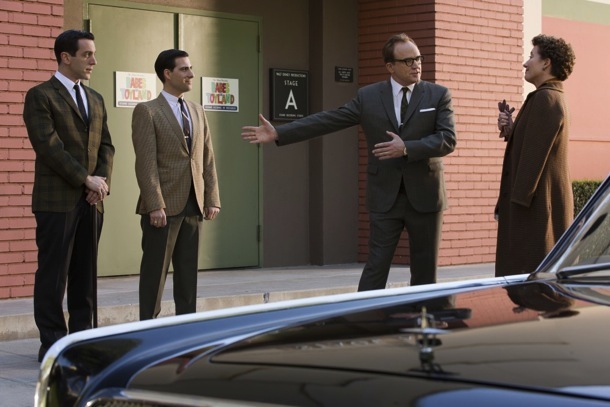
B. J. Novak as Robert Sherman, Jason Schwartzman as Richard Sherman, Bradley Whitford as Don DaGradi, and Emma Thompson as P. L. Travers.
On one level, watching Saving Mr. Banks is like waiting for the Titanic to sink in James Cameron’s 1999 epic. The filmmakers liven things up by cutting back and forth between Ms. Travers’ visit to Los Angeles to negotiate the film rights to her books and her troubled upbringing in rural Australia in the early 1900s, where she enjoyed (endured?) a tumultuous relationship with her imaginative and alcoholic father. For the most part, the parallel narratives work just fine but pay off brilliantly in one of the concluding scenes in which Ms. Travers sees the film version of Mary Poppins for the first time.
The film benefits from beautiful cinematography and some gorgeous set design. Having worked on the Disney lot for several months this year, it was interesting to see all those stunning art deco buildings back in their “original” context. Emma Thompson is, as always, brilliant, while Tom Hanks is, well, Tom Hanks (he gives a far more inspiring performance in Captain Phillips, however). The supporting cast of Bradley Whitford as screenwriter Don DaGradi and Jason Schwartzman and B. J. Novak as songwriting brothers Richard and Robert Sherman work just fine. Whitford employs his usual whit while Novak shows real big screen promise.
While I found much of the film plodding, I was struck by one particular scene in the final third of the film. Walt pursues Ms. Travers, who has gone back to London, in an effort to make one final plea for the film rights to Mary Poppins. During their conversation, Walt tells her of the power that storytellers (and their stories) have to re-orient people’s imaginations and to quite literally (re)shape their lives and memories. He rightly accuses Ms. Travers of being imprisoned by painful memories of her own creation, memories that breed feelings of guilt, anger, and sorrow that shut her off from the rest of the world. She guards her literary creation with an iron fist, in part, to tend these wounded feelings. Walt promises her that his adaptation of her stories can prove liberating for not only her, but for audiences around the world as well. Through this conversation, and her subsequent viewing of the film, Ms. Travers is liberated from these painful memories, seeing them anew for what they were/are and embracing an altogether more holisitc vision of her life.
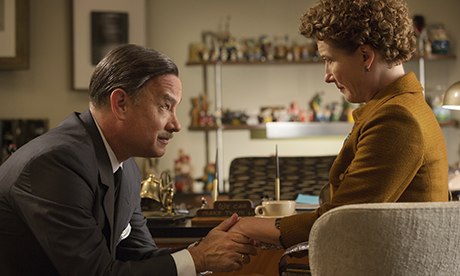
Tom Hanks as Walt Disney woos Ms. Travers (Thompson).
For me, this is as beautiful an articulation of the power of story, and particularly the Gospel, to (re)shape our lives as I’ve seen on film since Big Fish. In this way, Saving Mr. Banks is a fitting Christmastime release, because this is what the narrative of Jesus’ birth does for those who celebrate and re-tell it year after year. It reminds us that this season in particular, and life in general, is not as the rest of the world would have it. It re-orients our notions of power, vulnerability, and salvation. It rescues us from painful memories and emotions that imprison us and liberates us to be peacemakers and healers in a violent and broken world. My friend David Henson has written a beautiful homily to this effect. If you won’t be attending services tonight or tomorrow, please do yourself a favor and read it.

THE Mary Poppins (Julie Andrews), Walt Disney, and P. L. Travers.
The Christmas season, for many of us, is a reminder to expect the unexpected and to look for hope in the unlikeliest of places. Surprisingly enough, in the midst of a boring, messy film, I found a beautiful articulation of the power of story and the promise of the Gospel that reminded me yet again of why I love movies and why I embrace the Jesus narrative year after year.
Saving Mr. Banks (120 mins.) is rated PG-13 for thematic elements including some unsettling images and is in theaters everywhere.
Previous Post

December 21, 2013
How do I love my neighbor Phil?
Next Post

December 31, 2013 Angels Among Us
Browse Our Archives
Select a Category Classics DVD Film Music News Pop Culture Events Print Sports Television Uncategorized Video Games
Select a Month March 2017 February 2017 January 2017 December 2016 November 2016 October 2016 September 2016 August 2016 July 2016 June 2016 May 2016 April 2016 March 2016 February 2016 January 2016 December 2015 November 2015 October 2015 September 2015 August 2015 July 2015 June 2015 May 2015 April 2015 March 2015 February 2015 January 2015 December 2014 November 2014 October 2014 September 2014 August 2014 July 2014 June 2014 May 2014 April 2014 March 2014 February 2014 January 2014 December 2013 November 2013 October 2013 September 2013 August 2013 July 2013 June 2013 May 2013 April 2013 March 2013 February 2013 January 2013 December 2012 November 2012 October 2012 September 2012 August 2012 July 2012 June 2012 May 2012 April 2012 March 2012 February 2012 January 2012 December 2011 November 2011 October 2011 September 2011 August 2011 July 2011 June 2011 May 2011 April 2011 March 2011 February 2011 January 2011 December 2010 November 2010 October 2010 September 2010 August 2010 July 2010 June 2010 May 2010 April 2010 March 2010 February 2010 January 2010 December 2009 November 2009 October 2009 September 2009 August 2009 July 2009 June 2009 May 2009 April 2009 March 2009 February 2009 January 2009 December 2008 November 2008 October 2008 September 2008 August 2008 July 2008 June 2008 May 2008 April 2008 March 2008 February 2008 January 2008 December 2007 November 2007 October 2007 September 2007 August 2007 July 2007 June 2007 May 2007 April 2007 March 2007
Follow Us!
TAKE THE
Religious Wisdom Quiz
True or False: The first plague in Egypt turned the Nile River into blood.
Select your answer to see how you score.
FALSE TRUE
Related posts from Pop Theology


At SXSW2017: May It Last: A Portrait of...

At SXSW 2017: "Untold Tales of Armistead Maupin"
TRENDING AT PATHEOS Progressive Christian

Why Christians Have a Sacred Duty to Vote:...
The Bible offers strong support for the sacred duty to vote. Here...

What Being a Modern-Day Apostle Means to Me
In my last column, I discussed the ins and outs of modern-day...

Did Ancient China Once Worship the God of...
Across human history, a common thread weaves through the origins of the...

Love Your Neighbor – Including Earth-Kin: Lev. 19,...
God’s command to love your neighbor means acting in an ethical and...

Lead a Church Study of “Jesus and Lao...
Guest writer Jack Thomas (The Irreverent Reverend) reflects on leading his church...

Principles for Understanding the Apostolic Ministry Today
Whenever people discover that my formal ministry title is "apostle," as in...
view all Progressive Christian blogs
Ad-Free & Subscriber Log-In Subscription Support
- About Us
- 2026 Calendar
- Videos
- Podcasts
- Library of World Religions
- Faith In Media Tracker
- Advertise With Us
- Write for Us
- Privacy Policy
- Terms of Service
- Do Not Sell My Data
- Contact Us
- Radiant Digital
- Manage Newsletter Subscriptions
- Unsubscribe From Notifications
- Sitemap
Copyright 2008-2026, Patheos. All rights reserved.
Subscription Support Ad-Free & Subscriber Log-In
Follow Patheos