
BuddhistCatholicContemplativeEvangelicalGeneral ChristianHinduJewishLatter-day SaintMuslimNew VisionsProgressive Christian
Beliefs
- Buddhist
- Catholic
- Contemplative
- Evangelical
- General Christian
- Hindu
- Jewish
- Latter-day Saint
- More Voices
- Muslim
- New Visions
- Pagan
- Progressive Christian
Topics
- Religion News
- Food and Religion
- Sports and Religion
- Religious Art
- Religious Music and Entertainment
- Religious Events
- History and Religion
- Style and Religion
- Politics and Religion
- Women in Religion
- Recreation Outdoors and Religion
- Business Finance and Religion
- Careers Workplace and Religion
- Education and Religion
- Family Parenting and Religion
- Health Fitness and Religion
- Home and Religion
- Relationships and Religion
- Technology and Religion
- Travel and Religion
Columnists
- Buddhist Columnists
- Business Finance and Religion Columnists
- Careers Workplace and Religion Columnists
- Catholic Columnists
- Contemplative Columnists
- Education and Religion Columnists
- Evangelists Columnists
- Family Parenting and Religion Columnists
- General Christian Columnists
- Health Fitness and Religion Columnists
- Hindu Columnists
- History and Religion Columnists
- Home and Religion Columnists
- Jewish Columnists
- More Voices Columnists
- Latter Day Columnists
- Muslim Columnists
- New Visions Columnists
- Nonreligious Columnists
- Pagan Columnists
- Politics and Religion Columnists
- Progressive Columnists
- Recreation Outdoors and Religion Columnists
- Relationships and Religion Columnists
- Religion News Columnists
- Religious Art Columnists
- Religious Events Columnists
- Religious Music and Entertainment Columnists
- Sports and Religion Columnists
- Style and Religion Columnists
- Technology and Religion Columnists
- Travel and Religion Columnists
- Women in Religion Columnists
Resource Library
- 2026 Calendar
- Library of World Religions
- The 100 Most Holy Places on Earth
- Patheos Answers
- Podcasts
- Videos
- Faith Leaders Database
- Anglican Episcopalian
- Bahai
- Baptist
- Buddhism
- Christianity
- Confucianism
- Eastern Orthodoxy
- Hinduism
- Holiness and Pentecostal
- ISKCON
- Islam
- Judaism
- Lutheran
- Methodist
- The Church of Jesus Christ of Latter-day Saints
- New Age
- Paganism
- Presbytarian and Reformed
- Protestantism
- Religion Behind the Scenes
- Roman Catholic
- Scientology
- Shia Islam
- Sikhism
- Sufism
- Sunni Islam
- Taoism
- Zen
- See all religions
Research Tools
 Ad-Free & Subscriber Log-In Subscription Support
Ad-Free & Subscriber Log-In Subscription Support
Follow Patheos 

- Trending:
- Forgiveness
- |
- Marriage
- |
- Consciousness
- |
- Death Penalty
- |
- Election
- |
- Halloween
 Pop Theology
- Home
- Progressive Christian
- Religious Music & Entertainment
- Pirates On the Waterfront
Pirates On the Waterfront
Last updated on: October 17, 2013 at 10:57 am by J. Ryan Parker
Pirates On the Waterfront 2013-10-17T10:57:24-07:00 J. Ryan Parker
Patheos Explore the world's faith through different perspectives on religion and spirituality! Patheos has the views of the prevalent religions and spiritualities of the world.
If you pay attention to film reviews or watch SNL, you’ve seen that scientists have taken shots at the logistics of Gravity. Captain Richard Phillips’ crew members have pointed to inaccuracies in the film that bears his name. These criticisms embody something of the “little t”/”capital T” truth debates in which religious and theology folk often participate. Are these films (or stories in scripture) factually true? Who cares. Are they True? You bet. Captain Phillips, though boasting a nerve-wracking action plot, is a deeply thought-provoking drama that sheds light on truths about the world in which we live.
Captain Phillips recounts the 2009 Somali pirate attack on the crew of the Maersk Alabama, helmed by Captain Richard Phillips (Tom Hanks). The film follows their days-long ordeal in which a band of Somali pirates, lead by Muse (Barkhad Abdi) and Bilal (Barkhad Abdirahman), board the ship and hold Phillips and and his crew hostage. The crew manages to hide in and booby-trap the lower deck to protect themselves. Shortly after they board the ship, the pirates’ plan falls apart spectacularly. Muse would take Captain Phillips’ offer of $30,000 and a way out, but Bilal takes Phillips as a hostage when they flee on the lifeboat.
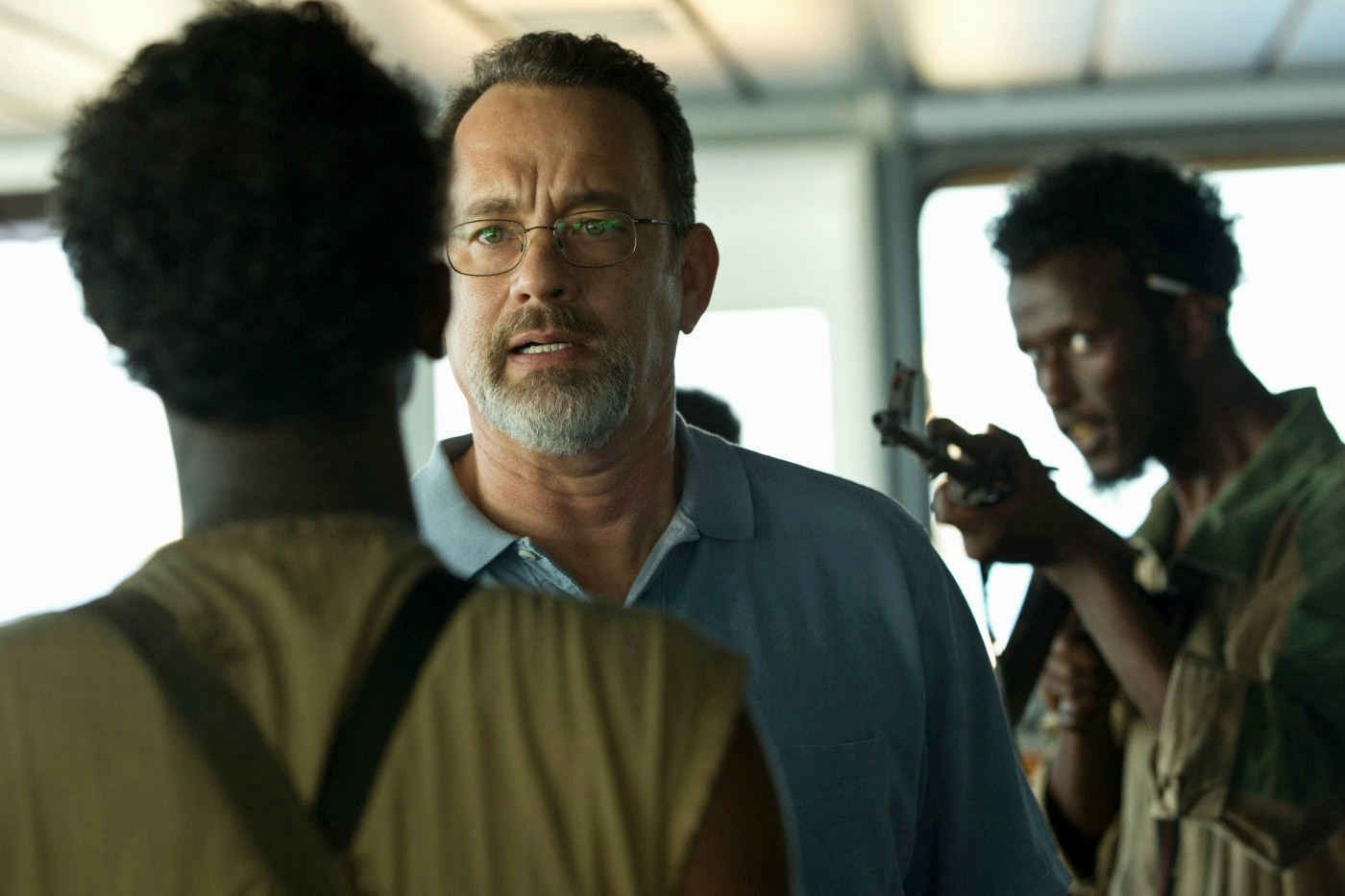
The Alabama crew signals the Navy, who promptly sends out the big guns, three heavily armed warships, that eventually catch up to and surround the lifeboat. Phillips knows what the pirates don’t: there’s no way the American Navy will let them make landfall. They’ll kill Phillips in the process of stopping them if need be, because, after all, we don’t negotiate with terrorists. Thankfully, it doesn’t come to that…for Phillips at least. A group of Navy Seals determine the layout of the lifeboat and Captain Phillips’ location in it. Navy commanders fool Muse into participating in negotiations with the American government and Somali tribal leaders. After several tense hours, Navy Seals kill the three pirates in the lifeboat and rescue Captain Phillips.
Like nearly all of his films, director Paul Greengrass gives us another narrative that moves relentlessly forward, no small feat given the fact that the main characters spend most of their time trapped in a small lifeboat. Yet this time in confined spaces gives him the ability to ramp up the emotional impact of the narrative by strengthening the bonds both between the characters themselves and with the audience. The film benefits from stellar performances from its two leads, Hanks and Abdi. Hanks turns in one of his best roles so far as the everyman who survives great trauma. The final minutes’ of his performance are worthy of any Oscar consideration that will surely come his way. A newcomer to the big screen, Abdi is every bit as equal to the task. He plays Muse as a tough but gentle soul who seems to be wrapped up in mob mentality, borne away on a wave of hopelessness that breeds violence. His inability to recognize both the failure of his efforts to take over the Alabama and his ultimate deception by the Navy is heartbreaking.
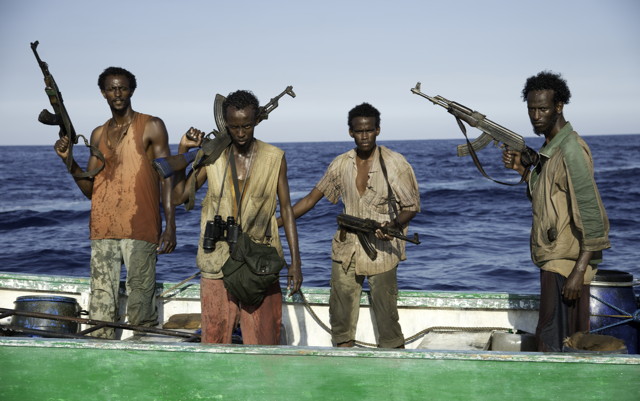
If Captain Phillips muddles the facts of the event, perhaps it is because it is focused on doing something else, namely revealing the tensions and disparities between the First and Third Worlds. When Phillips confronts Muse about his choice of occupation (pirate), Muse tells him it’s either that or a fisherman. Unfortunately, Western fishing conglomerates’ over-fishing leaves coastal Africans with precious little natural resources on which to live. If you’ve watched any of the recent nature documentary series, you’ll know this is having negative effects on the larger environment as well. When you’re faced with precious few career choices, piracy might be a viable option, even if, as Muse and Bilal’s situation suggests, you have to report to less than generous authorities.
The film does a fine job of not over-playing its political hand and, instead, focuses its attention on more intimate, personal relationships, particularly the fragile connection that develops between Captain Phillips and Muse. There is no grandstanding here, but rather honest, highly emotional human interaction. It is clear that Captain Phillips cares for his captors and wishes them no harm. He tries and tries to present Muse and Bilal with ways out, but they stubbornly refuse to take them. When the Navy Seals finally kill Captain Phillips’ three captors, he weeps openly for both them and, no doubt, out of relief over being rescued.
As the film draws to a close, it raises several moral and ethical questions with which we continually wrestle. What is the value of human life? How much does the American government truly value it? Are some lives worth more than others? In many ways, the conversations that revolve around these questions are far more complicated than they need to be. Yet, Captain Phillips is that rare film that refuses simple caricatures of good and evil and forces us to question American economic and military presence abroad.
Captain Phillips (134 mins.) is rated PG-13 for sustained intense sequences of menace, some violence with bloody images, and for substance use and is in theaters everywhere.
Previous Post

October 16, 2013
A 'Glee' Farewell to a Fallen Hero
Next Post

October 22, 2013 Duck Dynasty Blog #9 “Going Si-Ral"
Browse Our Archives
Select a Category Classics DVD Film Music News Pop Culture Events Print Sports Television Uncategorized Video Games
Select a Month March 2017 February 2017 January 2017 December 2016 November 2016 October 2016 September 2016 August 2016 July 2016 June 2016 May 2016 April 2016 March 2016 February 2016 January 2016 December 2015 November 2015 October 2015 September 2015 August 2015 July 2015 June 2015 May 2015 April 2015 March 2015 February 2015 January 2015 December 2014 November 2014 October 2014 September 2014 August 2014 July 2014 June 2014 May 2014 April 2014 March 2014 February 2014 January 2014 December 2013 November 2013 October 2013 September 2013 August 2013 July 2013 June 2013 May 2013 April 2013 March 2013 February 2013 January 2013 December 2012 November 2012 October 2012 September 2012 August 2012 July 2012 June 2012 May 2012 April 2012 March 2012 February 2012 January 2012 December 2011 November 2011 October 2011 September 2011 August 2011 July 2011 June 2011 May 2011 April 2011 March 2011 February 2011 January 2011 December 2010 November 2010 October 2010 September 2010 August 2010 July 2010 June 2010 May 2010 April 2010 March 2010 February 2010 January 2010 December 2009 November 2009 October 2009 September 2009 August 2009 July 2009 June 2009 May 2009 April 2009 March 2009 February 2009 January 2009 December 2008 November 2008 October 2008 September 2008 August 2008 July 2008 June 2008 May 2008 April 2008 March 2008 February 2008 January 2008 December 2007 November 2007 October 2007 September 2007 August 2007 July 2007 June 2007 May 2007 April 2007 March 2007
Follow Us!
TAKE THE
Religious Wisdom Quiz
How did Job's life end according to the book?
Select your answer to see how you score.
He lived many more years and prospered He became a king He died in misery He went to Egypt
Related posts from Pop Theology


At SXSW2017: May It Last: A Portrait of...

At SXSW 2017: "Untold Tales of Armistead Maupin"
TRENDING AT PATHEOS Progressive Christian

Why Christians Have a Sacred Duty to Vote:...
The Bible offers strong support for the sacred duty to vote. Here...

What Being a Modern-Day Apostle Means to Me
In my last column, I discussed the ins and outs of modern-day...

Did Ancient China Once Worship the God of...
Across human history, a common thread weaves through the origins of the...

Love Your Neighbor – Including Earth-Kin: Lev. 19,...
God’s command to love your neighbor means acting in an ethical and...

Lead a Church Study of “Jesus and Lao...
Guest writer Jack Thomas (The Irreverent Reverend) reflects on leading his church...

Principles for Understanding the Apostolic Ministry Today
Whenever people discover that my formal ministry title is "apostle," as in...
view all Progressive Christian blogs
Ad-Free & Subscriber Log-In Subscription Support
- About Us
- 2026 Calendar
- Videos
- Podcasts
- Library of World Religions
- Faith In Media Tracker
- Advertise With Us
- Write for Us
- Privacy Policy
- Terms of Service
- Do Not Sell My Data
- Contact Us
- Radiant Digital
- Manage Newsletter Subscriptions
- Unsubscribe From Notifications
- Sitemap
Copyright 2008-2026, Patheos. All rights reserved.
Subscription Support Ad-Free & Subscriber Log-In
Follow Patheos