
BuddhistCatholicContemplativeEvangelicalGeneral ChristianHinduJewishLatter-day SaintMuslimNew VisionsProgressive Christian
Beliefs
- Buddhist
- Catholic
- Contemplative
- Evangelical
- General Christian
- Hindu
- Jewish
- Latter-day Saint
- More Voices
- Muslim
- New Visions
- Pagan
- Progressive Christian
Topics
- Religion News
- Food and Religion
- Sports and Religion
- Religious Art
- Religious Music and Entertainment
- Religious Events
- History and Religion
- Style and Religion
- Politics and Religion
- Women in Religion
- Recreation Outdoors and Religion
- Business Finance and Religion
- Careers Workplace and Religion
- Education and Religion
- Family Parenting and Religion
- Health Fitness and Religion
- Home and Religion
- Relationships and Religion
- Technology and Religion
- Travel and Religion
Columnists
- Buddhist Columnists
- Business Finance and Religion Columnists
- Careers Workplace and Religion Columnists
- Catholic Columnists
- Contemplative Columnists
- Education and Religion Columnists
- Evangelists Columnists
- Family Parenting and Religion Columnists
- General Christian Columnists
- Health Fitness and Religion Columnists
- Hindu Columnists
- History and Religion Columnists
- Home and Religion Columnists
- Jewish Columnists
- More Voices Columnists
- Latter Day Columnists
- Muslim Columnists
- New Visions Columnists
- Nonreligious Columnists
- Pagan Columnists
- Politics and Religion Columnists
- Progressive Columnists
- Recreation Outdoors and Religion Columnists
- Relationships and Religion Columnists
- Religion News Columnists
- Religious Art Columnists
- Religious Events Columnists
- Religious Music and Entertainment Columnists
- Sports and Religion Columnists
- Style and Religion Columnists
- Technology and Religion Columnists
- Travel and Religion Columnists
- Women in Religion Columnists
Resource Library
- 2026 Calendar
- Library of World Religions
- The 100 Most Holy Places on Earth
- Patheos Answers
- Podcasts
- Videos
- Faith Leaders Database
- Anglican Episcopalian
- Bahai
- Baptist
- Buddhism
- Christianity
- Confucianism
- Eastern Orthodoxy
- Hinduism
- Holiness and Pentecostal
- ISKCON
- Islam
- Judaism
- Lutheran
- Methodist
- The Church of Jesus Christ of Latter-day Saints
- New Age
- Paganism
- Presbytarian and Reformed
- Protestantism
- Religion Behind the Scenes
- Roman Catholic
- Scientology
- Shia Islam
- Sikhism
- Sufism
- Sunni Islam
- Taoism
- Zen
- See all religions
Research Tools
 Ad-Free & Subscriber Log-In Subscription Support
Ad-Free & Subscriber Log-In Subscription Support
Follow Patheos 

- Trending:
- Forgiveness
- |
- Marriage
- |
- Consciousness
- |
- Death Penalty
- |
- Election
- |
- Halloween
 Pop Theology
- Home
- Progressive Christian
- Religious Music & Entertainment
- 12 Years a Slave: Review
12 Years a Slave: Review
Last updated on: October 14, 2013 at 12:53 pm by J. Ryan Parker
12 Years a Slave: Review 2013-10-14T12:53:22-07:00 J. Ryan Parker
Patheos Explore the world's faith through different perspectives on religion and spirituality! Patheos has the views of the prevalent religions and spiritualities of the world.
In his first three feature films, Steve McQueen has addressed an infamous prison hunger strike, sexual addiction, and slavery in the American South. Like his first two films, Hunger and Shame, 12 Years a Slave (releasing Friday, 10/18) juxtaposes beautiful cinematography with horrific human behavior. The result is a demanding viewing experience that must be seen.
12 Years a Slave is one of the few slave narrative films to focus on the reality of free black citizens who were kidnapped and sold into slavery. Solomon Northup (Chiwitel Ejiofor) is a free black man living in Saratoga with his wife Anne (Kelsey Scott) and two children, Margaret and Alonzo. When his wife goes away for work and takes the two children with her, he accepts a short-term job as a musician for a traveling carnival (he’s a talented violin player). He goes to Washington, D.C., where he plays for a week. On his final night in the city, his employers take him out and get him drunk. He wakes up the next morning chained in a cell and, a few days later, is sold to slave trader Theophilus Freeman (Paul Giamatti), who promptly changes his name to Platt and sells him to plantation owner William Ford (Benedict Cumberbatch).
Ford is a “kind” slave-owner, but his foreman/overseer, John Tibeats (Paul Dano), is a dangerous combination of ignorance and malice. When Platt can take no more of Tibeats’ mistreatment, he physically attacks him. In order to protect Platt, Ford sends him to transfers him to another plantation, owned by Edwin Epps (Michael Fassbender). Unfortunately for Platt, Epps prides himself on his ability to break even the most disobedient slaves. Epps swings back and forth between moments of bombastic religious fervor and violent alcoholic benders, but his hatred and abuse of his slaves never wavers. In fact, his conniving wife Mistress Epps (Sarah Paulson) fuel his fire as she (rightly) suspects that Epps has sex with some of his slaves. Throughout his twelve-year ordeal as a slave, Platt witnesses and experiences the brutalities of the slave system: separated families, physical and verbal abuse, religious exploitation, oppressive work and living conditions, torture, and the list grows mercilessly. Platt toils away under Epps’ harsh rule until an itinerant laborer and abolitionist, Bass (Brad Pitt), agrees to contact his friends in New York, who eventually come to his rescue, free him, and reunite him with his family.

Benedict Cumberbatch as the “kindly” slaveowner Ford and Chiwitel Ejiofor as Platt/Solomon.
There are numerous angles from which to approach 12 Years a Slave for a discussion of its theological and/or religious implications. My friend Bo Sanders will be writing about the film for Homebrewed Christianity, and the two of us partnered together on a podcast devoted to the film that we will post later this week. Here, I just want to highlight a couple of important elements of the film as a film and its function as a site of both memory and theological conversation.
12 Years a Slave benefits from fantastic performances throughout, but especially from Ejiofor, Fassbender, Paulson, and Dano. Again, McQueen’s combination of cinematography and staging create truly unforgettable images. Hans Zimmer’s score is appropriately haunting and reminiscent of Johnny Greenwood’s work in There Will Be Blood. Joe Walker’s editing frequently results in brilliant transitions and prophetic overlaps that condemn not only the practice of slavery, but Christianity’s role in it. Yet a narrative like 12 Years a Slave demands a director as fierce and fearless as McQueen. Like Hunger (and I as I’ve heard about Shame), McQueen refuses to look away from the disturbing and the horrific, which in the hands of some directors would be gratuitous. The violence and disturbing imagery in 12 Years a Slave is never that. In fact, I would argue that it could have been worse. Rather than cutting away from or aestheticizing scenes of abuse and torture, McQueen forces us to watch as whips tear and fists pound flesh.

Sarah Paulson as the vile Mistress Epps and Lupita Nyong’o as the brutalized Patsey.
One particular scene demands attention. When Platt lashes out at Tibeats, the overseer gets one of his cronies to help him hang him. Another overseer stops them in the middle of the act, leaving Platt in a perilous position, half-hung with the rope straining at his neck and his toes reaching for solid footing in the muddy soil. Platt is forced to stay that way all day until Ford arrives and cuts him down. McQueen lets this scene run for several minutes, with nothing but the sound of nature, slaves at work or play, and Solomon choking to accompany this disturbing image. As much as the violence that slaves had to endure, this scene reveals the psychological abuse and transformation they underwent. None of the slaves would cut him down for fear of retribution.
This psychological torture lies at the heart of Platt’s experience as he attempts to hold on to hope and not sink into despair. He does this by vehemently clinging to his true identity as Solomon and not his slave identity of Platt. This struggle begins to get at a central theological component of 12 Years a Slave, particularly the reality that, often, theology is anthropology and vice versa. Who Solomon Northup is as a free man and who Solomon Northup is as Platt the Slave shapes our understanding of who God is. If Solomon is a free man, then to be human and a child of God is not determined by race (and, we could add, by any other “obvious” identifier). God is a loving God who embraces all of God’s creation. On the other hand, if Platt is a slave to be bought, sold, and abused, then he is certainly less than human and loved less by God. In this chilling scenario, Epps is God, and God is Epps.
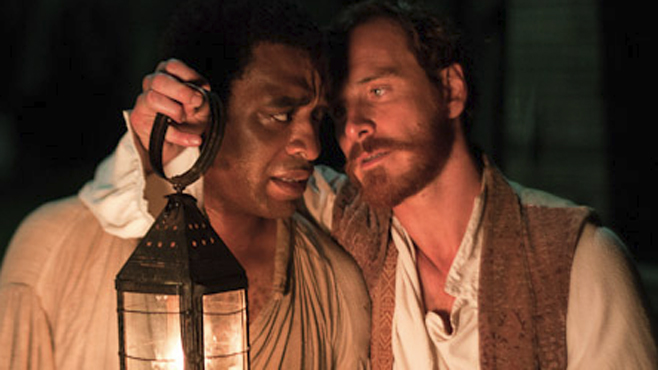
One of the film’s most unnerving moments in which Epps (Michael Fassbender) thinks he has uncovered Platt’s plans to escape.
The brutal Epps simultaneously reveals the ways in which slavers used religion to justify their system of oppression. He hypocritically uses “slaves obey your masters” scripture passages to keep his “property” in line while simultaneously disobeying his master by getting drunk and raping his slave Patsey (Lupita Nyong’o), all under the watchful eye of his wife. Epps is a warning for any of us tempted to use scripture to referee identity politics. Unfortunately, Epps has no equal “religious foe” in the sense of an abolitionist fueled by religious conviction. What we have instead is Bass’ “to-the-rescue” humanism, which, rather than providing a moment of historical insight, raises more questions. Who is this character and what are his motivations? We all don’t see examples of the ways in which slaves initiated their own religious experiences and how these helped them endure their brutal existence.
Another theological impact of 12 Years a Slave is to consider film as a site of memory, which asserts that memories and the act of remembering have broader implications. If we consider films as diverse as Roots, The Color Purple, Amazing Grace, Lincoln, and 12 Years a Slave, we are implicitly being asked to remember in a variety of different ways. While all of these films are important in their own way, I would argue that McQueen is forcing us to remember in vastly more complex ways than Spielberg, for example. McQueen’s juxtaposition of beautiful cinematography with an unflinching attention to the brutalities of slavery creates an unforgettable, haunting film that forces us to once again re-examine both our past and present. McQueen’s daring, challenging film is a must-see for everyone (of the appropriate age, of course), but especially for people who claim the Christian faith.
12 Years a Slave (123 mins.) is rated R for violence/cruelty, some nudity and brief sexuality and will be in theaters Friday, 10/18.
Previous Post

October 13, 2013
Guillermo del Toro's House of Horror
Next Post

October 16, 2013 A 'Glee' Farewell to a Fallen Hero
Browse Our Archives
Select a Category Classics DVD Film Music News Pop Culture Events Print Sports Television Uncategorized Video Games
Select a Month March 2017 February 2017 January 2017 December 2016 November 2016 October 2016 September 2016 August 2016 July 2016 June 2016 May 2016 April 2016 March 2016 February 2016 January 2016 December 2015 November 2015 October 2015 September 2015 August 2015 July 2015 June 2015 May 2015 April 2015 March 2015 February 2015 January 2015 December 2014 November 2014 October 2014 September 2014 August 2014 July 2014 June 2014 May 2014 April 2014 March 2014 February 2014 January 2014 December 2013 November 2013 October 2013 September 2013 August 2013 July 2013 June 2013 May 2013 April 2013 March 2013 February 2013 January 2013 December 2012 November 2012 October 2012 September 2012 August 2012 July 2012 June 2012 May 2012 April 2012 March 2012 February 2012 January 2012 December 2011 November 2011 October 2011 September 2011 August 2011 July 2011 June 2011 May 2011 April 2011 March 2011 February 2011 January 2011 December 2010 November 2010 October 2010 September 2010 August 2010 July 2010 June 2010 May 2010 April 2010 March 2010 February 2010 January 2010 December 2009 November 2009 October 2009 September 2009 August 2009 July 2009 June 2009 May 2009 April 2009 March 2009 February 2009 January 2009 December 2008 November 2008 October 2008 September 2008 August 2008 July 2008 June 2008 May 2008 April 2008 March 2008 February 2008 January 2008 December 2007 November 2007 October 2007 September 2007 August 2007 July 2007 June 2007 May 2007 April 2007 March 2007
Follow Us!
TAKE THE
Religious Wisdom Quiz
True or False: Hebrews teaches that Jesus is the same yesterday, today, and forever.
Select your answer to see how you score.
FALSE TRUE
Related posts from Pop Theology


At SXSW2017: May It Last: A Portrait of...

At SXSW 2017: "Untold Tales of Armistead Maupin"
TRENDING AT PATHEOS Progressive Christian

Why Christians Have a Sacred Duty to Vote:...
The Bible offers strong support for the sacred duty to vote. Here...

What Being a Modern-Day Apostle Means to Me
In my last column, I discussed the ins and outs of modern-day...

Did Ancient China Once Worship the God of...
Across human history, a common thread weaves through the origins of the...

Love Your Neighbor – Including Earth-Kin: Lev. 19,...
God’s command to love your neighbor means acting in an ethical and...

Lead a Church Study of “Jesus and Lao...
Guest writer Jack Thomas (The Irreverent Reverend) reflects on leading his church...

Principles for Understanding the Apostolic Ministry Today
Whenever people discover that my formal ministry title is "apostle," as in...
view all Progressive Christian blogs
Ad-Free & Subscriber Log-In Subscription Support
- About Us
- 2026 Calendar
- Videos
- Podcasts
- Library of World Religions
- Faith In Media Tracker
- Advertise With Us
- Write for Us
- Privacy Policy
- Terms of Service
- Do Not Sell My Data
- Contact Us
- Radiant Digital
- Manage Newsletter Subscriptions
- Unsubscribe From Notifications
- Sitemap
Copyright 2008-2026, Patheos. All rights reserved.
Subscription Support Ad-Free & Subscriber Log-In
Follow Patheos