
BuddhistCatholicContemplativeEvangelicalGeneral ChristianHinduJewishLatter-day SaintMuslimNew VisionsProgressive Christian
Beliefs
- Buddhist
- Catholic
- Contemplative
- Evangelical
- General Christian
- Hindu
- Jewish
- Latter-day Saint
- More Voices
- Muslim
- New Visions
- Pagan
- Progressive Christian
Topics
- Religion News
- Food and Religion
- Sports and Religion
- Religious Art
- Religious Music and Entertainment
- Religious Events
- History and Religion
- Style and Religion
- Politics and Religion
- Women in Religion
- Recreation Outdoors and Religion
- Business Finance and Religion
- Careers Workplace and Religion
- Education and Religion
- Family Parenting and Religion
- Health Fitness and Religion
- Home and Religion
- Relationships and Religion
- Technology and Religion
- Travel and Religion
Columnists
- Buddhist Columnists
- Business Finance and Religion Columnists
- Careers Workplace and Religion Columnists
- Catholic Columnists
- Contemplative Columnists
- Education and Religion Columnists
- Evangelists Columnists
- Family Parenting and Religion Columnists
- General Christian Columnists
- Health Fitness and Religion Columnists
- Hindu Columnists
- History and Religion Columnists
- Home and Religion Columnists
- Jewish Columnists
- More Voices Columnists
- Latter Day Columnists
- Muslim Columnists
- New Visions Columnists
- Nonreligious Columnists
- Pagan Columnists
- Politics and Religion Columnists
- Progressive Columnists
- Recreation Outdoors and Religion Columnists
- Relationships and Religion Columnists
- Religion News Columnists
- Religious Art Columnists
- Religious Events Columnists
- Religious Music and Entertainment Columnists
- Sports and Religion Columnists
- Style and Religion Columnists
- Technology and Religion Columnists
- Travel and Religion Columnists
- Women in Religion Columnists
Resource Library
- 2026 Calendar
- Library of World Religions
- The 100 Most Holy Places on Earth
- Patheos Answers
- Podcasts
- Videos
- Faith Leaders Database
- Anglican Episcopalian
- Bahai
- Baptist
- Buddhism
- Christianity
- Confucianism
- Eastern Orthodoxy
- Hinduism
- Holiness and Pentecostal
- ISKCON
- Islam
- Judaism
- Lutheran
- Methodist
- The Church of Jesus Christ of Latter-day Saints
- New Age
- Paganism
- Presbytarian and Reformed
- Protestantism
- Religion Behind the Scenes
- Roman Catholic
- Scientology
- Shia Islam
- Sikhism
- Sufism
- Sunni Islam
- Taoism
- Zen
- See all religions
Research Tools
 Ad-Free & Subscriber Log-In Subscription Support
Ad-Free & Subscriber Log-In Subscription Support
Follow Patheos 

- Trending:
- Forgiveness
- |
- Marriage
- |
- Consciousness
- |
- Death Penalty
- |
- Election
- |
- Halloween
 Pop Theology
- Home
- Progressive Christian
- Religious Music & Entertainment
- Star Trek: Into Darkness — Boldly Brimming with Bromance and Story
Star Trek: Into Darkness — Boldly Brimming with Bromance and Story
Last updated on: June 14, 2013 at 8:13 pm by Richard Lindsay
Star Trek: Into Darkness — Boldly Brimming with Bromance and Story 2013-06-14T20:13:50-07:00 Richard Lindsay
Patheos Explore the world's faith through different perspectives on religion and spirituality! Patheos has the views of the prevalent religions and spiritualities of the world.
 Continuing the bromance that is PopTheology.com, Ryan and I do a dialogue review for Star Trek: Into Darkness.
Ryan: I think we’ve got a modern day Shakespeare on our hands with J. J. Abrams. Elizabethan parlance lent an artistry to The Bard’s plays that Abrams lacks (and we’ll never have again), but Shakespeare was also a popular entertainer. There are none better than Abrams today, who packages rich, emotional, ethical, philosophical, and political themes in wildly entertaining films. Can you imagine the pitch for Into Darkness?
Abrams: We start with Spock in a volcano and the Enterprise submerged in the ocean.
Studio Head: Great! Done! How much money do you need?
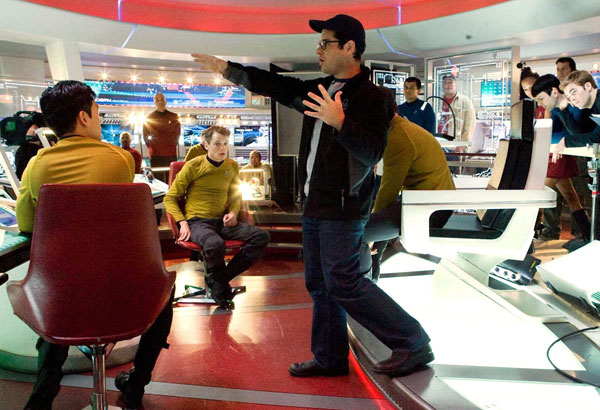
“Star Trek” director J.J. Abrams revives storytelling for the CGI age.
Richard: I agree. Once again J.J. Abrams proves himself to be not just a master of directing special effects, but also story. Perhaps more than any other director working today, he understands that the purpose of popular science fiction is not simply to amaze the senses (which this film does ravishingly) but to teach us something about the human condition.
Under many sci-fi/fantasy directors (especially Christopher Nolan) the title Into Darkness would be an indicator of the color palette and the anti-hero personalities of the major characters. Under a director like Michael Bay (God forbid) the actors would just be highly poseable action figures as the machines did the fighting. Abrams, on the other hand, dares to offer likeable, humanly flawed characters living in the still essentially utopian world of the Starfleet Federation, facing dark times.
Acts of terror, and the approach to searching out the perpetrators and what to do with them once found, are the film’s central ties to our own century’s political and moral dilemmas. The “darkness” of the title is to be found not just in the terrorist (a young Khan, played with singularly English relish by Benedict Cumberbatch), but in the violence and militarization of the state in reaction to that terror (embodied by the pitch-perfectly cast Peter Weller as Admiral Marcus).
A.O. Scott, writing for the New York Times, has lamented the film’s action movie explosiveness at the expense of the Start Trek franchise’s traditional nerdy idealism. As Scott wrote: “Maybe it is too late to lament the militarization of ‘Star Trek,’ but in his pursuit of blockbuster currency, Mr. Abrams has sacrificed a lot of its idiosyncrasy and, worse, the large-spirited humanism that sustained it.”
I found the film to be brimming with ‘large-spirited humanism.’ Abrams and Cumberbatch even managed to humanize Khan, bringing complexity to a character that was mainly a camp figure when played by Ricardo Montalban in Star Trek II. And I can think of no better scene pitting the human against the machine than Kirk’s self-sacrificing kick-starting of the reactor core. This was the true climax of the film (not the admittedly over-the-top fight scene between Spock and Khan) and it didn’t involve a single phaser fired or punch thrown.
Ryan: You bring up the terrorism component of the film, and it’s handled in interesting fashion here which echoes the recent attacks in Boston. That large(r) scale attacks are just as likely to come from Americans (or people who have been living here “for a while”) shouldn’t be a shock to us (remember Oklahoma City) even though in the aftermath of Boston it clearly was for many observers. I’m always a fan of films that critique violent solutions to violent problems and the ethical justifications that accompany them. However, I wonder if the 9/11 motif if a plane (or other airborne vehicle) crashing into a city hasn’t worn out its welcome? Or are filmmakers waiting on the terrorists to make their next move?
Richard: It’s almost like the filmmakers don’t think the terrorists have gone far enough. This summer we’ve had two—count them—two Attack on the White House movies. Post-Boston, however, I could very well see movie writers and directors returning to the small-scale terrorism suspense of something like Phone Booth. Not to poke fun at tragedy, but can you see the final scene as FBI agents storm Bed, Bath & Beyond trying to find the one pressure cooker that’s loaded?
But enough about politics and the philosophy of states, terror, and war. Can we focus on the most important relationship in this movie—Kirk and Spock? “Bromance” does not even begin to describe the love these two have for each other. Supposedly only a few missions into their careers, and already they’re bickering like an old married couple. The looks they exchange—including the “emotionless” Spock—sear the screen with Bogart and Bergman intensity. There is a female love interest for Spock, Uhura, and a sex interest for Kirk, Carol Marcus, daughter of the Admiral. (Somebody explain to me again why she has a British accent?) But as usual in action/buddy films, the women get little actual screen time and undergo little character development. Just like Ben-Hur and Butch Cassidy before them, it’s all about the boys.

In Kirk and Spock, we have a prime example of Eve Kosofsky Sedgwick’s homosocial triangle, in which avoiding the uncomfortable possibility of actual deep feeling—even erotic feeling—between men, forces the male characters to sublimate their feelings in the “safe” third party of a woman. But try as she will, Uhura will never be able to pry free the Vulcan death grip that Spock and Kirk have placed on each others’ hearts.
Ryan: I think you’re right on with the bromance commentary, which is evident in Abrams’ first installment as well. I don’t think it’s been done any cooler or smoother since Butch Cassidy. It’s the ways in which Abrams and writers Roberto Orci, Alex Kurtzman, and Damon Lindelof choose to reveal this through a deft combination of dialogue and action. In one of the most intense moments in the film, when Uhura, Kirk, and Spock are about to land on the Vulcan planet, we have the lovers quarrel between Uhura and Spock and Kirk and Spock. All the while, Spock is demonstrating the lack of feeling about which he is speaking. Just a brilliant combination of writing, directing, and acting.
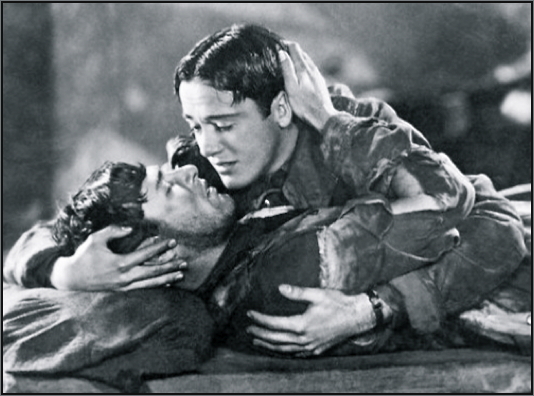
Richard: This kind of action/love scene between men has been going on since the dawn of film. Let us not forget the full-on man-kiss between fighter pilots Buddy Rogers and Richard Arlen at the end of the first Best Picture winner, Wings in 1927. As Clara Bow said of her role in the film: “Wings is a man’s picture and I’m just the whipped cream on top of the pie.”
Previous Post

May 22, 2013
Cooperative Creativity
Next Post

May 28, 2013 Dying in the Glass Closet
Browse Our Archives
Select a Category Classics DVD Film Music News Pop Culture Events Print Sports Television Uncategorized Video Games
Select a Month March 2017 February 2017 January 2017 December 2016 November 2016 October 2016 September 2016 August 2016 July 2016 June 2016 May 2016 April 2016 March 2016 February 2016 January 2016 December 2015 November 2015 October 2015 September 2015 August 2015 July 2015 June 2015 May 2015 April 2015 March 2015 February 2015 January 2015 December 2014 November 2014 October 2014 September 2014 August 2014 July 2014 June 2014 May 2014 April 2014 March 2014 February 2014 January 2014 December 2013 November 2013 October 2013 September 2013 August 2013 July 2013 June 2013 May 2013 April 2013 March 2013 February 2013 January 2013 December 2012 November 2012 October 2012 September 2012 August 2012 July 2012 June 2012 May 2012 April 2012 March 2012 February 2012 January 2012 December 2011 November 2011 October 2011 September 2011 August 2011 July 2011 June 2011 May 2011 April 2011 March 2011 February 2011 January 2011 December 2010 November 2010 October 2010 September 2010 August 2010 July 2010 June 2010 May 2010 April 2010 March 2010 February 2010 January 2010 December 2009 November 2009 October 2009 September 2009 August 2009 July 2009 June 2009 May 2009 April 2009 March 2009 February 2009 January 2009 December 2008 November 2008 October 2008 September 2008 August 2008 July 2008 June 2008 May 2008 April 2008 March 2008 February 2008 January 2008 December 2007 November 2007 October 2007 September 2007 August 2007 July 2007 June 2007 May 2007 April 2007 March 2007
Follow Us!
TAKE THE
Religious Wisdom Quiz
Elisha purified a pot of stew that had been poisoned with what?
Select your answer to see how you score.
Arsenic Wild Gourds Wild Mushrooms Bad Cheese
Related posts from Pop Theology


At SXSW2017: May It Last: A Portrait of...

At SXSW 2017: "Untold Tales of Armistead Maupin"
TRENDING AT PATHEOS Progressive Christian

Why Christians Have a Sacred Duty to Vote:...
The Bible offers strong support for the sacred duty to vote. Here...

What Being a Modern-Day Apostle Means to Me
In my last column, I discussed the ins and outs of modern-day...

Did Ancient China Once Worship the God of...
Across human history, a common thread weaves through the origins of the...

Love Your Neighbor – Including Earth-Kin: Lev. 19,...
God’s command to love your neighbor means acting in an ethical and...

Lead a Church Study of “Jesus and Lao...
Guest writer Jack Thomas (The Irreverent Reverend) reflects on leading his church...

Principles for Understanding the Apostolic Ministry Today
Whenever people discover that my formal ministry title is "apostle," as in...
view all Progressive Christian blogs
Ad-Free & Subscriber Log-In Subscription Support
- About Us
- 2026 Calendar
- Videos
- Podcasts
- Library of World Religions
- Faith In Media Tracker
- Advertise With Us
- Write for Us
- Privacy Policy
- Terms of Service
- Do Not Sell My Data
- Contact Us
- Radiant Digital
- Manage Newsletter Subscriptions
- Unsubscribe From Notifications
- Sitemap
Copyright 2008-2026, Patheos. All rights reserved.
Subscription Support Ad-Free & Subscriber Log-In
Follow Patheos