
BuddhistCatholicContemplativeEvangelicalGeneral ChristianHinduJewishLatter-day SaintMuslimNew VisionsProgressive Christian
Beliefs
- Buddhist
- Catholic
- Contemplative
- Evangelical
- General Christian
- Hindu
- Jewish
- Latter-day Saint
- More Voices
- Muslim
- New Visions
- Pagan
- Progressive Christian
Topics
- Religion News
- Food and Religion
- Sports and Religion
- Religious Art
- Religious Music and Entertainment
- Religious Events
- History and Religion
- Style and Religion
- Politics and Religion
- Women in Religion
- Recreation Outdoors and Religion
- Business Finance and Religion
- Careers Workplace and Religion
- Education and Religion
- Family Parenting and Religion
- Health Fitness and Religion
- Home and Religion
- Relationships and Religion
- Technology and Religion
- Travel and Religion
Columnists
- Buddhist Columnists
- Business Finance and Religion Columnists
- Careers Workplace and Religion Columnists
- Catholic Columnists
- Contemplative Columnists
- Education and Religion Columnists
- Evangelists Columnists
- Family Parenting and Religion Columnists
- General Christian Columnists
- Health Fitness and Religion Columnists
- Hindu Columnists
- History and Religion Columnists
- Home and Religion Columnists
- Jewish Columnists
- More Voices Columnists
- Latter Day Columnists
- Muslim Columnists
- New Visions Columnists
- Nonreligious Columnists
- Pagan Columnists
- Politics and Religion Columnists
- Progressive Columnists
- Recreation Outdoors and Religion Columnists
- Relationships and Religion Columnists
- Religion News Columnists
- Religious Art Columnists
- Religious Events Columnists
- Religious Music and Entertainment Columnists
- Sports and Religion Columnists
- Style and Religion Columnists
- Technology and Religion Columnists
- Travel and Religion Columnists
- Women in Religion Columnists
Resource Library
- 2026 Calendar
- Library of World Religions
- The 100 Most Holy Places on Earth
- Patheos Answers
- Podcasts
- Videos
- Faith Leaders Database
- Anglican Episcopalian
- Bahai
- Baptist
- Buddhism
- Christianity
- Confucianism
- Eastern Orthodoxy
- Hinduism
- Holiness and Pentecostal
- ISKCON
- Islam
- Judaism
- Lutheran
- Methodist
- The Church of Jesus Christ of Latter-day Saints
- New Age
- Paganism
- Presbytarian and Reformed
- Protestantism
- Religion Behind the Scenes
- Roman Catholic
- Scientology
- Shia Islam
- Sikhism
- Sufism
- Sunni Islam
- Taoism
- Zen
- See all religions
Research Tools
 Ad-Free & Subscriber Log-In Subscription Support
Ad-Free & Subscriber Log-In Subscription Support
Follow Patheos 

- Trending:
- Forgiveness
- |
- Marriage
- |
- Consciousness
- |
- Death Penalty
- |
- Election
- |
- Halloween
 Pop Theology
- Home
- Progressive Christian
- Religious Music & Entertainment
- Eat of My Flesh
Eat of My Flesh
Last updated on: May 20, 2013 at 9:46 am by J. Ryan Parker
Eat of My Flesh 2013-05-20T09:46:58-07:00 J. Ryan Parker
Patheos Explore the world's faith through different perspectives on religion and spirituality! Patheos has the views of the prevalent religions and spiritualities of the world.
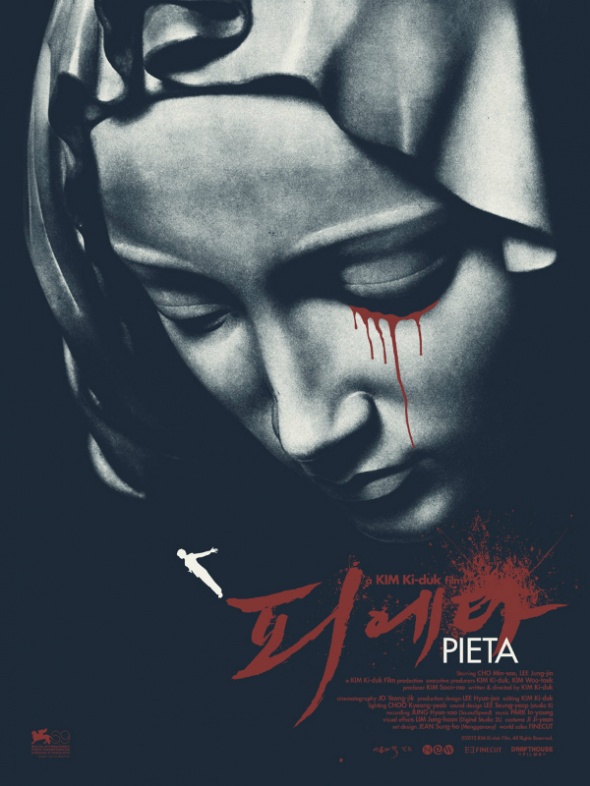
Pieta conjures up many beautiful artistic images of Mary cradling the dead body of Jesus, the most familiar of which is undoubtedly Michelangelo’s sculpture, Pieta. In fact, the poster for Korean filmmaker Kim Ki-duk‘s latest film, Pieta, employs the face of Mary from that very sculpture with a dash of blood, which points to its violent narrative. The disturbing scenes in Ki-duk’s film (and there are many) are haunting images that comprise a larger cinematic whole that delves deeply into Christian themes of sin, forgiveness, and redemption.
Pieta opens on a quick scene of a most unusual suicide followed by a woman’s terrified scream. It then cuts to a scene of a young man, Lee Kan-do (Lee Jeong-jin), masturbating in bed. He receives a text message, a picture of another man. He pays a visit to this man, and we quickly learn that Kang-do is the muscle behind a small-time loan shark. Needy small business owners borrow money at extreme interest, and when they cannot pay up, Kang-do “cripples” them and takes the payout from an insurance policy they signed upon agreeing to the loan. He is good at his job, which means he is unforgiving, quiet, and ruthless.
Things go smoothly for Kang-do until a mysterious woman, Mi-Son (Jo Min-soo) approaches him in an alley and says that she is the mother who abandoned him at birth. She sets about trying to participate in his life as if to make up for lost time. In the process, she defines persistence as she washes his dishes, buys him food, and cooks for him. Kang-do is reluctant to embrace her and verbally and physically abuses her. He eventually puts her through truly nauseating (to the audience) tests to prove her motherhood. When she “passes,” the two reconnect and wander around the city doing normal parent/child things. However, we soon realize that all is not as it seems, and one of Kang-do’s past assignments comes back to terrorize him, repaying the violence that he so mercilessly meted out before.
Writer/director Ki-duk has given audiences, simultaneously, a profoundly political and deeply intimate film. Though the two are closely intertwined, it will suffice to consider them separately. Kang-do is the “muscle” for a loan shark who provides money for small business owners attempting to make it on their own in the face of a surging wave of capitalism and urban expansion. High rises are fast approaching the slums. These small business will not only be literally crippled by Kang-do, but they will ultimately be leveled and displaced by the larger corporations that lay waste to their storage-shed operations. Ki-duk seems to be asking us who’s the worse criminal, the invading businesses or the loan shark? At least Kang-do and his employer let the shopkeepers keep their way of life, even if it is more difficult to work after Kang-do pays them a visit.
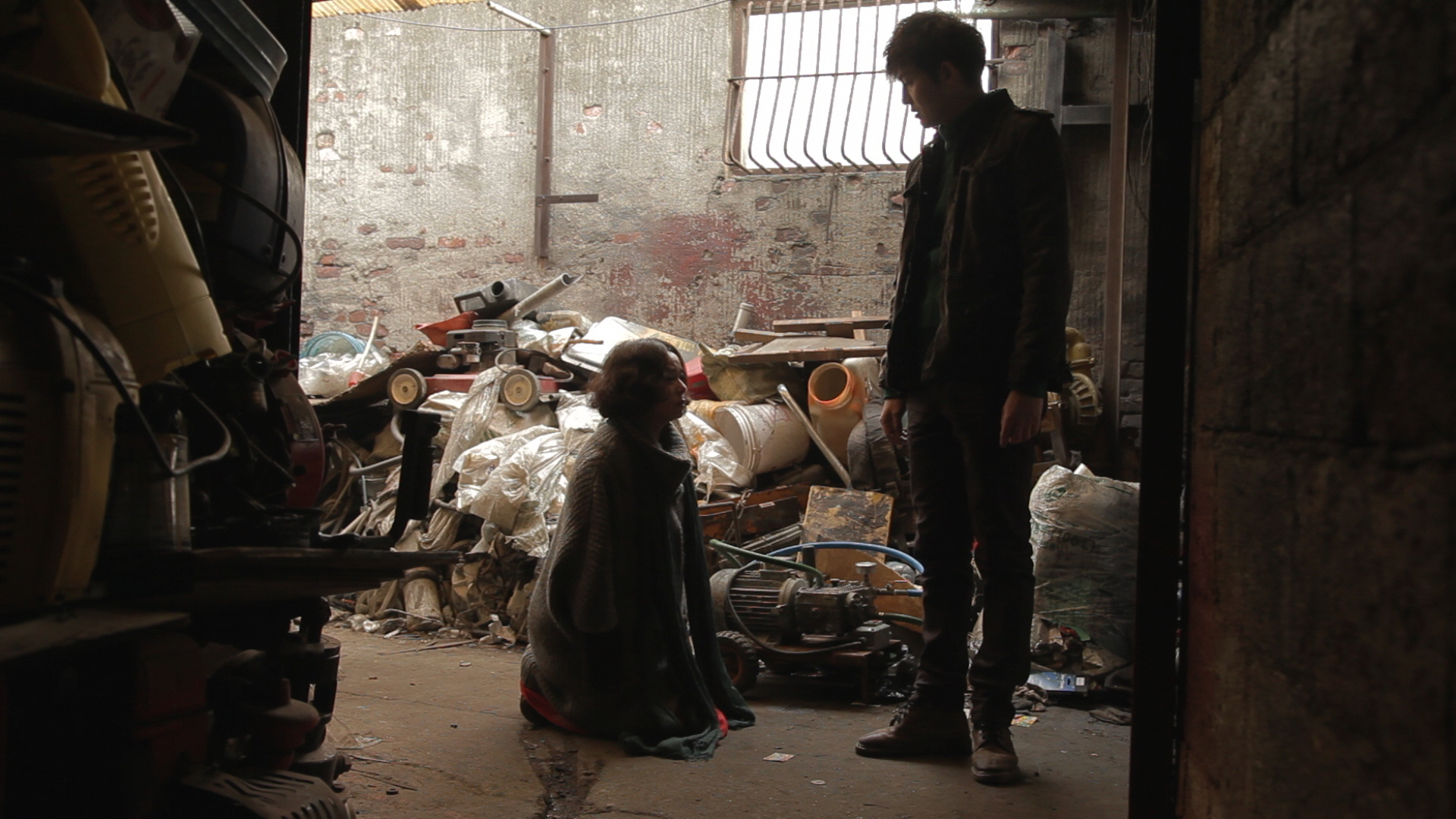
Mi-Son humbly begs to be a part of Kang-do’s life.
The personal element of Pieta is far more disturbing and challenging. There are troubling sexual and violent images here to be sure, which frustrate the possibility of forgiveness that Ki-duk holds out for Kang-do. There is, at least, a definite visual Christian framework that Ki-duk establishes very early in the film. After Kang-do finishes masturbating in the first scene in which we meet him, Ki-duk cuts to an exterior shot of a store-front church next door that features a cross and a sign that reads, “Hallelujah Forever.” Ki-duk occasionally cuts to this cross throughout the rest of the film, as if reminding readers of the spiritual and theological stakes of the narrative. It might also be a nod to the growing presence of Christianity in the region.
Mi-Son’s presence in Kang-do’s life (SPOILER though ultimately an act of revenge END SPOILER), serves a divine function. She is the catalyst that causes him to reassess his life’s work, that allows him to eventually show mercy to a customers who default on their loans (ANOTHER SPOILER although is would-be victims, for profound reasons, are happy to undertake his work themselves END SPOILER). She might literally be the most haunting “hound of heaven,” we’ve ever seen in film. The relationship between the two, as disturbing as it is, raises a profound question. Reviewing the film for NPR, Keith Phipps asks, “What does it mean to practice virtue in the service of a faith that can never be verified — one that might even be misplaced?”

Writer/director Ki-duk suggests that, as violent as he may be, Kang-do might not be beyond forgiveness.
It takes a real talent to balance the disturbing and offensive with the tender and sweet, but Ki-duk pulls it off brilliantly. Ki-duk shows masterful restraint with violence, forcing us to imagine what takes place rather than showing us. The cinematography helps add balance the grotesque with the beautiful. It’s hard to think of two other actors doing a better job than Lee Jeong-jin and Jo Min-soo, who themselves are not only beautiful people but capture the subtleties of each charter in ways that add layers to what could have easily just been another revenge fantasy. At the end, Ki-duk leaves us with as haunting (and hopeful?) a conclusion as we’re ever likely to see.
Pieta (104 mins.) contains scenes of gruesome violence and truly disturbing sexuality. It is in limited theatrical release and available to rent or buy on iTunes. Not for the faint of heart.
Previous Post

May 14, 2013
Iron Man 3 and Mud
Next Post
May 22, 2013 Cooperative Creativity
Browse Our Archives
Select a Category Classics DVD Film Music News Pop Culture Events Print Sports Television Uncategorized Video Games
Select a Month March 2017 February 2017 January 2017 December 2016 November 2016 October 2016 September 2016 August 2016 July 2016 June 2016 May 2016 April 2016 March 2016 February 2016 January 2016 December 2015 November 2015 October 2015 September 2015 August 2015 July 2015 June 2015 May 2015 April 2015 March 2015 February 2015 January 2015 December 2014 November 2014 October 2014 September 2014 August 2014 July 2014 June 2014 May 2014 April 2014 March 2014 February 2014 January 2014 December 2013 November 2013 October 2013 September 2013 August 2013 July 2013 June 2013 May 2013 April 2013 March 2013 February 2013 January 2013 December 2012 November 2012 October 2012 September 2012 August 2012 July 2012 June 2012 May 2012 April 2012 March 2012 February 2012 January 2012 December 2011 November 2011 October 2011 September 2011 August 2011 July 2011 June 2011 May 2011 April 2011 March 2011 February 2011 January 2011 December 2010 November 2010 October 2010 September 2010 August 2010 July 2010 June 2010 May 2010 April 2010 March 2010 February 2010 January 2010 December 2009 November 2009 October 2009 September 2009 August 2009 July 2009 June 2009 May 2009 April 2009 March 2009 February 2009 January 2009 December 2008 November 2008 October 2008 September 2008 August 2008 July 2008 June 2008 May 2008 April 2008 March 2008 February 2008 January 2008 December 2007 November 2007 October 2007 September 2007 August 2007 July 2007 June 2007 May 2007 April 2007 March 2007
Follow Us!
TAKE THE
Religious Wisdom Quiz
Who was thrown into a den of lions for praying?
Select your answer to see how you score.
Paul Daniel Andrew Peter
Related posts from Pop Theology


At SXSW2017: May It Last: A Portrait of...

At SXSW 2017: "Untold Tales of Armistead Maupin"
TRENDING AT PATHEOS Progressive Christian

Why Christians Have a Sacred Duty to Vote:...
The Bible offers strong support for the sacred duty to vote. Here...

What Being a Modern-Day Apostle Means to Me
In my last column, I discussed the ins and outs of modern-day...

Did Ancient China Once Worship the God of...
Across human history, a common thread weaves through the origins of the...

Love Your Neighbor – Including Earth-Kin: Lev. 19,...
God’s command to love your neighbor means acting in an ethical and...

Lead a Church Study of “Jesus and Lao...
Guest writer Jack Thomas (The Irreverent Reverend) reflects on leading his church...

Principles for Understanding the Apostolic Ministry Today
Whenever people discover that my formal ministry title is "apostle," as in...
view all Progressive Christian blogs
Ad-Free & Subscriber Log-In Subscription Support
- About Us
- 2026 Calendar
- Videos
- Podcasts
- Library of World Religions
- Faith In Media Tracker
- Advertise With Us
- Write for Us
- Privacy Policy
- Terms of Service
- Do Not Sell My Data
- Contact Us
- Radiant Digital
- Manage Newsletter Subscriptions
- Unsubscribe From Notifications
- Sitemap
Copyright 2008-2026, Patheos. All rights reserved.
Subscription Support Ad-Free & Subscriber Log-In
Follow Patheos