
BuddhistCatholicContemplativeEvangelicalGeneral ChristianHinduJewishLatter-day SaintMuslimNew VisionsProgressive Christian
Beliefs
- Buddhist
- Catholic
- Contemplative
- Evangelical
- General Christian
- Hindu
- Jewish
- Latter-day Saint
- More Voices
- Muslim
- New Visions
- Pagan
- Progressive Christian
Topics
- Religion News
- Food and Religion
- Sports and Religion
- Religious Art
- Religious Music and Entertainment
- Religious Events
- History and Religion
- Style and Religion
- Politics and Religion
- Women in Religion
- Recreation Outdoors and Religion
- Business Finance and Religion
- Careers Workplace and Religion
- Education and Religion
- Family Parenting and Religion
- Health Fitness and Religion
- Home and Religion
- Relationships and Religion
- Technology and Religion
- Travel and Religion
Columnists
- Buddhist Columnists
- Business Finance and Religion Columnists
- Careers Workplace and Religion Columnists
- Catholic Columnists
- Contemplative Columnists
- Education and Religion Columnists
- Evangelists Columnists
- Family Parenting and Religion Columnists
- General Christian Columnists
- Health Fitness and Religion Columnists
- Hindu Columnists
- History and Religion Columnists
- Home and Religion Columnists
- Jewish Columnists
- More Voices Columnists
- Latter Day Columnists
- Muslim Columnists
- New Visions Columnists
- Nonreligious Columnists
- Pagan Columnists
- Politics and Religion Columnists
- Progressive Columnists
- Recreation Outdoors and Religion Columnists
- Relationships and Religion Columnists
- Religion News Columnists
- Religious Art Columnists
- Religious Events Columnists
- Religious Music and Entertainment Columnists
- Sports and Religion Columnists
- Style and Religion Columnists
- Technology and Religion Columnists
- Travel and Religion Columnists
- Women in Religion Columnists
Resource Library
- 2026 Calendar
- Library of World Religions
- The 100 Most Holy Places on Earth
- Patheos Answers
- Podcasts
- Videos
- Faith Leaders Database
- Anglican Episcopalian
- Bahai
- Baptist
- Buddhism
- Christianity
- Confucianism
- Eastern Orthodoxy
- Hinduism
- Holiness and Pentecostal
- ISKCON
- Islam
- Judaism
- Lutheran
- Methodist
- The Church of Jesus Christ of Latter-day Saints
- New Age
- Paganism
- Presbytarian and Reformed
- Protestantism
- Religion Behind the Scenes
- Roman Catholic
- Scientology
- Shia Islam
- Sikhism
- Sufism
- Sunni Islam
- Taoism
- Zen
- See all religions
Research Tools
 Ad-Free & Subscriber Log-In Subscription Support
Ad-Free & Subscriber Log-In Subscription Support
Follow Patheos 

- Trending:
- Forgiveness
- |
- Marriage
- |
- Consciousness
- |
- Death Penalty
- |
- Election
- |
- Halloween
 Pop Theology
- Home
- Progressive Christian
- Religious Music & Entertainment
- Dying in the Glass Closet
Dying in the Glass Closet
Last updated on: June 14, 2013 at 8:10 pm by Richard Lindsay
Dying in the Glass Closet 2013-06-14T20:10:21-07:00 Richard Lindsay
Patheos Explore the world's faith through different perspectives on religion and spirituality! Patheos has the views of the prevalent religions and spiritualities of the world.
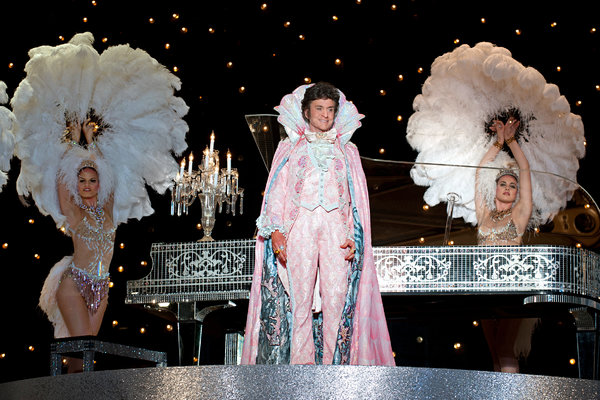 Prior to gay liberation, gay people, unable to come out, had little choice but to build magnificent closets. Mad King Ludwig built fairy-tale castles across Bavaria that became the prototypes for Disney theme parks. Michelangelo created the Sistine Chapel, a riotous orgy of male nudity under which which dozens of gay popes have been crowned by thousands of gay cardinals. The garden-variety queen built his castles in the air, with florid camp references made in gay bars, movie theaters, and bathhouses—closets that rented by the hour.
Liberace stood out in that he let everyone see into his closet, performing as a royal queen bedecked in Austrian rhinestones and doted on by his boy toy protégés on stage. Sometimes the best way is to hide is in plain sight.
In the Liberace biopic Behind the Candelabra, which premiered on HBO last Sunday night, Matt Damon’s character, Scott Thorson, comments to a boyfriend on first seeing Liberace’s act that he’s surprised the audience of middle-aged women and Las Vegas conventioneers would like a performance that was so gay. The boyfriend replies, “They don’t know he’s gay.”
Thorson, just seventeen when he was taken under Liberace’s feathered cape as a lover, Boy Friday, and surrogate son, lived a profoundly surreal life in the pianist’s mirror-ball universe. For several years in the late 70’s and early 80’s, Thorson played a part in Liberace’s Las Vegas act by dressing as a chauffer and driving the pianist onstage in a rhinestone-studded Rolls Royce. As very few Vegas tourists saw the act more than once, they could hardly notice the young man slowly turning into a Liberace caricature, complete with face implants to make his cheeks and chin stand out like the pianist.
Behind the Candelabra is an example of both the progress made by LGBT people and the Jupiter-like gravitational pull of director Steven Soderbergh. Just a few years ago, a film about a grotesque, aging gay man and his serial devotion to young male lovers would have sent Hollywood actors fleeing for the hills. Yet, despite this project receiving no theatrical distribution in the United States (it premiered at Cannes last week and will be released in theaters in Europe this summer) big-name talent seems to have clamored to be in on the project.
Besides the remarkable casting of Michael Douglas to play the lead and Damon to play Thorson, Candelabra features Dan Akroyd as Liberace’s cutthroat agent, Scott Bakula as a friend of Liberace and Thorson’s first boyfriend, Debbie Reynolds as Liberace’s mom, Cheyenne Jackson as former Liberace protégé Billy Leatherwood, and Rob Lowe as an unscrupulous (and hilarious) plastic surgeon. Like Soderbergh’s Ocean movies, the filming of which had a reputation as rolling rat-pack party sets, these actors seem to be having entirely too much fun under 70’s feather cuts, layers of garish makeup, and piles of jewelry.
The relationship between Douglas and Damon has a certain believable chemistry, but that’s not really the point. Watching two of the most macho actors in Hollywood—known for roles like Jason Bourne and Gordon Gekko—in clench after passionate clench, reminds one of Dr. Johnson’s comment on seeing a dog walk on its hind legs: *“*It is not done well, but you are surprised to find it done at all.”

Hard to believe, but Liberace actually won several cases against magazines in the 1950’s that suggested he was gay. Or, in the exact words of London’s “Daily Mirror”: “A deadly, winking, sniggering, snuggling, chromium-plated, scent-impregnated, luminous, quivering, giggling, fruit-flavoured, mincing, ice-covered heap of mother love.”
What is done well is Michael Douglas’ impersonation of Liberace. This film will burnish his legacy as an actor with more range than the typecasting of his Fatal Attraction/ Basic Instinct years. Douglas works as Liberace because he plays him without a hint of pathetic camp. His take, and the take of the film, is that Liberace was basically a professional—a consummate performer who happened to suffer from the excesses of taste and desire that accrue over a lifetime in show business. Having lived his entire life in the public eye, in the Hollywood shadow of his legendary father, maybe Douglas can relate.
The sad thing about Liberace, and perhaps this is an ache known by many performers, is they are beloved, but no one but their closest friends and family know them as they really are. In this way, most stars live their lives in the closet.
There’s a book that gets mentioned at the end of the movie, The Wonderful Private World of Liberace, a small coffee-table volume that purports to tell the “real story” of Liberace’s life. It contains gorgeous spreads of his homes, cars, and outfits, and includes such humble details as his mother’s recipe for lasagna and pictures of his beloved dogs. Even as the book went to press, however, Liberace was dying and his lawyers were still settling a palimony suit with Thorson. Yet, to the end, Liberace kept up the façade, including claims that he had never had a facelift, that his wig was his real hair, the ridiculous story that he had lost his virginity at age sixteen to a blues singer named Miss Bea Haven, and that he could never marry because the love of his life was ice skater/actress Sonja Henne.
In the end, the film is a tragedy, not because Liberace died of AIDS, or because he was unable to form a lasting relationship with Thorson, but because he never felt the joy of being truly known for who he was. The persona become inseparable from the person, and he suffocated in his diamond-studded closet.
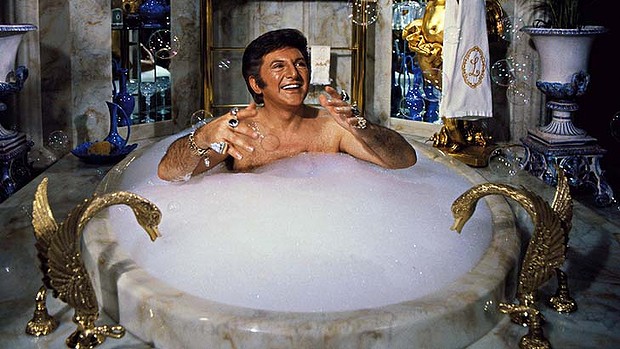
The magnificent closet.
Previous Post

May 26, 2013
Star Trek: Into Darkness -- Boldly Brimming with Bromance and Story
Next Post

June 14, 2013 What is PopTheology?
Browse Our Archives
Select a Category Classics DVD Film Music News Pop Culture Events Print Sports Television Uncategorized Video Games
Select a Month March 2017 February 2017 January 2017 December 2016 November 2016 October 2016 September 2016 August 2016 July 2016 June 2016 May 2016 April 2016 March 2016 February 2016 January 2016 December 2015 November 2015 October 2015 September 2015 August 2015 July 2015 June 2015 May 2015 April 2015 March 2015 February 2015 January 2015 December 2014 November 2014 October 2014 September 2014 August 2014 July 2014 June 2014 May 2014 April 2014 March 2014 February 2014 January 2014 December 2013 November 2013 October 2013 September 2013 August 2013 July 2013 June 2013 May 2013 April 2013 March 2013 February 2013 January 2013 December 2012 November 2012 October 2012 September 2012 August 2012 July 2012 June 2012 May 2012 April 2012 March 2012 February 2012 January 2012 December 2011 November 2011 October 2011 September 2011 August 2011 July 2011 June 2011 May 2011 April 2011 March 2011 February 2011 January 2011 December 2010 November 2010 October 2010 September 2010 August 2010 July 2010 June 2010 May 2010 April 2010 March 2010 February 2010 January 2010 December 2009 November 2009 October 2009 September 2009 August 2009 July 2009 June 2009 May 2009 April 2009 March 2009 February 2009 January 2009 December 2008 November 2008 October 2008 September 2008 August 2008 July 2008 June 2008 May 2008 April 2008 March 2008 February 2008 January 2008 December 2007 November 2007 October 2007 September 2007 August 2007 July 2007 June 2007 May 2007 April 2007 March 2007
Follow Us!
TAKE THE
Religious Wisdom Quiz
What does the Bible say about planning for the future?
Select your answer to see how you score.
Commit your plans to the Lord Don't think ahead Never plan Always worry
Related posts from Pop Theology
The Mastodon In The Room: A Conversation with...

#KillerSerials: THE PATH, S2 Ep. 11

At SXSW2017: Music Festival Day 5
At SXSW2017: Music Festival Day 4
TRENDING AT PATHEOS Progressive Christian

What Being a Modern-Day Apostle Means to Me
In my last column, I discussed the ins and outs of modern-day...

Did Ancient China Once Worship the God of...
Across human history, a common thread weaves through the origins of the...

Love Your Neighbor – Including Earth-Kin: Lev. 19,...
God’s command to love your neighbor means acting in an ethical and...

Lead a Church Study of “Jesus and Lao...
Guest writer Jack Thomas (The Irreverent Reverend) reflects on leading his church...

Pastoral Wisdom for Responding to Sermon Pushback
Getting sermon pushback on your social justice sermon? Learn practical, Proverbs-based strategies...

Principles for Understanding the Apostolic Ministry Today
Whenever people discover that my formal ministry title is "apostle," as in...
view all Progressive Christian blogs
Ad-Free & Subscriber Log-In Subscription Support
- About Us
- 2026 Calendar
- Videos
- Podcasts
- Library of World Religions
- Faith In Media Tracker
- Advertise With Us
- Write for Us
- Privacy Policy
- Terms of Service
- Do Not Sell My Data
- Contact Us
- Radiant Digital
- Manage Newsletter Subscriptions
- Unsubscribe From Notifications
- Sitemap
Copyright 2008-2026, Patheos. All rights reserved.
Subscription Support Ad-Free & Subscriber Log-In
Follow Patheos