
BuddhistCatholicContemplativeEvangelicalGeneral ChristianHinduJewishLatter-day SaintMuslimNew VisionsProgressive Christian
Beliefs
- Buddhist
- Catholic
- Contemplative
- Evangelical
- General Christian
- Hindu
- Jewish
- Latter-day Saint
- More Voices
- Muslim
- New Visions
- Pagan
- Progressive Christian
Topics
- Religion News
- Food and Religion
- Sports and Religion
- Religious Art
- Religious Music and Entertainment
- Religious Events
- History and Religion
- Style and Religion
- Politics and Religion
- Women in Religion
- Recreation Outdoors and Religion
- Business Finance and Religion
- Careers Workplace and Religion
- Education and Religion
- Family Parenting and Religion
- Health Fitness and Religion
- Home and Religion
- Relationships and Religion
- Technology and Religion
- Travel and Religion
Columnists
- Buddhist Columnists
- Business Finance and Religion Columnists
- Careers Workplace and Religion Columnists
- Catholic Columnists
- Contemplative Columnists
- Education and Religion Columnists
- Evangelists Columnists
- Family Parenting and Religion Columnists
- General Christian Columnists
- Health Fitness and Religion Columnists
- Hindu Columnists
- History and Religion Columnists
- Home and Religion Columnists
- Jewish Columnists
- More Voices Columnists
- Latter Day Columnists
- Muslim Columnists
- New Visions Columnists
- Nonreligious Columnists
- Pagan Columnists
- Politics and Religion Columnists
- Progressive Columnists
- Recreation Outdoors and Religion Columnists
- Relationships and Religion Columnists
- Religion News Columnists
- Religious Art Columnists
- Religious Events Columnists
- Religious Music and Entertainment Columnists
- Sports and Religion Columnists
- Style and Religion Columnists
- Technology and Religion Columnists
- Travel and Religion Columnists
- Women in Religion Columnists
Resource Library
- 2026 Calendar
- Library of World Religions
- The 100 Most Holy Places on Earth
- Patheos Answers
- Podcasts
- Videos
- Faith Leaders Database
- Anglican Episcopalian
- Bahai
- Baptist
- Buddhism
- Christianity
- Confucianism
- Eastern Orthodoxy
- Hinduism
- Holiness and Pentecostal
- ISKCON
- Islam
- Judaism
- Lutheran
- Methodist
- The Church of Jesus Christ of Latter-day Saints
- New Age
- Paganism
- Presbytarian and Reformed
- Protestantism
- Religion Behind the Scenes
- Roman Catholic
- Scientology
- Shia Islam
- Sikhism
- Sufism
- Sunni Islam
- Taoism
- Zen
- See all religions
Research Tools
 Ad-Free & Subscriber Log-In Subscription Support
Ad-Free & Subscriber Log-In Subscription Support
Follow Patheos 

- Trending:
- Forgiveness
- |
- Marriage
- |
- Consciousness
- |
- Death Penalty
- |
- Election
- |
- Halloween
 Pop Theology
- Home
- Progressive Christian
- Religious Music & Entertainment
- Jesus and John Lennon: Misremembered Messiahs
Jesus and John Lennon: Misremembered Messiahs
Last updated on: June 14, 2013 at 8:21 pm by Richard Lindsay
Jesus and John Lennon: Misremembered Messiahs 2013-06-14T20:21:47-07:00 Richard Lindsay
Patheos Explore the world's faith through different perspectives on religion and spirituality! Patheos has the views of the prevalent religions and spiritualities of the world.
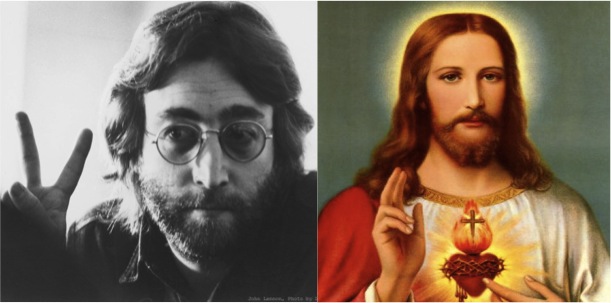 I had the opportunity to give a talk at the PSR Sacred Snapshots event in Berkeley on April 20th about John Lennon as a rock-n-roll messiah. This is a variation on a lecture I’ve given as part of my “Pop Goes Religion” course. The conversation with those who attended reinforced for me the intense spiritual meaning the life, music, and death of John Lennon has in American popular culture, particularly among the Baby Boom generation.
Just look at the song “Imagine.” A little more than a year ago, I wrote about the religious uproar that took place when Cee-Lo Green changed the words to this song when he sang it during the Times Square New Year’s Eve broadcast. (Green sang, “And all religion’s true,” rather than, “And no religion, too.”)
But think of the significance of the song’s placement in the national ceremony of ringing in the New Year. Since New Year’s Eve 2005-06, the song has preceded the Times Square ball drop. So the order goes: “Imagine” (a song that everyone can sing along with), countdown and ball drop, then “Auld Lang Syne” (a song everyone knows the first five words to, then stumbles along drunkenly for the rest, and nobody’s sure why we sing it on New Years anyway.) This means “Imagine” has extraordinary cultural currency; perhaps no other song besides “Amazing Grace” is as familiar to the English-speaking world.
What’s interesting is “Imagine” presents not so much a spiritual ideal of peace as an anti-ideal. If the song has a theology, it’s a theology of subtraction. Take the mess we’ve got today and subtract heaven, hell, countries, religion, possessions, and greed—then you have a peaceful world. Note the song doesn’t subtract God, which Lennon believed existed as a kind of energy source at the center of the universe.
This anti-ism-ism is consistent with some of Lennon’s other songs that deal with religion. In his song, “God,” which he wrote in 1970 for his first album after breaking up with the Beatles, he lists the things he no longer believes in:
I don’t believe in magic
” ” ” ” I-Ching
” ” ” ” Bible
” ” ” ” tarot
” ” ” ” Hitler
” ” ” ” Jesus
” ” ” ” Kennedy
” ” ” ” Buddha
” ” ” ” mantra
” ” ” ” Gita
” ” ” ” yoga
” ” ” ” kings
” ” ” ” Elvis
” ” ” ” Zimmerman
” ” ” ” Beatles…
I just believe in me/ Yoko and me/ And that’s reality.
“Gita” refers to the Bhagavad Gita, the sacred Hindu text. “Zimmerman” refers to Robert Zimmerman, or as he’s known to most of us, Bob Dylan.
Gary Tillery has written a good spiritual biography of John Lennon called “The Cynical Idealist.” Tillery describes “God” as Lennon’s “declaration of independence.”
“His objective is quite straightforward: to stand alone intellectually—rejecting all belief systems and all idols, even the idol he had helped to create and to which he owed his own power and influence. Descartes had proposed as an axiom, ‘I think therefore I am.’ Lennon’s version might have been phrased, ‘I don’t believe, therefore I am.'” (54)
What’s interesting about this is that despite his negative belief system people tend to associate all kinds of distinct ideologies about religion with John Lennon. Much of the uproar over Cee-Lo Green’s change of the lyrics came from the so-called neo-atheist camp, which seemed to think of “Imagine” as an atheist or anti-religious song.
Many people associate Lennon with a kind of groovy 60’s Eastern mysticism. 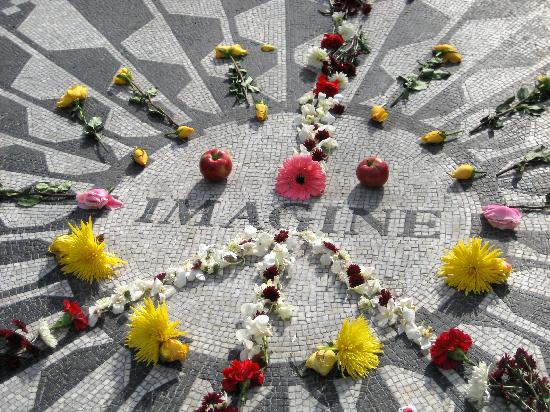 This can be seen in the offerings that are left at the “Imagine” mosaic at Strawberry Fields in Central Park. The fruit and flowers are symbols of impermanence that resemble the spiritual gifts left at Buddhist shrines. Again, this has more to do with projection than reality, as Lennon was never a Buddhist. His association with Eastern religion comes from the Beatles’ period of exploration of the meditation techniques of the Maharishi Mahesh Yogi in 1967. According to Tillery, Lennon continued some of the practices of meditation throughout his life, but this was not out of respect for the Maharishi, whom he came to despise as a charlatan. (See the song “Sexy Sadie.”) John Lennon was never much of a disciple.
In my talk in Berkeley I gave some examples of areas where the teachings of Jesus Christ and the songs or philosophy of John Lennon seem to match up.
It kind of started as a dare from a professor, but I think I can make a compelling case that “love is all you need,” is a pretty good summary of the Gospel message when viewed through a biblical lens. See here. (This will open a brief slideshow in the online PowerPoint app. Keep clicking through until you see the slide with Buddy Christ.)
Both Lennon and Christ attempted to free their followers of a simplistic disciple-and-guru relationship to a self-empowered spirituality or salvation..
When asked in the Gospel of Luke about what the Kingdom of God would look like, Jesus said, “The kingdom of God is not coming with things that can be observed; nor will they say, ‘Look, here it is!’ or ‘There it is!’ For, in fact, the kingdom of God is among you.”
This sounds like Lennon’s anti-manifesto in “Give Peace a Chance:”
“Everybody’s talkin’ ’bout Bagism, Shagism, Dragism, Madism, Ragism, Tagism This-ism, that-ism, ism ism ism…”
and in “Revolution:”
“You say you’ll change the constitution/Well, you know/We all want to change your head./ You tell me it’s the institution/Well, you know/You better free you mind instead.”
Continuing on this theme of self-empowerment, Jesus hardly ever healed anyone that he didn’t say, “Your faith has made you well,” a phrase of some variation that appears at least 10 times in the synoptic gospels. This suggests that the healings Christ participated in were not magic tricks, but collaborations between the individual and God, based on the individual’s own faith.
There are distinct moments in the gospels where Christ seemed, like Lennon in “God,” to deconstruct the very idolatry his people had created around him. When the rich young man in Mark 10:18 came and knelt before him and called him “Good teacher,” Jesus’ response was, “Why do you call me good? No one is good but God alone.” Likewise, in all of the gospel stories, Jesus denies he is a King when he stands before Pilate, and even appears to deny the title of Messiah in Luke.
“I was the dream weaver/ But now I’m reborn/ I was the Walrus/ But now I’m John…”
The idea that Christ was out to empower people to spiritual freedom rather than to create a cult of personality around himself is still pretty controversial in Christian circles. In Christianity, the one idolatry allowed is the cult of Jesus, in which Jesus becomes your best friend, your boyfriend, your healer, your confidante, your Prozac, your Santa Claus, your superhero, your favorite political philosopher (a la George W. Bush), your batting coach, your CEO, your drill sergeant, the Lion of Judah and the Lamb of God, the King of Kings and Lord of Lords. Not so much a person who had a specific teaching, a particular personality, and took specific actions in a particular time and place in history, but a symbol, an avatar, an embodiment of one’s fondest wishes and needs.
And here might be the most salient comparison between Christ and Lennon. After both of them were martyred, they began to take on a life as spiritual symbols rather than people—to become distanced from their specific teachings, personalities, and actions. Both Christ and Lennon became empty figures to be filled with people’s personal agendas and ideologies.
Often these followers’ projections are at direct odds with the actual beliefs of their purported spiritual gurus. How can anyone twist the teachings of Lennon to the point of lashing out at Cee-Lo Green by tweeting, “@Cee-Lo Green go to hell fat boy I hope you have a heart attack and die.” How could anyone distort the self-sacrificial love of Jesus Christ into “Onward Christian soldiers, marching as to war”?
The way many Christians think of Jesus, and many people think of John Lennon, is personally disempowering, leads to isolation rather than community, leads to self-delusion, often leads to self-righteousness, and in its most twisted forms, judgment and violence. I can’t think of anything both the Sage of Liverpool and the Man from Nazareth were more against.
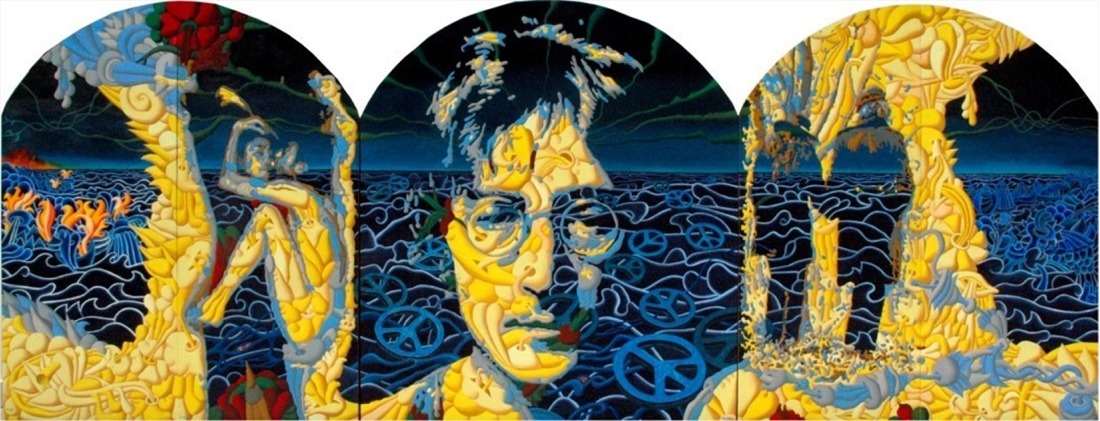
Peace Altar – John Lennon
Werner Horvarth, 2007
Previous Post

April 30, 2013
Film Freedom
Next Post
May 6, 2013 A Sacred Wonder
Browse Our Archives
Select a Category Classics DVD Film Music News Pop Culture Events Print Sports Television Uncategorized Video Games
Select a Month March 2017 February 2017 January 2017 December 2016 November 2016 October 2016 September 2016 August 2016 July 2016 June 2016 May 2016 April 2016 March 2016 February 2016 January 2016 December 2015 November 2015 October 2015 September 2015 August 2015 July 2015 June 2015 May 2015 April 2015 March 2015 February 2015 January 2015 December 2014 November 2014 October 2014 September 2014 August 2014 July 2014 June 2014 May 2014 April 2014 March 2014 February 2014 January 2014 December 2013 November 2013 October 2013 September 2013 August 2013 July 2013 June 2013 May 2013 April 2013 March 2013 February 2013 January 2013 December 2012 November 2012 October 2012 September 2012 August 2012 July 2012 June 2012 May 2012 April 2012 March 2012 February 2012 January 2012 December 2011 November 2011 October 2011 September 2011 August 2011 July 2011 June 2011 May 2011 April 2011 March 2011 February 2011 January 2011 December 2010 November 2010 October 2010 September 2010 August 2010 July 2010 June 2010 May 2010 April 2010 March 2010 February 2010 January 2010 December 2009 November 2009 October 2009 September 2009 August 2009 July 2009 June 2009 May 2009 April 2009 March 2009 February 2009 January 2009 December 2008 November 2008 October 2008 September 2008 August 2008 July 2008 June 2008 May 2008 April 2008 March 2008 February 2008 January 2008 December 2007 November 2007 October 2007 September 2007 August 2007 July 2007 June 2007 May 2007 April 2007 March 2007
Follow Us!
TAKE THE
Religious Wisdom Quiz
Who said, "I do not know how to speak; I am too young"?
Select your answer to see how you score.
Jeremiah Samuel Moses Isaiah
Related posts from Pop Theology
The Mastodon In The Room: A Conversation with...

At SXSW2017: Music Festival Day 5
At SXSW2017: Music Festival Day 4
At SXSW2017: Music Festival Day 3
TRENDING AT PATHEOS Progressive Christian

Why Christians Have a Sacred Duty to Vote:...
The Bible offers strong support for the sacred duty to vote. Here...

What Being a Modern-Day Apostle Means to Me
In my last column, I discussed the ins and outs of modern-day...

Did Ancient China Once Worship the God of...
Across human history, a common thread weaves through the origins of the...

Love Your Neighbor – Including Earth-Kin: Lev. 19,...
God’s command to love your neighbor means acting in an ethical and...

Lead a Church Study of “Jesus and Lao...
Guest writer Jack Thomas (The Irreverent Reverend) reflects on leading his church...

Principles for Understanding the Apostolic Ministry Today
Whenever people discover that my formal ministry title is "apostle," as in...
view all Progressive Christian blogs
Ad-Free & Subscriber Log-In Subscription Support
- About Us
- 2026 Calendar
- Videos
- Podcasts
- Library of World Religions
- Faith In Media Tracker
- Advertise With Us
- Write for Us
- Privacy Policy
- Terms of Service
- Do Not Sell My Data
- Contact Us
- Radiant Digital
- Manage Newsletter Subscriptions
- Unsubscribe From Notifications
- Sitemap
Copyright 2008-2026, Patheos. All rights reserved.
Subscription Support Ad-Free & Subscriber Log-In
Follow Patheos