
BuddhistCatholicContemplativeEvangelicalGeneral ChristianHinduJewishLatter-day SaintMuslimNew VisionsProgressive Christian
Beliefs
- Buddhist
- Catholic
- Contemplative
- Evangelical
- General Christian
- Hindu
- Jewish
- Latter-day Saint
- More Voices
- Muslim
- New Visions
- Pagan
- Progressive Christian
Topics
- Religion News
- Food and Religion
- Sports and Religion
- Religious Art
- Religious Music and Entertainment
- Religious Events
- History and Religion
- Style and Religion
- Politics and Religion
- Women in Religion
- Recreation Outdoors and Religion
- Business Finance and Religion
- Careers Workplace and Religion
- Education and Religion
- Family Parenting and Religion
- Health Fitness and Religion
- Home and Religion
- Relationships and Religion
- Technology and Religion
- Travel and Religion
Columnists
- Buddhist Columnists
- Business Finance and Religion Columnists
- Careers Workplace and Religion Columnists
- Catholic Columnists
- Contemplative Columnists
- Education and Religion Columnists
- Evangelists Columnists
- Family Parenting and Religion Columnists
- General Christian Columnists
- Health Fitness and Religion Columnists
- Hindu Columnists
- History and Religion Columnists
- Home and Religion Columnists
- Jewish Columnists
- More Voices Columnists
- Latter Day Columnists
- Muslim Columnists
- New Visions Columnists
- Nonreligious Columnists
- Pagan Columnists
- Politics and Religion Columnists
- Progressive Columnists
- Recreation Outdoors and Religion Columnists
- Relationships and Religion Columnists
- Religion News Columnists
- Religious Art Columnists
- Religious Events Columnists
- Religious Music and Entertainment Columnists
- Sports and Religion Columnists
- Style and Religion Columnists
- Technology and Religion Columnists
- Travel and Religion Columnists
- Women in Religion Columnists
Resource Library
- 2026 Calendar
- Library of World Religions
- The 100 Most Holy Places on Earth
- Patheos Answers
- Podcasts
- Videos
- Faith Leaders Database
- Anglican Episcopalian
- Bahai
- Baptist
- Buddhism
- Christianity
- Confucianism
- Eastern Orthodoxy
- Hinduism
- Holiness and Pentecostal
- ISKCON
- Islam
- Judaism
- Lutheran
- Methodist
- The Church of Jesus Christ of Latter-day Saints
- New Age
- Paganism
- Presbytarian and Reformed
- Protestantism
- Religion Behind the Scenes
- Roman Catholic
- Scientology
- Shia Islam
- Sikhism
- Sufism
- Sunni Islam
- Taoism
- Zen
- See all religions
Research Tools
 Ad-Free & Subscriber Log-In Subscription Support
Ad-Free & Subscriber Log-In Subscription Support
Follow Patheos 

- Trending:
- Forgiveness
- |
- Marriage
- |
- Consciousness
- |
- Death Penalty
- |
- Election
- |
- Halloween
 Pop Theology
- Home
- Progressive Christian
- Religious Music & Entertainment
- Super Fun Pack – 3 Music Reviews!
Super Fun Pack – 3 Music Reviews!
Last updated on: June 14, 2013 at 8:27 pm by Richard Lindsay
Super Fun Pack – 3 Music Reviews! 2013-06-14T20:27:54-07:00 Richard Lindsay
Patheos Explore the world's faith through different perspectives on religion and spirituality! Patheos has the views of the prevalent religions and spiritualities of the world.
Finally getting around to writing about some music I’ve been listening to for the last few months, here’s some brief reviews of three albums that have made the rotation on my iPhone.
Has Matisyahu become “spiritual but not religious?”
Matisyahu, the Chasidic reggae star, has evolved both in sound and spirituality. Just the picture should tell you a lot—no more beard or Pe’ot (hair curls). There are some touching interviews online that explain his transition, when he realized that God loved him whether he wore the outward signs of his religion or not. He’s moved from Crown Heights in Brooklyn to the decidedly more sunny Jewish community in L.A.
His first post-conversion  album is called Spark Seeker, and the name says it all. Just as Matisyahu’s theology has become less strict, so has his musical style. No longer laying down roots reggae with his band as he does in his magnificent Live at Stubbs albums, Matisyahu has mixed electronic beats with traditional Middle Eastern music to form a considerably poppier sound. Lyrics match the change, echoing a vague sounding spirituality, as in the song “Sunshine:”
Reach up for the sky/ Keep your eye on the prize,
Forever in my mind/ you’re my golden sunshine.
The song “Tel Aviv’n” celebrates the “life’s a beach” (albeit in the midst of near-permanent war) mentality of “The Bubble” of Israel’s cultural capital, with a dubstep dance beat.
There could be no bigger difference between the old Chasidic Matisyahu and the new Reform Matisyahu than “Live Like a Warrior,” which cheerily admonishes listeners:
Today, today, live like you wanna,
Let yesterday burn and throw it in a fire,
Live like a warrior.
Compare this to his song “Warrior,” which at least in the live version on Stubbs has a lesson on Jewish metaphysics, including the soul’s reincarnation and desperate desire to reunite with God.
When I lived in the Midwood neighborhood of Brooklyn, it was fascinating to experience Jewish holidays like Sukkot, Simchat Torah, and Hanukkah vicariously through my Orthodox and Chasidic neighbors. But like the Amish, it’s easy to idealize 19th-Century clothing and insistence on old-world practices like walking to synagogue as revealing a refreshing spiritual innocence.
I was shaken from any idealization of mid-Brooklyn ritual when I told a lesbian Rabbi friend where I was living and she winced as though I had told her I was in Alabama. It’s easy to forget that Chasidim and Orthodox Judaism are fundamentalist beliefs, and like all such practices, exact a devastating toll on those who stray from their narrow course.
So kudos to Matisyahu, a secular Jew who had an intense conversion to a fundamentalist faith, and then through his spiritual journey came to a place where he saw God’s love as more inclusive.
But I just can’t help but think the more dogmatic lyrics and beats of Live at Stubbs 1 & 2 will be his musical legacy, not Spark Seeker’s interfaith pop. What Matisyahu had before was an orthodox sense of belief that he shared through an unorthodox musical form, and the mixture expressed an intense passion. His music now expresses a nonspecific sense of the divine—a “spark”—that may leave him more spiritually at peace but misses the religious ecstasy of his previous work.
Macklemore and Ryan Lewis
 Just got this album so I haven’t had much time to listen to it, but first impressions are positive. First of all, their hit song “Thrift Shop” which has soared beyond 200 million views on YoutTube has an incredible anti-aesthetic. Imagine a rap song that celebrates putting together your look not with Dolce and bling, but with second-hand clothes. Genius. And an amazing message to “the kids” who listen to this stuff to let go of aspirational greed in favor of inspirational creativity.
Second, I know I’m not exactly ahead of the curve on this, but M&L’s marriage equality video “Same Love,” is beautiful. It features a heavenly-groove chorus vocal by Mary Lambert and a brilliant lyric by Macklemore that ranges from his own fear of being labeled gay as a kid to denouncing the culture of homophobia in hip-hop.
Macklemore then calls out the Church for its contributions to the oppression of gay people, but ends up reclaiming the Gospel, saying his religious upbringing also taught him to love unconditionally. The song contains a quote from 1 Corinthians 13, repeated over and over again: “Love is patient, love is kind.”
And here’s the kicker. If you watch the video complete with credits, the rappers give a shout-out to All Pilgrims Church in Seattle. It’s not clear what role the UCC/Disciples congregation plays in the video—possibly the setting for the wedding scene or providing the minister—but this is exactly the kind of outreach I’m hoping liberal Protestant churches will make. Don’t set up a “Christian alternative” to culture, structure your message in such a way that the mainstream culture will find it irresistible.
Sister Rosetta Tharpe, forgotten blues great.
Thanks to American Masters on PBS, I was recently introduced to the music of Sister Rosetta Tharpe, one of the godmothers of gospel, rock, and R&B. I rushed to the Internet and bought a compilation of remastered recordings from her Decca years from the late 30’s through the late 40’s called The Gospel of the Blues.
Tharpe not only sang gospel tunes in a silky smooth voice, but she was also an innovator on the guitar. Her meticulously picked swing matches her carefully enunciated, preacher-like diction. In her guitar you hear the embryonic sounds of the rock and R&B artists she influenced, like Little Richard, Johnny Cash, and Chuck Berry.
Some of her hits of Gospel classics, including “This Train” and “Nobody’s Fault but Mine” are sung in the old Delta Blues style with just Sister Rosetta’s voice and genius guitar in the background. “Nobody’s Fault,” first made famous by Blind Willie Johnson, has since been recorded by such artists as Led Zeppelin, Me’shell Ndegeocello, and Ben Harper.
Tharpe’s gospel message is clear, but of course she didn’t learn those guitar licks in the choir loft. The lady spent some time in clubs and juke joints, and this contact with the “sinful world” comes across in popular recordings like “My Man and I,” and “Tall Skinny Papa,” songs that scandalized her church followers.
In fact, Tharpe had as difficult a life you might expect for a blues musician, struggling through relationships with both men and women, fighting the indignities of touring and performing in the segregated South, and eventually losing her leg to diabetes and dying of a stroke at age 54.
Her life experiences lend a note of credibility to Gospel warning songs like, “There Are Strange Things Happening Every Day,” and “The Natural Facts.” These songs admonish against “backsliding” and preachers who have spent too much time at college (uh oh, I’m screwed). Yet despite their warning tone, the songs don’t lose their joyful bluesy bounce.
The finest recordings on this album are Sister Rosetta’s collaborations with talented background vocalists, including Marie Knight, Sister Tharpe’s sometime lover. Their recordings of “Didn’t It Rain” and “Up Above My Head I Hear Music in the Air” are meticulous contrapuntal trios between Sister, Knight, and the guitar; these women clearly made beautiful music together.
The song “Jonah” should be called “Jonah and the Wail,” because of Sister’s magnificent vocal glissandos that emulate the wavy swallow and spit-up of Jonah’s trek. And the song comes with a dose of humor as Sister sings the chorus:
Oh some people don’t believe
That a whale could him receive,
But that does not make my song at all untrue.
Why, there are wales on every side,
With their big mouths open wide,
Just take care my friend, or one will swallow you.
Her recording of “Down by the Riverside” with a male gospel quartet has been entered into the collection of the Library of Congress. Besides its historical significance as a precursor to rock n’ roll with its boogie-woogie piano and guitar duet, it’s just a charmer all around. I dare anyone to listen to Sister’s scat-jazzy “No-no-no-no-no-no-no,” answer to the quartet’s “Ain’t gonna study war no more” and not be happy.
Sister Rosetta Tharpe is the embodiment of a great truth, that the Blues is not “sad” music. Even when it seems to be about the most difficult things: addiction, lost love, the oppressions of poverty and racism, Blues is about human beings refusing to be buried by their situation. The music is a life cry for dignity and a lamentation prayer for a better life to come. And in the case of Sister Tharpe’s Blues Gospel, more often than not, it’s an expression of unmitigated joy.
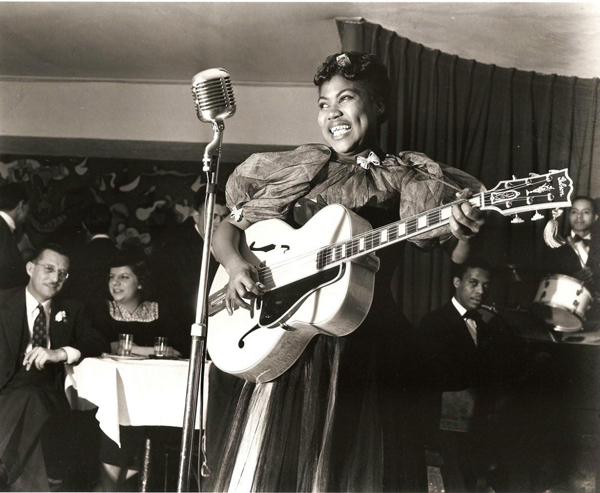
A joyful noise.
Previous Post

April 3, 2013
Can I Get an Amen...Or At Least a Gun and a Wad of Cash?
Next Post
April 15, 2013 Psalms of "Black Velvet"
Browse Our Archives
Select a Category Classics DVD Film Music News Pop Culture Events Print Sports Television Uncategorized Video Games
Select a Month March 2017 February 2017 January 2017 December 2016 November 2016 October 2016 September 2016 August 2016 July 2016 June 2016 May 2016 April 2016 March 2016 February 2016 January 2016 December 2015 November 2015 October 2015 September 2015 August 2015 July 2015 June 2015 May 2015 April 2015 March 2015 February 2015 January 2015 December 2014 November 2014 October 2014 September 2014 August 2014 July 2014 June 2014 May 2014 April 2014 March 2014 February 2014 January 2014 December 2013 November 2013 October 2013 September 2013 August 2013 July 2013 June 2013 May 2013 April 2013 March 2013 February 2013 January 2013 December 2012 November 2012 October 2012 September 2012 August 2012 July 2012 June 2012 May 2012 April 2012 March 2012 February 2012 January 2012 December 2011 November 2011 October 2011 September 2011 August 2011 July 2011 June 2011 May 2011 April 2011 March 2011 February 2011 January 2011 December 2010 November 2010 October 2010 September 2010 August 2010 July 2010 June 2010 May 2010 April 2010 March 2010 February 2010 January 2010 December 2009 November 2009 October 2009 September 2009 August 2009 July 2009 June 2009 May 2009 April 2009 March 2009 February 2009 January 2009 December 2008 November 2008 October 2008 September 2008 August 2008 July 2008 June 2008 May 2008 April 2008 March 2008 February 2008 January 2008 December 2007 November 2007 October 2007 September 2007 August 2007 July 2007 June 2007 May 2007 April 2007 March 2007
Follow Us!
TAKE THE
Religious Wisdom Quiz
Who urged Esther to approach the king, saying, "For such a time as this"?
Select your answer to see how you score.
Mordecai Haggai Ezra Nehemiah
Related posts from Pop Theology
The Mastodon In The Room: A Conversation with...

At SXSW2017: Music Festival Day 5
At SXSW2017: Music Festival Day 4
At SXSW2017: Music Festival Day 3
TRENDING AT PATHEOS Progressive Christian

Why Christians Have a Sacred Duty to Vote:...
The Bible offers strong support for the sacred duty to vote. Here...

What Being a Modern-Day Apostle Means to Me
In my last column, I discussed the ins and outs of modern-day...

Did Ancient China Once Worship the God of...
Across human history, a common thread weaves through the origins of the...

Love Your Neighbor – Including Earth-Kin: Lev. 19,...
God’s command to love your neighbor means acting in an ethical and...

Lead a Church Study of “Jesus and Lao...
Guest writer Jack Thomas (The Irreverent Reverend) reflects on leading his church...

Principles for Understanding the Apostolic Ministry Today
Whenever people discover that my formal ministry title is "apostle," as in...
view all Progressive Christian blogs
Ad-Free & Subscriber Log-In Subscription Support
- About Us
- 2026 Calendar
- Videos
- Podcasts
- Library of World Religions
- Faith In Media Tracker
- Advertise With Us
- Write for Us
- Privacy Policy
- Terms of Service
- Do Not Sell My Data
- Contact Us
- Radiant Digital
- Manage Newsletter Subscriptions
- Unsubscribe From Notifications
- Sitemap
Copyright 2008-2026, Patheos. All rights reserved.
Subscription Support Ad-Free & Subscriber Log-In
Follow Patheos