
BuddhistCatholicContemplativeEvangelicalGeneral ChristianHinduJewishLatter-day SaintMuslimNew VisionsProgressive Christian
Beliefs
- Buddhist
- Catholic
- Contemplative
- Evangelical
- General Christian
- Hindu
- Jewish
- Latter-day Saint
- More Voices
- Muslim
- New Visions
- Pagan
- Progressive Christian
Topics
- Religion News
- Food and Religion
- Sports and Religion
- Religious Art
- Religious Music and Entertainment
- Religious Events
- History and Religion
- Style and Religion
- Politics and Religion
- Women in Religion
- Recreation Outdoors and Religion
- Business Finance and Religion
- Careers Workplace and Religion
- Education and Religion
- Family Parenting and Religion
- Health Fitness and Religion
- Home and Religion
- Relationships and Religion
- Technology and Religion
- Travel and Religion
Columnists
- Buddhist Columnists
- Business Finance and Religion Columnists
- Careers Workplace and Religion Columnists
- Catholic Columnists
- Contemplative Columnists
- Education and Religion Columnists
- Evangelists Columnists
- Family Parenting and Religion Columnists
- General Christian Columnists
- Health Fitness and Religion Columnists
- Hindu Columnists
- History and Religion Columnists
- Home and Religion Columnists
- Jewish Columnists
- More Voices Columnists
- Latter Day Columnists
- Muslim Columnists
- New Visions Columnists
- Nonreligious Columnists
- Pagan Columnists
- Politics and Religion Columnists
- Progressive Columnists
- Recreation Outdoors and Religion Columnists
- Relationships and Religion Columnists
- Religion News Columnists
- Religious Art Columnists
- Religious Events Columnists
- Religious Music and Entertainment Columnists
- Sports and Religion Columnists
- Style and Religion Columnists
- Technology and Religion Columnists
- Travel and Religion Columnists
- Women in Religion Columnists
Resource Library
- 2026 Calendar
- Library of World Religions
- The 100 Most Holy Places on Earth
- Patheos Answers
- Podcasts
- Videos
- Faith Leaders Database
- Anglican Episcopalian
- Bahai
- Baptist
- Buddhism
- Christianity
- Confucianism
- Eastern Orthodoxy
- Hinduism
- Holiness and Pentecostal
- ISKCON
- Islam
- Judaism
- Lutheran
- Methodist
- The Church of Jesus Christ of Latter-day Saints
- New Age
- Paganism
- Presbytarian and Reformed
- Protestantism
- Religion Behind the Scenes
- Roman Catholic
- Scientology
- Shia Islam
- Sikhism
- Sufism
- Sunni Islam
- Taoism
- Zen
- See all religions
Research Tools
 Ad-Free & Subscriber Log-In Subscription Support
Ad-Free & Subscriber Log-In Subscription Support
Follow Patheos 

- Trending:
- Forgiveness
- |
- Marriage
- |
- Consciousness
- |
- Death Penalty
- |
- Election
- |
- Halloween
 Pop Theology
- Home
- Progressive Christian
- Religious Music & Entertainment
- Wedded Bliss?? Hardly.
Wedded Bliss?? Hardly.
Last updated on: March 26, 2013 at 1:42 pm by J. Ryan Parker
Wedded Bliss?? Hardly. 2013-03-26T13:42:54-07:00 J. Ryan Parker
Patheos Explore the world's faith through different perspectives on religion and spirituality! Patheos has the views of the prevalent religions and spiritualities of the world.
I find it somewhat fitting that, as the Supreme Court of the United States considers marriage equality, I finished up film historian Jeanine Basinger‘s latest book, I Do and I Don’t: A History of Marriage in the Movies. In her incisive, encyclopedic work, she takes readers through the history of “marriage movies” from the silents to today and deftly reveals their cultural implications, the ways in which they serve as windows into what marriage meant, and has come to mean, to so many filmmakers and film-watchers.
I Do and I Don’t, like all of Basinger’s books, is full of her signature wit and wisdom and is yet further evidence of her ability to synchronize so much of American film history. Even though she traces a chronological path through film history from the silent through the studio to the modern era, she is able to bounce back and forth between these eras to draw stunning comparisons between films separated by many decades and their accompanying social changes. Perhaps the only drawback to Basinger’s book is that it devotes a significant portion of its attention to the studio era, giving less to the silent and modern eras. Of course, this is not a surprise given that this period of film history certainly lies in Basinger’s wheelhouse. This book will obviously appeal to film lovers, be they practicing or armchair historians. It will also be an interesting read for those interested in the on-going conversations around gay marriage/marriage equality…or to observers intrigued by those who continue to vehemently point to marriage as some sort of penultimate, historical social contract. As Basinger shows, Hollywood hardly ever portrayed it in such a light. That audiences flocked to films that, as Basinger points out, essentially told the same story over and over, perhaps reveals that many members of the viewing audience really didn’t either. As a fan of Basinger’s work, I recognize that I’m a bit biased, but I Do and I Don’t is one entertaining read that I highly recommend. Read on for a few more of her insights if you’re interested.

Hollywood’s reticence to label a film a “marriage” film, even when it was the central plot point and often emphasizing comic or “erotic” elements is certainly telling, as are the ways in which marriage itself was frequently portrayed in these films. Basinger writes, “The bottom line was that the marriage movie was a difficult story to both tell and sell, because to find dramatic purpose, it has to become negative about itself in a positive way. It had to both link to and escape from reality, and it had to remember that the audience already knew its secrets” (xxvii). Of the three eras that Basinger covers, the silent era seems to be the most straightforward. I say seems to be because marriage in these films was often depicted as a problem to be overcome. One of the more interesting filmmakers of this era was Cecil B. DeMille, who most contemporary viewers remember for his lush biblical epics. However, during his prime, he was far more famous for his “marriage movies” that boasted glamorous production values and a wealth of sin that was morally tidied up at the end. As Basinger puts it about films like DeMille’s, “A story about infidelity unfolds, confirming an audience’s real-life knowledge about what might go wrong in a marriage, as well as giving them a glimpse of licentious freedom” (11). Or more harshly put, “[Audiences] were willing to pimp marriage out as an excuse to see clothes and furniture and places they would never see any other way” (19).
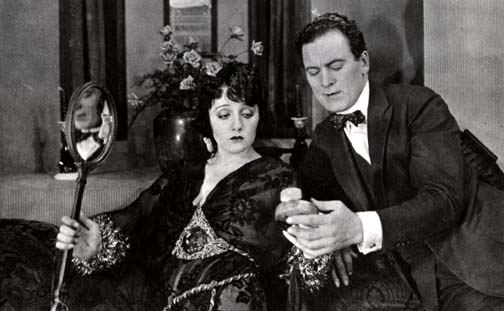
Luxury on display. Gloria Swanson in Cecil B. DeMille’s “Why Change Your Wife?”
In the second part of her book, Basinger turns her attention to the studio era, which happens to be the most interesting section. Here, she consistently argues that viewers did (and must continue to) pay attention to the subtexts that ran throughout marriage movies: “Underneath every movie story runs another story, and it often contradicts or questions the one on the surface” (31). One might quickly sum up the subtext: marriage is awful/no it’s not, or marriage is awesome/no it’s not. For Basinger, the “I Do” movie marriage is one in which a couple meets, falls in love, marries, undergoes hardship, but ultimately affirms their love for one another. The “I Don’t” version…well…you can probably guess what happens in these. The marriage movie became so “formulaic” during the studio era that Basinger is able to boil it down to three consistent components: the couple, their problems, and their situation (81).
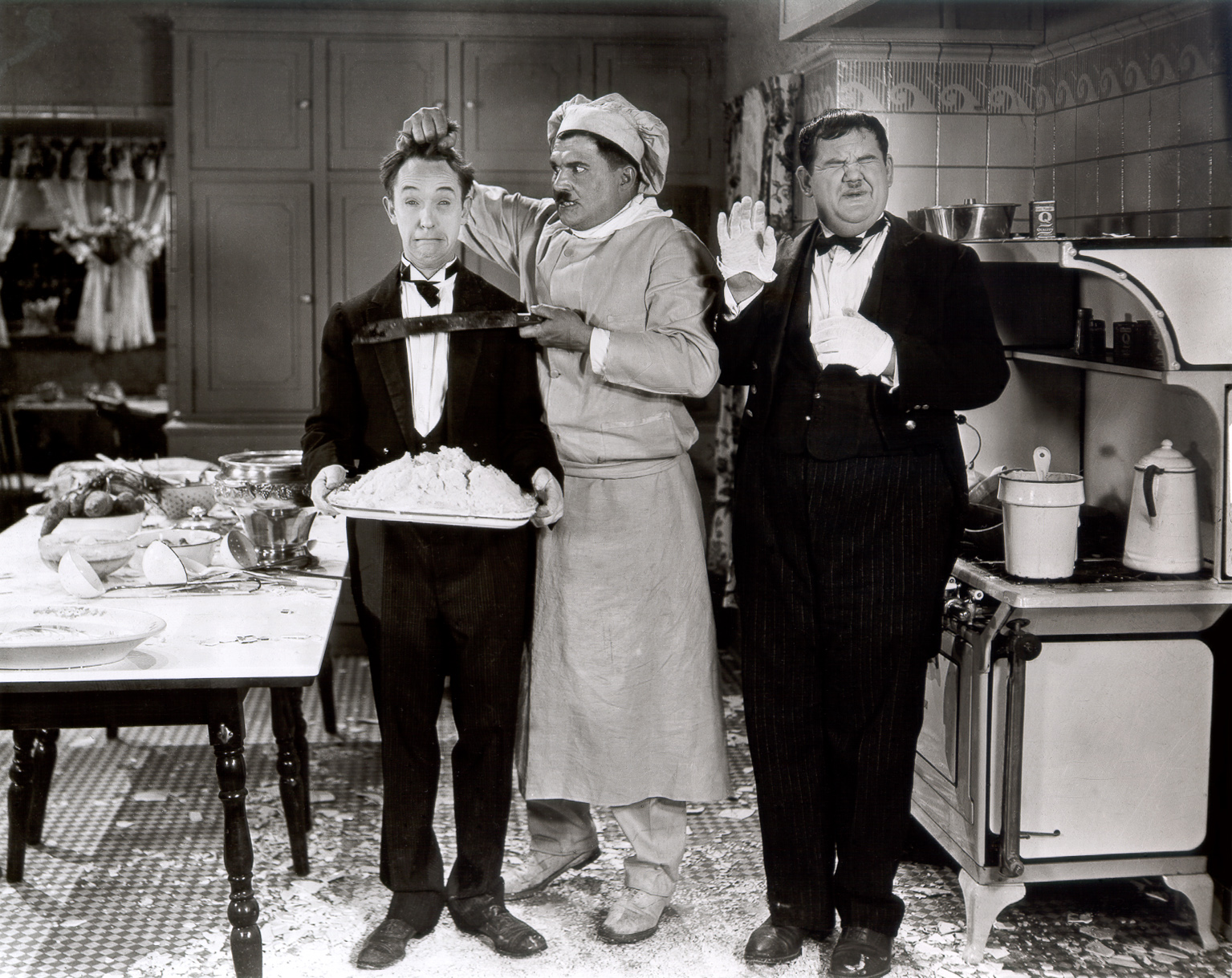
Unlikely candidates, but Basinger argues that Laurel and Hardy make for a successful movie marriage couple.
Throughout the majority of the second section, Basinger analyzes each of these components through hundreds of films. In terms of the film couple, she analyzes the way(s) in which they often “meet cute,” their suitability for each other, how they get along, etc. While this might seem to be a rather simple analysis, Basinger writes, “[…The] simple definition of a married couple is that they are husband and wife. For the movies, though, they also need to be something more metaphoric or emblematic” (85). As such, marriage movies were often perfect vehicles for “star pairings” which relied extensively on audience familiarity with the stars married to one another on screen…and often off as well.
Basinger also identifies seven problems that movie couples consistently faced: money, infidelity and/or adultery, in-laws and children, incompatibility, class, addiction, and murder (132-133). Her discussion of infidelity in marriage movies is just fascinating. Basinger writes, “Some of the movies’ most beautiful and memorable scenes involve infidelity. […] Infidelity was everywhere onscreen, which is really fascinating, since, because of censorship, technically it couldn’t be anywhere at all (unless someone was going to die and pay for it)” (147). American filmgoers liked to disavow the existence of class structures in the United States about as vehemently as they would public deny their interest in infidelity. Movies, once again, provided the perfect escape: “The story of a marriage was an excellent way to fulfill the goal of discussing class without discussing class, and to tell an audience that they were upwardly mobile” (187).
Marriage movies feature a married couple facing a wide array of problems set in different situations. For Basinger, the situation was essentially the setting against which these couples are married and in which they face their troubles. Few situations influenced marriage movies (and real life marriages) as drastically as the time during and after World War II. (Post)War-time marriage movies actively (re)defined the nature of that relationship and its composite “roles” even as real-world couples were engaged in the same task.

The most honest “movie marriage?” Turn to television and “Friday Night Lights'” Eric and Tammy Taylor.
Towards the end of the second section, Basinger begins making comparisons between marriage movies and sitcom marriages and discusses the ways in which the latter began to dominate the discussion. This helps lead her smoothly into the modern era where, today, according to many observers, television stands on equal footing with cinema. Therefore, it should come as no surprise that Basinger lists Friday Night Lights’ lead couple, Eric and Tammy Taylor, as one of the most “successful,” honest portrayals of “movie marriages.” She writes, “The ‘big seven’ problems that I could clearly identify in marriage movies didn’t swamp the Taylors or interfere with their daily lives. […] The Taylor marriage was a marriage not governed by genre rules or assaulted by plot development” (331). A disappointing reality of this third and final section, however, is its revelation that there is, essentially, no there there. Contemporary marriage movies talk about the institution at length but never arrive at any conclusions. Others simply re-tread old themes that have been treated better in studio era films. That marriage has so clearly declined in importance across a wide swatch of society (divorces are rampant, people are waiting longer to get married, couples have children out of wedlock, etc.) is a point to which Basinger repeatedly returns in this section. What Basinger fails to point out are the benefits that marriages bestow on couples in terms of legal and financial rights and privileges, the very things that are so often abused in marriage movies and for which so many people are fighting today.
Previous Post

March 25, 2013
Teorema: God Will Save You from Your Dull Middle-Class Existence
Next Post

March 29, 2013 Musical Indoctrination
Browse Our Archives
Select a Category Classics DVD Film Music News Pop Culture Events Print Sports Television Uncategorized Video Games
Select a Month March 2017 February 2017 January 2017 December 2016 November 2016 October 2016 September 2016 August 2016 July 2016 June 2016 May 2016 April 2016 March 2016 February 2016 January 2016 December 2015 November 2015 October 2015 September 2015 August 2015 July 2015 June 2015 May 2015 April 2015 March 2015 February 2015 January 2015 December 2014 November 2014 October 2014 September 2014 August 2014 July 2014 June 2014 May 2014 April 2014 March 2014 February 2014 January 2014 December 2013 November 2013 October 2013 September 2013 August 2013 July 2013 June 2013 May 2013 April 2013 March 2013 February 2013 January 2013 December 2012 November 2012 October 2012 September 2012 August 2012 July 2012 June 2012 May 2012 April 2012 March 2012 February 2012 January 2012 December 2011 November 2011 October 2011 September 2011 August 2011 July 2011 June 2011 May 2011 April 2011 March 2011 February 2011 January 2011 December 2010 November 2010 October 2010 September 2010 August 2010 July 2010 June 2010 May 2010 April 2010 March 2010 February 2010 January 2010 December 2009 November 2009 October 2009 September 2009 August 2009 July 2009 June 2009 May 2009 April 2009 March 2009 February 2009 January 2009 December 2008 November 2008 October 2008 September 2008 August 2008 July 2008 June 2008 May 2008 April 2008 March 2008 February 2008 January 2008 December 2007 November 2007 October 2007 September 2007 August 2007 July 2007 June 2007 May 2007 April 2007 March 2007
Follow Us!
TAKE THE
Religious Wisdom Quiz
Who was known as the doubter among Jesus' disciples?
Select your answer to see how you score.
Peter John James Thomas
Related posts from Pop Theology


#KillerSerials: An Interview with Kutter Callaway

Book Review: MUSLIMS AND THE MAKING OF AMERICA

TRENDING AT PATHEOS Progressive Christian

Why Christians Have a Sacred Duty to Vote:...
The Bible offers strong support for the sacred duty to vote. Here...

What Being a Modern-Day Apostle Means to Me
In my last column, I discussed the ins and outs of modern-day...

Did Ancient China Once Worship the God of...
Across human history, a common thread weaves through the origins of the...

Love Your Neighbor – Including Earth-Kin: Lev. 19,...
God’s command to love your neighbor means acting in an ethical and...

Lead a Church Study of “Jesus and Lao...
Guest writer Jack Thomas (The Irreverent Reverend) reflects on leading his church...

Principles for Understanding the Apostolic Ministry Today
Whenever people discover that my formal ministry title is "apostle," as in...
view all Progressive Christian blogs
Ad-Free & Subscriber Log-In Subscription Support
- About Us
- 2026 Calendar
- Videos
- Podcasts
- Library of World Religions
- Faith In Media Tracker
- Advertise With Us
- Write for Us
- Privacy Policy
- Terms of Service
- Do Not Sell My Data
- Contact Us
- Radiant Digital
- Manage Newsletter Subscriptions
- Unsubscribe From Notifications
- Sitemap
Copyright 2008-2026, Patheos. All rights reserved.
Subscription Support Ad-Free & Subscriber Log-In
Follow Patheos